
I can see why ADHD and narcissism may feel difficult to tell apart. I notice that impulsivity, missed social cues or strained conversations can leave you wondering what’s behind a behaviour. In an ADHD vs narcissism comparison, I look beyond the moment and consider the wider pattern, including what happens afterwards.
If someone’s behaviour has hurt or confused you, it makes sense to want clarity. You may also be questioning your own focus, emotional reactions or relationships. Labels can add shame when what you need is understanding.
This article explains what narcissism and narcissistic personality disorder (NPD) mean, how they relate to ADHD, and why some behaviours can look similar from the outside. You can explore these patterns without trying to diagnose yourself or someone else.
- I’d help you distinguish a passing self-focused moment from a lasting pattern.
- I’d explore how attention and impulsivity can affect how you connect with others.
- I’d keep in mind that ADHD and narcissistic personality disorder are distinct, though they can occur together.
- If these patterns are causing you distress, I can help you explore them in individual psychotherapy without rushing to label you or someone else.
Is there a link between ADHD and narcissism?
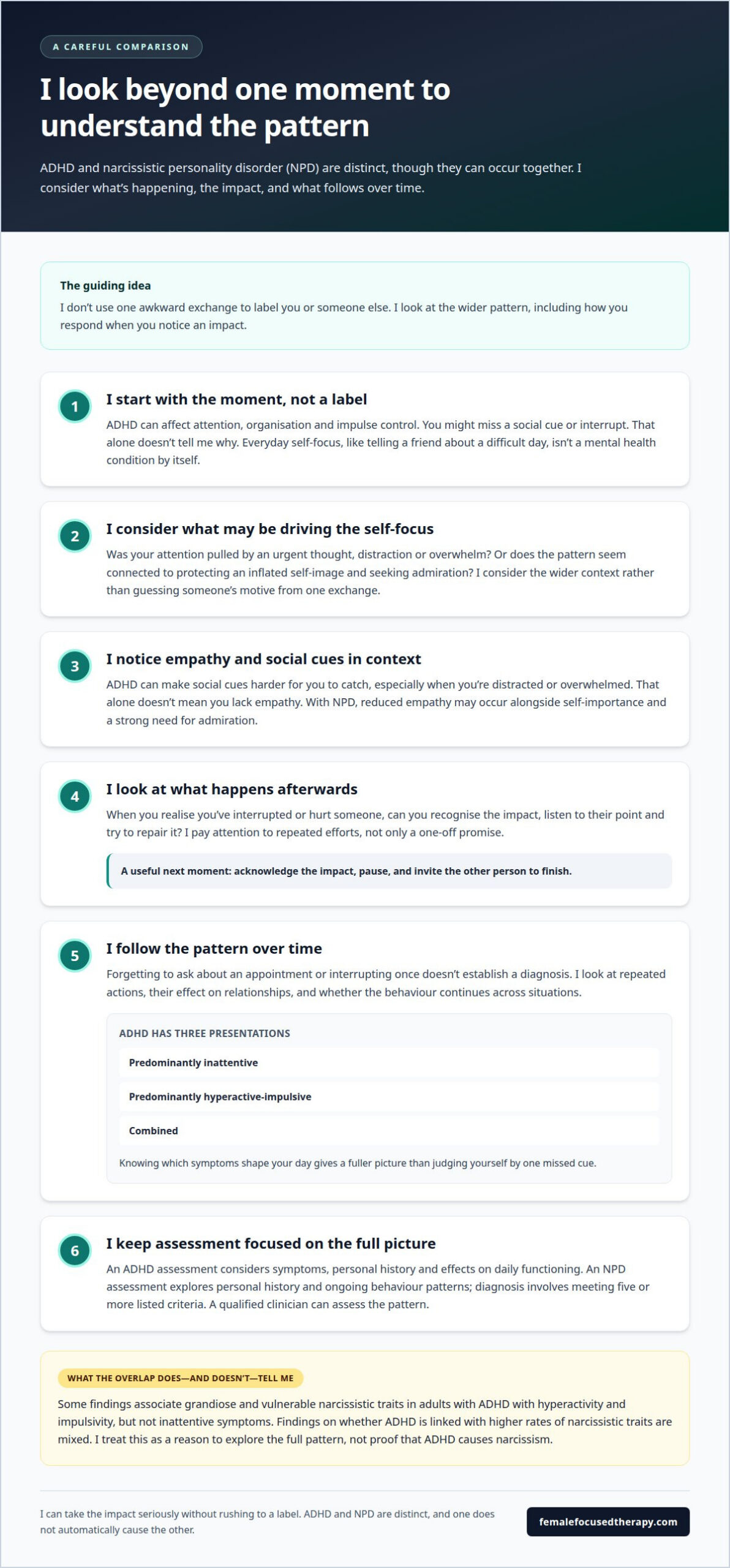
I see ADHD and narcissistic personality disorder (NPD) as distinct, though they can occur together. I’d look beyond a behaviour to understand its pattern, intent and impact.
ADHD, NPD, and Everyday Self-Focus
ADHD can affect attention, organisation and impulse control. NPD describes a persistent pattern involving grandiosity, a need for admiration and reduced empathy. Everyday self-focus, such as telling a friend about a difficult day, is not a mental health condition by itself.
Look at what happens over time, not one awkward exchange. Forgetting to ask about a friend’s appointment may reflect distraction, while still affecting your friend. Repeatedly expecting praise while dismissing their needs points to a wider relationship pattern. One moment alone isn’t enough to apply a label.
Empathy, Intent, and Accountability
Empathy involves noticing another person’s feelings and responding with care. ADHD can make social cues harder to catch, especially when you’re distracted or overwhelmed. That alone doesn’t mean you lack empathy. With NPD, reduced empathy may occur alongside self-importance and a strong need for admiration.
An interruption alone can’t reveal someone’s intent. If you realise you’ve spoken over someone, acknowledge the impact and return to their point. Notice whether you can recognise harm and make an effort to repair it, rather than relying on a one-off promise.
Motivation and Apparent Self-Focus
I’ve seen how ADHD-related self-focus may emerge when an urgent thought takes over, or feedback feels intense. You might bring a conversation back to your worry before noticing your friend’s expression. I understand how that can look uncaring, even when you want connection.
Consider whether self-focus is linked to attention or to protecting an inflated self-image and seeking admiration. It can also help to notice how self-esteem shifts in response to feedback. This wider view helps distinguish a pattern from an isolated self-centred moment.
Impulsivity Differences
ADHD-related impulsivity may show up as interrupting, answering before a question ends or acting before considering the effect. You might disrupt a conversation while trying to join in. Notice the moment, pause, then invite the other person to finish.
Don’t infer motive or diagnosis from one interruption. Look at repeated actions and how you respond when someone describes their impact. You can take responsibility for the effect while exploring what made it hard to pause. Consider the full pattern before deciding what support may help.
Does narcissism present differently in people with ADHD?
Consider which ADHD symptoms are present, how they affect daily life, and whether a pattern continues across relationships. A single behaviour can’t show whether you’re seeing ADHD, narcissistic traits or both.
Inattentive Symptoms
With inattentive ADHD, you may lose track of conversations, forget plans or struggle to organise tasks. These symptoms can occur in adult ADHD even when restlessness isn’t obvious.
For example, you might miss a detail a friend shared, then feel genuine concern when you remember. ADHD has three presentations: predominantly inattentive, predominantly hyperactive-impulsive and combined. Knowing which symptoms shape your day gives you a more useful picture than judging yourself by one missed cue.
Hyperactivity and Impulsivity
Hyperactivity can feel like restlessness, while impulsivity can mean speaking or acting before you’ve had time to pause. In attention deficit hyperactivity disorder, these symptoms may affect conversations, work and relationships.
You might interrupt because a thought feels urgent, or change plans quickly without considering the impact. Those moments can seem self-centred to someone else, especially if they happen repeatedly. Notice what follows: do you recognise the effect, listen to feedback and try a different response next time?
Overlapping Symptoms and Behavioral Traits
Some traits can look similar from the outside. Difficulty focusing during a conversation may seem like disinterest, while sensitivity to criticism may look like a need for admiration. That resemblance doesn’t tell you what drives the behaviour.
In adults with ADHD, grandiose and vulnerable narcissistic traits have been associated with hyperactivity and impulsivity, but not inattentive symptoms. Findings on whether ADHD is linked with higher rates of narcissistic traits are mixed. Treat this connection as a reason to explore the full pattern, not as proof that ADHD causes narcissism.
If you’re trying to understand your own symptoms, note when they appear, what was happening beforehand and how they affect your relationships. These observations can help you describe the pattern in a conversation about adult ADHD or mental health.
Can ADHD lead to narcissism or narcissistic personality disorder?
ADHD and narcissistic personality disorder are distinct, and one does not automatically cause the other. It helps to distinguish a diagnosis from behaviours that may look self-centred.
ADHD and NPD Definitions
ADHD involves inattention and/or hyperactive-impulsive symptoms, while NPD is a personality disorder marked by a persistent pattern of grandiosity, a need for admiration and reduced empathy. The distinction matters because difficulties with attention, organisation and relationships can have different meanings and support needs.
To assess ADHD, a clinician considers symptoms, personal history and effects on daily functioning. An NPD assessment also explores personal history and ongoing behaviour patterns; diagnosis involves meeting five or more listed criteria. In Singapore, you can arrange a mental health assessment with a qualified clinician and describe the symptoms or relationship difficulties affecting daily life.
Narcissism, Behavior, and NPD Traits
Narcissism can describe traits such as wanting recognition, but narcissistic traits alone don’t mean you have NPD. Feeling proud after a work achievement, for example, is not the same as persistently expecting special treatment and dismissing other people’s needs.
In a study of 164 adults attending a specialist ADHD clinic, 9.5% met criteria for NPD. This finding shows that the conditions can co-occur, not that ADHD leads to NPD. I avoid using a label to explain one difficult interaction; the pattern, its impact and the person’s response matter.
ADHD support may combine medication, behavioural therapy and lifestyle changes suited to attention, organisation and impulse control. For NPD, psychotherapy can help build self-awareness and empathy, and explore grandiosity and insecurity. If you’re considering an assessment in Singapore, you can seek a mental health appointment and explain whether you want help understanding ADHD symptoms, personality traits or both.
Why ADHD and narcissistic behaviors can look similar
The same moment can have different meanings. Consider what’s happening around the behaviour, its impact and what follows. The ADHD vs narcissism distinction is difficult to judge from one interaction.
ADHD Behaviors Mistaken for Selfishness
ADHD can affect attention, impulse control, perspective-taking and follow-through, so you may seem not to care when you do. For example, you might forget an important detail your partner shared, then feel upset when they assume you weren’t listening.
When trying to understand a relationship, separate the impact from the explanation. Forgetting still affects the other person, but one missed detail doesn’t prove deliberate disregard. Notice whether you can hear their concern and take steps to remember next time, such as writing the detail down.
Emotional and Behavioral Regulation
Emotional regulation means noticing and managing feelings before they shape your response. With ADHD, overwhelm can build quickly, and a strong reaction may seem out of proportion to the moment. For instance, criticism at work might leave you feeling flooded before you’ve had time to reflect.
Rejection sensitivity or masking can also appear as a need for constant praise or control. Ask yourself what happened just before the reaction, and whether you felt criticised, overloaded or afraid of getting something wrong. This context adds nuance to the ADHD vs narcissism comparison without excusing hurtful behaviour.
Relationship Behaviors
In relationships, ADHD-related inattention or impulsivity can be mistaken for manipulation or a lack of care. You might interrupt, lose track of a conversation, or promise to follow through and then forget. These moments can strain trust, even when you meant to connect or help.
With narcissistic patterns, similar difficulties may relate to seeking admiration or superiority. One disagreement doesn’t reveal the distinction. Look at what repeats and what happens after you raise the impact. Can you acknowledge it, listen and try to repair? That response offers more context than the moment alone.
If relationship patterns are leaving you confused or hurt, you can book an individual psychotherapy appointment to explore what’s happening and what support may help.
Female Focused Therapy: Individual Psychotherapy Sessions
Female Focused Therapy offers individual psychotherapy for women seeking space to understand ADHD, relationship patterns or the impact of narcissistic abuse. Sessions can help you explore what’s happening without rushing to label you or someone close to you.
If attention, impulsivity or overwhelm is affecting your confidence, ADHD-focused therapy can help you make sense of your experiences. If a relationship has left you doubting yourself, psychotherapy offers space to explore its impact and what you need next. Online therapy is available if meeting remotely feels more comfortable.
You can take a small first step by visiting Female Focused Therapy and finding out more about working with me.
Take a thoughtful next step towards clarity
Questions about ADHD vs narcissism can bring up doubt, especially when behaviour has affected a relationship or your sense of self. You don’t need to settle on a label before making sense of what’s happening. Start with one observation: what feels difficult, how it affects you and what you need to feel heard and respected.
Hold compassion and accountability together. Understanding what may sit beneath a behaviour doesn’t erase its impact, and recognising the impact doesn’t require you to diagnose anyone. You can take your own feelings seriously while staying curious about the fuller picture.
If you’d value a supportive space to explore your experiences, I invite you to book an appointment with Female Focused Therapy. You can take this at your own pace, one considered step at a time.
Frequently Asked Questions
What are narcissism and NPD?
“Narcissism” can describe traits or behaviours without implying a diagnosis. Narcissistic personality disorder (NPD) is a mental health condition involving a persistent pattern that affects how someone sees themselves and relates to others. Taking pride in an achievement, for example, differs from repeatedly expecting special treatment. The label alone can’t tell you what’s happening in a relationship.
What is ADHD?
ADHD is a condition involving ongoing inattention, hyperactivity and impulsivity, in different combinations. Symptoms begin by age 12 and can continue into adulthood. I’d look at how they affect everyday life, such as keeping track of appointments, organising tasks or waiting to speak in a meeting. ADHD isn’t a measure of intelligence, care or character, and one difficult day doesn’t establish a diagnosis.
What are the main symptoms of ADHD in adults?
Adult ADHD symptoms can affect attention, restlessness, impulsivity, organisation and emotional regulation. You might open an email to reply, get pulled into another task, then forget to respond. Or you may feel physically restless during a long meeting and speak before your thought is fully formed. Notice whether these difficulties recur in everyday settings and interfere with work, home life or relationships.
What are the common traits and diagnostic criteria for narcissistic personality disorder?
NPD is associated with grandiosity, a strong need for admiration and reduced empathy. Exploitative behaviour and an inflated self-image can also form part of the pattern. A clinician considers the person’s history and how behaviours affect functioning; diagnosis involves meeting five or more listed criteria. One boastful comment or argument isn’t enough to label someone. Look instead for persistent patterns across situations.
How do ADHD and narcissistic personality disorder differ in motivation, empathy, and relationships?
Consider the pattern and what happens after a difficult interaction. ADHD can affect attention and impulse control, so someone might miss a cue, interrupt, then try to repair the conversation. NPD involves a broader pattern associated with self-importance and a need for admiration. Both can strain relationships, but an interruption alone doesn’t reveal someone’s motivation. Notice whether your concerns are heard and whether behaviour changes over time.
Can ADHD look like narcissism, such as seeming self-centred, interrupting, or forgetting commitments?
Yes, ADHD-related difficulties with attention and impulse control can seem self-centred from the outside. You might interrupt because a thought feels urgent, or forget a commitment despite caring about the person. The impact still matters, so name what happened and agree on a practical reminder for next time. Look at the wider pattern, including whether there’s acknowledgement and an effort to repair, rather than judging by one moment.

Article by
Cheryl Kennedy MacDonald MA BA (Hons) Pg. Dip. SAC BACP
Cheryl Kennedy MacDonald is a psychotherapist specialising in women’s mental health, relationships, and life transitions. She works with women navigating trauma, relationship breakdown, identity shifts, and midlife change, helping them rebuild self-trust, emotional stability, and a clear sense of who they are and what they want.
With over 20 years’ experience working with women internationally, Cheryl is the founder of YogaBellies, a global women’s yoga school, and the creator of the Birth ROCKS method. Her work sits at the intersection of psychotherapy and embodiment, integrating evidence-based therapeutic approaches with somatic, body-based practices that support deep, lasting change.
Known for her grounded and direct approach, Cheryl moves beyond surface-level insight to address the patterns held in the body and nervous system. Her work supports women to regulate, reconnect, and respond to their lives from a place of clarity, strength, and self-respect.
She is a published author in academic journals and has written multiple books on women’s health, pregnancy, and midlife wellbeing, available on Amazon and leading book retailers worldwide.