
Infidelity can leave you questioning what was real and whether trust can return. Therapy for infidelity recovery can offer space to process the hurt, understand your reactions and consider whether rebuilding the relationship feels right. It can support you as you heal, but it cannot decide whether you stay or leave.
You may feel torn between wanting answers and needing a break from thinking about what happened. Reminders might bring the pain back suddenly. These reactions deserve care, not judgement.
Counselling can help you make sense of the betrayal, manage painful responses and have difficult conversations with more support. Survey findings can offer context, but they cannot predict how recovery will unfold for you. Understanding that can help you approach healing with more clarity and less pressure.
Key Takeaways
- I explain how couples counselling can create space for honest conversations while helping you consider whether to repair the relationship or part ways.
- You’ll learn how naming the hurt and choosing what you need to understand can support processing without overwhelming you.
- I explore ways to notice triggers and respond to painful waves of emotion with more care and steadiness.
- You’ll see what survey findings reveal about differing views of infidelity, and why they can’t decide what your relationship needs.
Marriage Therapy for Infidelity: Can Couples Heal After Betrayal?
I can help you use couples therapy to explore whether repair or separation feels right. I understand the Gottman Trust Revival Method as a framework with three stages: Atonement, Attunement and Attachment.
Recovery Through Staying Together or Separating
Recovery can mean processing the betrayal and finding a way forward, whether you stay together or part. Therapy can make space for both possibilities without treating reconciliation as the only measure of progress. Sessions may help you speak honestly, understand what you need next and consider what separation would mean. Your decision can unfold alongside your healing.
Individual and Couples Therapy Approaches
I see couples therapy as a place for shared conversations, while individual therapy gives you private space for your own feelings. Emotionally focused couples therapy may help partners work on intimacy and forgiveness, while reducing marital burnout. The Gottman Trust Revival Method is another framework, with Atonement, Attunement and Attachment. I’d encourage you to consider which approach fits your needs, whether you attend together, individually, or both.
Rebuilding Trust After Infidelity
Rebuilding trust involves understanding what reliability and transparency would look like in daily life. You might agree on a calm time for emotional check-ins instead of revisiting painful questions during every disagreement. Notice whether actions match words over time. Promises alone may not give you the experience of reliability you need.
Choosing a Therapist and Planning Treatment
I’d look for a therapist with relevant experience and a clear way to structure difficult conversations. You can ask what approach they use and how each partner will have space to speak. Therapy may take months or even years, depending on your situation, feelings and needs. If an affair is ongoing, starting sessions may bring difficult conversations into sharper focus. I’d discuss boundaries and immediate priorities first. In Singapore, you can seek counselling support through couples or individual sessions. I’d choose the format that feels manageable for your next decision.
Acknowledging the affair and processing pain
After an affair, you may replay conversations, question your judgement or feel unsure what to believe. You might also experience lowered self-esteem, anxiety, low mood, flashbacks or numbness. These feelings can be unsettling, but they do not define who you are or decide what comes next.
Acknowledging the affair means naming what happened without minimising its impact. You could begin by describing what feels hardest today, such as finding hidden messages or realising a promise was broken. Therapy can help you separate what you know from what you fear, without requiring you to make sense of everything at once.
Before asking for intimate details, consider what you need to know and why. Some details may deepen your distress, so focus on information that supports your wellbeing or decisions. Clarity about whether contact has ended, for example, may matter more than hearing every private exchange. Therapy can help you explore what feels necessary and what might overwhelm you.
You might feel angry during a conversation, sad on the way home or numb when someone asks how you are. Notice what is happening in your body and pause before responding. You could name the feeling privately, then choose whether to talk, write or rest.
I don’t believe you need to forgive, reconcile, or decide before you’re ready. You might begin with one honest sentence: “I’m hurt, and I need time to understand what I need.” If you’d value support making room for those feelings, you can book an appointment and begin with what feels manageable.
Managing trauma responses and triggers
After betrayal, a message alert, familiar café, or late arrival may bring fear or anger back sharply. I can help you notice what’s happening without judging your response. You might feel watchful, detached, or unable to settle. I’d invite you to see the reaction as information about what feels tender now, not proof that you’re failing.
When a trigger appears, try noting it in plain words: “I felt anxious when plans changed.” Then consider what happened just before the feeling and what you needed. I can help you look for patterns, such as difficult evenings or unexpected changes. Bringing those observations into therapy gives us something specific to explore together.
Questions about the affair can also stir distress. Before asking for intimate details, pause and consider what the answer would help you understand. Be cautious about details that could re-traumatise you. Clarity about ongoing contact, for example, may matter more than a vivid account of private conversations.
If a reminder leaves you overwhelmed, try a simple grounding step. Feel your feet against the floor, look around the room and name what you see. You could say, “I’m at home, and that message has passed.” This will not erase the hurt, but it may help you return your attention to the present before replying.
I keep in mind that unresolved resentment may surface 10 or 15 years later. You might notice it returning during an argument about something unrelated, such as a missed call. I can help you explore what that reaction connects to and what still feels unresolved. I also know that emotions can return in waves when you’re triggered, so a difficult day doesn’t erase your progress.
Survey findings on infidelity counselling
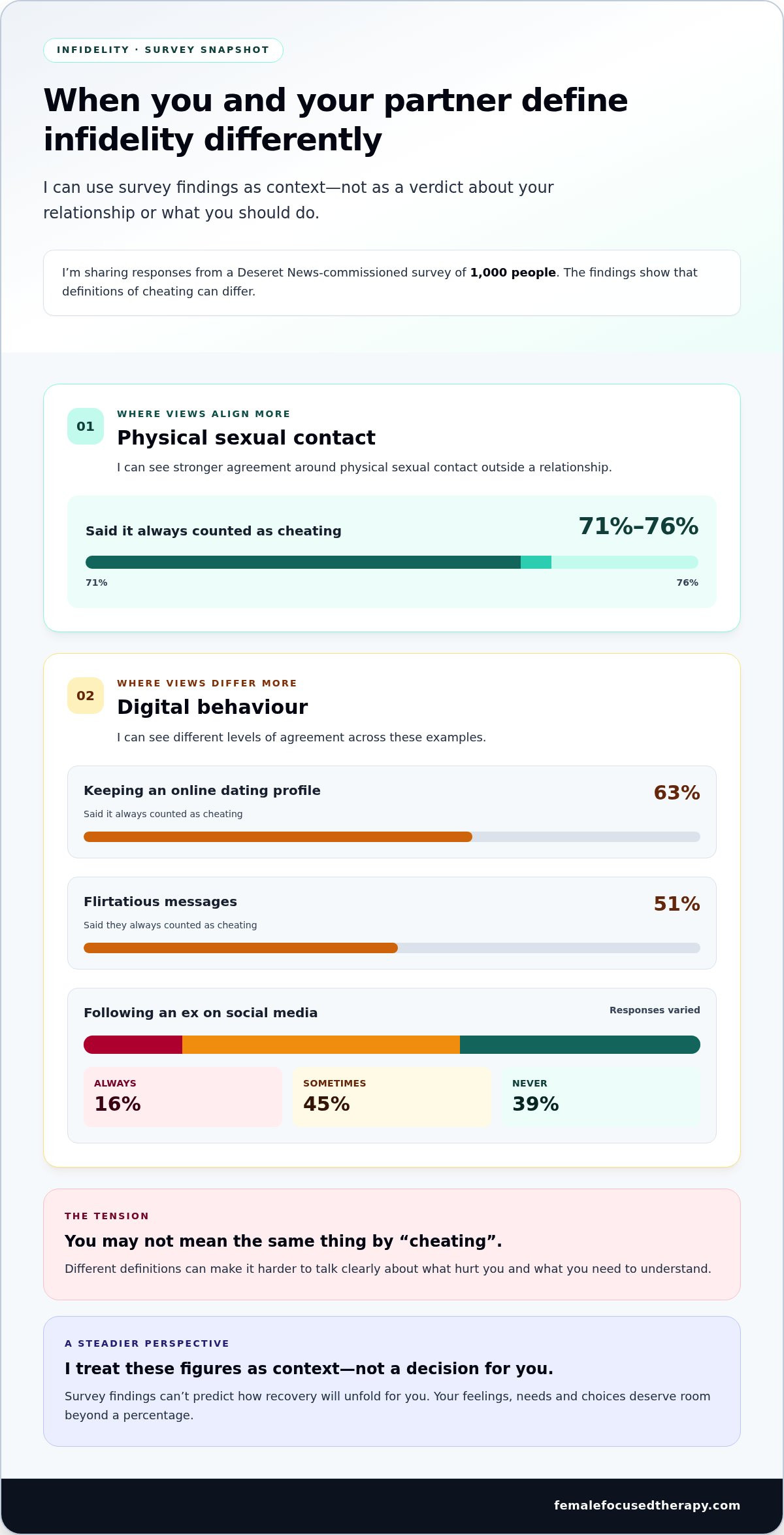
A Deseret News-commissioned survey asked 1,000 people what they considered cheating. Between 71% and 76% said physical sexual contact outside a relationship always counted. Views differed for digital behaviour: 63% said keeping an online dating profile always counted. For flirtatious messages, 51% said the same. Following an ex on social media drew more varied answers: 16% said always, 45% sometimes, and 39% never.
These differences matter because partners may define “cheating” differently. You might see an online profile as a clear betrayal, while your partner describes it as harmless. Survey responses reflect a range of personal boundaries, not one rule for every relationship. Counselling can help you discuss what an action meant to you and how it affected trust.
Findings about counselling also vary. In Peggy Vaughan’s 2002 survey, 57% said their counsellor wasn’t helpful, while 20% called their counsellor very helpful. The survey reported that 13% of therapists dealt with infidelity directly. By comparison, 59% focused on general marital patterns instead. Those figures suggest the focus of counselling can shape how supported you feel. It’s reasonable to discuss whether sessions will address the betrayal itself.
Affair Recovery’s 2024 survey, repeated twenty-two years after Vaughan’s, found 34% of therapists focused directly on infidelity. Another 48% mostly addressed the affair, while 27% treated affairs as a symptom of unmet marital needs. These reported approaches describe different emphases. They don’t establish which approach will fit your experience or decide whether your relationship can heal.
For you, the clearest takeaway is to look for space to discuss the affair, its impact, and what you need now. A therapist’s focus can guide the conversation without deciding your next step. If you’d like to explore personal support, you can book an appointment.
Female Focused Therapy: Individual Psychotherapy Sessions
At Female Focused Therapy, I offer Individual Psychotherapy Sessions for women processing relationship hurt and its effect on their sense of self. You do not need to decide whether to stay or leave before beginning. We can focus on what you are feeling, what you need and how to find steadier ground as you consider your next steps.
Individual sessions may suit you if joint conversations feel too difficult or you want space to understand your needs first. I also offer Online Therapy, so you can access support remotely. My work includes relationship trauma, narcissistic abuse and ADHD-focused therapy when these experiences are relevant to your concerns.
If you’d like to explore whether individual support feels right for you, you’re welcome to visit Female Focused Therapy.
Choose a next step that feels manageable
You do not need to turn what happened into a decision today. Start by noticing what might help you feel more grounded: space to speak freely, support with self-doubt or time to understand what you want from the relationship. Therapy for infidelity recovery can make room for these questions without asking you to decide before you are ready.
I offer Individual Psychotherapy Sessions and Online Therapy for women, including support related to narcissistic abuse. Together, we can explore how the relationship has affected your confidence, boundaries and sense of safety. We can focus on what matters to you, rather than following a fixed timetable. Before beginning, write down one concern you would like to bring to a session.
If you’d like to explore whether this support feels right for you, you can book an appointment with me. You’re allowed to take this one step at a time, and to let your needs guide what comes next.
Frequently Asked Questions
Infidelity Counseling: How Effective Is It?
Therapy for infidelity recovery can be useful when it helps you understand the impact, express what you need and make decisions with greater clarity. Progress might mean being able to discuss a difficult subject without losing your voice, or recognising which boundaries matter to you. The work is most relevant when it addresses your real relationship, not someone else’s idea of success.
How does couples therapy for infidelity work, and what are the typical steps?
A useful starting point is agreeing what each of you wants from counselling, such as understanding what happened or deciding what comes next. The therapist can then help you discuss the impact, notice where conversations get stuck and practise listening without rushing to defend or persuade. Later, review whether sessions are helping you speak more honestly and address the issues that brought you there.
Can individual therapy help after a partner’s affair?
Yes. Individual therapy gives you private space to explore feelings you may not yet want to share with your partner. You could use a session to separate self-blame from responsibility or prepare for a conversation about boundaries. It can also help you notice what you need in everyday life, such as rest, support from someone you trust or time before making a major relationship decision.
How do couples decide whether to rebuild the relationship or separate after infidelity?
Start by considering what is happening now, rather than making a decision to satisfy others. Ask whether both of you are willing to speak honestly, respect boundaries and make room for the impact of the affair. Consider what would need to change for staying to feel possible, and what support you would need if you chose to separate. Therapy can help you explore either path without choosing for you.

Article by
Cheryl Kennedy MacDonald MA BA (Hons) Pg. Dip. SAC BACP
Cheryl Kennedy MacDonald is a psychotherapist specialising in women’s mental health, relationships, and life transitions. She works with women navigating trauma, relationship breakdown, identity shifts, and midlife change, helping them rebuild self-trust, emotional stability, and a clear sense of who they are and what they want.
With over 20 years’ experience working with women internationally, Cheryl is the founder of YogaBellies, a global women’s yoga school, and the creator of the Birth ROCKS method. Her work sits at the intersection of psychotherapy and embodiment, integrating evidence-based therapeutic approaches with somatic, body-based practices that support deep, lasting change.
Known for her grounded and direct approach, Cheryl moves beyond surface-level insight to address the patterns held in the body and nervous system. Her work supports women to regulate, reconnect, and respond to their lives from a place of clarity, strength, and self-respect.
She is a published author in academic journals and has written multiple books on women’s health, pregnancy, and midlife wellbeing, available on Amazon and leading book retailers worldwide.