
You don’t have to be bad at decisions to feel worn down by them. Decision fatigue describes mental tiredness that can build when you’re facing choice after choice. It isn’t a diagnosis, and therapy for decision fatigue can help you explore what’s making decisions feel difficult.
If small choices leave you second-guessing yourself, putting things off or choosing quickly just to be done, try meeting that feeling with curiosity rather than blame. You may already sense that you’re carrying too much.
This article explores how decision fatigue can show up in your thoughts, feelings and behaviour. It also looks at how individual therapy may help you understand your patterns, reconnect with your priorities and find a steadier way through decisions.
Key Takeaways
- I encourage you to notice when choices feel harder and what you’re feeling in those moments.
- I can help you explore how stress and exhaustion may be affecting your focus and wellbeing.
- You can use structured therapy to explore what’s behind the overwhelm and reconnect with your priorities.
- If decision struggles keep disrupting daily life, I invite you to consider individual support.
Can Therapy Help With Decision Making?
Therapy is one option when choices bring distress or repeated self-doubt. It can help you understand emotional patterns. Coaching may suit you if you want support with a defined goal, while self-help can be useful for manageable everyday habits.
Effects on Focus and Well-Being
A run of choices can crowd your attention and leave less room for other things. You might reread a work email, then struggle to follow a conversation over dinner. Consider how decision-making affects your patience, rest and relationships, and which choices feel most draining. Naming a specific moment can help clarify its impact on your day.
Consequences of Prolonged Decision-Making
I understand prolonged decision-making as carrying an unresolved choice across hours or days without finding a workable next step. You might put off replying to a message or agree quickly just to end the discomfort. I’d explore whether stress, exhaustion or fear of getting it wrong keeps you circling the same options, and how the delay affects work or home life.
When weighing a choice, notice what you’re holding in mind: the options, details, feelings and possible outcomes. After a day of messages and appointments, for example, choosing an evening plan may feel like one more demand. Identifying which part feels hardest can be more useful than assuming every choice asks the same of you.
Beliefs can also shape your response. Perfectionism or worry about disappointing someone can make an ordinary decision feel loaded. If you lead a team, try naming your priorities, comparing realistic options and explaining your reasoning. That structure may help you feel more grounded in leadership choices, without expecting certainty about every outcome.
What is Decision Fatigue?
Decision fatigue describes mental tiredness that can build after repeated choices; it isn’t a diagnosis. If choosing feels difficult alongside persistent worry, low mood, attention difficulties or exhaustion, notice how broadly these experiences affect daily life.
Decision Fatigue and Anxiety
Decision fatigue and anxiety can happen together, but they describe different experiences. Repeated choices may leave you mentally tired, while anxiety can bring worry about what might go wrong. Imagine postponing a work reply because you’re comparing options and fearing criticism. The decision and worry may reinforce each other, making it harder to settle on a next step.
Notice when the worry appears. Does it centre on one demanding choice, or follow you into sleep, relationships and ordinary tasks? This distinction can help you describe what’s happening without trying to label yourself. A short note about the choice, thought and feeling can offer a clearer starting point.
Links to Depression and Burnout
Low mood and burnout can make choices feel harder, while prolonged decision strain can add to emotional distress. You might find it difficult to choose what to eat after a demanding workday, then notice less interest in plans you usually enjoy. This matters because the change reaches beyond one decision and affects your energy, mood or daily responsibilities.
Decision fatigue alone doesn’t tell you whether you have depression, anxiety, ADHD or burnout. Notice whether the difficulty is new or long-standing, and whether it affects work, rest or relationships. Trouble choosing after a packed day, for example, differs from persistent low mood across different parts of life.
In therapy for anxiety, burnout or low mood, I can help you explore the emotional and psychological pattern around decisions. We can consider what feels demanding, what thoughts keep returning, and what support might help you recover a sense of steadiness. If attention and organisation have felt difficult over time, ADHD-focused support may also help you explore that experience.
If distress keeps returning or interferes with work, sleep or daily life, speaking with a mental health professional can be a useful next step. You can arrange a conversation about what you’re experiencing when you feel ready.
Cognitive, emotional, and behavioural signs
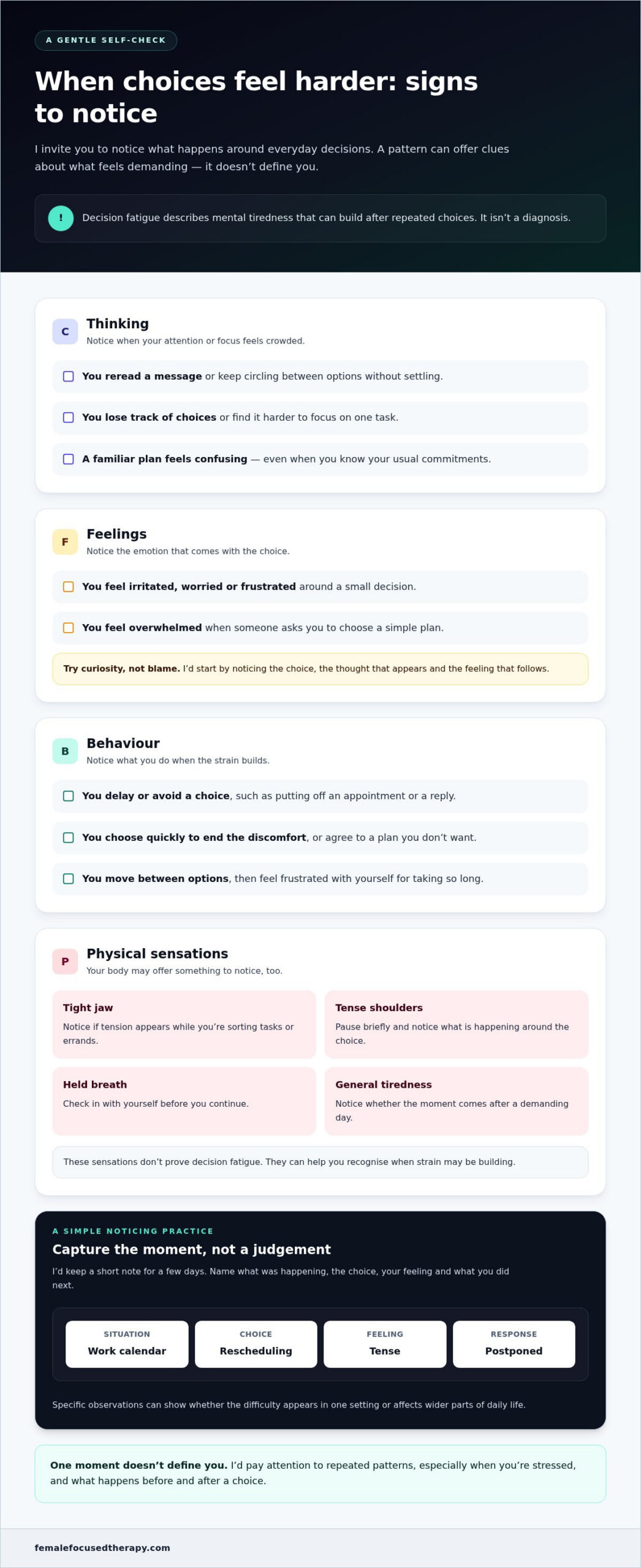
Pay attention to changes in how you think, feel and respond during ordinary choices. At the supermarket, you might compare familiar products for longer than usual, then leave without choosing. One moment like this doesn’t define you. A repeated pattern, especially during stressful days, can offer useful clues about what feels demanding.
- Cognitive: You may reread a message, lose track of options or struggle to focus on one task. For example, planning a weekly calendar might feel confusing despite knowing your usual commitments.
- Emotional: Irritation, worry, frustration or feeling overwhelmed may surface around small choices. You might feel unusually upset when asked to pick a weekend plan.
- Behavioural: You may delay, avoid or make a quick choice to end the strain. For instance, you might put off booking an appointment or agree to a plan you don’t want.
Stress can make these cognitive and emotional shifts more noticeable. You may move between options without settling, then feel frustrated with yourself for taking so long. Or you might stop comparing and choose the first available option. Pay attention to what happens before and after: the choice, the thought that appears and your response.
Physical sensations can be part of what you notice, too. While sorting household errands, you might become aware of a tight jaw, tense shoulders, held breath or general tiredness. These sensations don’t prove decision fatigue, but noticing them can help you recognise when strain is building. Pause briefly and ask yourself what your body is signalling before you continue.
Try keeping a short note for a few days: name the situation, the choice, your feeling and what you did next. For example, write “work calendar, rescheduling, tense, postponed”. This record can show whether decision difficulty appears in one setting or affects wider functioning. Specific observations are more useful than judging yourself as indecisive.
Structured individual therapy for decision fatigue
In individual therapy, you can explore what makes choices difficult in your life, rather than treating every decision alike. There isn’t a fixed session number for decision fatigue. Review what you want support with and whether everyday choices are becoming more manageable as you work together.
A structured starting point is to choose one recent example, such as postponing a conversation with someone close to you. Notice the situation, the thoughts that followed, the feeling in your body and what you did next. This can reveal whether fear, constant pressure or a relationship pattern is adding to the strain.
From there, consider what matters to you in that situation. If you’re weighing a change at work, for example, separate your values from other people’s expectations. The aim isn’t to hand you an answer. It’s to help you understand your choices and build trust in your own judgement.
Therapy can also make space to practise a different response. Bring one current decision and explore a smaller next step, such as asking for time before replying. Then reflect on what happened, what felt difficult and what you learned. This connects the work to real situations, not just ideas.
For some individuals, counseling also explores how stress, low mood or ADHD-related difficulties affect decision-making. I can help you notice whether attention, emotional overwhelm or self-doubt is part of the picture. If online sessions suit your circumstances, they can offer a way to take part from your own space.
If you’d like to explore individual support for choices that keep feeling stuck, you can book an individual therapy appointment.
Female Focused Therapy: Individual Psychotherapy Sessions
At Female Focused Therapy, I offer individual psychotherapy sessions to help you explore what is making choices feel difficult. We can look at the pressure, emotions and personal patterns around a decision, then consider what matters to you. The aim is to support your understanding, not to make choices for you.
If meeting online suits you, I also offer Online Therapy. If decision-making difficulties feel connected to ADHD or experiences of narcissistic abuse, those can be part of the conversation too.
You might consider individual support if indecision keeps affecting your work, relationships or everyday routines. You can visit Female Focused Therapy online to find out more.
Make Space for a More Considered Choice
You don’t need to solve every decision at once. A useful next step is to pause before one choice today and ask, “What matters most to me here?” Even a brief moment can help you notice whether you’re responding to your own priorities or trying to quiet pressure from elsewhere.
If the same uncertainty keeps returning, therapy for decision fatigue can give you space to understand what’s underneath it. Bring one decision that feels difficult; you don’t need a perfect explanation. We can explore the feelings around it and find a way forward that feels more grounded in your own values.
If you’d like to explore that support, you can book an appointment with Female Focused Therapy. You’re allowed to take this one step at a time, and to build confidence in your choices as you go.
Frequently Asked Questions
Is indecisiveness a symptom of anxiety or ADHD?
Indecisiveness can occur alongside anxiety or ADHD, but it doesn’t establish either by itself. Notice the pattern: does worry about consequences make choices feel risky, or have planning and attention felt difficult across different parts of your life? A therapist can explore your experiences and history with you, rather than draw conclusions from one difficult decision.
Why do I struggle to make even small decisions?
Small choices can feel surprisingly hard when you’re already carrying a full mental load. Choosing lunch, for example, may involve dietary needs, time, cost and someone else’s preferences. Name what the choice requires, then separate essential factors from details that matter less. This can show whether the difficulty comes from the choice itself or everything around it.
What is decision fatigue and what causes it?
Decision fatigue describes mental tiredness that can build as you make choices and handle demands. A day spent planning care, responding to messages and weighing work priorities may leave less energy for another choice at home. Stress, exhaustion and too many competing options can contribute. It isn’t a diagnosis, so the phrase describes an experience without explaining every reason behind it.
Can therapy help with decision fatigue?
Therapy can help you explore recurring decision difficulties and what may contribute to them. In therapy for decision fatigue, you could look at a recent choice, what you feared might happen and whose needs you were considering. This exploration can help you recognise patterns and clarify what matters to you. It won’t make choices on your behalf, but it can help you approach them with greater understanding.
Which therapy approaches are used for decision fatigue, such as CBT or ACT?
CBT and ACT can help explore thoughts, feelings and responses around difficult choices. CBT can help you examine a thought such as “I’ll get this wrong” and consider how it influences your actions. ACT can support reflection on personal values and steps that fit them, even when uncertainty remains. Any approach should be related to your needs and experiences.
What practical strategies can reduce decision fatigue in daily life?
Make routine choices easier by setting a simple default, such as planning weekday lunches in advance. Keep a short list of open decisions so you don’t have to remember each one. For a choice with several options, write down the two factors that matter most, then compare options against them. You can also take a brief pause between demanding tasks before making another decision.

Article by
Cheryl Kennedy MacDonald MA BA (Hons) Pg. Dip. SAC BACP
Cheryl Kennedy MacDonald is a psychotherapist specialising in women’s mental health, relationships, and life transitions. She works with women navigating trauma, relationship breakdown, identity shifts, and midlife change, helping them rebuild self-trust, emotional stability, and a clear sense of who they are and what they want.
With over 20 years’ experience working with women internationally, Cheryl is the founder of YogaBellies, a global women’s yoga school, and the creator of the Birth ROCKS method. Her work sits at the intersection of psychotherapy and embodiment, integrating evidence-based therapeutic approaches with somatic, body-based practices that support deep, lasting change.
Known for her grounded and direct approach, Cheryl moves beyond surface-level insight to address the patterns held in the body and nervous system. Her work supports women to regulate, reconnect, and respond to their lives from a place of clarity, strength, and self-respect.
She is a published author in academic journals and has written multiple books on women’s health, pregnancy, and midlife wellbeing, available on Amazon and leading book retailers worldwide.