
Leaving a relationship can bring relief, but it may also leave you questioning yourself. Learning how to heal from being gaslit isn’t about forcing yourself to feel certain straight away. It starts with making space for your own experience, even when some moments still feel confusing.
You might replay conversations, doubt your reactions, or wonder whether you’re allowed to feel angry and sad at once. You don’t have to make sense of everything today. Your pace matters, and a difficult day doesn’t erase the small steps you’ve already taken towards feeling more like yourself.
This article explores how to understand what you’ve been through and move gently towards greater self-trust. It looks at emotional responses, personal needs, boundaries, and everyday choices that can help you reconnect with what feels right for you. You don’t need a perfect plan before you begin. Start by noticing one thing you need, and let that be enough for now.
Key Takeaways
- I encourage you to let your feelings matter, even when someone else sees things differently.
- I want you to make room for anger, sadness, relief, or confusion without judging yourself.
- I invite you to practise self-trust through small choices that reflect what you enjoy and need.
- I encourage you to choose boundaries that protect your wellbeing and step away from conversations that become a struggle.
- I hope you’ll learn to notice gaslighting patterns without needing to diagnose anyone or explain every detail.
Accepting that you cannot control another person’s opinion
- Separate your experience from the verdict you hear. Notice what you felt and remember, even when someone challenges your account. Write one example in a notebook: “I felt unsettled when the conversation changed, and I remember what I heard.” You don’t need to prove your experience before taking it seriously. This distinction can help you make room for your perception alongside someone else’s view.
- Let go of trying to win agreement. If you’re explaining the same event again, pause and ask, “What am I hoping this conversation will give me?” You may want an apology, clarity, or reassurance. Those needs matter, but repeating your explanation may not bring the response you hope for. Notice when the exchange feels like a contest over whose memory is right. You could say, “I remember it differently, and I’m leaving this here.”
- Meet one basic need before analysing the relationship. Check whether you’re hungry, thirsty, tired, or due for a shower. Choose one simple action, such as drinking water or making something to eat, before rereading old messages. When your energy is caught up in trying to understand what happened, these needs can slip from view. Caring for your body won’t settle a disagreement, but it may help you feel steadier as you decide what would help next.
- Make room for differences without treating them as flaws. You may prefer quiet evenings, while your former partner preferred constant plans. Different preferences don’t make you difficult or wrong. Write down one thing you enjoy and one thing you don’t, without adding an apology. Manipulation can leave you questioning ordinary choices, including what you like. Your preferences, boundaries, and pace are useful clues to what feels right for you.
- Name your growth and value through specific examples. Write down one choice you made for yourself this week, such as declining a conversation, taking a walk, or choosing what to eat. Then note what that choice says about the care you’re learning to offer yourself. If you hear that your ex has started a new relationship, remember that it doesn’t measure your worth or erase your growth. Ground your value in your own actions, not in anyone’s opinion of you.
Emotional responses after leaving a gaslighting relationship
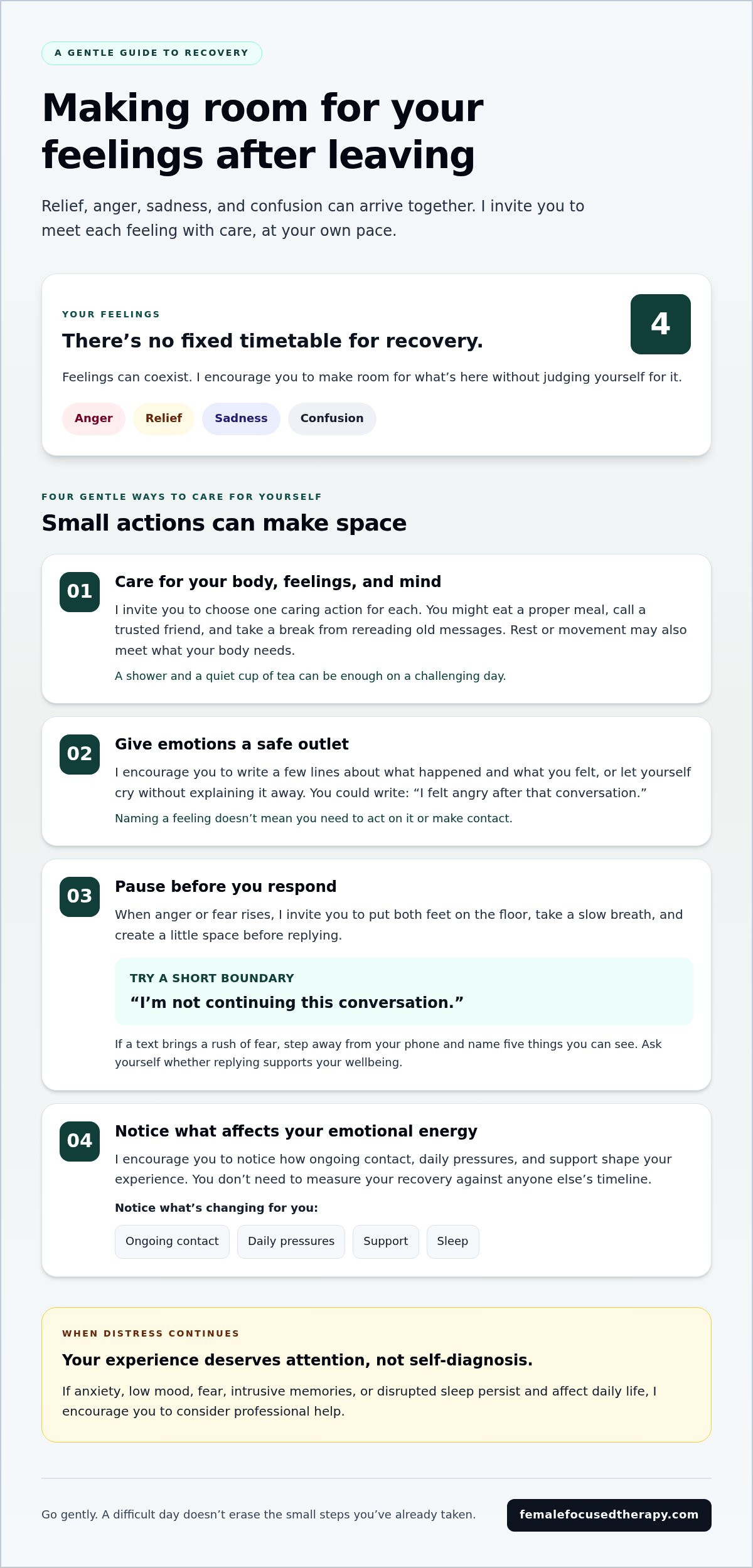
You may feel anger, relief, sadness, or despair after leaving; different feelings can arrive together. Recovery has no fixed timetable, and ongoing contact, daily pressures, and support can shape your experience. If anxiety, low mood, fear, intrusive memories, or disrupted sleep persist and affect daily life, consider professional help. These signs deserve attention, not self-diagnosis.
-
Practise Physical, Emotional, and Mental Self-Care
Choose one caring action for your body, one for your feelings, and one for your mental space. You might eat a proper meal, call a trusted friend, then take a break from rereading old messages. Notice what your body needs, including rest or movement. Don’t turn self-care into another task you must do perfectly. On challenging days, a shower and a quiet cup of tea can be enough.
-
Express Emotions
Give your emotions a safe outlet instead of judging them as unreasonable. Write a few lines about what happened and what you felt, or let yourself cry without explaining it away. You might write, “I felt angry after that conversation,” then stop there. Naming a feeling doesn’t mean you need to act on it or contact your former partner. It can help you notice what you’re still carrying from the relationship.
-
Regulate Emotions
When anger rises after unfair criticism, pause before replying. Put both feet on the floor, take a slow breath, and choose a brief statement such as, “I’m not continuing this conversation.” If a text brings a rush of fear, step away from your phone and name five things you can see. These small actions create space between a feeling and your response. Consider whether replying will support your wellbeing or draw you back into a painful exchange.
-
Consider Recovery Time and Its Influences
Track what affects your emotional energy rather than measuring recovery against someone else’s timeline. One personal account described beginning to feel better within a few months; that is one experience, not a deadline. Notice whether sleep, contact with your former partner, practical pressures, or support changes how you feel. If distress keeps disrupting daily life, talking with a therapist can help you make sense of it. You can explore booking individual support when you feel ready.
Rebuilding self-esteem and self-trust
Self-trust can return through small choices, not one perfect explanation of the past. These steps can help you make room for your own judgement when doubt or shame makes it difficult to feel like yourself.
-
Respond to Repeated Self-Doubt
When doubt returns, pause and ask what you’re trying to understand or protect. Write down what you remember, what you felt, and what you need now. For example: “I felt uneasy when the plan changed, and I need time before deciding.” You don’t have to prove every detail to yourself. Ask whether you’re replaying the situation to find clarity or punishing yourself for not seeing everything sooner.
If rereading a message helps you feel grounded, note what it says without treating it as the whole story. Then choose one small action, such as putting the note away and making a cup of tea. This can interrupt the loop without demanding that you suddenly believe every thought you have.
-
Practise Forgiveness and Self-Forgiveness
Decide what forgiveness means to you, rather than treating it as a duty. It doesn’t mean the other person’s actions were acceptable or that you must restore contact. You might instead loosen your hope that the past could have unfolded differently. If you regret staying, write down what you were trying to preserve or manage at the time. That can make room for understanding without blaming yourself.
Self-forgiveness can start with one kind sentence: “I made the best choice I could with what I understood then.” You don’t need to excuse what happened to offer yourself compassion. Consider whether an apology or act of forgiveness would support your wellbeing, or whether you’re doing it to keep someone else comfortable.
-
Use Self-Care Activities
Choose an activity that reconnects you with pleasure, energy, or a sense of capability. You might take a walk, paint, read, watch a familiar film, or call someone you trust. Pick something you used to enjoy, or something that gives you a manageable sense of achievement. Notice how you feel before and afterwards. If an activity becomes another demand on a difficult day, scale it down rather than criticising yourself.
You can also keep a short list of soothing or energising choices on your phone. Add options for different moments, such as deep breathing when tense or a walk when restless. As you consider how to heal from being gaslit, include activities that feel genuinely yours, not just things you think you should enjoy.
-
Practise Self-Compassion
Speak to yourself as you might speak to a friend facing the same difficult moment. If you make a mistake, try, “That didn’t go as I hoped; what can I learn?” rather than calling yourself foolish. Write down one recent achievement, even a small one, such as making a decision without asking for approval. This gives your sense of self evidence beyond the painful relationship.
Reconnect with your preferences by listing one thing you like, one thing you dislike, and one fear you want to meet gently. You’re allowed to change your mind as you learn more about yourself. Learning how to heal from being gaslit can include getting support when self-doubt makes everyday choices feel difficult. If that feels right, you can explore individual support through therapy.
Establishing boundaries and limiting contact
A boundary gives you a clear way to protect your time and emotional space. Start by deciding what level of contact feels manageable, then choose a response you can maintain.
-
Limit or Stop Contact
Choose the amount of contact that helps you step back from upsetting behaviour. You might mute messages, stop following social media updates, or reply only to practical questions. Notice how you feel after each interaction. If one phone call leaves you replaying the conversation for hours, that’s useful information about what contact is costing you.
Write a brief boundary before you need it, such as, “I’ll respond to messages about collecting my belongings.” Keep it focused on what you’ll do, rather than trying to persuade the other person to agree. If you share responsibilities, identify the necessary topics and keep communication to those matters. A trusted friend or therapist can help you think through what feels workable in your circumstances.
You may wonder whether reducing contact makes you unkind or unreasonable. Instead, ask, “What helps me feel less pulled into this pattern?” You don’t have to adopt a label such as victim to take your experience seriously. You can set a limit because certain interactions affect your mental health, even if the other person disagrees.
-
Set No-Contact Boundaries
If you decide to stop contact, make the boundary practical. Block or silence their number, email, and social media accounts if that supports your decision. Remove reminders from your main screen, and ask a trusted person not to pass along updates. These steps can reduce the urge to check, explain, or reopen a difficult conversation.
Prepare one short line in case a message reaches you through another channel: “I’m not available for further contact.” You don’t need to answer follow-up questions or defend the boundary. If unwanted contact continues, save relevant messages and speak with someone you trust about your options. Focus on what you can control, rather than monitoring whether the other person respects your choice.
In some situations, no contact may not be practical. You may need to communicate about shared responsibilities or belongings. Set a narrow boundary instead, such as replying only in writing about a specific arrangement. Before responding, pause and consider whether the message needs an answer. A clear limit can support your healing without requiring you to settle every question about the relationship.
Learning about gaslighting and psychological abuse
It can help to understand the pattern without turning that understanding into a test you must pass. These steps can help you name what may have been happening and notice its effects on your decisions.
- Start with the meaning of gaslighting. Gaslighting is manipulation intended to make you doubt your perceptions, memories, or sense of what happened. The term came from Patrick Hamilton’s play in the 1930s. That history offers context, but your own experience matters more than knowing the term’s origin. For example, if you remember hearing a remark and someone repeatedly insists you imagined it, notice the effect on your confidence.
- Look at repeated behaviours, not one disagreement. A difference in memory can happen without being emotional abuse. Pay attention to a pattern: someone denies what you saw, blames you for their feelings, calls you “crazy”, or says your family and friends are against you. Ask yourself whether these interactions repeatedly leave you confused, apologising, or unsure about ordinary decisions. Focus on what happened and how it affected you, rather than trying to diagnose someone.
- Notice where the pattern appears. Gaslighting can happen in romantic relationships, families, and workplaces. In a relationship, you might be praised intensely at first, then criticised or dismissed later. At work, you might raise a concern and be told you misunderstood a conversation. These examples don’t prove a label on their own. They can help you examine the wider pattern and whether your confidence or choices changed over time.
- Separate the label from your identity. If you call yourself a victim of gaslighting, remember that this describes an experience, not your whole self. Write down one concrete example, the words you remember, and what you felt afterwards. That record can help you reflect without needing to settle every detail. You can learn about psychological abuse while making room for uncertainty, personal complexity, and the parts of yourself beyond the relationship.
- Use what you learn to choose your next support. Understanding gaslighting may help explain why you second-guess your decisions, but it doesn’t mean every difficult memory needs a label. Choose one question to bring into a conversation with someone you trust, such as, “Why do I feel responsible for managing their reactions?” If the pattern still weighs on you, I can help you explore booking individual therapy support at a pace that feels manageable.
Female Focused Therapy: Individual Psychotherapy Sessions
At Female Focused Therapy, I offer individual psychotherapy and counselling for women making sense of gaslighting and rebuilding self-trust. If you’re still questioning your memories, struggling with boundaries, or feeling the effects of narcissistic abuse, therapy can give you space to explore what’s happening at your own pace.
I listen carefully and help you make sense of your experience without expecting you to have every detail worked out first. I also offer online therapy, including ADHD-focused support if attention or overwhelm is part of what you’re navigating. You can begin with one question or feeling that’s been difficult to carry alone.
If you’d like to explore whether working with me feels right for you, visit femalefocusedtherapy.com.
Let Your Next Choice Be Yours
Learning how to heal from being gaslit isn’t about finding a perfect explanation for every painful moment. It can mean making room for a future shaped by your own values, even while parts of the past still feel unclear. You’re allowed to move forward without having every answer.
For your next step, choose one thing you want to give more space to this week. It might be a quiet morning, a conversation with someone you trust, or an activity that feels like yours. Let that choice be guided by what matters to you, not by what you imagine someone else would approve of.
Reaching for support can feel like a big step, especially if trust has been shaken. You don’t need to prepare a full account or know exactly what you want from therapy before getting in touch. You can begin with what feels most present today.
If you’d like to explore support with me, you’re welcome to book an appointment. Take your time, and keep choosing what helps you feel more at home in your own life.
Frequently Asked Questions
What are common signs that you have been gaslit?
You may find yourself rehearsing simple conversations before having them or feeling uneasy making everyday choices. For example, after a disagreement about plans, you might repeatedly ask a friend whether your reaction was reasonable. These experiences alone don’t establish what happened. Consider whether they form a pattern that leaves you feeling less able to express yourself, make decisions, or feel settled in ordinary moments.
How can you tell gaslighting from a misunderstanding or normal conflict?
A misunderstanding can involve different memories, but both people can usually make room for questions and repair. Notice what happens after you say, “That’s not how I remember it.” Does the conversation allow curiosity, or does it repeatedly shift towards blaming you, dismissing your experience, or making you doubt your judgement? Pay attention to the repeated pattern and its impact, rather than labelling someone based on one difficult exchange.
What are practical steps to rebuild trust in your own memory and judgment after gaslighting?
After a confusing interaction, try recording three parts: what you directly observed, what you understood from it, and what you need next. For instance, note, “The meeting moved to Tuesday,” “I thought I’d been told Wednesday,” and “I’ll confirm the next date in writing.” This keeps facts and interpretations distinct. Then practise one low-stakes choice without seeking reassurance, and notice how it feels to follow through.
How do you set boundaries or safely end contact with someone who gaslights you?
Choose a boundary that describes your action, such as ending a call when insults begin or replying only about practical arrangements. If ending contact feels difficult or could make your situation less safe, speak privately with someone you trust or a therapist before changing how you communicate. You can plan how to handle essential messages and where to keep them. You don’t need to announce or defend every boundary for it to matter.
What should you do if a partner, parent, or boss is gaslighting you?
Focus first on the specific behaviour and its effect on you, rather than trying to diagnose the person. With a boss, keep a clear record of work instructions and decisions; with a parent or partner, consider which conversations you’re willing to continue. Share your concerns with someone you trust who can listen without pressuring you. If you feel overwhelmed or unsure how to respond, professional support can help you explore your options.
Can therapy help with recovery from gaslighting, and what types of therapy are used?
Therapy can give you space to explore what happened and work towards steadier self-trust. In my individual psychotherapy work, I use an integrative, trauma-informed and feminist approach. Depending on what you bring, this may draw on ACT, CBT, psychodynamic therapy, somatic and mindfulness-based practices, Coherence Therapy, or Depth-Oriented Brief Therapy. You can begin by discussing what feels hardest now, rather than arriving with a complete account.

Article by
Cheryl Kennedy MacDonald MA BA (Hons) Pg. Dip. SAC BACP
Cheryl Kennedy MacDonald is a psychotherapist specialising in women’s mental health, relationships, and life transitions. She works with women navigating trauma, relationship breakdown, identity shifts, and midlife change, helping them rebuild self-trust, emotional stability, and a clear sense of who they are and what they want.
With over 20 years’ experience working with women internationally, Cheryl is the founder of YogaBellies, a global women’s yoga school, and the creator of the Birth ROCKS method. Her work sits at the intersection of psychotherapy and embodiment, integrating evidence-based therapeutic approaches with somatic, body-based practices that support deep, lasting change.
Known for her grounded and direct approach, Cheryl moves beyond surface-level insight to address the patterns held in the body and nervous system. Her work supports women to regulate, reconnect, and respond to their lives from a place of clarity, strength, and self-respect.
She is a published author in academic journals and has written multiple books on women’s health, pregnancy, and midlife wellbeing, available on Amazon and leading book retailers worldwide.