
When You Keep Explaining Yourself and Still Feel Alone
What if feeling unheard matters, even when a label cannot explain your whole relationship? If you have tried to share a concern and left the conversation doubting yourself, you may be looking for an explanation. The phrase cassandra syndroom might catch your attention.
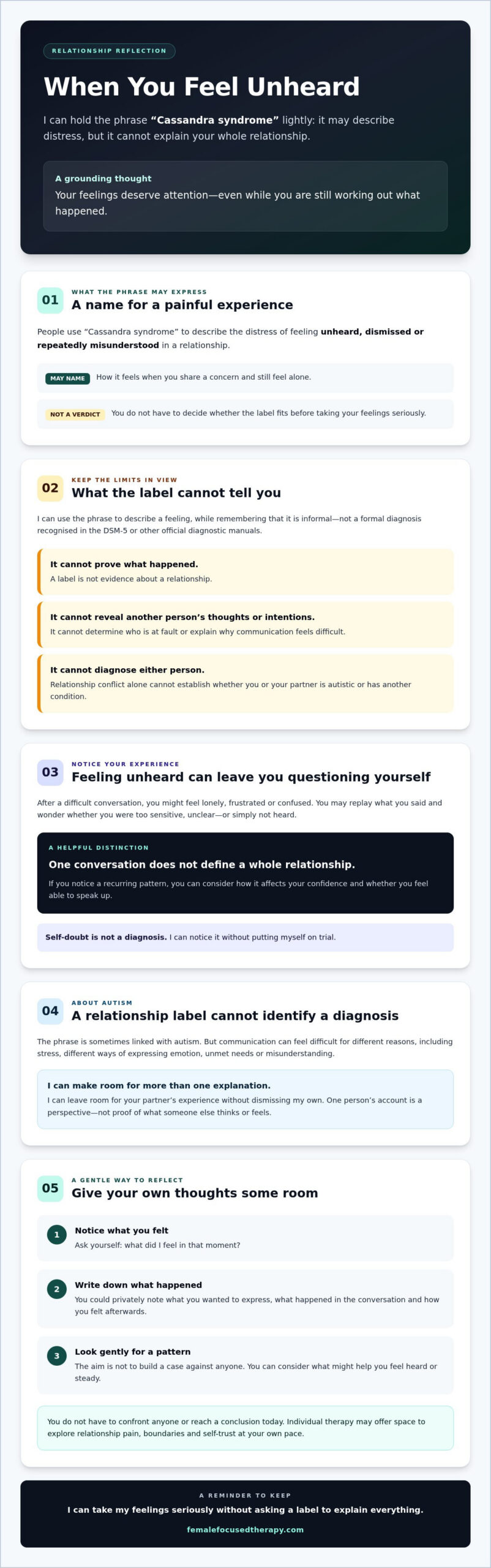
People use “Cassandra syndrome” to describe the painful experience of feeling unheard or disbelieved in a relationship. It is not a formal diagnosis, and it cannot prove what happened or tell you what another person thinks or feels.
This article looks at what the phrase may express, where it has limits and how you can reflect on your experience. You do not need to decide whether the label fits. You can start by noticing what has happened and what support, if any, feels right for you.
Key Takeaways
- Understand what people mean by cassandra syndroom without treating it as a diagnosis.
- Notice how feeling unheard may affect your confidence, while remembering that your feelings deserve attention.
- Learn why the phrase is sometimes linked with autism, and why it cannot identify or diagnose either person.
- Reflect on what happened and what support you might want, without feeling that you have to confront anyone.
- Explore how individual therapy may offer space to consider relationship pain, boundaries and self-trust at your own pace.
Cassandra syndrome: when you feel unheard in a relationship
You may try to explain what is troubling you, choose your words carefully and still come away feeling alone. You might wonder whether you made yourself clear or whether your concern was taken seriously. If that feels familiar, the phrase cassandra syndroom may catch your attention.
“Cassandra syndrome” is an informal phrase for the distress of feeling unheard, dismissed or repeatedly misunderstood in a relationship. It may help you describe how things feel, but it cannot prove what happened or explain your whole relationship.
What people may mean by Cassandra syndrome
People use the phrase in different ways. You might use it when you share a concern but feel it has not been understood, or when you replay a difficult conversation and wonder whether your point came across. The phrase will not mean the same thing to everyone, and you may not recognise yourself in every description of it.
The name draws on the Cassandra metaphor, from the Greek myth of Cassandra, whose warnings went unbelieved. The image may resonate if you feel that others do not hear your account. It is still a metaphor, not proof about your relationship or your partner’s intentions.
Why a name can feel comforting and complicated
Finding words for a lonely experience may bring some relief. A phrase can make it easier to explain what you feel, especially if difficult conversations have left you questioning your own perceptions.
It is also important to use labels carefully. Cassandra syndrome is not a formal diagnosis recognised in the DSM-5 or other official diagnostic manuals. It cannot tell you what another person thinks or feels, explain why communication has become difficult or determine who is at fault.
You can hold the phrase lightly. It may help describe how things feel, but it is not a verdict. Your feelings deserve attention whether or not the label fits. If you want to explore relationship concerns, you can read more about relationship trauma and support.
How feeling unheard can affect your confidence and sense of self
After a difficult conversation, you might feel lonely, frustrated or confused. If you have tried to explain what hurt and are still unsure whether your words were understood, you may start questioning your own judgement as well as the conversation.
For example, imagine raising a concern about plans changing at the last minute. The discussion moves on, and you are left wondering whether you were too sensitive, unclear or simply not heard. One conversation does not define a whole relationship. If you notice a recurring pattern, however, it may be useful to consider how it affects your confidence and whether you feel able to speak up.
Your feelings are real, even when you are still working out what may be behind them. You do not have to prove your experience before giving yourself time to notice it.
When you begin to question your own experience
Self-doubt is not a diagnosis. You might notice it when you replay a conversation, revise your words in your mind or wonder whether you remember what happened accurately. Instead of putting yourself on trial, consider whether this feeling comes up often and what tends to happen around it.
You could make a private note of what you wanted to express, what happened in the conversation and how you felt afterwards. The aim is not to build a case against anyone. It is to give your own thoughts room without expecting one difficult moment to explain everything.
Making room for more than one explanation
Communication can feel difficult for different reasons. Stress, different ways of expressing emotion, unmet needs or a misunderstanding may all play a part. Relationship conflict alone cannot establish whether you or your partner is autistic or has another condition.
You can leave room for your partner’s experience without dismissing your own. If you are curious about how autistic people describe their lives, this thesis explores the experiences of young adults with Asperger Syndrome. Treat one account as a perspective, not as evidence of what your partner thinks or feels.
You might ask yourself: what did I feel in that moment, and what could help me feel heard or steady? You do not have to confront anyone or reach a conclusion today. If you would value a private space to explore these questions at your own pace, you can find out about booking a therapy session.
Cassandra syndrome and autism: what I can and cannot conclude
The phrase Cassandra syndrome sometimes appears in discussions about relationships where one person is autistic and the other feels unheard or emotionally alone. That may be a context in which the phrase feels relevant. It cannot tell you whether you or your partner is autistic, or explain why a particular conversation or pattern is happening.
It helps to separate your account of feeling distressed from any explanation of what may be causing that distress. Your experience deserves attention in its own right. Working out whether autism or something else is relevant requires a broader, individual assessment, not a conclusion based on relationship conflict or an informal label.
Is Cassandra syndrome a recognised diagnosis?
No. Cassandra syndrome, sometimes called Cassandra affective deprivation disorder, is not a recognised diagnosis in the DSM-5 or other official diagnostic manuals. Here, it is a descriptive phrase for a relationship experience, not a medical or mental health condition.
That distinction does not make your pain less real. You do not need a diagnosis to say that conversations leave you confused, unheard or unsure what to do next. A phrase may help you put words to your feelings, but it cannot confirm what happened or provide a clinical assessment.
Why I avoid diagnosing a partner from relationship pain
You can describe what you notice without guessing at your partner’s diagnosis, motives or character. For example, “I raised a concern and the conversation ended before I felt heard” describes an experience. “They did that because they’re autistic” is an interpretation that the phrase alone cannot establish.
Some discussions link Cassandra syndrome with autism, but that link is not a way to assess anyone. An autism assessment considers the individual more broadly. One partner’s account of difficult communication cannot establish a diagnosis. Different communication styles do not necessarily mean there is no care, and care does not make the impact on you unimportant.
| What the phrase may express | What it cannot establish |
|---|---|
| You may feel unheard, isolated or worn down by repeated misunderstandings. | It can’t diagnose autism or any other condition in either person. |
| You may be looking for words to describe the effect of a relationship dynamic on you. | It can’t prove another person’s intentions, feelings or reasons for acting as they do. |
Bring the focus back to what you can observe and what you need. You might consider whether you feel able to speak freely, whether your boundaries are respected and what helps you feel safe. You do not have to settle on a label before taking those questions seriously.
What you can do when you feel unseen or unsure
If you find yourself replaying conversations, you do not have to decide straight away what they mean. Start gently: notice what happened, name how you felt, then consider what might help you feel supported. You can reflect privately. Doing so does not mean you have to confront anyone or make a decision about the relationship.
You might write down one specific moment and its impact. For example: “I felt unsettled after our conversation, and I’m not sure my concern came across.” Keep the note for yourself if that feels right. The purpose is not to build a case against someone. It is to make room for your experience, especially if cassandra syndroom has helped you find words for feeling unheard.
How to describe your experience without using a label
Try describing the moment and your feelings or needs. You might say, “I felt hurt when the subject changed. I’d like to finish explaining what matters to me.” This communicates your experience without claiming to know the other person’s intention. You can choose whether to have that conversation and when. You can also decide not to have it if it does not feel right or safe.
Finding a small next step that feels manageable
A manageable next step might be speaking with someone you trust or noting what you need before deciding what comes next. You do not have to tell the whole story at once. If you would rather begin quietly, explore these free therapy resources in your own time.
You can seek support for relationship distress without a diagnosis or proof that a particular label fits. Individual therapy can offer space to explore what you are feeling and what boundaries or support might matter to you, at a pace that feels manageable. If you would like to talk it through, you can book an individual therapy session. You do not need to be certain about what is happening before asking for support.
How I can support you as you make sense of relationship pain
You do not need to arrive with a diagnosis or a tidy explanation for why you feel alone in a relationship. I’m Cheryl Kennedy MacDonald, a registered psychotherapist offering individual therapy for women in Singapore and online to a global clientele. We can begin with what you have noticed and what you want to understand, without deciding in advance what your experience means.
What I can explore with you in therapy
Therapy can provide space to explore your feelings, boundaries and sense of self-trust. You might want to make sense of a recurring interaction, understand why you feel unsettled afterwards or find words for what you need. You set the pace. I will not use the phrase cassandra syndroom to diagnose you or your partner.
My trauma-informed, integrative approach may include CBT and mindfulness. CBT can help you notice connections between thoughts, feelings and actions. Mindfulness can support attention to what is happening in the present. We can consider what feels relevant to your goals. Neither approach promises a particular outcome or assigns blame to either person.
If relationship trauma feels relevant to what you are living through, you can read more about my relationship trauma support. You do not need to use that label for your experience to deserve care and attention.
Choosing support at your own pace
Booking is an option, not an obligation. You might take time to consider what you want from support or read about my work through the Female Focused Therapy homepage. If you feel ready to talk, you can book an appointment with Cheryl. You do not need to have everything worked out first.
You might write down a question you would like to bring to a session, or choose to wait. Feeling unheard can be painful, but you can explore that pain without turning yourself or your partner into a diagnosis.
Take the next step towards trusting your experience
The phrase cassandra syndroom may help you describe the loneliness of feeling unheard, but it is not a diagnosis or proof of what is happening in your relationship. You can take your feelings seriously without deciding what explains them or assigning blame. Noticing what happened, how you felt and what support you want can be a gentle place to begin.
Therapy can offer space to explore relationship pain, boundaries and self-trust at your own pace. You do not need to be certain about a label before asking for support. You can learn more about my work through the Female Focused Therapy homepage.
If you feel ready, book an appointment with Cheryl. There is no pressure to have all the answers. One small step towards understanding yourself is enough for now.
Frequently Asked Questions
What is Cassandra syndrome?
Cassandra syndrome is an informal phrase for the distress of feeling unheard, dismissed or repeatedly misunderstood in a relationship. It is sometimes linked with feeling isolated when you try to explain what is troubling you and feel your concerns are not believed. The phrase may help you put words to an experience, but it does not explain every relationship or prove what happened between you and your partner.
Can you have Cassandra syndrome if your partner is autistic?
The phrase cannot determine that from your partner’s diagnosis or from relationship difficulties. Some discussions use Cassandra syndrome to describe feeling unheard in a relationship involving an autistic person, but it cannot diagnose either of you or establish why communication feels difficult. Different communication needs may be worth understanding, while your feelings and boundaries still matter. An informal label is not a substitute for an individual professional assessment.
What does Cassandra syndrome feel like in a relationship?
You might feel lonely, frustrated, confused or doubtful about your own perceptions after raising a concern. For example, you may leave a conversation unsure whether you were understood, then replay your words and wonder if you expressed yourself badly. You may recognise some of this, or none of it. These feelings do not confirm a diagnosis, but they can help you notice what you need.
Does Cassandra syndrome mean my partner is abusive?
No. The phrase alone cannot tell whether a relationship is abusive or establish your partner’s motives or character. Consider what you experience over time, including whether you feel safe, whether your boundaries are respected and whether you can speak freely. If you are worried about your safety, consider reaching out to someone you trust or an appropriate local support service. You do not need a label to take concerns seriously.
Can therapy help if I feel unheard in my relationship?
Therapy can offer a space to explore what you are feeling, what boundaries matter to you and how you might rebuild trust in your own experience. I’m Cheryl Kennedy MacDonald, a registered psychotherapist. In individual therapy, I can explore your concerns with you at your pace. I cannot promise a particular outcome, but you do not have to make sense of everything alone.
What can I do if I keep doubting my experience?
Begin gently by noting a specific moment, how you felt afterwards and what you needed. You could write this privately, without trying to prove anything or build a case against your partner. If it feels helpful, share your reflections with someone you trust or a therapist. You do not have to confront anyone or settle on a label first. Your feelings are worth exploring even while you are unsure what they mean.

Article by
Cheryl Kennedy MacDonald MA BA (Hons) Pg. Dip. SAC BACP
Cheryl Kennedy MacDonald is a psychotherapist specialising in women’s mental health, relationships, and life transitions. She works with women navigating trauma, relationship breakdown, identity shifts, and midlife change, helping them rebuild self-trust, emotional stability, and a clear sense of who they are and what they want.
With over 20 years’ experience working with women internationally, Cheryl is the founder of YogaBellies, a global women’s yoga school, and the creator of the Birth ROCKS method. Her work sits at the intersection of psychotherapy and embodiment, integrating evidence-based therapeutic approaches with somatic, body-based practices that support deep, lasting change.
Known for her grounded and direct approach, Cheryl moves beyond surface-level insight to address the patterns held in the body and nervous system. Her work supports women to regulate, reconnect, and respond to their lives from a place of clarity, strength, and self-respect.
She is a published author in academic journals and has written multiple books on women’s health, pregnancy, and midlife wellbeing, available on Amazon and leading book retailers worldwide.