
What if finding the right ADHD support starts with feeling understood, rather than having everything figured out? If you’re searching “adhd therapy singapore”, you may be managing well on the outside while privately carrying overwhelm, emotional intensity, or the feeling that everyday tasks take more effort than they should.
It can be exhausting to keep going while wondering whether a psychologist, psychotherapist, or ADHD-focused therapist will understand your experience. As a registered psychotherapist and an adult woman with ADHD, I know support should feel personal, not like a generic list of strategies that overlooks the realities of your day.
This article can help you clarify what you want from ADHD therapy in Singapore, what ADHD-focused support may involve, and what to ask when considering whether a therapist is a good fit. I’ll also cover in-person and online options, so you can think about a next step that feels manageable. Therapy isn’t a quick fix, but it can be a steady, collaborative space to make sense of your experiences and explore coping strategies that work for you.
Key Takeaways
- Notice where you’re coping well and where ADHD may be making daily life feel heavier.
- Consider whether masking or emotional intensity is part of your experience, without assuming it applies to everyone.
- When exploring adhd therapy singapore, ask how a therapist supports adult women and adapts sessions to your needs.
- Compare the practicalities of in-person sessions in Singapore and online therapy, including privacy and routine.
- Learn how my perspective as a registered psychotherapist and a woman with ADHD informs the support I offer.
When ADHD feels heavy, what kind of support are you looking for?
You may be getting through work, caring for others, and keeping life moving while feeling stretched thin inside. Perhaps small tasks take more energy than you expect, or you find it hard to settle after an emotionally intense day. You don’t have to wait until everything feels unmanageable to consider what support might help.
ADHD-focused therapy is a collaborative space to understand how ADHD affects your life and explore coping strategies that fit your needs.
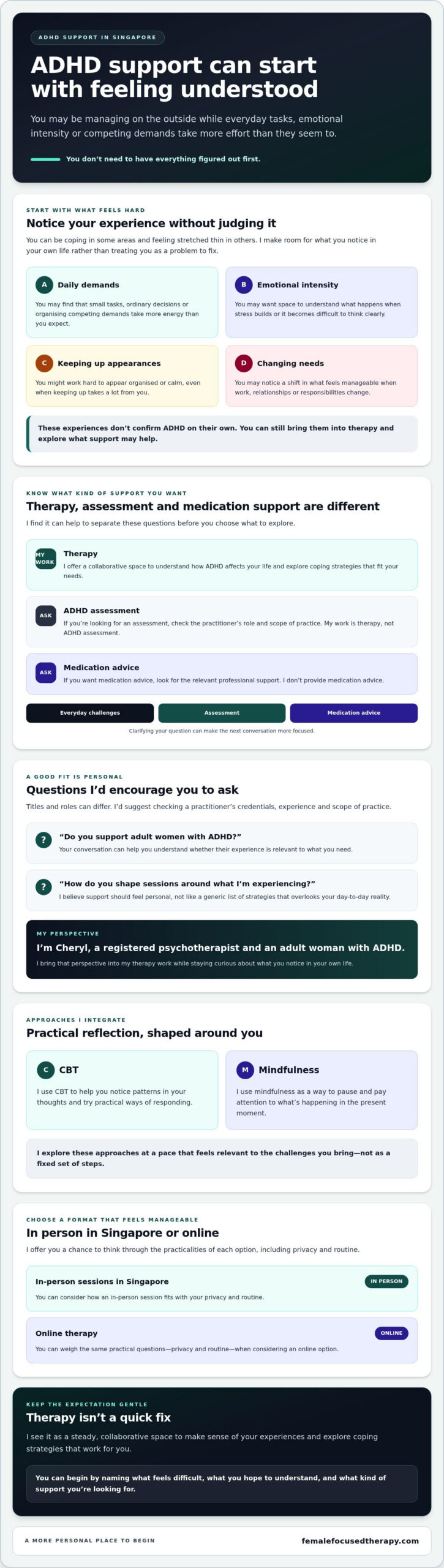
Therapy is different from an ADHD assessment and from psychiatric medication management. If you’re unsure what you need, try separating those questions: are you looking for help working through everyday challenges, an assessment, or advice about medication? Each calls for a different kind of professional support. Being clear about your goal can make it easier to find the right person to contact.
What might make you seek ADHD therapy in Singapore?
You might be handling plenty on the surface but feeling overwhelmed by competing demands. Therapy can give you space to identify what is making daily life difficult and consider practical ways to approach it. For example, you could bring a situation where tasks feel hard to organise, or a recurring source of stress that you want to understand better.
Perhaps your emotions feel intense, or stress builds until it’s difficult to think clearly. You may want to make sense of what’s happening and explore ways to steady yourself in those moments. These experiences don’t confirm ADHD on their own, but they can still be worth discussing in therapy.
If you’d like to learn more about how I approach ADHD-focused support, I’ve shared further information on my website. For a general overview of attention deficit hyperactivity disorder, you can also refer to this background source.
What is the difference between an ADHD psychologist and therapist?
Professional titles and roles can differ, so check each practitioner’s credentials, experience, and scope of practice. Psychologist and psychotherapist are not interchangeable titles, and the support offered can depend on the practitioner’s qualifications and role. I’m Cheryl, a registered psychotherapist and an adult woman with ADHD. My work is therapy, not ADHD assessment or medication advice.
Before choosing, consider what you hope to get help with. Then ask the practitioner directly: “Do you support adult women with ADHD?” and “How do you shape sessions around what I’m experiencing?” Their answers can help you assess whether their experience and approach are relevant to your needs.
Searching for adhd therapy singapore can bring up different kinds of support. Clarifying whether you’re looking for therapy, an assessment, or medication advice can make the next conversation more focused and less daunting.
How can ADHD therapy make room for your experience as a woman?
You may feel capable in some parts of life and quietly worn down by others. You might manage a busy workday, then find ordinary decisions or household tasks unusually draining. There isn’t one way to experience ADHD as a woman, and you don’t need to match a particular picture to make sense of what is happening for you.
You may recognise masking, such as working hard to appear organised or calm, or notice that emotions sometimes feel intense. You may not recognise either experience, and neither defines you. In therapy, I make room for what you notice in your own life rather than treating you as a problem to fix.
When you have spent years trying to keep up
You might have learned to meet expectations by planning carefully, pushing through, or hiding how much effort something takes. Perhaps you hold everything together through a full day of work and family responsibilities, then feel depleted once you’re alone. I won’t assume what is behind that experience. We can look at what feels tiring and what kinds of support might make daily life more manageable.
I integrate CBT and mindfulness in my work. CBT can help you notice patterns in your thoughts and try practical ways of responding. Mindfulness offers a way to pause and pay attention to what’s happening in the present moment. We can explore these approaches at a pace that feels relevant to the challenges you bring, rather than treating them as a fixed set of steps.
When your needs shift through different stages of life
A change in work, a relationship, or your responsibilities can affect what feels manageable and what kind of support you need. Strategies that once helped may no longer fit your circumstances. In therapy, we can make space to notice what has changed, identify your priorities, and explore coping strategies that make sense for your life now.
My perspective is shaped by my work as a registered psychotherapist and my own experience as an adult woman with ADHD. If you’d like to learn more about my ADHD-focused therapy, I’ve shared further information on my page.
Therapy isn’t an assessment, and it doesn’t replace medical advice. If you’re weighing different forms of support, the Mayo Clinic overview of ADHD diagnosis and treatment may help you understand the distinction. If talking through your needs feels like a useful next step, you can find out about arranging a session with me. For adhd therapy singapore, look for support that takes your experience seriously and makes room for your individual needs.
How can you decide whether an ADHD therapist is a good fit?
Choosing support can feel personal, especially if you’re used to managing things on your own. You don’t need to arrive with perfect words or know exactly what you want from therapy. It may help to start with a few questions and notice how the conversation feels. You can also consider whether the practitioner’s role matches the kind of support you’re seeking.
What can you ask before choosing a therapist?
Ask how the therapist understands ADHD-related overwhelm or emotional intensity, and whether they have experience supporting adult women with ADHD. You could also ask what their approach involves and how sessions are shaped around your needs. Their answers can help you assess whether they’re curious about your experience or relying on a one-size-fits-all explanation.
It’s reasonable to ask how you can raise a concern if something in therapy doesn’t feel right. You might say, “What happens if I’m unsure about an approach?” or “Can we adjust the pace if I feel overwhelmed?” These questions help clarify how the therapist responds to feedback. You can ask them without sharing anything you’re not ready to discuss.
If you want broader background as you consider support, you can read ADHD information from NIMH. Use general information as a starting point, not as a substitute for discussing what you personally need from therapy with a practitioner.
What can a sense of fit feel like?
You may notice that you feel listened to, respected, and able to speak at your own pace. You don’t need to agree with everything I say or have a clear answer straight away. A helpful conversation leaves room for your questions, your own understanding, and the possibility of changing direction.
Comfort doesn’t always arrive instantly. You might feel uncertain at first and become more at ease over time. Rather than treating one session or one feeling as proof of a perfect match, notice whether you can bring up what matters to you and whether your perspective is taken seriously.
As you compare options for adhd therapy singapore, jot down what you hope to feel more supported with, then bring one question to an initial conversation. I’m Cheryl Kennedy MacDonald, a registered psychotherapist and an adult woman with ADHD. If you’d like to explore whether my approach feels right for you, you can find out about arranging a session with me.
What might ADHD therapy look like in Singapore or online?
Finding a workable format is part of finding support that suits you. I offer individual psychotherapy in person in Singapore and online to a global clientele. Neither option is automatically better. Your routines, surroundings, and sense of ease matter, so consider what would help you take part comfortably and consistently.
How can you weigh in-person and online sessions?
Consider whether travelling to a session feels manageable or whether speaking from a familiar space would help you settle. Privacy matters too. For online therapy, think about whether you have a quiet place for a conversation and whether you can speak freely there. For in-person sessions, consider whether a dedicated setting away from home would feel more supportive. Access, travel, and your routine can all affect what feels realistic alongside work and other responsibilities.
These are practical considerations, not a test you need to pass. I can talk through what may be suitable for you, but please confirm availability and details directly with me. Consider the format in the context of your needs, rather than assuming one option works better for everyone.
What can you expect from an integrative approach?
I draw on CBT and mindfulness in my work. CBT can help you notice patterns in your thoughts and explore different ways of responding. Mindfulness can help you pause and pay attention to what’s happening in the present moment. We can consider whether either approach feels useful for the challenges you bring.
I shape sessions around what feels most present for you rather than following a fixed programme. You might bring a recurring source of stress or a situation you want to understand differently. We can explore possible coping strategies and adjust the focus as your needs change.
I also pay attention to the connection between what you’re thinking and what you’re experiencing in your body. For example, you might notice tension when a particular demand comes up. We can include that observation as part of understanding your experience, without turning therapy into a set of exercises or expecting you to have everything worked out beforehand.
If you’re considering adhd therapy singapore, start by asking yourself which format feels more manageable and what you’d like support with. You can explore arranging an appointment with me if you’d like to discuss a next step.
How can you take a gentle next step towards ADHD support?
You don’t need to make a big decision all at once. Start by asking yourself what feels hardest right now, what kind of support you’re hoping for, and what you’d like to understand about a therapist’s approach. Then notice how you feel in the conversation. Do you feel listened to and respected? Are you able to ask questions and explain what matters to you?
I’m Cheryl Kennedy MacDonald, a registered psychotherapist and an adult woman with ADHD. My own experience informs my interest in supporting women, but it doesn’t mean I’ll assume I know what ADHD feels like for you. I want to understand your experience in your words and explore what may be useful together. You can read more about my work and approach if you’d like to understand how I practise.
When could therapy be one useful form of support?
Therapy is one option, not something you have to choose, and it can’t promise a particular outcome. I offer psychotherapy, not medication management or inpatient treatment. If you’re looking for an ADHD assessment or advice about medication, speak with an appropriately qualified professional who can support those needs.
If you want space to understand your experiences and explore coping strategies, you might consider whether talking with a therapist feels like a helpful next step. You’re allowed to take time to think it through.
How can you begin without having everything figured out?
You don’t need a perfect explanation before reaching out. You might simply say that you’re looking for support with ADHD-related challenges and are still working out what would help. Before booking, jot down one or two questions. For example: “How do you shape sessions around what I bring?” or “Can we talk about what I need before deciding whether to continue?”
A short note can give you somewhere to begin, especially if it’s hard to find the words in the moment. Share only what feels comfortable. As you consider adhd therapy singapore, let your needs and your sense of the relationship guide you, rather than feeling pressured to decide quickly.
If you’d like to explore whether working with me feels right for you, you can book an appointment with me. There’s no need to have everything settled before taking that step.
Choose support that feels right for you
You don’t need every answer before seeking support. Start by noticing what feels difficult, asking how a therapist works, and paying attention to whether you feel heard and respected. ADHD-focused therapy can offer space to understand your experience and explore coping strategies, without treating you as someone who needs fixing.
If you’re considering adhd therapy singapore, the right fit matters more than choosing a particular format. I offer individual psychotherapy in person in Singapore and online. I’m Cheryl Kennedy MacDonald, a registered psychotherapist and an adult woman with ADHD. My lived experience informs my work, while your needs and perspective remain at the centre of our conversations.
You could write down one question you’d like to ask, then decide whether you want to take another step. There’s no need to rush. If you feel ready, book an appointment with me to explore individual psychotherapy. You deserve support that meets you with care and respect, at a pace that feels manageable.
Frequently Asked Questions
What is the difference between an ADHD psychologist and an ADHD therapist?
I’m a registered psychotherapist, not a psychologist. Titles and roles can differ, so check each practitioner’s credentials and ask what support they provide. A therapist may help you understand your experiences and explore coping strategies, while assessment is a separate need to clarify directly. Before choosing, consider whether you’re looking for therapy, an ADHD assessment, or advice about medication.
Can therapy help me manage ADHD-related overwhelm?
Therapy can give you space to understand what feels overwhelming and explore coping strategies that may suit your everyday life. You might talk with me about stress at work or consider what makes tasks feel hard to organise. I draw on CBT and mindfulness to help you notice patterns and pause with what’s happening. I can’t promise a quick fix, and I shape our work around what you bring.
Can an ADHD therapist diagnose me?
I don’t offer ADHD diagnosis. My work is psychotherapy, where I can help you explore your experiences and consider coping strategies. If you’re seeking an assessment, contact a qualified psychologist or psychiatrist and ask whether they assess adults for ADHD. If you’re unsure which support you need, ask about the practitioner’s role before arranging therapy. You don’t have to decide everything at once.
How do I find ADHD therapy in Singapore that feels right?
As you look for ADHD therapy Singapore, start by clarifying what you’d like support with. Ask about the therapist’s experience supporting adult women and how sessions are shaped around you. Notice whether you feel listened to and respected, and whether you can ask questions at your own pace. You don’t need instant certainty after one conversation. Reflect on the fit over time rather than treating it as a pass-or-fail test.
Is online ADHD therapy available if I live outside Singapore?
Yes, I offer online therapy to a global clientele, including people who live outside Singapore. Consider whether you have privacy and a quiet space for sessions, and whether online conversations feel comfortable for you. Please contact me to confirm availability and practical details before booking. You can ask what the online format involves so you can decide whether it suits your circumstances.
What should I ask before booking ADHD therapy?
You could ask me whether I support adult women with ADHD, how I approach overwhelm and emotional intensity, and how I shape sessions around your needs. You may also want to clarify that I offer psychotherapy, not assessment or medication advice. You don’t need to share anything you’re not ready to discuss. Writing down one or two questions beforehand can give you a gentle place to begin.

Article by
Cheryl Kennedy MacDonald MA BA (Hons) Pg. Dip. SAC BACP
Cheryl Kennedy MacDonald is a psychotherapist specialising in women’s mental health, relationships, and life transitions. She works with women navigating trauma, relationship breakdown, identity shifts, and midlife change, helping them rebuild self-trust, emotional stability, and a clear sense of who they are and what they want.
With over 20 years’ experience working with women internationally, Cheryl is the founder of YogaBellies, a global women’s yoga school, and the creator of the Birth ROCKS method. Her work sits at the intersection of psychotherapy and embodiment, integrating evidence-based therapeutic approaches with somatic, body-based practices that support deep, lasting change.
Known for her grounded and direct approach, Cheryl moves beyond surface-level insight to address the patterns held in the body and nervous system. Her work supports women to regulate, reconnect, and respond to their lives from a place of clarity, strength, and self-respect.
She is a published author in academic journals and has written multiple books on women’s health, pregnancy, and midlife wellbeing, available on Amazon and leading book retailers worldwide.