
You are sitting in a sun-drenched cafe in a city you once dreamed of, only to feel a heavy, hollow ache in your chest. The coffee is perfect, yet you’ve never felt more invisible. This quiet weight you’re carrying is a confusing, exhausting place to be, and I want you to know that you aren’t alone.
I know how it feels to lose the familiar rhythms of home and the sense of who you are along with them. It isn’t a failure to adapt; it’s a deep, somatic response to losing your internal and external anchors. I’ll help you understand why living abroad feels so isolating and how we can gently rebuild your sense of belonging together.
We’ll explore the loss of identity that comes with such a major life transition and find a path back to internal stability. By looking at the roots of your struggle, we can begin the journey of restoration at a pace that feels safe for you.
Key Takeaways
- I’ll help you understand why your feelings of isolation are a valid response to losing your anchors rather than a failure to adapt.
- We’ll explore how being a woman or neurodivergent changes your experience of relocation and the unique pressure of “settling” a family.
- I’ll show you how expat loneliness lives in your body and why healing requires your nervous system to feel safe.
- We’ll look at gentle “micro-connections” to help you rebuild belonging without the pressure of finding an immediate best friend.
- I’ll share how a warm, boundaried space can help you process your international journey and restore your internal stability.
Why Living Abroad Often Feels So Unexpectedly Lonely
I want to start by acknowledging that what you’re feeling right now is completely real. It’s incredibly common, yet we rarely talk about it. We’re conditioned to expect the “Instagram dream” of sunset cocktails and exotic markets, but the reality of expat loneliness is often much quieter and heavier. It’s the silence in your apartment when you have news to share and no one to tell.
Loneliness isn’t just about the absence of people; it’s about the absence of being truly seen or understood. You can be in a crowded room at a networking event and still feel the quiet weight of loneliness pressing down on you. I see this often in my work with women navigating life transitions, where the external change is visible but the internal struggle remains hidden.
The Gap Between the Adventure and the Reality
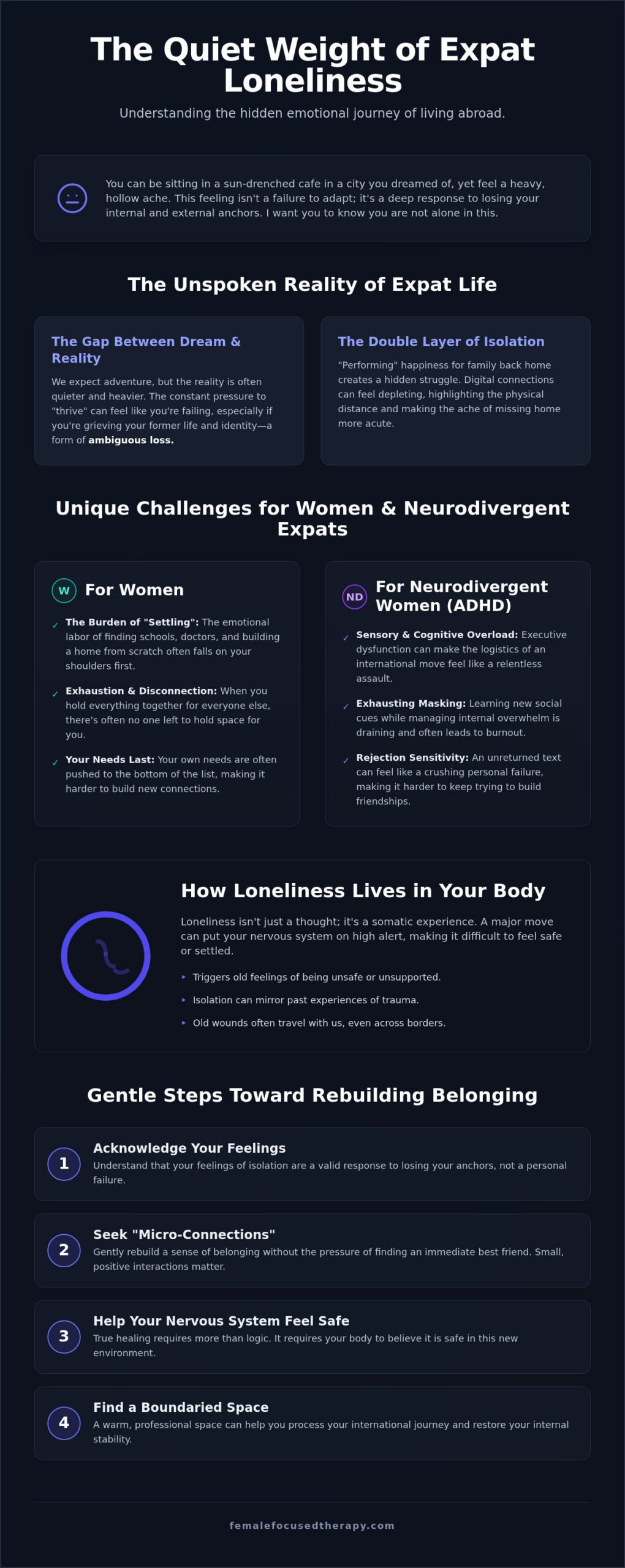
I’ve noticed how the constant pressure to “thrive” in your new home can actually make you feel like you’re failing. If you moved as a “trailing spouse,” you might be grappling with a profound loss of professional identity and purpose. I often describe this specific type of expat loneliness as a form of ambiguous loss; you’re grieving your former life and the person you used to be, even though they haven’t physically gone anywhere.
When Your Support System Is a Different Time Zone Away
I understand the deep exhaustion that comes from “performing” happiness for friends and family back home. You don’t want them to worry, so you highlight the wins and hide the hollow moments. This creates a double layer of isolation. There’s also a physical fatigue that comes from having no “easy” relationships nearby. Every interaction in a new country requires effort.
You’re constantly translating social cues or explaining your background. While we’re lucky to have video calls, I’ve found that digital connection often leaves us feeling more depleted. It’s a sharp reminder of the physical distance, highlighting the fact that a screen can’t offer a hug or the comfort of a shared, silent space. This digital gap can make the ache of missing home feel even more acute.
The Unique Challenges for Women and Neurodivergent Expats
I believe that our individual histories and brain wiring change how we experience relocation. For many women, the burden of “settling” the family often falls on our shoulders first. We find the schools, source the doctors, and try to build a home from scratch while our own needs are pushed to the bottom of the list. This emotional labour can make the experience of expat loneliness feel much more heavy and isolating.
I see this frequently in my practice, where high-functioning women are doing everything “right” but feel completely disconnected inside. When you’re the one holding everything together for everyone else, there’s often no one left to hold space for you. This creates a specific kind of exhaustion that makes it even harder to reach out and build new, meaningful connections.
How ADHD Impacts Your International Transition
I want to speak directly to those of you navigating this journey with ADHD. I know how executive dysfunction can make the logistics of an international move feel like a relentless sensory assault. Between the endless paperwork and the loss of your familiar routines, your brain is working overtime just to stay afloat.
Masking in a new culture is also twice as exhausting for neurodivergent women. You’re trying to learn new social cues while managing your own internal overwhelm, which often leads to burnout. Rejection sensitivity can also make making new friends feel like a minefield. An unreturned text from a new acquaintance isn’t just a busy moment; it can feel like a crushing personal failure that keeps you from trying again.
When Past Trauma Follows You Across Borders
I often find that a major move can trigger old feelings of being unsafe or unsupported. If you have experienced relationship trauma, being isolated in a new country can feel particularly frightening. Your internal alarm system might be on high alert, making it difficult to trust new people or feel settled in your new environment.
We often hope that “starting over” means the old wounds stay behind, but they usually travel with us in our bodies. The health risks of loneliness are significant, and for trauma survivors, this isolation can mirror past experiences of being trapped or alone. It’s why I offer a space where you don’t have to apologise for your overwhelm. If you feel ready to process these layers, you can book a session to talk through your journey in a safe, grounded way.
How Loneliness Lives in Your Body and Your Mind
I want you to take a moment right now to notice where you feel this loneliness in your body. Is it a hollowness in your chest, a tightness in your throat, or perhaps a heavy, leaden feeling in your limbs? Healing from the ache of living abroad isn’t just about “thinking” your way into a better mood. It’s about helping your nervous system feel safe again in a world that feels unfamiliar.
As a psychotherapist and yoga master, I’ve seen how expat loneliness manifests as more than just a passing emotion. It often shows up as physical fatigue or a persistent “brain fog” that makes even simple decisions feel impossible. When your mind is constantly scanning for social cues and your body is waiting for a sense of home that hasn’t arrived yet, you’re living in a state of chronic depletion.
The Physical Toll of Long-Term Isolation
I’ve observed that long-term isolation keeps your body in a state of high alert, similar to a low-grade fight-or-flight response. This constant vigilance can disrupt your sleep patterns and even affect your digestion, as your system prioritises survival over rest. A 2025 World Health Organisation report highlighted that loneliness increases the risk of early mortality by 26%, proving it is a significant physical health concern.
I believe that somatic movement can help release the deep-seated tension of being “on” all the time. By finding your breath and moving with intention, you’re telling your body it’s okay to let go of the guard you’ve been holding up. This physical release is often the first step in clearing the mental fog that accompanies social disconnection.
Moving from “Fixing” to Restoring Your Internal Anchor
I don’t want to “fix” you or give you a checklist of hobbies to join. My goal is to help you restore your trust in your own intuition and internal stability. During a major life transition, we often feel pressured to be constantly “doing”—unpacking, networking, or exploring. However, I’ve found that true restoration often happens in the “non-doing” and allowing yourself space to simply be.
Finding your internal home is the first step to feeling at home anywhere in the world. When you can sit with yourself and feel grounded in your own skin, the external world becomes less threatening. We work together to build that internal sanctuary, allowing you to move through your international journey with a renewed sense of self-assurance and peace.
Gentle Steps Toward Rebuilding Your Sense of Belonging
I want to offer you some realistic, gentle ways to start feeling a little more connected. When you’re in the thick of expat loneliness, the common advice to “just get out there” can feel like being told to climb a mountain when you can barely stand. We’re going to focus on micro-connections instead of the pressure to find a best friend immediately.
I believe in the power of small, consistent rituals to ground you in your new city. These aren’t about fixing your life; they’re about being kind to yourself while you navigate this massive change. It’s okay if your progress feels slow. Your nervous system needs time to adjust to your new surroundings before it can truly open up to others.
Creating a Micro-Community That Feels Safe
I suggest looking for “low-stakes” social interactions first. This might mean visiting the same coffee spot every Tuesday morning or attending a local class where the focus is on a skill, like pottery or language, rather than intense conversation. These small points of contact help you feel recognised in your community without the exhaustion of a high-pressure social event.
We can talk about how to set boundaries so you don’t over-extend yourself in the search for friends. It’s tempting to say yes to every invitation, but if you’re neurodivergent or recovering from trauma, this can lead to a sensory crash. I encourage you to look for people who value you for who you are, rather than just your shared status as a foreigner.
The Power of Breath and Movement in Your Daily Life
I want to share a simple 2-minute breathing practice for when the expat loneliness feels particularly sharp. Find a quiet seat, place one hand on your heart, and simply notice the rise and fall of your chest. Don’t try to change it; just acknowledge that you’re here and you’re breathing. This tiny act of presence can help anchor you when everything else feels untethered.
A gentle walk in a local park can also help you “digest” the heavy emotions of the day. Movement allows the stagnant energy of isolation to shift through your body. I want you to see these as acts of self-compassion, not just another item on your to-do list. If you’re finding it hard to take these first steps alone, you can book a session with me to begin rebuilding your internal stability.
Finding a Safe Space to Process Your International Journey
I offer a warm, boundaried space where you can be exactly who you are, without the need to perform or mask your struggle. Whether you are in Singapore or elsewhere, online therapy allows us to connect in the environment where you feel most secure. You don’t have to carry the quiet weight of expat loneliness alone anymore.
I use an integrative approach that respects the deep connection between your mind and your body. We will work together to understand why this transition feels so heavy and how we can gently restore your internal sense of home. My goal is to help you feel seen and validated in a world that often feels indifferent to your pain.
How We Can Work Together
I’ve designed my sessions for women in Singapore to address the specific emotional and psychological challenges of international transitions. We won’t just focus on “fitting in.” Instead, we will explore how to rebuild your internal confidence and self-reliance from the ground up.
I am here to guide you through the fog of this change at a pace that feels manageable for you. We might look at how your ADHD or past experiences of trauma are colouring your current reality. By understanding these layers, we can find strategies that actually work for your unique brain and history.
Taking Your First Step Toward Restoration
I invite you to reach out for a consultation if you feel ready to start this conversation. This first step isn’t about committing to a long-term programme immediately. It’s simply about seeing if this space feels right for you and what you need right now to feel a little more grounded.
I believe that with the right support, you can do more than just survive your move; you can truly thrive in this new chapter. Expat loneliness doesn’t have to be your permanent companion. Together, we can find a path back to your own self-trust and a genuine sense of belonging, no matter where in the world you are.
Moving Toward a Season of Restoration
You don’t have to navigate this international transition in silence. We’ve explored how the quiet weight of expat loneliness is often a somatic response to losing your familiar anchors. By acknowledging how your unique history, whether it involves ADHD or past trauma, shapes your experience, you can begin to treat yourself with the compassion you deserve.
As a registered integrative psychotherapist and yoga master, I specialise in providing a safe, confidential environment for women in Singapore and online globally. I’m here to help you move beyond the exhaustion of “performing” happiness. We will work together at your own pace to restore your internal stability and trust in your own intuition.
If you feel ready to find your way back to a grounded, connected version of yourself, I invite you to take one small step today. You can book a session with me to start your journey toward restoration and begin processing your story in a space designed just for you.
Your sense of belonging starts from within, and it’s a path we can walk together. You’ve already shown incredible strength by moving across the world. Now, let’s focus on helping you feel at home in your own skin again.
Frequently Asked Questions
Is it normal to feel lonely as an expat even if I have a family?
It’s completely normal to feel this way. You can be surrounded by your family and still feel a profound sense of expat loneliness because you’re missing the wider support network of home. Often, the emotional labour of settling your children and partner falls on you, leaving little room for your own needs. You’re grieving the shared history and easy connections that your current unit simply cannot replace.
How do I know if my expat loneliness is actually depression?
Loneliness is often a situational response to isolation, while depression is a persistent state that affects your energy and sense of worth. If you find that you’ve lost interest in things you once enjoyed or feel a heavy hopelessness that doesn’t lift, it may be more than a passing phase. I help women navigate these feelings in a safe, grounded space to determine what kind of support will best aid their restoration.
Can online therapy really help with the isolation of living abroad?
Yes, online therapy is a powerful tool for navigating expat loneliness because it offers a stable connection while your external world is in flux. It allows us to work together regardless of where you are located. This consistency helps you rebuild your internal confidence and self-reliance, providing a safe, confidential space to process the specific challenges of international transitions without needing to wait until you feel “settled” in your new city.
Why does my ADHD make it harder to settle into a new country?
ADHD often involves executive dysfunction and sensory processing challenges, which makes the chaos of a move feel like a relentless assault. Your brain has to work much harder to establish new routines and learn unfamiliar social cues. This extra effort leads to burnout and can make the rejection sensitivity common in ADHD feel even more painful when you’re trying to build a new social circle from scratch in an unfamiliar culture.
How long does it typically take to stop feeling like an outsider?
There’s no set timeline, but many women find that the first 12 to 18 months are the most challenging. It’s a gradual process of building micro-connections and restoring your internal stability. I encourage you to focus on your own rhythm rather than comparing your journey to the polished versions of life others might project. True belonging grows slowly as your nervous system begins to feel safe in your new environment.
What should I do if I feel like I’ve lost my identity since moving?
Losing your professional or social identity is a form of ambiguous loss that requires gentle processing. I suggest starting with small acts of internal restoration to reconnect with who you are outside of your expat status. This might involve returning to a hobby you loved at home or simply carving out space for “non-doing” where you can listen to your own needs without the constant pressure to adapt or perform.
How can somatic movement help with the emotional stress of relocation?
Somatic movement helps release the physical tension that your body holds when you’re in a constant state of high alert. It moves stagnant energy and helps your nervous system feel safe again. By focusing on your breath and gentle, intentional movement, you’re telling your body it’s okay to let go of the guard you’ve been holding up. This physical release is often a vital first step in clearing mental fog.
What is the first step to take if I’m feeling completely overwhelmed today?
The most important first step is to pause and breathe. Acknowledge that your overwhelm is a valid response to a massive life transition. You don’t have to fix everything at once. Reaching out for a consultation is a gentle way to start processing your journey. I’m here to hold space for you and help you find a path back to feeling grounded and secure, focusing on exactly what you need to feel safe today.

Article by
Cheryl Kennedy MacDonald MA BA (Hons) Pg. Dip. SAC BACP
Cheryl Kennedy MacDonald is a psychotherapist specialising in women’s mental health, relationships, and life transitions. She works with women navigating trauma, relationship breakdown, identity shifts, and midlife change, helping them rebuild self-trust, emotional stability, and a clear sense of who they are and what they want.
With over 20 years’ experience working with women internationally, Cheryl is the founder of YogaBellies, a global women’s yoga school, and the creator of the Birth ROCKS method. Her work sits at the intersection of psychotherapy and embodiment, integrating evidence-based therapeutic approaches with somatic, body-based practices that support deep, lasting change.
Known for her grounded and direct approach, Cheryl moves beyond surface-level insight to address the patterns held in the body and nervous system. Her work supports women to regulate, reconnect, and respond to their lives from a place of clarity, strength, and self-respect.
She is a published author in academic journals and has written multiple books on women’s health, pregnancy, and midlife wellbeing, available on Amazon and leading book retailers worldwide.