
What if that persistent feeling of being ‘broken’ isn’t a sign that you’re failing, but rather a signal that your internal system is simply overwhelmed by the weight of everything you carry? I’ve sat with many women who are high-achieving and capable, yet find themselves drowning in cyclical negative thoughts after a difficult relationship or struggling with the sensory and emotional intensity of a late ADHD diagnosis.
I understand that the pressure to stay ‘on’ in a city like this can be exhausting. You might feel like you’re constantly bracing for the next wave of overwhelm, losing touch with the woman you used to be. It’s a heavy burden to bear alone, especially when you’re trying to maintain a sense of normalcy for everyone else around you.
I want you to know that healing doesn’t have to be clinical or cold. By using a compassionate, integrative approach to cognitive behavioral therapy singapore, we can work together to restore your self-trust. I’ll help you find practical tools to manage your daily life while creating a safe, non-judgmental space for your mind and body to finally rest and recover.
In this article, I’ll explain how we can combine evidence-based CBT with gentle somatic practices like breath and movement. We’ll look at how this mind-body connection helps you navigate life transitions and trauma, allowing you to regain your internal stability at a pace that feels manageable, steady, and kind.
Key Takeaways
- Learn why I view CBT as a way to understand your mind’s stories rather than a clinical tool to ‘fix’ you.
- Discover how my approach to cognitive behavioral therapy singapore supports you through the specific complexities of relationship trauma and late-diagnosed ADHD.
- Understand how I integrate somatic awareness, like breath and movement, to help you release the stress your body is holding onto.
- Explore how we can work together to restore your self-trust and rebuild the internal stability that life transitions may have shaken.
Understanding Cognitive Behavioural Therapy Through a Compassionate Lens
I don’t see CBT as a cold, clinical tool meant to ‘fix’ what is broken within you. Instead, I view it as a gentle way to understand the complex stories your mind tells you every day, especially when you’re feeling overwhelmed despite being high-achieving. It’s about looking at the patterns we’ve developed to survive and deciding which ones still serve us.
At its heart, Cognitive Behavioral Therapy is about exploring the intimate relationship between what you think, how you feel, and how your body reacts. When we practice cognitive behavioral therapy singapore, it becomes a collaborative journey where we work together to reclaim your narrative from overwhelming thoughts. We aren’t just changing thoughts; we’re restoring your internal stability.
Living as a woman in Singapore often means balancing high expectations with intense personal transitions. Whether you’re managing a demanding career or navigating relationship changes, I focus on how these cycles manifest in your daily life. It’s about finding practical ways to stay grounded when the world feels like it’s moving too fast, ensuring you don’t lose yourself in the process.
Moving Beyond the Clinical Label
The term ‘Cognitive Behavioural Therapy’ can sound incredibly intimidating, almost like a classroom exercise or a rigid set of rules. I prefer to soften this approach, making our sessions feel like a supportive, human conversation rather than a lecture. You deserve to be heard as a person, not treated as a case study or a clinical label.
Before we even begin looking at ‘behaviours’, I ensure you feel safe and validated in our space. My integrative background means I combine clinical frameworks with personal warmth and empathy. This ensures therapy feels like a partnership where your experiences are respected, helping you move forward with a renewed sense of self-assurance and internal peace.
The Simple Power of Awareness
So much of our daily stress comes from ‘autopilot’ thoughts that we don’t even realise we’re having. These are the quiet, persistent whispers telling you that you aren’t doing enough or that you’re failing to keep up with everyone else. These thoughts often drive the anxiety and exhaustion you feel at the end of a long day.
Recognising these patterns is the first step toward genuine change. Small, intentional shifts in how you perceive a situation can lead to profound changes in your emotional stability. By bringing these thoughts into the light, we strip them of their power to overwhelm you, allowing you to trust your own intuition again.
If you’re wondering if this approach fits your specific situation, you can read more about who I work with. Understanding these cycles is the key to managing the unique pressures that lead women to seek cognitive behavioral therapy singapore. My goal is to help you thrive by creating a sustainable path forward that respects your energy and your boundaries.
Why Your Unique Experience as a Woman Matters in Therapy
I believe that therapy is most effective when it acknowledges the specific lens through which you see the world. For many women I see, life in Singapore is a delicate juggling act of high-pressure careers and complex personal lives. Generic approaches often ignore the unique dynamics of power and control found in relationship trauma or narcissistic abuse.
I work with many women who appear incredibly successful on the outside but feel like they’re failing internally. This is often the case for those navigating late-diagnosed ADHD or significant life transitions that feel impossible to manage alone. My approach to cognitive behavioral therapy singapore is specifically adapted to account for the hormonal and societal shifts we face, from the challenges of motherhood to the changes of menopause.
Your trauma is entirely valid and doesn’t need a medical label to deserve care. Whether you are dealing with a specific event or a long-term feeling of being ‘too much’, your experience matters. I’m here to help you understand these feelings without judgment, providing a space where your voice is the most important one in the room.
Navigating Relationship Trauma and Recovery
If you’ve experienced narcissistic abuse, you might still be carrying ‘gaslighting’ thoughts that make you doubt your own reality. CBT can help you untangle these threads and begin rebuilding the self-trust that was eroded during that difficult time. It’s about learning to distinguish between the critical voice of an ex-partner and your own inner truth.
According to the American Psychological Association, these techniques are highly effective for processing trauma and regaining a sense of personal agency. You can explore how I support relationship trauma and narcissistic abuse recovery through a mind-body lens. We focus on restoring your confidence so you can move forward with clarity.
Supporting the Neurodivergent Woman
For the ADHD brain, traditional productivity advice often feels like a setup for failure, leading to a heavy cycle of shame. I adapt CBT techniques to work with your neurodivergence rather than against it, helping you manage sensory and emotional overwhelm. We look at what actually works for your brain instead of what society tells you ‘should’ work.
If you’re feeling the weight of a late diagnosis, ADHD therapy for women can provide the tools you need to find stability without the self-criticism. We focus on practical strategies that respect your energy levels and cognitive style. If you feel ready to explore these patterns in a safe, female-focused space, you might find it helpful to schedule a quiet time to talk with me.
Bridging the Gap Between Your Mind and Your Body
As a Yoga Master, I’ve spent years observing how our bodies carry the weight of our unspoken stories. Your mind might try to rationalise why you’re feeling overwhelmed, but your body doesn’t lie. It often holds onto the stress of high-pressure life in Singapore long after your workday has ended, manifesting as exhaustion or physical discomfort.
In our sessions, I integrate somatic awareness because I’ve seen how powerful your breath and movement can be as allies in your healing journey. We explore how anxiety feels like a tightness in your chest or how the emotional intensity of ADHD manifests as physical tension in your shoulders. A single, conscious breath can be the gentle first step in breaking a relentless negative thought cycle.
By blending cognitive behavioral therapy singapore with this body-focused lens, we address the root of your overwhelm. This approach helps you move forward with a renewed sense of self-assurance. We aren’t just looking at what you think; we’re looking at how your whole being experiences the world around you.
The Role of Somatic Movement and Rest
Traditional Cognitive behaviour therapy (CBT) often focuses purely on the cognitive, but gentle movement can help ‘unstick’ the deep emotions that talk-therapy alone might miss. I believe that true healing happens in both the mind and the body. You don’t even need a yoga mat to begin this work; it’s about learning to listen to what your nervous system is telling you.
You can learn more about how I use Somatic Movement & Yoga for Women to support this internal restoration. This integrative approach ensures that we aren’t just ‘fixing’ thoughts, but calming the physical house they live in. It allows you to find a steady, manageable speed for change that respects your physical and emotional capacity.
Mindfulness as a Practical Tool
I don’t use mindfulness as a trendy buzzword. For the women I work with, it’s a grounded, practical way to stay present when things feel heavy or chaotic. It’s about finding your centre amidst the noise of a busy day in Singapore, allowing you to respond rather than react to the pressures around you. Whether you’re in a boardroom or navigating a crowded MRT station, these moments of presence help you reclaim your calm.
Using cognitive behavioral therapy singapore in this way means we look at the whole of you. We use simple techniques like grounding exercises or mindful breathing that you can use anywhere. These tools help you build a sense of safety within yourself, making the daily overwhelm feel far more manageable and less frightening. It’s about creating a toolkit that supports your mind and body equally as you navigate life’s transitions.
What Our Cognitive Behavioural Therapy Sessions in Singapore Look Like
I offer a safe, confidential space where you are always the priority. Whether we meet in-person in Singapore or through online therapy, the environment is designed to make you feel completely at ease. Our first session is primarily about me listening to your story and identifying exactly where you feel stuck right now.
We move at a pace that feels manageable for you. I avoid the high-pressure, clinical feel of traditional hospital settings because I know that healing cannot be rushed. In our work with cognitive behavioral therapy singapore, I provide you with realistic, small steps to take between our meetings to support your growth.
Creating a Boundaried and Safe Space
Having a ‘warm but boundaried’ relationship with me means you have a therapist who is deeply human but also maintains professional safety. For professional women in Singapore’s close-knit community, confidentiality is often a primary concern. You need to know that your story stays within our room, away from the prying eyes of social or professional circles.
If you feel you need more concentrated support, you might explore my Focused Intensive Therapy Options. These sessions allow us to dive deeper into specific challenges without the distractions of a typical week. It’s about creating a container where you can finally let your guard down and focus entirely on your internal restoration.
Your Journey from Intake to Restoration
Our initial assessment is a conversation, not an interrogation. I want to understand your history and the context of your life without you feeling like a patient on a chart. We set gentle goals that focus on how you want to feel, such as ‘at peace’ or ‘capable’, rather than just a checklist of tasks to complete.
Choosing cognitive behavioral therapy singapore allows us to track your transition from managing overwhelming symptoms to thriving in your new stability. We look at the physical and emotional cues we discussed earlier to see how you are progressing. As you gain confidence, you’ll find that the tools we develop together become second nature, allowing you to trust your intuition again.
If you’re ready to start this journey in a space that truly understands the pressures you face, I invite you to book a session with me today. We can begin the process of finding your calm together.
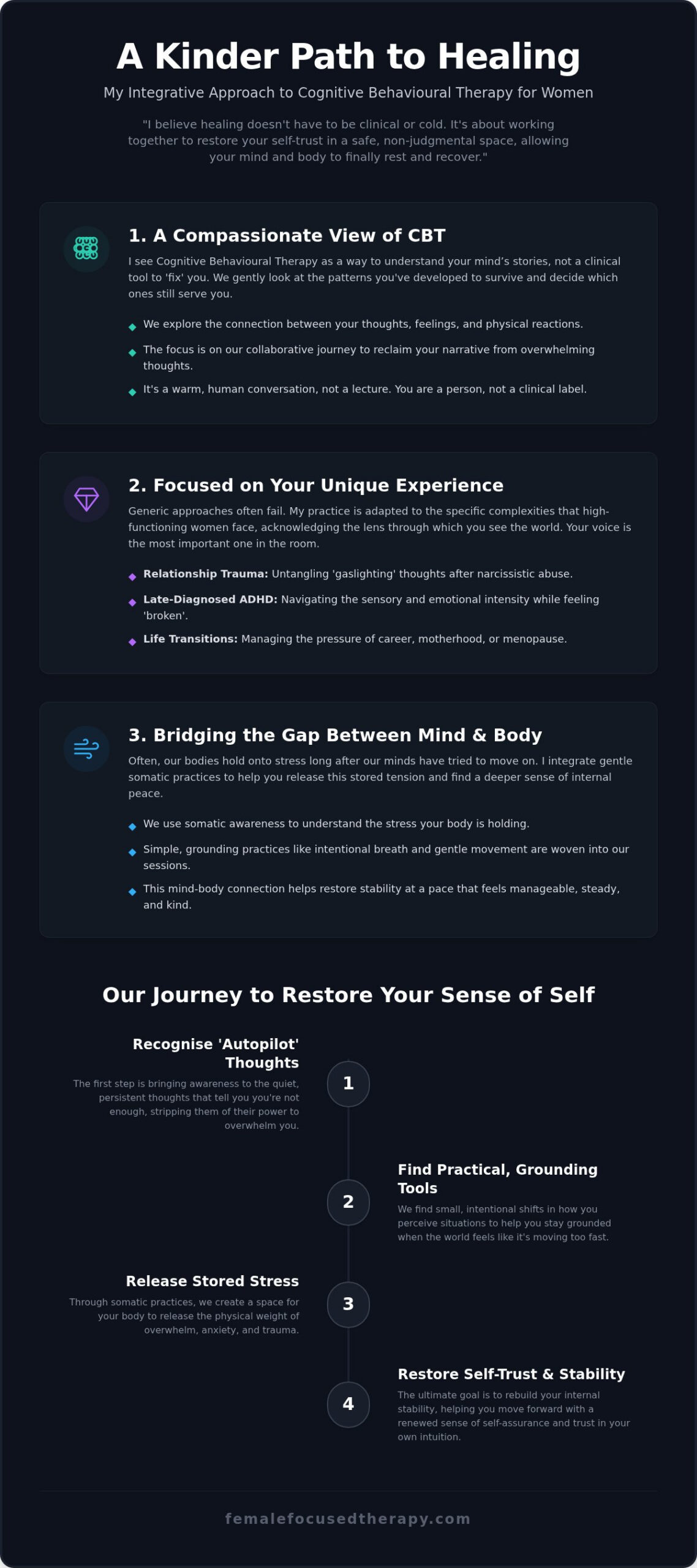
Restoring Your Sense of Self and Moving Forward
My ultimate goal for our work together is to help you rebuild the internal confidence that life transitions or trauma may have shaken. It’s so easy to feel like you’ve lost the ‘real’ you beneath the layers of expectations and past hurts. Through our use of cognitive behavioral therapy singapore, we work to peel back those layers, allowing your natural strength to surface once again.
Therapy with me is a journey toward trusting your own intuition again. You’ve likely spent a long time looking outward for answers or trying to rationalise away your discomfort. I want to help you tune back into that quiet, steady voice inside that knows exactly what you need to feel safe and whole.
You don’t have to carry the weight of ‘fixing’ everything on your own. I see so many women who feel they must be their own architect, builder, and decorator when it comes to their mental health. My role is to stand beside you, offering the tools and the steady presence you need to reconstruct your sense of self at a pace that feels kind.
Reclaiming Your Story
CBT provides a framework to help you write a new narrative where you are the resilient protagonist rather than just a witness to your own life. We look at the stories you tell yourself about your worth and your capabilities. By examining these through a lens of compassion, we can shift the focus from what has happened to you toward who you are becoming.
This means moving past the labels of ‘ADHD’ or ‘survivor’ and into a place of integrated wholeness. While these labels can offer helpful context, they don’t define the entirety of your being. We work to ensure that your diagnosis or your history is just one part of a much larger, more vibrant story that you are in control of.
Your Next Step Toward Healing
I invite you to take a moment to reflect on how you’re feeling right now. If you feel a resonance with the approach we’ve discussed, I would be honoured to support you. Taking that first step toward change can feel daunting, but it’s the beginning of a much more peaceful chapter.
When you feel ready, you can book your session to begin this process of internal restoration. We’ll find a time that works for you, whether you prefer to meet in person or online. Remember that the first step is often the hardest to take, but you don’t have to take it alone.
Your Path to Internal Stability and Peace
You’ve carried the weight of transitions, trauma, and neurodivergence for long enough. Healing is a journey of restoration, not a quick fix; it begins by acknowledging that your experience is valid. By combining traditional cognitive behavioral therapy singapore with gentle somatic practices, we can work together to reclaim your narrative and calm your nervous system.
As a Registered Integrative Psychotherapist and Yoga Master specializing in female-centric trauma and ADHD, I’m here to provide the confidential, warm, and boundaried support you deserve. You don’t have to navigate these complex emotions alone. I’m ready to hold space for you whenever you feel prepared to begin.
Book your initial consultation with me here to begin your journey toward calm.
Trust your intuition; you have everything you need within you to find your way back to a life of steady, manageable peace.
Frequently Asked Questions
What is the difference between CBT and traditional talk therapy?
Traditional talk therapy often focuses on the ‘why’ of the past, while I use CBT to focus on the ‘how’ of your present. It’s a more structured way to help you identify specific patterns between your thoughts, feelings, and physical reactions. We work together to build a toolkit of practical strategies that you can use immediately to manage daily life and restore your internal stability.
How many sessions of CBT will I need to see a difference?
The number of sessions varies because every woman’s journey is unique, but many of my clients begin to feel a shift within 6 to 12 weekly meetings. We move at a pace that feels manageable for you, rather than sticking to a rigid clinical timeline. My focus is on supporting your change at a steady speed that respects your emotional capacity and your busy schedule.
Is CBT effective for women with ADHD who feel overwhelmed?
Yes, CBT is incredibly effective for women with ADHD because it provides a structured way to manage emotional and sensory intensity. I adapt these techniques specifically for the neurodivergent brain to help you navigate overwhelm without the weight of shame. We focus on practical, realistic steps that work with your unique cognitive style. This approach helps you move away from the ‘productivity’ trap toward genuine peace.
Can CBT help me if I am recovering from a relationship with a narcissist?
I use CBT to help you untangle the ‘gaslighting’ thoughts and self-doubt that often linger after relationship trauma. It’s a powerful tool for rebuilding the self-trust that was eroded by narcissistic abuse. By identifying and challenging the critical voices that aren’t yours, you can begin to trust your own intuition again. This process is about reclaiming your narrative and moving forward with a renewed sense of self-assurance.
Do I need a formal diagnosis to start Cognitive Behavioural Therapy in Singapore?
No, you don’t need a formal medical diagnosis to begin cognitive behavioral therapy singapore with me. I believe that your trauma and your feelings of overwhelm are valid regardless of whether they have a clinical label. Our work is about understanding your personal story and finding where you feel stuck right now. We focus on your lived experience and the practical restoration of your well-being.
Is online CBT as effective as meeting in-person at your Singapore practice?
Research and my own professional experience show that online CBT is just as effective as meeting in-person at my Singapore practice. What matters most is the feeling of safety and the ‘warm but boundaried’ connection we build together. Online therapy offers the same level of confidentiality and professional support while allowing you to stay in a space where you already feel comfortable. It’s a flexible way to prioritize your healing.
How do I know if I am ready to start this therapeutic journey?
You’re likely ready if you feel a persistent desire for change or a need to understand the cycles that keep you feeling overwhelmed. Readiness doesn’t mean you have all the answers; it just means you’re open to exploring your thoughts and feelings in a safe space. If you find yourself repeatedly searching for ways to find calm or restore your self-trust, that’s often a sign it’s time.
What happens if I feel like CBT isn’t the right fit for me?
If you feel that CBT isn’t the right fit, we can adjust our approach because I am an integrative psychotherapist. I combine various evidence-based modalities with mindfulness and somatic practices to ensure the therapy meets your needs. If we need to pivot our approach to cognitive behavioral therapy singapore to include more somatic work or different frameworks, we’ll do so at a pace that feels right for you.

Article by
Cheryl Kennedy MacDonald MA BA (Hons) Pg. Dip. SAC BACP
Cheryl Kennedy MacDonald is a psychotherapist specialising in women’s mental health, relationships, and life transitions. She works with women navigating trauma, relationship breakdown, identity shifts, and midlife change, helping them rebuild self-trust, emotional stability, and a clear sense of who they are and what they want.
With over 20 years’ experience working with women internationally, Cheryl is the founder of YogaBellies, a global women’s yoga school, and the creator of the Birth ROCKS method. Her work sits at the intersection of psychotherapy and embodiment, integrating evidence-based therapeutic approaches with somatic, body-based practices that support deep, lasting change.
Known for her grounded and direct approach, Cheryl moves beyond surface-level insight to address the patterns held in the body and nervous system. Her work supports women to regulate, reconnect, and respond to their lives from a place of clarity, strength, and self-respect.
She is a published author in academic journals and has written multiple books on women’s health, pregnancy, and midlife wellbeing, available on Amazon and leading book retailers worldwide.