
Have you ever felt like a stranger in your own skin, watching your emotions spiral while you stand by, helpless to stop them? I know that feeling of being “out of control” all too well. When your hormones shift, the brain fog and ADHD-related overwhelm can feel like a heavy storm; however, practicing mindfulness for hormonal balance can offer a gentle way back to yourself.
It is exhausting to live with the physical tension of chronic stress, especially when you are trying to maintain a high-functioning life. You might feel like your body has betrayed you, but I believe this is actually an invitation to listen more deeply. I want to help you use mindful presence to soothe your nervous system and restore a sense of internal harmony.
I will guide you through how this mind-body connection can transform your relationship with your moods. We will explore somatic techniques to ease overwhelm and help you find lasting emotional stability. My goal is to help you reach a place of better sleep, more energy, and a renewed sense of self-trust during these transitions.
Key Takeaways
- Understand how I view the link between your endocrine and nervous systems so you can see why your body reacts to stress.
- Discover how I use mindfulness for hormonal balance as a gentle check-in to soothe your nervous system.
- Learn my approach to moving from mental overwhelm to somatic safety, acknowledging that healing happens in your body and mind.
- Explore my favourite grounded practices that offer moments of grace instead of adding more chores to your list.
- Find out how I use integrative therapeutic support to help you rebuild self-trust and navigate the roots of your overwhelm.
Understanding the deep connection between your stress and your hormones
I see so many women in my practice who feel completely betrayed by their own bodies. One week you feel capable and grounded; the next, it’s as if a storm has moved in, leaving you exhausted and emotionally raw. It’s easy to blame your character or your willpower, but the truth is often found in the silent conversation between your endocrine system and your nervous system.
Your body is a masterpiece of communication. However, when life feels relentless, your nervous system prioritises survival over everything else. In this state, your “fight or flight” response becomes the loudest voice in the room, effectively overriding your natural hormonal harmony. Understanding this shift is the first step toward using mindfulness for hormonal balance to find your way back to steady ground.
The cortisol hijack and your monthly cycle
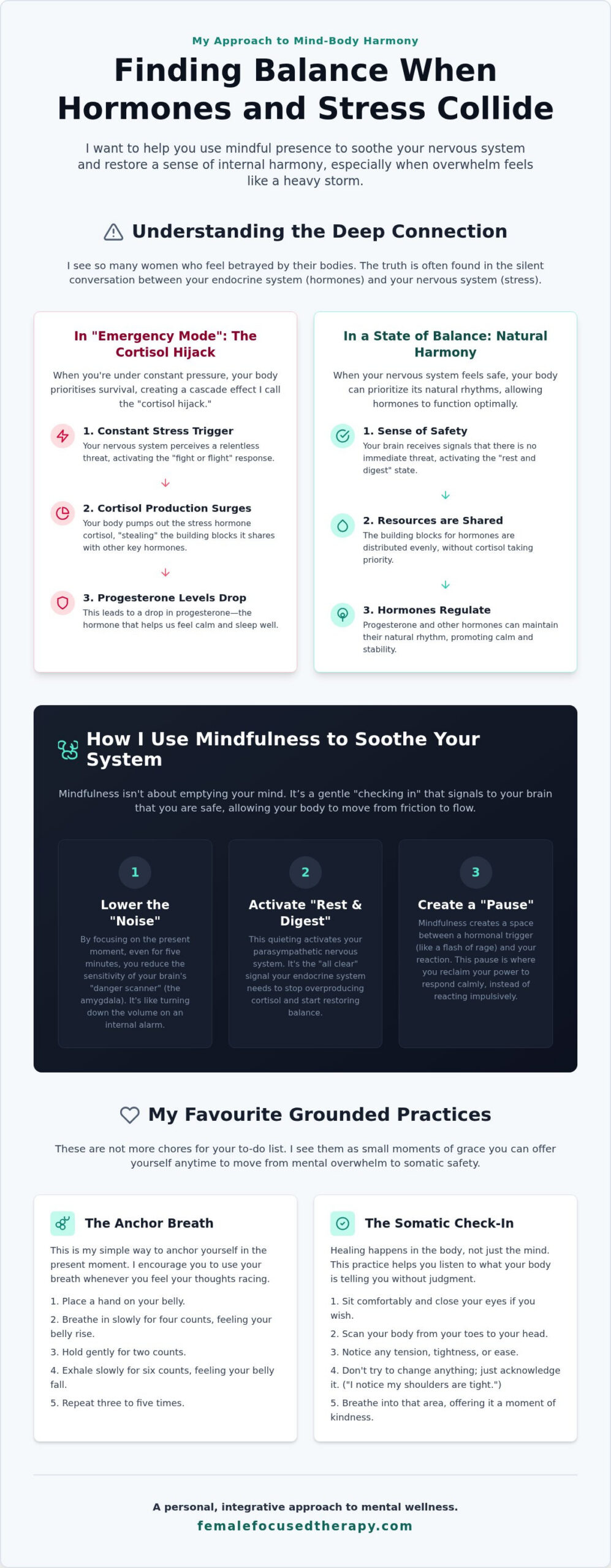
When you’re under constant pressure, your body enters what I call “emergency mode”. It pumps out cortisol, the primary stress hormone, to help you survive a perceived threat. The problem is that your body uses the same building blocks to make cortisol as it does to make progesterone. If you’re always stressed, cortisol “steals” those resources.
This hormonal theft often leads to a drop in progesterone, which is the hormone that helps us feel calm and sleep well. You might notice increased irritability, heavier periods, or a feeling of being “wired but tired” in the days before your cycle begins. These aren’t just random symptoms; they are clear signs that your stress levels are driving your hormonal experience.
Why high-functioning women are most at risk
I’ve noticed that many of my clients, especially those navigating ADHD or high-pressure careers, don’t even realise they’re stressed. You might be so used to the “do it all” pace that hyper-arousal feels like your normal state. This constant state of high alert keeps your body in a loop of physiological overwhelm.
I want to validate that this sense of being out of control is a physical response, not a personal failing. Your brain is simply doing its job by keeping you ready for a crisis. By incorporating structured approaches like Mindfulness-Based Stress Reduction (MBSR), we can begin to signal to your body that the emergency is over.
Healing begins when we stop fighting our bodies and start listening to them. When we move away from “fixing” ourselves and toward understanding our internal rhythms, we create space for genuine restoration. This is the heart of my work in menopause and midlife support, where we bridge the gap between the mind and the body.
How mindfulness actually works to soothe your nervous system
I often tell my clients that mindfulness for hormonal balance isn’t about clearing your mind or achieving a state of perfect Zen. Instead, it’s a gentle “checking in” with yourself. It’s the practice of returning to the present moment, especially when your thoughts are racing or your body feels physically heavy. It is about acknowledging what is happening without judgment.
When you focus on the “now”, you signal to your brain that you are safe in this exact second. This is vital because your hormones can’t find their natural rhythm if your brain thinks you’re constantly under attack. When safety is felt, your body can finally stop prioritising survival and resume its natural balancing act. It moves from a state of friction to one of flow.
Lowering the ‘noise’ in your internal environment
Regular practice is a research-proven way to reduce stress because it actually changes how your brain works. It reduces the sensitivity of your amygdala, the part of the brain that scans for danger. I find that even five minutes of intentional presence can shift your internal chemistry. It’s like turning down the volume on a loud, distracting radio.
By quieting that internal alarm, you activate the parasympathetic nervous system. This is the “rest and digest” mode where hormonal restoration truly happens. It’s the quiet space where your body can recover from the cortisol spikes we discussed. Think of it as giving your endocrine system the “all clear” signal it needs to function properly.
The science of the ‘pause’
One of the most powerful things I teach is the “pause”. This is the tiny space between a hormonal trigger, like a sudden flash of rage or anxiety, and your emotional reaction. Mindfulness gives you the room to breathe before you respond. This is especially helpful for my clients with ADHD who struggle with emotional regulation and impulsivity.
I encourage using the breath as an anchor during these transitions. This physical act does more than just calm your mind; it has a biological impact. Simple mindful movements or focused breathing have been shown to increase levels of GABA and serotonin. These are the neurotransmitters that help you feel stable, content, and more like yourself again.
If you’re finding it hard to create this space on your own, we can work together to find your personal path to calm. You don’t have to navigate these stormy internal shifts without support.
Moving from mental overwhelm to a state of somatic safety
I’ve found that many women believe mindfulness is purely a mental exercise. While shifting your mindset is vital, true healing happens in both the body and the mind, not just one. Because your hormones are felt physically, through racing hearts or heavy limbs, I incorporate somatic themes to address these sensations directly.
For many of the overwhelmed women I work with, sitting still in a quiet room is actually the hardest thing to do. If you’re living with ADHD or the aftermath of relationship trauma, stillness can feel agitating rather than calming. I invite you to explore movement as a more accessible form of mindfulness for hormonal balance instead.
When we move with intention, we signal to the nervous system that it’s safe to let go of the “bracing” it has been doing. This shift from mental scanning to physical feeling is where the restoration begins. It allows you to move from a state of high-alert survival into a space of genuine somatic safety.
Somatic movement and the art of listening
Gentle, rhythmic movement acts as a release valve for the tension stored deep within your tissues. When you move slowly and with awareness, you begin the process of listening to your body again. I often use somatic movement and yoga to help women reconnect with themselves without the pressure of “performing” a pose.
This practice helps you learn to hear what your body needs before it reaches a breaking point. You might notice a tightening in your jaw or a shallow breath earlier in the day. By catching these signals early, you can use mindfulness for hormonal balance to intervene before the stress response overrides your system entirely.
Rest as a radical therapeutic act
In our current culture, we’re often taught to fear stillness and productivity-free time. We’ve been conditioned to believe that our worth is tied to how much we achieve, which keeps our endocrine systems under constant strain. I want to encourage you to see rest as a radical, essential part of your hormonal health.
One technique I find particularly effective is “non-sleep deep rest” (NSDR). It allows you to reset your nervous system and support your endocrine system without the pressure of “meditating perfectly”. It is a quiet, restorative practice that gives your body the space it needs to return to its natural state of equilibrium.
My favourite mindful practices for restoring your internal balance
I want to give you tools that feel realistic and grounded. These aren’t chores to add to your list, but moments of grace that you can weave into your existing routine. If you have a “busy brain”, these ADHD-friendly approaches are designed specifically for you. I’ve found these practices particularly helpful for those navigating life transitions and menopause.
When your hormones feel like they are dictating your mood, having a simple “go-to” can be a lifeline. These techniques don’t require special equipment or a quiet room. They only require a few minutes of your time and a willingness to be kind to yourself. We are looking for small shifts that add up to a greater sense of internal stability.
The 3-minute check-in for busy days
I recommend doing this during natural transitions in your day. Boiling the kettle is my favourite anchor. While the water heats up, simply scan your body for tension. Notice if your jaw is clenched or if your shoulders have crept up toward your ears. These are often the first places we hold the physical weight of overwhelm.
Focus on the sensation of your breath without trying to change it. Just observe how it feels as it enters and leaves your body. This tiny window of mindfulness for hormonal balance reminds your nervous system that you are safe in the present moment. It’s a way of saying “I am here” to your body when everything else feels out of control.
Mindful movement for neurodivergent women
I support many women with ADHD who find that silent sitting actually increases their anxiety. For a neurodivergent brain, walking or gentle stretching can be far more effective. Movement provides the rhythmic stimulation your brain needs while allowing your body to settle into a calmer state.
Try using sensory anchors to stay present during your walk. Notice the firm feel of your feet on the floor or the temperature of the air on your skin. This physical feedback helps anchor your attention and prevents you from getting lost in the mental fog. It is a powerful way to practice mindfulness for hormonal balance without the pressure of being still.
If you feel ready to explore these practices in a more personalised way, I am here to guide you. You can book a session with me to begin your journey toward internal restoration in a safe, supportive space.
Rebuilding your sense of self through integrative therapeutic support
Mindfulness is a powerful tool for finding quiet in the middle of a storm. However, I’ve found that sometimes we need more than a solitary practice to find our way back. A guide can help you navigate the deeper waters when the overwhelm feels too heavy to carry alone.
I offer a safe, confidential space where we can explore the roots of your emotional distress together. My approach combines evidence-based therapy with the holistic practices we’ve discussed. This integrative path ensures we aren’t just managing symptoms, but truly healing from the inside out.
Rebuilding self-trust is the ultimate goal of our work. When hormones shift, it’s easy to feel like you can’t rely on your own mind or body. I want to help you restore that internal confidence and learn to trust your intuition again through mindfulness for hormonal balance and deep therapeutic insight.
When to seek professional psychotherapy
It’s important to identify when your hormonal shifts are interacting with deeper life experiences. Sometimes, what feels like cycle-related anxiety is actually being amplified by past trauma. I specialise in relationship trauma and narcissistic abuse recovery, helping women untangle these complex threads.
Therapy provides the containment you need to process these intense emotional states safely. When we work together, we create a supportive boundary around your experience. This allows you to look at difficult feelings without being swept away by them, even when your hormones feel unpredictable.
Using mindfulness for hormonal balance alongside psychotherapy helps bridge the gap between your physical sensations and your emotional history. It’s a way of honouring the whole of your experience. We move at a pace that feels manageable for your nervous system, ensuring you always feel grounded.
Taking your first gentle step toward healing
You don’t have to navigate these transitions alone or in silence. Whether you’re dealing with the fog of ADHD or the shifts of midlife, professional support is available. I’ve helped many women find their footing again through my practice in Singapore and through my online sessions.
I invite you to book a consultation to see how we might work together. This is a chance for us to connect and discuss what you’re facing in a warm, non-judgmental environment. It’s a simple, brave first step toward reclaiming your calm and your sense of self.
Remember that healing is a steady, unhurried process that you deserve. There’s no rush to “fix” everything overnight. We focus on small, sustainable changes that lead to lasting internal restoration and a renewed sense of peace in your daily life.
Reclaiming your internal peace
I hope you now see that the storm of hormonal shifts doesn’t have to define your life. By understanding how your nervous system communicates with your hormones, you can begin to shift from survival mode into a state of restoration. We’ve explored how practicing mindfulness for hormonal balance is about gentle check-ins and somatic safety rather than forcing yourself to be still when your brain feels busy.
Your journey toward emotional stability and self-trust is a path you don’t have to walk alone. As a Registered Integrative Psychotherapist specialising in women’s mental health, I provide a trauma-informed and neurodivergent-friendly space where we can work through these transitions together. Whether you’re navigating ADHD, menopause, or the aftermath of relationship trauma, I am here to support your healing.
If you feel ready to move forward with a renewed sense of self-assurance, I invite you to book a consultation with me to begin your journey of restoration. You deserve to feel grounded and steady in your own skin again. I look forward to holding that safe, supportive space for you as you rediscover your calm.
Frequently Asked Questions
Can mindfulness really balance my hormones naturally?
Mindfulness for hormonal balance works by lowering cortisol, which allows your body’s natural endocrine rhythms to resurface. Chronic stress triggers high cortisol, which can disrupt the production of progesterone and oestrogen. By signalling safety to your nervous system, you stop the “cortisol steal” and create the physiological conditions for your body to find its own equilibrium again. It’s about supporting your body’s innate wisdom rather than forcing a fix.
How long do I need to practice mindfulness to see a difference?
You might feel a shift in your nervous system after just one intentional three minute check-in. However, research suggests that consistent practice over eight weeks can lead to measurable changes in brain structure and stress reactivity. In my practice, I find that women who weave small moments of presence into their daily lives notice improved emotional stability and better sleep within a few weeks. Consistency matters more than the length of each session.
I have ADHD and can’t sit still—is mindfulness still for me?
Yes, mindfulness is absolutely for you, and it doesn’t have to involve sitting still. As someone who lives with ADHD myself, I know that forced stillness can sometimes increase agitation. I encourage you to use movement, like rhythmic walking or gentle stretching, as your anchor. We focus on sensory experiences, such as the feel of your feet on the ground, to keep your “busy brain” engaged while your nervous system settles.
Is mindfulness different from just relaxing or taking a nap?
Mindfulness is an active state of awareness, whereas relaxation or napping is often about switching off. While both are valuable, mindfulness for hormonal balance involves consciously noticing your internal state without judgment. This active “checking in” helps you identify stress triggers before they spiral into physical tension. It builds a different kind of resilience by teaching your brain how to return to a state of calm even during a busy, high-pressure day.
How does stress specifically affect oestrogen and progesterone?
When you’re under chronic stress, your body prioritises making cortisol over sex hormones. This often leads to a drop in progesterone, which is our natural “calming” hormone. Without enough progesterone to balance your oestrogen, you might experience more intense mood swings, heavier periods, or sleep disturbances. I help you understand these physiological shifts so you can see that your symptoms are a response to stress, not a personal failing or character flaw.
Can mindfulness help with the symptoms of perimenopause and menopause?
It can be incredibly effective for managing the emotional and physical shifts of midlife. A 2024 review of 19 trials showed that mindfulness significantly decreased anxiety, depressive symptoms, and perceived stress in menopausal women. By lowering your baseline stress, you can reduce the intensity of symptoms like hot flushes or irritability. It gives you a way to navigate these significant life transitions with more grace, self-compassion, and internal stability.
What is the best time of day to practice these techniques?
The best time is whenever you can realistically fit a few minutes into your existing routine. Many of my clients find that a morning check-in sets a grounded tone for the day, while others prefer using mindfulness in the evening to signal to their body that it’s time to rest. I suggest using “natural anchors” like boiling the kettle or your commute to practice, as this makes it a sustainable part of your lifestyle.
Can I use mindfulness alongside other treatments or medication?
Mindfulness is a complementary practice that works beautifully alongside other evidence based treatments. Whether you’re using HRT for menopause or medication for ADHD, mindfulness helps you stay attuned to how your body is responding. It provides an extra layer of emotional support and nervous system regulation. While I don’t offer psychiatric medication management, I support you in integrating these holistic tools with the care you receive from your other healthcare providers.

Article by
Cheryl Kennedy MacDonald MA BA (Hons) Pg. Dip. SAC BACP
Cheryl Kennedy MacDonald is a psychotherapist specialising in women’s mental health, relationships, and life transitions. She works with women navigating trauma, relationship breakdown, identity shifts, and midlife change, helping them rebuild self-trust, emotional stability, and a clear sense of who they are and what they want.
With over 20 years’ experience working with women internationally, Cheryl is the founder of YogaBellies, a global women’s yoga school, and the creator of the Birth ROCKS method. Her work sits at the intersection of psychotherapy and embodiment, integrating evidence-based therapeutic approaches with somatic, body-based practices that support deep, lasting change.
Known for her grounded and direct approach, Cheryl moves beyond surface-level insight to address the patterns held in the body and nervous system. Her work supports women to regulate, reconnect, and respond to their lives from a place of clarity, strength, and self-respect.
She is a published author in academic journals and has written multiple books on women’s health, pregnancy, and midlife wellbeing, available on Amazon and leading book retailers worldwide.