
What if that constant, buzzing tension in your shoulders isn’t just everyday stress, but your body’s way of protecting you from a past that hasn’t quite let go? You might find yourself “performing” wellness for the world, smiling through meetings and social dates, while feeling your self-trust crumble the moment you are alone. It is exhausting to live in a state of constant hyper-vigilance, always tensing up and waiting for the next emotional blow.
I understand how lonely this feels, especially when you are a high-functioning woman who is used to having it all together. You aren’t broken, and you don’t need fixing. You need a safe space to process what happened. I want to help you understand how therapy for relationship trauma can be a gentle, restorative path where we address both your mind and your body’s need for safety.
In this article, we will look at the deep impact of these experiences on your nervous system. I will share how a compassionate, mind-body approach can help you reclaim your intuition and finally move forward with a renewed sense of internal stability.
Key Takeaways
- You will understand why the heavy exhaustion you feel is a valid response to trauma rather than just another layer of daily stress.
- I will explain how narcissistic abuse erodes your self-trust and how we can work together to rebuild your intuition and sense of truth.
- Learn why therapy for relationship trauma must involve the body, helping you release the physical tension held in your muscles and breath.
- We will explore the practical steps needed to establish immediate emotional safety so you can begin to find your footing again.
- Discover how my integrative approach offers a safe harbour for you to reclaim your life and internal stability.
Understanding the heavy weight of relationship trauma
I want you to know that the heavy, bone-deep exhaustion you are carrying right now isn’t just “stress” or a sign that you aren’t coping well with life. It is a completely valid response to trauma. When you have lived through a toxic bond, your system stays stuck in a survival loop, even long after the relationship has ended. This is why you feel so drained, even on days when nothing “bad” happens.
Relationship trauma often happens so slowly that you don’t even notice your sense of reality shifting. Subtle manipulation and small betrayals act like a slow leak. Eventually, they drain your confidence until you don’t recognise the woman in the mirror. I see this as a wound to your core identity, not just a “bad breakup” that you should be over by now. It changes how you see yourself and the world around you.
I work with many high-functioning women who are masters at hiding their pain. You might be leading teams, managing a household, or navigating a busy career while feeling like you are crumbling inside. You’ve learned to wear a mask of “having it all together” because that feels safer than admitting how much you are struggling. This performance is exhausting, and it keeps you from the deep restoration you truly need.
Recognising the signs in your daily life
Do you find yourself over-analysing every text or the specific tone of someone’s voice? That isn’t just “overthinking.” It is your nervous system on high alert, trying to predict the next storm before it hits. This feeling of “walking on eggshells” can persist even when you are alone or with people who genuinely love you. Your body has forgotten how to feel safe.
I define relationship trauma as a persistent state of emotional dysregulation that follows a toxic bond, where your internal compass has been intentionally skewed. For many women, this leads to Understanding Complex PTSD. This is where the trauma isn’t from one single event, but from the repeated, daily stress of the relationship itself. Seeking therapy for relationship trauma is about acknowledging that these patterns have a physical and emotional hold on you.
Why traditional labels often fall short for women
As women, we are often socialised from a young age to “keep the peace” and put others’ needs before our own. This makes healing more complex because you might feel guilty for even acknowledging the trauma. My approach to who I work with takes these gender-specific pressures into account, creating a space where your experiences are validated without judgment.
I also see how life transitions, such as menopause or significant career shifts, can cause old relationship wounds to resurface. When your hormones shift or your external roles change, the coping mechanisms you once used to suppress the trauma might stop working. It’s often your body’s way of saying it is finally time to heal the mind and the heart together. Restoration is possible, but it starts with understanding the weight of what you’ve been carrying.
The impact of narcissistic abuse on your self-trust
Narcissistic abuse is a very specific type of trauma. It doesn’t just hurt your feelings; it intentionally targets your intuition and your sense of truth. I often talk with women who feel they have completely “lost their mind” because of prolonged gaslighting. When someone you love constantly twists the facts, you eventually stop trusting your own eyes and ears.
I believe that effective therapy for relationship trauma must focus on helping you reclaim that lost “gut” feeling. My goal isn’t just to help you move on from a difficult person. I want to help you rebuild the internal foundation that was systematically dismantled. You deserve to feel certain about your own thoughts and feelings again.
Research from the U.S. Department of Veterans Affairs highlights the vital role of the therapeutic relationship in the healing process. This safe, boundaried connection between us acts as a steady mirror. It reflects your true self back to you at a time when your self-image has been distorted by another person’s projections.
Healing from the fog of gaslighting
In our sessions, I will help you gently unpick the lies you were told about your character and your worth. Gaslighting is designed to make you dependent on the abuser for the “truth,” but we can work to restore your own internal compass. If you feel ready to start clearing that mental fog, focusing on narcissistic abuse recovery can provide the specific tools you need to feel grounded again.
Breaking the cycle of self-blame
It is not your fault that you were targeted, and I want to help you let go of the heavy shame you might be carrying. Narcissistic abuse is a systematic erosion of one’s autonomy, often using your best qualities, like your empathy and kindness, as tools against you. You weren’t “weak” for staying; you were navigating a complex psychological landscape that was designed to trap you. If you are ready to begin this journey of restoration, you can book a session with me here.
Integrative therapy: Why a mind-body approach matters
Trauma isn’t just a narrative we carry in our heads. It is a physical experience that lives in your muscles, your posture, and the very rhythm of your breath. When you’ve experienced toxic dynamics, your body remembers the tension even when your mind tries to move on. I believe that to truly heal, we must involve both the mind and the body in the process.
In our work together, I focus on creating a “safe container.” This is a therapeutic space where your nervous system finally feels it’s okay to let down its guard. By combining traditional psychotherapy with somatic movement and mindfulness, we address the trauma from every angle. This is why therapy for relationship trauma is most effective when it acknowledges you as a whole person rather than just a set of symptoms.
I integrate these different modalities because I’ve seen how powerful it is when a woman finally feels “at home” in her own skin again. We work at a pace that respects your boundaries, ensuring that you never feel overwhelmed by the process. It’s about gentle restoration rather than a forced “quick fix.”
Moving beyond ‘just talking’
Have you ever spent a therapy session talking about your past, only to leave feeling just as tense and “on edge” as when you arrived? Traditional talk therapy is incredibly valuable, but it can sometimes feel like you’re just circling the drain without finding real relief. This happens because the trauma is held deep within your nervous system.
We need to move beyond the story to regulate your system, specifically focusing on the health of your vagus nerve. When we incorporate somatic movement and yoga, we are teaching your body that the danger has passed. It’s a way of moving from a state of constant survival into a state of genuine restoration. You’re not just talking about being okay; your body is actually starting to feel it.
The power of rest and gentle movement
For a trauma survivor, simply sitting still or taking a deep breath can feel surprisingly difficult. I incorporate my background as a yoga master to help you reconnect with your physical self in a way that feels safe and manageable. We don’t use movement to “fix” you. Instead, we use it to listen to what your body is trying to say.
Healing happens when we stop fighting our feelings and start honouring our physical needs. Simple breathwork and intentional rest are radical acts of self-care for someone who has been through relationship trauma. They signal to your brain that you are worthy of peace and that your environment is finally secure. By listening to your body, you begin to reclaim the self-trust that was taken from you.
Practical steps to begin your journey toward emotional safety
I often tell my clients that healing isn’t linear. It’s more like a spiral; you might pass the same points of pain again, but each time you do, you are at a different level of strength. There are concrete steps we can take to help you find your footing. My approach to therapy for relationship trauma starts with one simple goal: establishing immediate safety.
Before we can dive into the past, we must ensure your present feels secure. We focus on establishing safety both in your physical surroundings and your emotional world. This might mean creating a “no-contact” plan or simply learning how to ground yourself when a memory feels too loud. We start where you are, ensuring you never feel rushed or pressured.
Once you feel steady, we work on identifying your triggers without letting them overwhelm you. These are the specific words, tones, or situations that send your nervous system into a tailspin. Finally, we move toward internal restoration. This is the deep work of rebuilding the woman you were always meant to be, before the trauma tried to rewrite your story.
Setting boundaries that actually stick
For many of the women I work with, the word “no” feels like a threat rather than a tool. I will help you learn that “no” is a complete sentence and a vital part of your protection. It is a way of honouring your own energy and space. When you first start setting these limits, you might feel a heavy wave of guilt or fear. This is a normal part of the process.
Managing that guilt is something we navigate together. We look at why you feel responsible for others’ reactions and how to stay grounded in your own truth. If you are looking for local support to help you with these first steps, you might find my guide on Finding a Therapist in Singapore a helpful place to start.
Finding the right therapeutic fit
Choosing a therapist is a deeply personal decision, especially when you are healing from betrayal. It’s important to find someone who understands the specific nuances of female trauma and how it intersects with our roles as partners, mothers, and professionals. A trauma-informed practitioner won’t just focus on your symptoms; they will seek to understand the story your body is still telling.
In my practice, I maintain what I call a “warm but boundaried” therapeutic relationship. This means I provide a deeply compassionate, nurturing space where you feel seen and validated, while keeping the professional structure that ensures you always feel safe and supported. This balance is essential for rebuilding the trust that was broken in your past. If you feel ready to begin this journey toward restoration, you can book your initial consultation with me here.
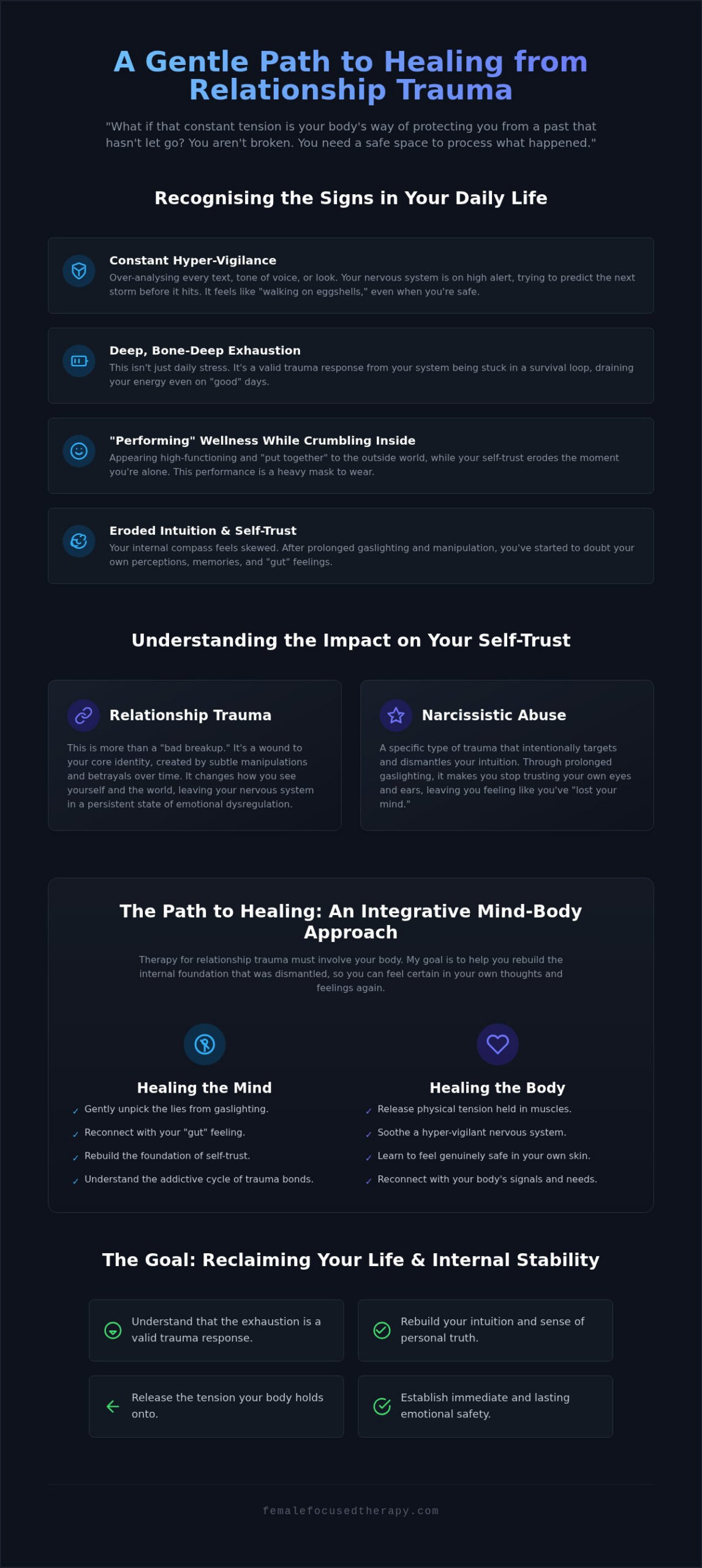
How I can support you in reclaiming your life
I want to offer you a space where you don’t have to spend your energy explaining why you’re struggling. I already understand the weight of these experiences and the toll they take on your spirit. You’ve spent so long taking care of everyone else, perhaps playing a role to keep others happy or safe. It’s finally time to turn that compassion toward yourself.
My practice provides specialised therapy for relationship trauma that respects your pace and your unique story. You won’t find a clinical, detached environment here. Instead, I offer a warm, boundaried space where you can let go of the “performance” of being okay. We will work together to quiet the noise of the past so you can hear your own voice again.
Whether you need a steady weekly check-in or more intensive support, my approach is always tailored to you. I believe that healing is a collaborative journey. I’m here to act as a grounded guide, helping you navigate the complex emotions that come with reclaiming your autonomy and self-trust.
Online and in-person therapy options
For those in the international community navigating transitions, I provide a steady point of stability. I understand the specific challenges of moving between cultures while trying to heal from a toxic bond. If you feel that you need a more concentrated period of restoration, we can explore my intensive therapy options to jumpstart your recovery.
Your first step toward healing
Starting this process doesn’t have to feel pressured or clinical. It begins with a simple conversation. In our first session, we will focus on your immediate needs. We won’t rush into the most painful parts of your history. Instead, we start by building the safety you need to eventually process those memories without being overwhelmed.
You might feel hesitant or unsure if you’re “ready” for this, and that’s perfectly okay. Most women feel that way at the start. I want to leave you with a final word of calm reassurance. You are stronger than you feel right now. The fact that you are looking for answers shows a resilience that hasn’t been extinguished. I am here to walk beside you while you reclaim your life and your peace.
Reclaiming your peace and intuition
Healing from a toxic bond isn’t about “fixing” who you are. It’s about gently unpeeling the layers of doubt and exhaustion that were never yours to carry. We’ve explored how a mind-body approach can help you release the physical tension of the past and rebuild your internal compass. This journey is about finding your way back to the woman you were always meant to be.
As a Registered Integrative Psychotherapist, Yoga Master, and somatic expert, I specialise in narcissistic abuse recovery. I blend clinical expertise with compassionate insight to help you move from survival into true restoration. Choosing therapy for relationship trauma is a profound act of self-reclamation. It is the moment you decide that your future belongs entirely to you.
You don’t have to navigate this path alone. I am here to provide a safe, boundaried harbour where you can finally let down your guard and breathe. When you feel ready to take that first step toward emotional stability, I am here to support you.
Book a session with me to start your healing journey.
Trust your gut. You are stronger than you feel right now, and your healing is already beginning.
Frequently Asked Questions
What exactly is relationship trauma, and how does it differ from a normal breakup?
Relationship trauma involves an erosion of your sense of self and safety, whereas a normal breakup is a painful but manageable loss. While a standard breakup involves grief, trauma leaves you with a dysregulated nervous system and persistent self-doubt. You aren’t just missing a person; you are struggling to trust your own reality because the bond was built on manipulation or betrayal rather than mutual respect.
Can I have relationship PTSD even if my partner was never physically abusive?
Yes, you can absolutely experience symptoms of PTSD or C-PTSD from emotional and psychological abuse alone. Physical violence is not a requirement for trauma to take root in your body and mind. Constant gaslighting, isolation, and verbal attacks can keep your nervous system in a state of high alert, leading to flashbacks, anxiety, and the constant feeling of being on edge.
How long does it usually take to heal from relationship trauma in therapy?
Healing is a deeply personal journey, and there is no fixed timeline for how long it takes to process these experiences. Some women start feeling a sense of relief and stability within a few months of starting therapy for relationship trauma, while deeper restoration of self-trust can take longer. We work at a pace that respects your unique nervous system, ensuring you feel supported rather than rushed.
I’m a high-functioning professional; will people think I’m weak for seeking therapy?
Seeking support is a sign of high emotional intelligence and strength, not a sign of weakness. As a high-functioning woman, you are likely used to “powering through,” but true resilience involves acknowledging when you need a safe space to process your experiences. I work with many professionals who find that therapy actually enhances their leadership and clarity by removing the heavy emotional weight they’ve been carrying.
What is the difference between traditional talk therapy and your integrative approach?
Traditional talk therapy focuses on the narrative of what happened, while my integrative approach involves both your body and your mind. I combine evidence-based psychotherapy with somatic movement and mindfulness to help you release trauma stored in your muscles and breath. This means we aren’t just talking about the past; we are actively teaching your nervous system how to feel safe and grounded in the present.
Is online therapy as effective as in-person sessions for trauma recovery?
Online therapy is just as effective as in-person sessions for trauma recovery and offers the added benefit of being in your own safe environment. Many women find that being in a familiar, private space allows them to open up more easily and reduces the stress of commuting. Whether I see you in Singapore or online, the quality of our therapeutic relationship and the tools we use remain the same.
How do I know if I was in a relationship with a narcissist?
You can often identify narcissistic dynamics by looking for patterns of grandiosity, a total lack of empathy, and a cycle of intense “love bombing” followed by cold devaluation. If you felt like you were constantly being manipulated or that your needs were entirely ignored to serve their ego, these are strong indicators. In our sessions, we focus on your experience of the relationship rather than just a clinical label.
What should I do if I’m still in the relationship but want to start healing?
You can certainly begin the process of internal restoration and setting emotional boundaries even if you haven’t left the relationship yet. Our first priority is always your safety and helping you find a sense of inner stability amidst the chaos. We focus on strengthening your intuition and grounding your nervous system, which gives you the clarity you need to make decisions about your future.

Article by
Cheryl Kennedy MacDonald MA BA (Hons) Pg. Dip. SAC BACP
Cheryl Kennedy MacDonald is a psychotherapist specialising in women’s mental health, relationships, and life transitions. She works with women navigating trauma, relationship breakdown, identity shifts, and midlife change, helping them rebuild self-trust, emotional stability, and a clear sense of who they are and what they want.
With over 20 years’ experience working with women internationally, Cheryl is the founder of YogaBellies, a global women’s yoga school, and the creator of the Birth ROCKS method. Her work sits at the intersection of psychotherapy and embodiment, integrating evidence-based therapeutic approaches with somatic, body-based practices that support deep, lasting change.
Known for her grounded and direct approach, Cheryl moves beyond surface-level insight to address the patterns held in the body and nervous system. Her work supports women to regulate, reconnect, and respond to their lives from a place of clarity, strength, and self-respect.
She is a published author in academic journals and has written multiple books on women’s health, pregnancy, and midlife wellbeing, available on Amazon and leading book retailers worldwide.