
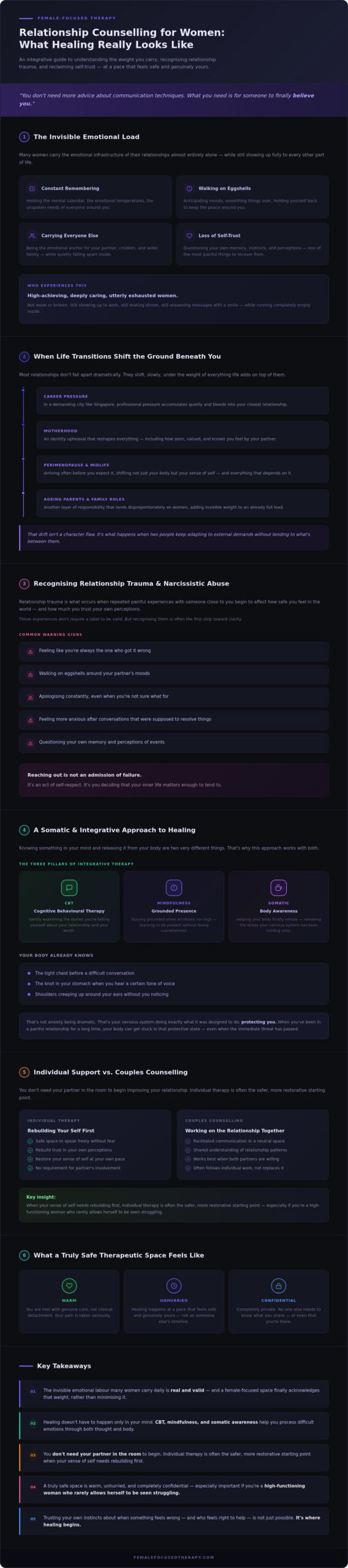
You don’t need more advice about communication techniques. What you need is for someone to finally believe you.
If you’ve been questioning your own memory, shrinking yourself to keep the peace, or carrying the emotional weight of everyone around you while quietly falling apart inside, you already know that something is wrong. You just might not trust yourself enough to say it out loud yet.
That loss of self-trust is one of the most painful things I see in my work offering relationship counselling for women in Singapore. And it’s far more common than you might think. The women who come to me aren’t weak or broken. They’re often high-achieving, deeply caring, and utterly exhausted from holding everything together.
This article is for you if you’re wondering whether what you’re experiencing in your relationship is actually as difficult as it feels, or whether you’ve simply lost your footing somewhere along the way. In the pages below, I want to walk you through what female-focused relationship counselling really looks like, why reclaiming your self-trust sits at the heart of it, and how healing can begin at a pace that feels safe and genuinely yours.
Key Takeaways
- The invisible emotional labour many women carry daily is real and valid — and relationship counselling for women in Singapore offers a female-focused space where that weight is finally acknowledged, not minimised.
- Healing doesn’t have to happen only in your mind. An integrative approach that combines CBT, mindfulness, and somatic awareness can help you process difficult emotions through both thought and body.
- You don’t need your partner in the room to begin improving your relationship. Individual therapy is often the safer, more restorative starting point — especially when your sense of self needs rebuilding first.
- A truly safe therapeutic space is warm, unhurried, and completely confidential — qualities that matter deeply if you’re a high-functioning woman who rarely allows herself to be seen struggling.
- Trusting your own instincts about when something feels wrong — and who feels right to help you — is not just possible. It’s where healing begins.
Understanding the Weight You Carry in Your Relationships
There’s a particular kind of exhaustion that doesn’t show up on your face. You’re still showing up to work, still making dinner, still answering messages with a smile in your voice. But inside, you’re running on empty in a way you can’t quite explain to anyone around you.
That invisible load is real. And it’s worth naming.
Many women carry the emotional infrastructure of their relationships almost entirely alone. The remembering, the anticipating, the smoothing over, the holding back. It doesn’t always look like a problem from the outside. Which is exactly why it so rarely gets addressed.
When the Spark Becomes a Struggle
Most relationships don’t fall apart dramatically. They shift, slowly, under the weight of everything life adds on top of them. Career pressure in a city as demanding as Singapore. Ageing parents. The identity upheaval of becoming a mother. The quiet disorientation of perimenopause arriving before you expected it.
What once felt like a partnership can start to feel like a role you never auditioned for. You might notice yourself going through the motions, feeling more like a household manager than a person who is truly known by her partner. That drift isn’t a character flaw. It’s what happens when two people keep adapting to external demands without tending to what’s between them.
Life transitions like motherhood and menopause and midlife don’t just change your body or your schedule. They shift the ground beneath your sense of self. And when your sense of self is shaky, your relationships feel it too.
Recognising Relationship Trauma and Narcissistic Abuse
Sometimes what’s happening in a relationship is more than disconnection. Relationship trauma is what occurs when repeated painful experiences with someone close to you begin to affect how safe you feel in the world, and how much you trust your own perceptions.
You might recognise some of these patterns:
- Feeling like you’re always the one who got it wrong
- Walking on eggshells around your partner’s moods
- Apologising constantly, even when you’re not sure what for
- Feeling more anxious, not less, after conversations that were supposed to resolve things
These experiences don’t require a label to be valid. But understanding what’s happening can be the first step toward clarity. If any of this feels familiar, I’d gently encourage you to read more about relationship trauma and narcissistic abuse and what recovery can look like.
Reaching out for relationship counselling for women in Singapore isn’t an admission that your relationship has failed. It’s an act of self-respect. It’s you deciding that your inner life matters enough to tend to.
That decision alone is significant. And it’s yours to make.
A Somatic and Integrative Approach to Relationship Healing
Talking helps. But it doesn’t always reach the places where your pain actually lives.
In my work offering relationship counselling for women in Singapore, I’ve sat with women who could articulate exactly what was wrong in their relationship, in careful, intelligent detail, and still feel completely stuck. Because knowing something in your mind and releasing it from your body are two very different things. That’s why the approach I use is integrative: it works with both.
Integrative therapy isn’t a single method. It’s a thoughtful blend of evidence-based tools, chosen to meet you where you are. For me, that means drawing on Cognitive Behavioural Therapy to gently examine the stories you’re telling yourself, mindfulness to help you stay grounded when emotions run high, and somatic awareness to help your body finally exhale.
Why the Body Holds Your Relationship Stress
You probably know that feeling. The tight chest before a difficult conversation. The knot in your stomach when you hear a certain tone of voice. The way your shoulders creep up around your ears without you noticing.
That’s not anxiety being dramatic. That’s your nervous system doing exactly what it was designed to do: protecting you. The trouble is, when you’ve been in a stressful or painful relationship for a long time, your body can get stuck in that protective state even when the immediate threat has passed.
Healing, then, isn’t just about reframing your thoughts. It’s about helping your body learn that it’s safe again. That’s where somatic movement and yoga can become a genuinely powerful complement to the therapeutic work we do together. Movement creates space where words sometimes can’t reach.
The Power of Mindfulness in Conflict
One of the most disorienting things about relationship stress is how quickly you can lose yourself in it. A conversation escalates, and suddenly you’re reacting from a place of fear or hurt rather than responding from your own grounded truth.
Mindfulness creates a pause in that moment. Not a passive one, but a deliberate breath of space between what’s happening and how you choose to respond. Over time, that pause becomes something you can rely on.
If you’d like to try something small right now: breathe in slowly for four counts, hold gently for two, then release for six. Do that twice. Notice what shifts, even slightly.
It sounds simple. It is simple. And simple, practised consistently, changes things.
This isn’t a clinical process where I hand you a worksheet and send you home. It’s a collaborative journey, shaped around your life, your pace, and what feels bearable on any given week. If you’re curious about what that might look like for you, you’re warmly welcome to take the first step and reach out.
Deciding Between Individual Support and Couples Counselling
One of the first questions I hear from women reaching out is: “Do I need to bring my partner?” The honest answer is: not necessarily. And for many women, especially those who’ve lost touch with their own sense of self, starting without a partner in the room is not just acceptable. It’s often the wiser choice.
Improving your relationship doesn’t always require your partner’s participation from day one. Sometimes the most powerful work happens when you finally have space that is entirely yours.
When Individual Therapy is the Priority
If you’ve been in a relationship where your perceptions were regularly dismissed, your confidence quietly eroded, or your needs consistently came last, then rebuilding your own foundation has to come first. You can’t negotiate from a place of clarity if you’re not sure you trust your own judgement anymore.
This is especially true when recovering from narcissistic abuse. Entering couples therapy before you’ve had space to reconnect with your own voice can sometimes feel destabilising rather than supportive. Individual relationship counselling for women in Singapore gives you something couples work simply can’t: a space where the focus is entirely on restoring you.
That means rebuilding your self-trust, understanding your patterns, and learning what you actually need from a relationship, not just what you’ve been conditioned to accept. If you’re unsure whether individual therapy is the right fit for where you are right now, the Who I Work With page offers a gentle starting point for clarity.
The Role of Couples Counselling in Building Connection
Couples therapy in Singapore works best when both people come with a genuine willingness to understand, not just to be understood. It’s a space for rebuilding intimacy, improving how you communicate under pressure, and creating new patterns together.
A concern I hear often is: “Will the therapist take sides?” My approach is boundaried and deliberately even-handed. Both people need to feel safe enough to be honest. Without that safety, the sessions don’t work. My role isn’t to decide who’s right. It’s to help both of you hear each other more clearly, and to identify the dynamics that are keeping you stuck.
The goal of couples work isn’t to save the relationship at any cost. It’s to help two people build something healthier, whether that’s a renewed connection or a clearer understanding of what each person needs going forward.
Both paths are valid. And you don’t have to decide alone which one is right for you.
Creating a Safe Space for Your Emotional Restoration
Before anything else, I want you to know this: the room you walk into, whether physically or virtually, should feel like it belongs to you. Not to a process. Not to a checklist. To you.
My practice is deliberately unhurried. There’s no fluorescent lighting, no clipboard handed to you at the door, no sense that we’re working against a clock. What I’ve tried to create is a space that feels private, warm, and genuinely removed from the pace of daily life in Singapore. Because you can’t begin to exhale in a space that doesn’t feel safe enough to breathe in.
Confidentiality isn’t just a legal obligation here. It’s a promise I take seriously. Many of the women I work with are high-functioning in their professional lives, managing teams, holding titles, maintaining reputations. The idea of being seen struggling, even by one person, can feel enormous. I understand that. Nothing you share in our sessions leaves that space.
What to Expect in Your First Session
The first fifty minutes aren’t about fixing anything. They’re about beginning to feel safe enough to be honest, possibly for the first time in a long while.
You don’t need to arrive with a prepared speech or a clear sense of what’s wrong. Some women come in knowing exactly what they want to say. Others arrive and find that the words don’t come easily at first, and that’s completely fine. There’s no right way to show up. There’s no performance expected of you here.
What I’ll gently ask is what brought you to this point, what feels most pressing, and what you’re hoping might shift. We’ll move at whatever pace feels manageable. If you’d like to read a little more before your first session, the free therapy resources on my site are there to help settle some of that first-session anxiety before you arrive.
You’re in control of your own healing here. Always.
Online vs. In-Person Counselling in Singapore
Relationship counselling for women in Singapore doesn’t have to mean sitting in a room together. For many of the women I work with, online sessions are not a compromise. They’re genuinely the better fit.
If you’re managing a demanding career, caring for children or parents, or simply can’t carve out travel time across the city, online therapy meets you exactly where you are. The quality of connection doesn’t diminish through a screen. What matters is that you feel heard, and that happens through presence, not proximity.
That said, some women find the in-person experience carries something different. A physical space that is separate from home, from work, from all the roles you play. A small sanctuary. If that appeals to you, I’d encourage you to explore what’s currently available for in-person sessions.
Both formats are held with the same care, the same confidentiality, and the same commitment to your pace. The right choice is simply the one that makes it easier for you to show up.
When you feel ready, I’d gently invite you to take that first step and reach out. There’s no pressure in that conversation. Just a beginning.
Beginning Your Journey Toward Healthy Connection and Self-Trust
The goal of this work isn’t to turn you into someone unrecognisable. It’s to help you find your way back to yourself. From the overwhelm and second-guessing. From the exhaustion of managing everyone else’s emotional world while neglecting your own. Toward something quieter and steadier: a calm, grounded clarity about who you are and what you need.
That shift doesn’t happen overnight. But it does happen. And it begins with one small, honest step.
Trusting Yourself Again
If there’s one thing I want you to take from everything you’ve read here, it’s this: your instincts are not broken. They may be buried under years of being told you were too sensitive, too much, or not enough. But they’re still there. And learning to trust them again, gently, without pressure, is at the heart of what relationship counselling for women in Singapore can offer you.
You deserve to feel safe in your own life. Not just functional. Not just coping. Actually safe, and genuinely at ease.
There’s no timeline you need to meet here. Healing isn’t a performance, and it doesn’t run on anyone else’s schedule. If you need to move slowly, we move slowly. If some weeks feel like standing still, that’s part of it too. What matters is that you’re moving in a direction that’s yours.
Be as patient with yourself as you would be with someone you love. You’ve been carrying a great deal for a long time. You’re allowed to put some of it down.
Take the First Step Today
When you feel ready, I’d gently invite you to book a session directly through my online booking page. There’s no complicated form to fill in, no long waiting list to navigate. Just a simple, private way to begin.
If booking feels like too big a step right now, that’s completely fine. You’re welcome to start with a question. Reach out through the Female Focused Therapy website, have a look at the About Me page to get a sense of who I am, or browse the free therapy resources if you’d like something to read before we speak.
There’s no pressure in any of it. The right therapist will feel like a quiet yes, not an obligation. Trust that feeling.
I offer sessions in person in Singapore and online for women wherever they are. If you’d like to know more about who I work with and how I can support you, the Who I Work With page is a good place to start.
You’ve already done something meaningful by reading this far. That matters. And whenever you’re ready, I’ll be here.
Your Voice Is Still There. It’s Time to Find It Again.
If anything in this article felt familiar, that recognition matters. The invisible weight you’ve been carrying, the self-doubt, the quiet exhaustion of always being the one who holds things together: none of that is simply how life has to feel.
Relationship counselling for women in Singapore, when it’s done well, isn’t about fixing you. You’re not broken. It’s about creating enough space for you to hear yourself clearly again, to rebuild the self-trust that difficult relationships can quietly erode, and to move forward from a place that actually feels like yours.
As a registered integrative psychotherapist specialising in relationship trauma, I work with women who are ready to stop managing and start healing. In a safe, female-focused environment, at a pace that respects where you are right now.
Whenever you feel ready, take that first gentle step and book your initial consultation. There’s no pressure in it. Just a beginning, and the possibility of something steadier on the other side.
You’ve been heard here. That doesn’t have to stop now.
Frequently Asked Questions About Relationship Counselling for Women in Singapore
How do I know if I need relationship counselling or if it’s just a rough patch?
If you’re asking this question, that instinct alone is worth paying attention to. A rough patch tends to pass with time and some honest conversation. What’s harder to name is the persistent feeling that something is off in a way you can’t quite reach on your own: a quiet erosion of yourself, recurring patterns that never quite resolve, or a growing sense of disconnection that doesn’t lift. If you’re questioning your own perceptions or feeling consistently unseen, that’s not just a rough patch.
You don’t need to be in crisis to seek support. Therapy isn’t reserved for breaking points. Coming before things feel catastrophic is often when the work is most effective.
What is the difference between marriage counselling and relationship therapy for women?
Marriage counselling typically involves both partners working together to address specific dynamics within a committed relationship. Relationship therapy for women is different in focus: it centres on you, your inner world, your patterns, and your sense of self within relationships, not just one particular partnership. It’s particularly valuable if you’ve experienced relationship trauma, if your confidence has quietly eroded over time, or if you need space to understand what you actually want before deciding what comes next.
The two approaches aren’t mutually exclusive. Many women begin with individual relationship therapy and later choose to bring a partner into the work, once they feel grounded enough to do so.
Can I come to relationship counselling alone if my partner refuses to join?
Yes, absolutely. You don’t need your partner’s participation to begin meaningful work. Individual sessions give you something couples therapy can’t: a space that belongs entirely to you, where the focus is on rebuilding your clarity, your self-trust, and your understanding of what’s happening in your relationship. This is especially important if you’ve been in a dynamic where your perspective has been regularly dismissed or minimised.
In fact, for women recovering from emotionally difficult or controlling relationships, starting individually is often the wiser and safer choice. Your healing doesn’t depend on anyone else’s willingness to show up.
How many sessions of therapy will I need to see a difference in my relationship?
There’s no single answer to this, and I’d be cautious of anyone who gives you a precise number upfront. Some women notice a meaningful shift in their thinking and emotional responses within the first few sessions. Deeper patterns, particularly those rooted in relationship trauma or long-standing dynamics, take longer to understand and gently reshape. What I can say honestly is that therapy isn’t a linear process, and the pace is always yours to set.
Rather than measuring progress in sessions, it’s more useful to notice whether you’re beginning to feel clearer, calmer, or more like yourself. Those shifts, however small, are real indicators that something is moving.
Is relationship counselling in Singapore confidential if we are both well-known in our community?
Confidentiality is a professional and ethical obligation, not simply a preference. Nothing shared in sessions is disclosed to anyone outside of that space. For women who hold visible roles in their professional or social communities, this matters enormously, and I take it seriously. Online sessions offer an additional layer of privacy for those who prefer not to be seen entering a practice in person.
If confidentiality is a particular concern for you, I’d encourage you to raise it directly when you first reach out. You deserve to feel completely secure before you begin opening up.
What should I do if I suspect I’m in an emotionally abusive relationship?
Trust what you’re noticing. Emotional abuse often works by making you doubt your own perceptions, so the fact that something feels wrong is meaningful, even if you can’t yet name exactly what it is. You don’t need certainty or a formal label to seek support. Reaching out to a therapist who understands relationship trauma is a safe and appropriate first step, and it doesn’t commit you to any particular course of action.
If you’re in Singapore and feel you may be at risk, the Association of Women for Action and Research (AWARE) offers confidential support alongside therapeutic options. A trauma-informed therapist can help you make sense of your experience at a pace that feels safe.
How much does a typical relationship counselling session cost in Singapore?
Session fees vary depending on the therapist’s training, experience, and whether you’re attending in person or online. I’d encourage you to reach out directly to any therapist you’re considering to ask about their current rates, as these can change and I wouldn’t want to give you a figure that doesn’t reflect what you’ll actually find. What’s worth knowing is that many women find even a short course of therapy offers significant and lasting value relative to the cost of continuing to carry everything alone.
If cost is a concern, it’s always worth asking about session frequency and whether a less intensive schedule might still meet your needs.
Can relationship therapy help me if I’m already considering a divorce?
Yes, and perhaps more than you might expect. Relationship counselling for women in Singapore isn’t about preserving a relationship at any cost. It’s about helping you move forward with clarity, whatever that looks like for you. If you’re considering divorce, therapy can help you process the grief and fear that often accompany that decision, understand your own needs and boundaries more clearly, and feel steadier as you navigate what comes next.
Some women arrive already knowing what they need to do but needing a safe space to say it out loud for the first time. That is entirely valid work, and it’s a beginning, not an ending.

Article by
Cheryl Kennedy MacDonald MA BA (Hons) Pg. Dip. SAC BACP
Cheryl Kennedy MacDonald is a psychotherapist specialising in women’s mental health, relationships, and life transitions. She works with women navigating trauma, relationship breakdown, identity shifts, and midlife change, helping them rebuild self-trust, emotional stability, and a clear sense of who they are and what they want.
With over 20 years’ experience working with women internationally, Cheryl is the founder of YogaBellies, a global women’s yoga school, and the creator of the Birth ROCKS method. Her work sits at the intersection of psychotherapy and embodiment, integrating evidence-based therapeutic approaches with somatic, body-based practices that support deep, lasting change.
Known for her grounded and direct approach, Cheryl moves beyond surface-level insight to address the patterns held in the body and nervous system. Her work supports women to regulate, reconnect, and respond to their lives from a place of clarity, strength, and self-respect.
She is a published author in academic journals and has written multiple books on women’s health, pregnancy, and midlife wellbeing, available on Amazon and leading book retailers worldwide.