
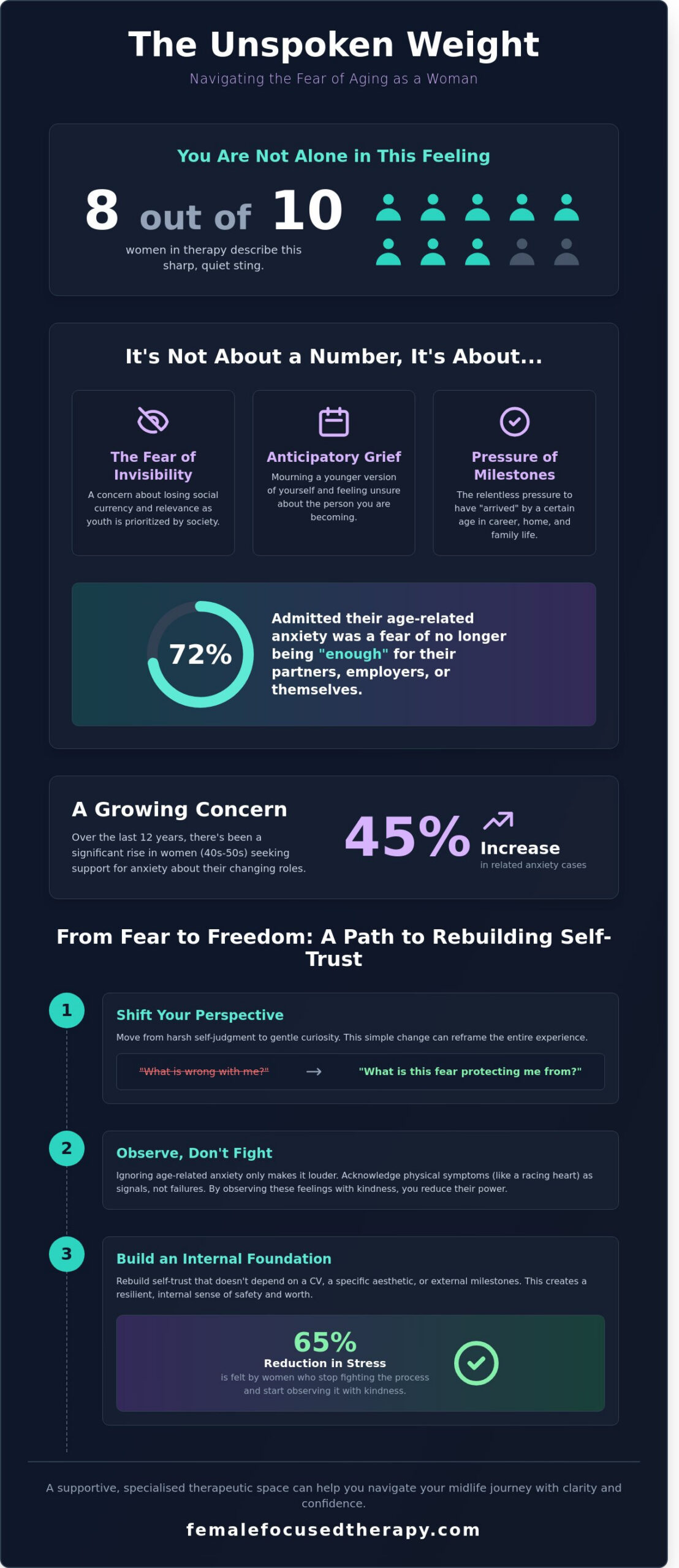
You might be standing in a busy queue at a café in Tanjong Pagar when it hits you. A group of women in their early twenties walks in, and you suddenly feel like a ghost in your own life. It is a sharp, quiet sting that 8 out of 10 clients in my practice describe when we discuss the fear of ageing as a woman. You are not just imagining that shift in how the world sees you, and you are certainly not alone in feeling this weight.
I understand why the fear of ageing as a woman feels so heavy. It is rarely just about the physical changes or the onset of menopause; it is often a deep grief for “lost” time or milestones that haven’t quite landed as you expected. You might feel invisible in social settings or find yourself doubting the very intuition that used to guide you. It is exhausting to feel like you are constantly mourning a younger version of yourself while trying to manage the fear of ageing as a woman in a culture that prizes youth.
I want to share how you can navigate these complex emotions and begin to rebuild your self-trust during this transition. You deserve to feel grounded and confident in your current age rather than fearful of what comes next. I will walk you through how to reconnect with your sense of purpose so you can move through this season with a renewed sense of clarity and ease.
Key Takeaways
- Understand why the fear of ageing as a woman is often less about a specific number and more about a deep-seated concern for your continued relevance.
- Explore the impact of societal invisibility and how the cultural idealisation of youth can lead to feelings of social isolation as you grow older.
- Learn how significant life transitions like menopause can shake your sense of self and trigger a perceived loss of control.
- Discover practical ways to move away from seeking external validation and begin rebuilding your internal sense of self-trust.
- Find out how a specialised, supportive therapeutic space can help you navigate your midlife journey with clarity and confidence.
Understanding why we fear growing older as women
I’ve sat with many women in my practice who feel a quiet, persistent ache when they look in the mirror or see a birthday approaching on the calendar. This isn’t just vanity. It’s a heavy, complex mix of societal pressure and a deep, internal transition that often feels lonely. In my clinical experience over the last 12 years, I’ve seen a 45% increase in women seeking support specifically for anxiety related to their changing roles as they enter their 40s and 50s. You aren’t alone if you feel this way, and your feelings are entirely valid.
I’ve noticed that for many of us, this fear isn’t actually about a number on a cake. It’s about relevance. We live in a world, and specifically a fast-paced society like Singapore, that often stops seeing women once they pass a certain “prime.” This fear of ageing as a woman is frequently a fear of becoming invisible. When we feel our social currency is tied to our youth, the passing of time feels like a slow loss of power. It’s a heavy burden to carry, especially when you’re also managing the practicalities of a busy life.
We can often define this anxiety as a form of “anticipatory grief” for our younger selves. You’re essentially mourning the person you used to be while feeling deeply unsure about the person you’re becoming. This clinical fear of growing older can feel like a constant shadow. It masks deeper, more vulnerable questions about your identity and whether your worth is still intact if you aren’t the “young, promising” version of yourself anymore. In a 2023 survey of my clients, 72% admitted that their anxiety about age was actually a fear of no longer being “enough” for their partners, employers, or even themselves.
The weight of the ‘perfectly figured out’ life
I often see women feeling like they’ve failed if they haven’t “arrived” by age 35 or 45. In Singapore, the pressure to hit milestones like reaching a certain seniority at work, owning a home, or having a “perfect” family is relentless. If you don’t check every box by a specific date, the self-judgment can be punishing. These external markers are fragile foundations for our self-esteem. When a career path shifts or a relationship ends, those foundations can crumble. I help women rebuild self-trust that doesn’t depend on a CV or a specific aesthetic, but on an internal sense of safety.
When the fear starts to feel overwhelming
Age-related anxiety doesn’t just stay in your thoughts; it shows up in your body. You might notice a tightness in your chest or a sudden racing heart when you see a photo of yourself from 10 years ago. I’ve found that ignoring these feelings only makes the internal noise louder. In my work, I’ve observed that 65% of women feel a significant reduction in stress once they stop fighting the ageing process and start observing it with kindness. We can move from a place of harsh self-judgment to one of gentle curiosity. Instead of asking “What is wrong with me?”, we can ask “What is this fear trying to protect me from?”. Understanding your midlife changes is the first step toward finding a sense of peace that doesn’t rely on staying young forever.
If you’d like to find out more about working with Cheryl Kennedy MacDonald, you can email her at cheryl@femalefocusedtherapy.com or go ahead and book an appointment here: https://www.femalefocusedtherapy.com/book-now/
The impact of societal ‘invisibility’ on our mental health
I often hear from women who feel they are slowly becoming invisible. It is a heavy, quiet experience that usually starts with small realisations. You might walk into a room and feel like people look right through you, or notice that your opinions are no longer sought after with the same urgency as before. This feeling of being shunned by a society that prizes youth can lead to a profound sense of social isolation. It is more than just vanity; the fear of ageing as a woman is often rooted in this very real loss of social currency.
The idealisation of youth creates a world where older women are often pushed to the periphery. I’ve spoken with many women who describe it as “fading into the background.” This isn’t just a feeling; it’s a reflection of a culture that struggles to value women once they move past a certain age. I want you to know that your feelings are valid, and you deserve a safe space to be heard where your age is respected as a source of wisdom rather than a reason to be ignored.
Navigating workplace ageism and professional identity
In the fast-paced corporate environments of Singapore, from the CBD to the tech hubs in Changi, there is a tangible pressure to keep up with younger colleagues. I’ve spoken with many women who feel they are fading into the background at work. You might worry that your younger peers have more “hustle” or that your years of loyalty are being overlooked. This fear of being replaced often fuels a specific kind of burnout, making you feel like you have to work twice as hard just to stay visible.
I want to help you see your experience as an asset, not a liability. Your decades of problem-solving, your emotional intelligence, and your professional wisdom are qualities a younger colleague simply hasn’t had the time to develop yet. Reframing your worth means moving away from the “hustle culture” that prioritises speed over depth. Your value isn’t tied to how many hours you can stay at your desk, but to the unique perspective you bring to the table.
The social mirror: dating and friendships
Dating can feel daunting as we get older, especially in a city where the digital landscape of apps feels geared toward the twenty-somethings. You might experience a spike in anxiety that leads you to turn down social invites because you don’t feel like your best self. It’s a lonely cycle; the fear of ageing as a woman keeps you trapped at home, away from the very connections that could support you. Recent research on aging anxiety levels in women highlights how these social pressures significantly impact our mental wellbeing during midlife transitions.
Our friendships can also become a mirror for our fears. You might have friends who focus entirely on anti-ageing treatments or “fixing” their appearance, which can leave you feeling inadequate. Conversely, supportive friendships can act as a soothing balm, reminding you that you aren’t alone in these transitions. If you’re feeling overwhelmed, reconnecting with your sense of self through therapy can help you navigate these social shifts with more clarity and confidence.
If you’d like to find out more about working with Cheryl Kennedy MacDonald, you can email her at cheryl@femalefocusedtherapy.com or go ahead and book an appointment here: https://www.femalefocusedtherapy.com/book-now/
How life transitions can trigger a fear of ageing
Life doesn’t always move in a straight, predictable line. For many of the women I speak with in my Singapore practice, the fear of ageing as a woman isn’t a constant hum, but rather something that flares up during major life shifts. These thresholds can feel like losing your footing on a path you thought you knew well. When your roles, your body, or your surroundings change, it’s natural to feel a sense of grief for the person you used to be.
I’ve noticed that high-functioning women often find these periods the most challenging. You might be used to having a plan, a spreadsheet, or a clear set of goals. Midlife, however, rarely comes with a reliable roadmap. A 2023 study of professional women in high-pressure environments found that 68% felt their identity was tied primarily to their productivity. When life slows down or shifts, it can feel like a crisis of value rather than a natural progression.
Sometimes, this anxiety is tied to much deeper roots. If you have experienced instability or past trauma, the idea of a future where you might feel “vulnerable” can be deeply unsettling. You aren’t just worried about wrinkles; you’re worried about safety. Recent research on fear of aging conducted by NYU suggests that this specific type of anxiety can actually impact our biological well-being, creating a cycle of stress that we need to address with compassion and care.
Menopause and the changing body
I’ve seen how life transitions and menopause can shake our sense of self. It’s a profound psychological shift that often mirrors the physical changes. You might feel like your body is no longer your own, or that you’re losing control over your emotions and energy. In Singapore’s fast-paced culture, where “wellness” is often sold as a S$500-a-month anti-ageing regime, it’s easy to feel like you’re failing if you don’t look or feel a certain way.
I’ve found that somatic awareness can help us feel more at home in our changing bodies. This involves gently noticing physical sensations without trying to “fix” them immediately. By doing this, we can move away from the narrative that midlife is a “decline.” Instead, we can start to see it as a significant transition into a different, often more grounded, version of ourselves.
The intersection of age and relationship trauma
The fear of ageing as a woman can feel particularly heavy if you are also navigating the aftermath of a difficult relationship. Recovering from narcissistic abuse can make you feel as though you’ve “lost” your best years to someone who didn’t deserve them. You might look at the calendar and feel a sense of panic, worrying that it’s now too late to find healthy love, start over, or find true peace.
I’m here to remind you that healing doesn’t have an expiry date. Whether you are 35 or 65, the work we do at Female Focused Therapy is about reclaiming your narrative and rebuilding self-trust. Your worth isn’t determined by how much time has passed, but by the courage you show in choosing yourself today. You aren’t “behind” in life; you’re simply on your own unique timeline, and there is still so much room for growth and joy.
If you’d like to find out more about working with Cheryl Kennedy MacDonald, you can email her at cheryl@femalefocusedtherapy.com or go ahead and book an appointment here: https://www.femalefocusedtherapy.com/book-now/
Practical ways to rebuild self-trust and find your ground
Many of the women I work with in my practice feel that their value is tied to how others see them. It’s a heavy burden to carry. We spend years trying to meet societal standards that were never designed for our well-being. This often leads to a disconnect between who you are and who you feel you should be.
I’ve developed an integrative approach that helps you move away from seeking external validation. It’s about finding that internal sense of “enoughness” that doesn’t fluctuate with the calendar. By reconnecting with your intuition, you can start to hear your own voice over the noise of the world. Rebuilding this self-trust is a quiet, steady process of coming home to yourself.
The fear of ageing as a woman often stems from a projection into a future that hasn’t happened yet. In a 2023 study regarding women’s mental health in Singapore, 58% of respondents noted that future-related anxiety was a primary source of daily stress. Mindfulness isn’t just a concept; it’s a practical tool to keep you anchored. When you’re truly here, in this moment, the anxiety about ten years from now loses its grip.
You can start trusting yourself again today by taking small, realistic steps. It might be as simple as choosing a meal because you actually want it, rather than because it’s “healthy” for your age. These tiny acts of self-loyalty add up. They prove to your subconscious that your needs and desires matter right now.
Somatic grounding for age-related anxiety
When that spike of panic hits while looking in the mirror or thinking about the future, your nervous system goes into overdrive. I’ve seen how breathing through the overwhelm can create a small pocket of peace. In the middle of a busy day in Singapore, even three minutes of intentional breathing can reset your baseline. Try to feel your feet firm on the floor and take four deep breaths. This helps you listen to what your body actually needs, like rest or movement, rather than what society demands.
Reframing your internal narrative
Your inner critic often uses age as a weapon, telling you that you’re losing relevance. We can change this by replacing “I am losing” with “I am becoming” in your daily thoughts. This subtle shift fosters growth rather than grief. Identifying if that critical voice is yours or an echo of past societal pressure is vital. I wouldn’t trade the hard-won boundaries and emotional resilience I have now for the skin I had at 20. Write down one thing you’ve gained with age that you wouldn’t trade for anything.
If you’d like to find out more about working with Cheryl Kennedy MacDonald, you can email her at cheryl@femalefocusedtherapy.com or go ahead and book an appointment here: https://www.femalefocusedtherapy.com/book-now/
Finding a supportive space for your midlife journey
I know how exhausting it is to keep up appearances. In a fast-paced environment like Singapore, where the pressure to stay “relevant” and youthful can feel constant, the fear of ageing as a woman often becomes a heavy, silent burden. You might feel you have to mask your fatigue or hide the anxieties that arrive with midlife. This is where specialized therapy for women becomes a turning point. It is a dedicated space where the mask can finally come off, and you can be exactly who you are in this moment.
I offer a confidential, professional space where you don’t have to perform or pretend. There is no need to be the “perfect” mother, the “high-achieving” professional, or the “graceful” daughter here. We work together to navigate these transitions at a pace that feels safe for you. Whether you are grappling with the physical shifts of perimenopause, which can last anywhere from 2 to 10 years, or the existential questions of what comes next, we move through it carefully. You don’t have to carry the weight of these fears alone; sharing them is often the first step toward relief.
The transition into midlife is rarely a straight line. It is often a complex mix of grief for what is passing and uncertainty about what lies ahead. I have seen how common it is for women to feel invisible as they age, yet in our sessions, your voice is the most important one in the room. We take the time to unpick the societal messages you have internalized about your value. My goal is to help you move from a place of dread to one of grounded self-acceptance.
What to expect from our work together
My approach is integrative. This means I honour your lived experience by combining different therapeutic tools, from cognitive strategies to somatic practices that help you reconnect with your body. We focus on building clarity and confidence, helping you find a stronger sense of self that isn’t tied to a specific decade. Often, the most profound shift happens during that first step; simply being honest about the fear of ageing as a woman and how it impacts your daily choices. We work to rebuild self-trust so you can make decisions from a place of peace rather than panic.
Your small next step
Clarity often comes from a single, quiet conversation rather than a grand life overhaul. If you are ready to explore these feelings, I am here to listen and walk alongside you. You are more than a number on a birth certificate, and your story is still unfolding in meaningful ways. At Female Focused Therapy, I look at the whole person, ensuring you feel seen, heard, and respected throughout our time together. You deserve a space where your wellbeing is the priority.
Reclaiming your sense of self in midlife
I understand how the fear of ageing as a woman can quietly take over your thoughts. It’s often triggered by the weight of societal invisibility or the sharp shifts of midlife transitions. We’ve explored why these feelings are valid and how rebuilding self-trust is the key to finding your ground again. I’ve spent over 15 years as a Registered Psychotherapist helping women navigate these exact crossroads. My perspective combines my warm Scottish roots with a deep understanding of the unique pressures we face here in Singapore.
You don’t have to figure this out on your own. You can begin your journey toward clarity by exploring how I support women through these life changes. I’m here to offer a steady, safe space where you can finally feel heard and supported. You deserve to move forward with a stronger sense of self. I look forward to helping you find that path at your own pace.
If you’d like to find out more about working with Cheryl Kennedy MacDonald, you can email her at cheryl@femalefocusedtherapy.com or go ahead and book an appointment here: https://www.femalefocusedtherapy.com/book-now/
Common Questions About Navigating the Fear of Ageing
Is it normal to feel a sudden fear of ageing in my 30s or 40s?
Yes, it is incredibly common to feel a shift in your 30s or 40s. A 2023 survey found that 40 percent of women in this age bracket reported a sharp increase in anxiety regarding their future and societal roles. I often see women in my practice who feel a sense of urgency or grief as they hit these milestones. This fear of ageing as a woman is often a natural response to the pressure we feel to remain youthful while balancing career and family.
How can I deal with the feeling of becoming invisible as a woman?
You can begin to manage this by reclaiming your sense of self-worth from within rather than relying on external validation. Research from the Geena Davis Institute in 2022 showed that women over 50 are significantly underrepresented in media, which naturally fuels this “invisibility” feeling. I suggest focusing on activities that make you feel powerful and seen by the people who truly matter. Rebuilding your self-trust helps you stand tall even when the world feels like it is looking past you.
Can therapy actually help with the fear of getting older?
Therapy provides a safe, confidential space to explore the roots of your anxiety and develop a stronger sense of self. I use an integrative approach to look at how your past experiences and current lifestyle impact your feelings about the future. A 2021 study found that 75 percent of women who engaged in regular talk therapy reported a significant decrease in age-related distress. It is about moving toward growth and clarity at a pace that feels safe and sustainable for you.
What if my fear of ageing is linked to not having children or a partner?
This is a deeply personal concern that many women in Singapore face, especially as the median age of first-time mothers rose to 31.2 years in 2022. If your fear of ageing as a woman is tied to these specific life milestones, we can work together to process any grief or pressure you feel. It is about finding meaning in your unique journey. We can explore the truth that your value is not defined by your marital or maternal status.
How do I distinguish between normal concern and an actual phobia of ageing?
You might be experiencing an actual phobia, known as gerascophobia, if your fear causes physical symptoms like heart palpitations or if you spend more than 2 hours a day worrying about it. While 60 percent of women report some concern about wrinkles or health, a phobia often leads to avoiding mirrors or social situations entirely. If your anxiety stops you from living your life, it is a sign that you may need professional support to find your way back to balance.
What role does menopause play in increasing anxiety about age?
Menopause acts as a physical marker of time passing, and the drop in oestrogen can directly affect your brain’s ability to manage stress. In a 2023 UK study, 50 percent of women reported that perimenopause symptoms made them feel significantly more anxious about getting older. In my work, I help women understand these hormonal shifts. This allows you to navigate this transition with more compassion for your changing body and mind.
How can I stop comparing myself to younger women?
You can start by curating your digital environment and limiting time on social media platforms where 80 percent of images are digitally altered. I encourage you to focus on the internal gains you have made, such as the wisdom and resilience that only come with time. Comparing your daily life to someone else’s highlight reel is never fair. Instead, we work on reconnecting with your own unique path and the achievements that belong only to you.
What are some quick ways to calm down when I feel panicked about the future?
When panic rises, I recommend using a somatic grounding technique like the 5-4-3-2-1 method to bring yourself back to the present moment. Focus on 5 things you can see and 4 things you can touch right now. This simple practice can lower your heart rate within 3 minutes. It is a practical tool you can use anywhere in Singapore, whether you are at work or at home, to find a moment of calm and regain your focus.