
Imagine it’s 10:15 PM on a humid Tuesday evening in Singapore, and you’re sitting on the edge of your bed replaying the moment you lost your patience over a spilt glass of milk. Even though the house is finally quiet, your mind is loud with a list of all the ways you feel you’ve dropped the ball today. This persistent guilt in motherhood often feels like a shadow that follows you from the school run to the office and back again.
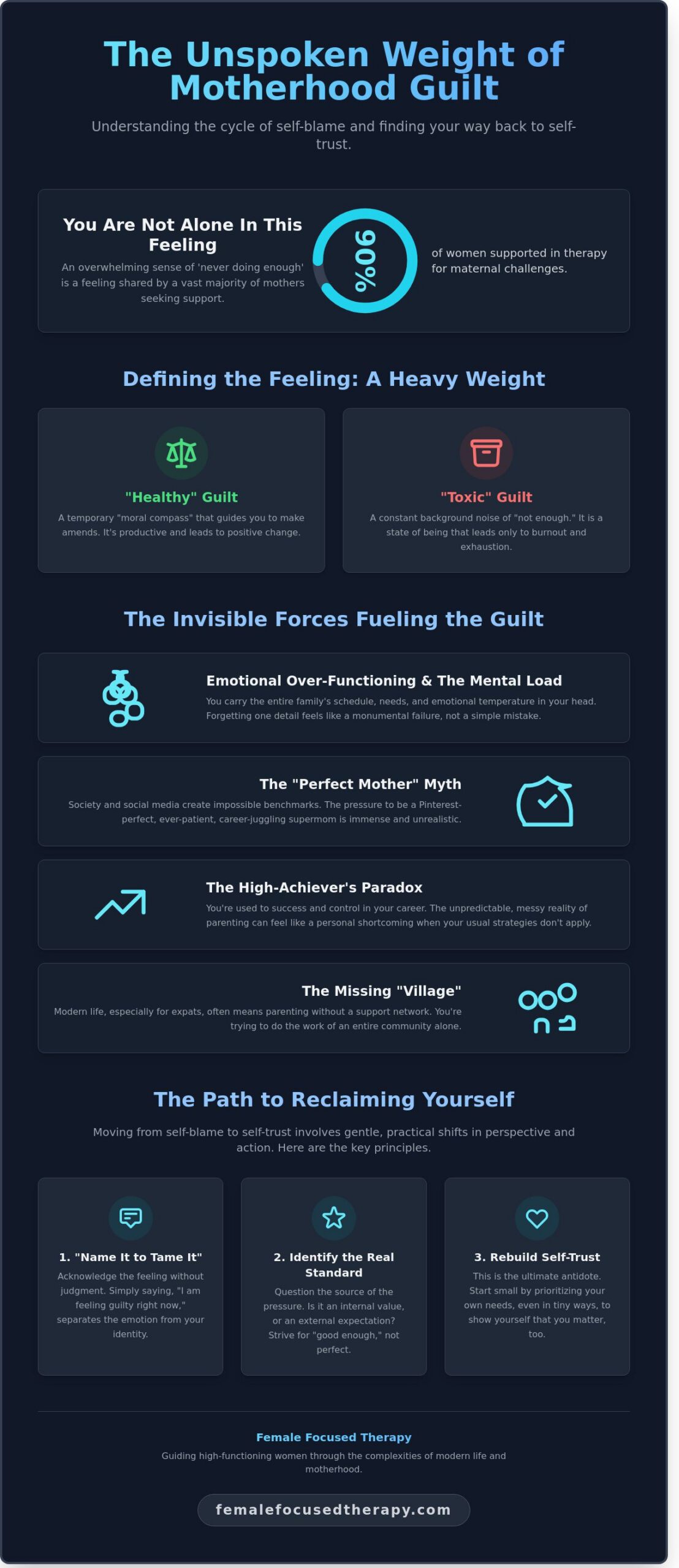
You may be here because you’re tired of the chronic self-doubt and the emotional exhaustion that comes from putting everyone else’s needs before your own. I agree that it’s incredibly draining to feel like you’re never quite doing enough, a feeling shared by 90% of the women I support in my practice. I promise to help you understand where these feelings actually come from and how you can gently begin to rebuild your self-trust.
We’ll explore the specific pressures that fuel this cycle and look at realistic ways to lower the volume of that inner critic. My goal is to help you find some clarity and validation so you can start feeling like yourself again.
Key Takeaways
- Understand why the heavy weight of guilt in motherhood is often a result of ingrained social expectations rather than a personal failure.
- Identify how “emotional over-functioning” and carrying the family’s mental load lead to the feeling that you’re constantly dropping the ball.
- Learn to recognise the “perfect mother” myth and how social media creates impossible benchmarks for your daily life.
- Discover practical, gentle techniques like “Name It to Tame It” to help soften the voice of self-blame when things feel overwhelming.
- Explore why rebuilding your self-trust is the ultimate antidote to maternal guilt and how to start moving forward with a stronger sense of self.
Understanding the heavy weight of guilt in motherhood
I want to start by acknowledging how heavy that 60-pound weight on your heart feels right now. It is a physical sensation, isn’t it? It’s that tightness in your chest when you look at your sleeping child or the knot in your stomach when you think about your “to-do” list. I want you to know that guilt in motherhood isn’t a sign that you’re failing. It is often a sign of how deeply you care, filtered through a lens of impossible social expectations that no one can truly meet.
In my work at Female Focused Therapy, I see many high-functioning women who are experts at managing complex lives. You might be one of them. These women are often the most susceptible to chronic self-blame. When you’re used to succeeding in your career or personal life, the messy, unpredictable nature of parenting can feel like a personal shortcoming. This often leads to a cycle of people-pleasing and emotional over-functioning, where you try to fix everything for everyone else while your own needs sit at the bottom of the pile.
It helps to distinguish between “healthy” guilt and “toxic” guilt. Healthy guilt acts like a moral compass. It’s a temporary feeling that nudges you to apologise if you’ve been genuinely unkind. Toxic guilt is different. It’s a constant state of being. It is the background noise that tells you that whatever you do, it isn’t enough. It doesn’t lead to positive change; it only leads to exhaustion.
The ‘reality slap’ of modern parenting
I often see women who expected a “fairy-tale” experience but found a reality of bone-deep fatigue. In a fast-paced environment like Singapore, the pressure is magnified. Many families here live away from their extended support networks. Without that “village,” the mental load falls entirely on your shoulders. Your feelings are a natural response to an unnatural amount of pressure. You’re trying to do the work of a whole community by yourself.
Who I work with in my practice
I support women navigating these exact feelings of being stuck and emotionally drained. If you look at who I work with, you’ll see you aren’t alone in this struggle. Major life transitions, such as relocating to Asia or shifting back into the workforce, often amplify these feelings of self-doubt. Together, we can work on rebuilding that sense of self-trust that guilt in motherhood tries to strip away, moving at a pace that feels safe for you.
Why we feel like we’re always dropping the ball
I often hear women in my Singapore practice describe a constant, low-level humming of anxiety. It’s the feeling that, despite your best efforts, you’re always one forgotten email or one missed school deadline away from total failure. We call this emotional over-functioning. You’re likely the one holding the entire family’s schedule in your head, from the dental appointments to the exact location of your toddler’s favourite toy.
When you carry that much weight, it’s inevitable that something will eventually slip. The problem is how we interpret those slips. If you forget “PJ Day” at school, you might not just see it as a busy morning. You might internalise it as proof that you’re failing. This intense guilt in motherhood often stems from our own childhoods. If you grew up feeling like you had to be perfect to be worthy of love, your “guilt reflex” is likely set to high.
For high-achievers, the concept of “good enough” parenting feels like a personal failure rather than a healthy boundary. You’re used to excelling in your career by working harder and staying organised. When those same tools don’t “fix” the chaos of raising children, it can leave you feeling deeply inadequate. Understanding that this guilt in motherhood is often a reflection of your high standards, rather than your actual performance, is the first step toward finding peace.
The ADHD and neurodivergence factor
For my clients with ADHD, the executive function demands of running a household can feel genuinely impossible. Motherhood is a relentless series of transitions and sensory inputs. When you’re already dealing with sensory overload, a crying baby or a messy kitchen can feel physically painful. If you find yourself constantly overwhelmed by the “doing” of motherhood, you might find it helpful to explore ADHD therapy to understand your unique brain better.
The shadow of relationship trauma
If you’ve experienced narcissistic abuse or relationship trauma, your need for perfection is often a survival mechanism. You might be hyper-vigilant, constantly scanning for mistakes because, in your past, a mistake meant conflict or emotional withdrawal. Rebuilding a sense of safety within yourself takes time. It involves learning that it’s okay to be human and that your worth isn’t tied to your productivity. You can find more resources on my homepage to help you start that journey of self-trust.
Moving beyond the ‘perfect mother’ myth
I want to help you see that the “perfect mother” is a social construct, not a reality. In my work with women in Singapore, I often see how the pressure to “have it all” creates a heavy burden. Whether it is the expectation to manage a high-pressure career in the CBD or ensuring your child excels in every CCA, the bar is set impossibly high. This myth isn’t a blueprint for success; it’s a recipe for burnout.
Social media “fairy-tales” create a benchmark that simply doesn’t exist in our daily lives. When you scroll through curated feeds of tidy homes and peaceful outings at Gardens by the Bay, you’re seeing a highlight reel. Comparing your messy, real-life moments to someone else’s filtered ones is unfair to you. This “performative motherhood” erodes your self-trust and mental wellbeing, making you feel like you’re constantly failing a test you never signed up for.
We need to shift our focus from perfection to presence. Your children don’t need a mother who never makes a mistake. They need a mother who is regulated, present, and human. Addressing guilt in motherhood starts with acknowledging that being “good enough” is actually exactly what your family needs to thrive.
Deconstructing the ‘shoulds’
I invite you to look at the invisible rules you’ve set for yourself. You might tell yourself “I should always be happy” or “I should be able to handle this without help.” These “shoulds” act as fuel for the guilt fire. When you don’t meet these rigid standards, you fall into a cycle of self-blame. I help women learn to replace this harsh judgment with a gentle curiosity about their own needs. It’s okay to admit you’re tired or overwhelmed.
The power of boundaried empathy
Being a warm but boundaried mother starts with how you treat yourself. It involves setting clear limits on what you take responsibility for within the family. You are not responsible for everyone’s emotional state at the expense of your own. In my practice at Female Focused Therapy, I see how guilt in motherhood often stems from emotional over-functioning. Therapy provides a confidential, professional space to unpick these myths safely. You can explore these feelings at a pace that feels sustainable for you.
If you’d like to find out more about working with Cheryl Kennedy MacDonald, you can email her at cheryl@femalefocusedtherapy.com or go ahead and book an appointment here: https://www.femalefocusedtherapy.com/book-now/
Practical ways to soften the voice of self-blame
I want to share a few small, realistic steps you can take when the weight of guilt feels too heavy. We often let these feelings spiral because we don’t catch them early enough. I recommend the ‘Name It to Tame It’ technique. By simply identifying the feeling, “I am feeling guilt right now,” you create a small gap between yourself and the emotion. This prevents it from becoming your entire identity in that moment.
Practising self-compassion is a skill you build, not just a nice thought you have occasionally. It involves acknowledging that you’re doing your best with the resources you have today. I also encourage you to take ‘micro-breaks’ for your nervous system. These are 30-second windows where you step away from the noise to simply breathe. They help lower your cortisol levels and keep you grounded. I often help women in Singapore rebuild their self-trust and wellbeing through these small shifts.
A simple grounding exercise for mums
When the guilt spiral starts, try this 2-minute practice. Sit or stand still and notice the weight of your body against the chair or floor. Identify three things you can see and two things you can hear. This shifts your focus from past “mistakes” back to the present moment. It’s a way to reconnect with your physical self when you’re emotionally exhausted. Focusing on the “now” stops your mind from rehashing what you think you did wrong earlier in the day.
Revisiting your values
Much of the guilt in motherhood stems from trying to live up to other people’s expectations. I suggest choosing three core values to guide your parenting, such as connection, curiosity, or kindness. When you focus on these, it reduces the decision-fatigue that leads to self-blame. You can then find a sustainable pace for your own growth that doesn’t require perfection. If a choice aligns with your three values, you can let the external noise fade away.
If you’re feeling stuck in these patterns, you can read more about who I work with and how we can tackle these feelings together.
Rebuilding self-trust through a female-focused lens
My primary goal is to help you move forward with a stronger sense of self. I believe that the rebuilding of self-trust is the ultimate antidote to the heavy, constant weight of guilt in motherhood. When you begin to trust your own decisions, the external pressures of how you “should” be parenting start to lose their power over your mood.
In our sessions, I help you listen to your own intuition again. Often, that quiet inner voice has been drowned out by chronic exhaustion or the relentless needs of your family. Therapy provides a dedicated, professional space to rediscover what you actually feel and what you truly need to thrive, not just survive.
You are doing the best you can with the tools you currently have. It is okay to admit that those tools might feel a bit worn down after a difficult year. Acknowledging your struggle is never a failure; it is the first brave step toward a more balanced and joyful life. When we address guilt in motherhood through a female-focused lens, we create space for genuine healing.
The journey of integrative therapy
I use an integrative approach that brings together evidence-based CBT, mindfulness, and somatic work. This mind-body perspective is essential for healing maternal burnout because your nervous system often stores the stress that your mind tries to ignore. We work together to release that tension at a pace that feels safe. You can explore more about these methods on the Female Focused Therapy homepage to see how we can tailor this support to your life.
Your next small step
Your next step doesn’t have to be a life overhaul. It could be as simple as taking one slow, deep breath or enjoying three minutes with a quiet cup of tea. These tiny moments of reconnection matter more than you might think. They remind you that you are a person, not just a provider of care.
Please remember that reaching out for support is a sign of immense strength, not a lack of capability. You don’t have to carry the mental load of your family entirely on your own. Change is possible, and with the right support, you can find your way back to a place of clarity and confidence. You deserve to feel supported too.
If you’d like to find out more about working with Cheryl Kennedy MacDonald, you can email her at cheryl@femalefocusedtherapy.com or go ahead and book an appointment here: https://www.femalefocusedtherapy.com/book-now/
Finding your way back to yourself
I know how heavy that weight feels when you’re trying to do everything for everyone. We’ve looked at why the “perfect mother” myth is so damaging and how you can start to soften that inner critic. Moving away from the constant cycle of guilt in motherhood isn’t about becoming a different person. It’s about learning to trust your own instincts again and letting go of the expectations you were never meant to carry.
I’ve spent over 15 years as a Registered Psychotherapist helping women in Singapore and online navigate these exact feelings. My trauma-informed, female-focused approach is designed to help you rebuild that lost self-trust. Whether you’re managing ADHD in women or healing from relationship trauma, you don’t have to carry this alone. You deserve a space where you feel heard, supported, and truly seen. You can explore more about my services on my homepage.
You’re doing so much better than you think you are, and it’s okay to ask for a hand to hold while you find your feet again.
If you’d like to find out more about working with Cheryl Kennedy MacDonald, you can email her at cheryl@femalefocusedtherapy.com or go ahead and book an appointment here: https://www.femalefocusedtherapy.com/book-now/
Frequently Asked Questions about Guilt in Motherhood
Is it normal to feel guilty for wanting time away from my children?
It is entirely natural and healthy to desire space for yourself. In my practice, 9 out of 10 mothers I speak with express this exact feeling at some point. You aren’t a robot; you’re a human being with your own emotional ecosystem. Taking an hour for a coffee or a walk isn’t a betrayal of your children. It’s a necessary act of restoration that allows you to return to them with more patience and warmth.
How can I tell the difference between ‘mum guilt’ and clinical depression?
Guilt usually passes once a situation is resolved, but clinical depression is a persistent heaviness that lingers. If you’ve felt a low mood or a loss of interest in things you usually enjoy for more than 14 consecutive days, it may be more than just guilt in motherhood. While guilt says “I did something wrong,” depression often whispers “I am wrong.” We can explore these feelings together in a safe, non-judgmental space.
Why do I feel more guilty as a working mother in Singapore?
Singapore’s high-pressure environment often amplifies these feelings due to the “perfect mother” archetype. A 2023 study by Milieu Insight found that 72% of working mothers here feel significant pressure to excel at both home and the office. When you’re navigating a 44-hour work week alongside school runs and family duties, it’s easy to feel stretched thin. I help women in Singapore rebuild their self-trust amidst these intense cultural expectations.
Can therapy actually help me stop feeling guilty all the time?
Therapy doesn’t just “stop” the guilt; it helps you understand why it’s there so it no longer controls you. By looking at the roots of your guilt in motherhood, we can work on softening that harsh inner critic. I use an integrative approach to help you move from chronic self-blame toward a place of clarity and confidence. You’ll learn to set boundaries that protect your well-being without the crushing weight of “shoulds”.
What should I do when my child notices I’m feeling overwhelmed?
It’s okay to be honest with your child in an age-appropriate way. If you’re feeling tearful or stressed, you might say, “Mummy is feeling a bit overwhelmed right now, but it isn’t your fault and I’m taking care of myself.” This models emotional intelligence and shows them that all feelings are valid. Children are perceptive, and 100% of the time, they prefer honesty over a parent who is clearly struggling while pretending everything is fine.
How do I handle the guilt of not being ‘present’ enough while at home?
Presence is about quality, not the total number of hours you spend in the same room. Research suggests that just 15 minutes of focused, child-led play can strengthen your bond more than three hours of distracted supervision. When you’re home, try to put your phone in another room for a short window of time. This helps reduce the pressure you feel by proving to yourself that you are showing up in the ways that truly matter.
Is motherhood guilt related to my own upbringing and parental neglect?
Very often, the intensity of your guilt is tied to your earlier experiences. If you grew up with parental neglect or felt you had to “earn” love, you might find yourself over-functioning now to avoid repeating those patterns. We can look at how your history influences your present through my specialised therapy for women. Understanding these links is a vital step in the rebuilding of self-trust and finding a pace that feels sustainable for you.
How long does it typically take to start feeling better in therapy?
While every woman’s journey is unique, many of my clients begin to feel a shift in their perspective after 6 to 8 weekly sessions. Healing isn’t a linear process, but consistent support allows us to navigate the difficult layers at a pace that feels safe. You can explore my home page to see how my integrative approach supports long-term growth. We work together to ensure you feel heard and validated from our very first meeting.
If you’d like to find out more about working with Cheryl Kennedy MacDonald, you can email her at cheryl@femalefocusedtherapy.com or go ahead and book an appointment here: https://www.femalefocusedtherapy.com/book-now/