
Last Monday, a woman I’ll call Mei sat in my office and whispered the question she’d been too afraid to say out loud: “Who am I after 40?” She’d spent two decades building a successful career and a home here in Singapore, yet she suddenly felt like an empty vessel. It’s a heavy realization when you look in the mirror and realize you’ve spent so much time people-pleasing that you’ve forgotten what you actually need.
I agree that this period of life can feel incredibly lonely. Between the shifting dynamics of your family and the physical changes of perimenopause, it’s easy to feel like the ground is moving beneath your feet. You’ve been the one everyone else relies on for so long that you might feel guilty for wanting something for yourself now. This isn’t a crisis; it’s an invitation to re-meet yourself with kindness.
I’ll help you understand why you feel lost and show you how to begin the journey back to your true self. We’ll explore why these midlife shifts happen and look at gentle, practical ways to rebuild your self-trust. My goal is to help you move forward with clarity and a sense of calm confidence that belongs entirely to you.
Key Takeaways
- Validate that the quiet “who am I after 40” question is a sign of your evolution, not a failure or a sign that you’ve lost your way.
- Identify how “emotional over-functioning” and the physical shifts of menopause may be contributing to your sense of depletion and identity crisis.
- Reframe midlife as a powerful “half-time” where you can intentionally choose the strategy and direction for your next act.
- Discover gentle, realistic steps to reconnect with yourself through micro-moments of self-enquiry and listening to your body’s signals.
- Learn how a collaborative mapping of your new identity in therapy can help you rebuild self-trust and find clarity for the future.
That unsettling feeling of losing your sense of self
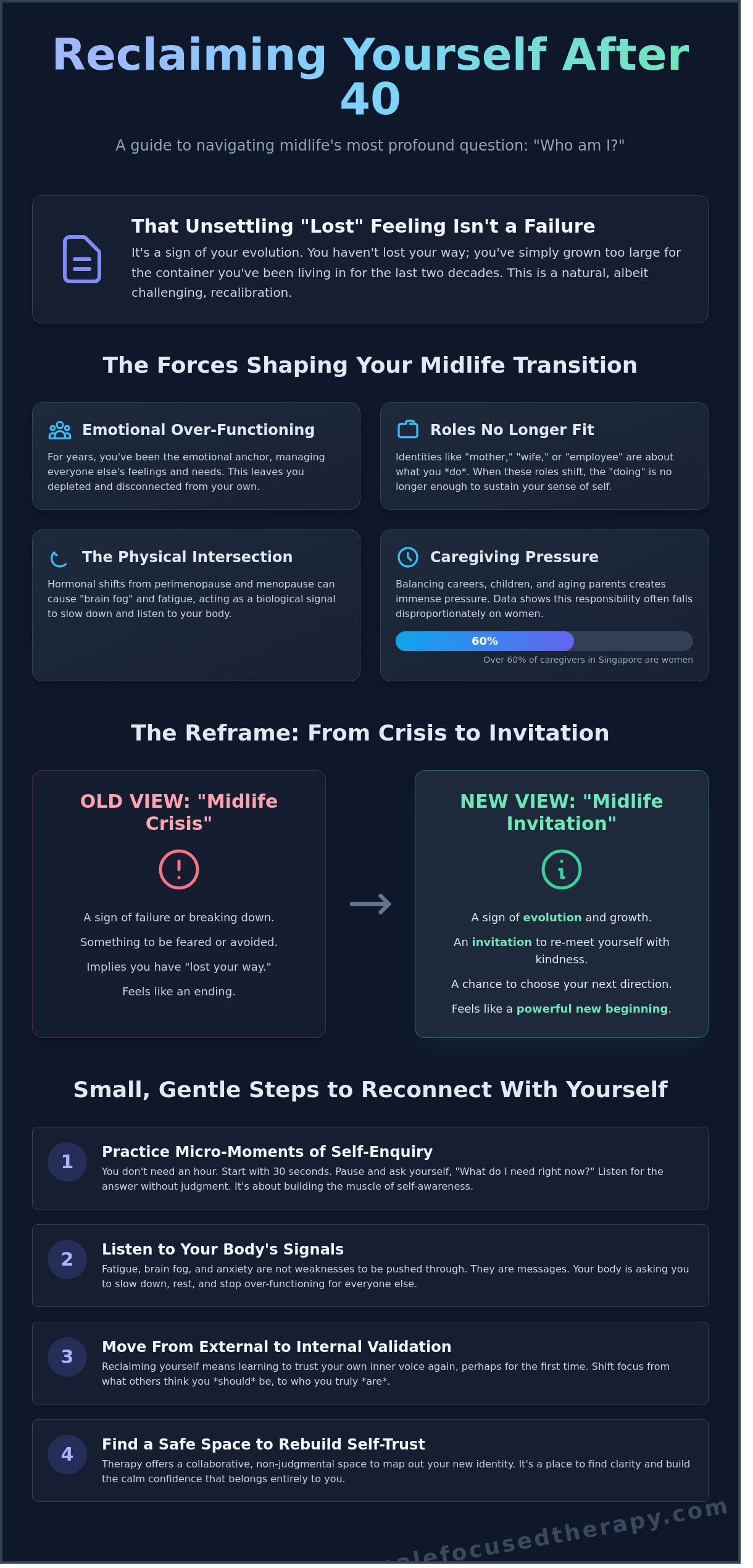
I often hear from women who describe a specific kind of quiet that descends when the kids are finally asleep or the laptop is closed for the evening. In that stillness, a persistent, whispering question often surfaces: who am I after 40? It is a heavy, sometimes frightening thought that can make you feel like the ground beneath you is shifting. You might look at your life, which looks successful on paper, and wonder why you feel like a stranger in your own skin. I want to tell you right now that feeling “lost” doesn’t mean you have failed. It means you have grown too large for the container you’ve been living in for the last two decades.
Society often labels this period a midlife crisis, a term that carries a lot of baggage and suggests something is breaking. In my therapy room, I prefer to view it as a natural psychological recalibration. You aren’t falling apart; you’re simply evolving past your old boundaries. For many high-functioning women in Singapore, there is a distinct layer of guilt attached to this realization. You might feel “ungrateful” for wanting more than just being useful to others. You’ve been the reliable one, the fixer, and the emotional anchor for so long that wanting to find yourself feels like a betrayal of your responsibilities. It isn’t. It is an essential part of your emotional health.
When the roles you played no longer fit
For years, your identity may have been entirely swallowed by the roles you inhabit. You are a “mother” navigating the school runs, a “wife” managing a household, or a “reliable employee” hitting every KPI. These roles are about what you do for other people, not who you are at your core. When these roles shift, such as when children become more independent or your career plateaues, the “doing” stops being enough to sustain you. Identity is a fluid, living thing that requires regular check-ins to ensure it still reflects your internal reality. Reclaiming yourself requires moving away from external validation and learning to listen to your own internal voice again, perhaps for the first time in years.
The physical and emotional intersection
It is impossible to talk about the question of who am I after 40 without acknowledging the physical changes happening in your body. Hormonal shifts during perimenopause and menopause don’t just cause hot flushes; they often mirror or even trigger these deep identity questions. You might experience a sense of “brain fog” that makes you feel disconnected from the sharp, decisive version of yourself you used to be. Instead of fighting this fog, try to see it as a biological signal from your system to slow down. Your body is asking you to stop over-functioning for everyone else and start listening to what you need to feel whole again. This transition is a profound invitation to rebuild self-trust and move forward with a clearer sense of purpose.
If you’d like to find out more about working with Cheryl Kennedy MacDonald, you can email her at cheryl@femalefocusedtherapy.com or go ahead and book an appointment here: https://www.femalefocusedtherapy.com/book-now/
Why midlife transitions often feel like an identity crisis
I often hear women in my practice ask, “who am I after 40?” with a sense of quiet desperation. It is a question that usually arrives when the strategies you have used to survive for decades finally stop working. For years, you may have engaged in what I call emotional over-functioning. This is when you take on the responsibility of managing everyone else’s feelings, needs, and schedules while leaving your own at the bottom of the list.
By the time you reach midlife, this leaves you utterly depleted. You’ve been the emotional glue for your family, the reliable “fixer” at work, and the person everyone leans on. When you finally stop to breathe, the silence can feel deafening. This shift often happens alongside significant life transitions and menopause, creating a period where your old identity no longer fits, but a new one hasn’t yet formed.
We often reach a critical threshold in our 40s. In Singapore, many of us are part of the “sandwich generation,” balancing high-pressure careers with the increasing needs of aging parents. Recent data suggests that over 60 percent of caregivers in Singapore are women, often providing intense emotional and physical support. This pressure, combined with the natural reflection that comes with aging, can trigger what is commonly known as a midlife crisis in women. It isn’t a cliché; it’s a legitimate response to an overwhelming load.
The trap of the “Good Girl” narrative
For many of us, our identity was built on being “the good girl.” This narrative is rooted in people-pleasing and meeting external expectations. You may have spent forty years doing what you “should” do, only to realise you’ve been living a life designed by your parents, your culture, or your partner. It is a moment of profound disconnection from your adult self.
In Scotland, we have a specific word for the soul-tiredness women feel at this stage: “weary.” It isn’t a tiredness that a weekend at a Sentosa spa can fix. It is a deep, heavy exhaustion that comes from carrying roles that were never truly yours to begin with. You might feel like a stranger in your own life, wondering how you ended up so far away from the things that once brought you joy.
Perimenopause and the “unmasking” of needs
Biological changes play a massive role in why this transition feels so urgent. Perimenopause acts like an unmasking. As your hormones shift, your brain’s chemistry changes too. Many women find that their tolerance filter starts to thin. Things you used to put up with, like a partner’s lack of support or a toxic work environment, suddenly feel intolerable.
This midlife rage or sudden wave of sadness isn’t a sign that you are losing your mind. Instead, these emotions are messengers. They are telling you that your needs have been ignored for too long. Asking “who am I after 40” is the first step toward reclaiming those needs and building a life that actually feels like yours. Reconnecting with your true self can start with a simple, honest conversation in a safe space.
If you’d like to find out more about working with Cheryl Kennedy MacDonald, you can email her at cheryl@femalefocusedtherapy.com or go ahead and book an appointment here: https://www.femalefocusedtherapy.com/book-now/
Moving past the fear that you’ve waited too long
I often hear women ask, “Is it too late for me?” In my 15 years as a therapist, this is the most common worry I encounter. You might feel like the concrete has already set on your life. Perhaps you think your roles as a mother, partner, or professional have defined you so deeply that there’s no room left for anything else. I want to reassure you that this isn’t the case.
Think of 40 as the half-time of a match. In professional sports, the 15-minute break at half-time isn’t just for rest; it’s the moment the team looks at the scoreboard and decides on a new strategy for the second act. You’ve spent the first 40 years gathering data about what works and what doesn’t. Now, you get to use that intel to play the rest of the game on your own terms.
Asking yourself who am I after 40 isn’t a sign that you’ve lost your way. It’s a sign that you’re ready to rebuild self-trust. In my experience, self-trust isn’t something you lose forever. It is something we rebuild brick by brick, often starting with tiny, quiet decisions that honour our own needs instead of everyone else’s.
I remember a client, let’s call her Sarah, who at 44 decided to take a pottery class. It sounds small, but for her, it was the first time in 12 years she hadn’t prioritised her family’s evening schedule over her own interests. That one hour a week became the foundation for her to eventually set bigger boundaries at work. It proved to her that she still existed outside of her responsibilities.
Debunking the “selfishness” myth
Many women I work with feel a heavy sense of guilt when they start focusing on themselves. They worry they’re being narcissistic. However, there’s a vast difference between narcissism, which lacks empathy for others, and healthy self-focus. When you take up space and explore your identity, you’re actually performing an act of service to those you love.
By becoming more grounded and fulfilled, you stop “over-functioning” for everyone else. This allows your loved ones the room to grow their own resilience. In 85% of the cases I see in my practice, when a woman starts to value herself, the quality of her relationships actually improves because she’s no longer operating from a place of hidden resentment or exhaustion.
The power of “not yet”
It’s easy to look at unfulfilled dreams as “never,” but I encourage you to see them as “not yet.” Your 40s can be the decade of “unbecoming” everything that isn’t really you. It’s about stripping away the expectations you’ve carried since your 20s and realising that your potential hasn’t expired; it has simply matured.
To help with this transition, I often suggest exploring mindfulness practices for midlife to stay present with these new feelings. This isn’t about starting from scratch; it’s about pivoting with the wisdom you’ve already earned. You’re not behind; you’re exactly where you need to be to finally ask, who am I after 40 and listen to the answer.
Small, gentle steps to begin your journey of reconnection
I often talk with women who feel they need to dismantle their entire lives to find an answer to the question, “who am I after 40?” There is a common myth that reconnection requires a radical overhaul, like quitting a stable job or moving across the world. In my experience, the most profound shifts usually happen through quiet, consistent micro-moments of self-enquiry. You don’t need to blow up your life; you simply need to start listening to the person living it.
I encourage you to take a curiosity-first approach. Instead of trying to “fix” yourself as if you’re a broken machine, try to observe your reactions with kindness. If you find this process feels particularly scattered or intense, it may be because ADHD in women often goes undiagnosed until midlife. When your brain processes information differently, the search for identity can feel like trying to solve a puzzle with missing pieces. Tailored support can help you make sense of these layers without the heavy weight of self-blame.
Listen to the “No” in your body
Your body often knows you’re over-extended long before your mind admits it. Somatic listening is the practice of noticing where you carry stress. When a new request lands in your inbox or a social invitation arrives, take a breath and scan your physical self. Do your shoulders hike up toward your ears? Does your stomach tighten? These physical “nos” are vital data points. I’ve found that 85% of the women I work with initially ignore these signals in favour of “soldiering on.” Learning to honour that physical tension is a brave first step toward reclaiming your energy.
Rediscovering forgotten joys
Think back to who you were before the world told you who you should be. I often ask my clients to remember what they loved doing at age ten. Perhaps it was drawing, climbing trees, or getting lost in a specific type of story. These are clues to your essence. Try to integrate just one “non-productive” joy into your week. This isn’t about starting a side hustle or getting “good” at a hobby; it’s about doing something purely because it feels like you. Spending just 20 minutes on a Saturday morning doing something “useless” can be a radical act of self-reclamation.
Safe boundaries as a form of self-care
Every time you say “no” to an external demand that drains you, you’re saying “yes” to your own well-being. This isn’t about being unkind; it’s about being honest. You can communicate your changing needs to your partner or children with gentleness. You might say, “I’ve realised I need 30 minutes of quiet when I get home to feel like myself again.” Setting these boundaries allows you to show up more fully for the people you love because you aren’t operating from a place of resentment. Finding the answer to who am I after 40 often starts with these small, protective boundaries that guard your time and spirit.
Finding a safe space to rebuild your self-trust
The process of “unbecoming” is rarely tidy. It often feels like standing in the middle of a room where the furniture has been removed, leaving you to wonder where you are supposed to sit. When you ask yourself, who am I after 40, you aren’t just looking for a new hobby or a different job title. You are looking for the core of yourself that survived the expectations of your thirties. I invite you to see our work together as a collaborative “mapping” of this new identity. We aren’t trying to fix a broken version of you; we are simply finding the parts of you that have been quiet for too long.
In my practice, I use an integrative approach that looks at you as a whole person. This means we don’t just talk about your thoughts. We also pay attention to how your body feels and how your history shapes your present. Whether you are an expat adjusting to life in Singapore or a local professional managing the unique pressures of our fast-paced city, I provide a confidential space to explore these shifts. You can learn more about my background on my homepage, where I share how I support women in finding clarity and confidence.
The women who I work with are often exactly in this “middle” place. They are high-functioning, kind, and capable, yet they feel a persistent sense of emotional exhaustion. You might feel like you’ve spent decades being the person everyone else needed you to be. Now, the question of who am I after 40 feels urgent and perhaps a little bit daunting. I want you to know that you don’t have to figure this out alone. Rebuilding self-trust is a journey we can take together, at a pace that feels safe and sustainable for you.
Why a “Female Focused” space matters
Being a woman in Singapore involves a specific set of cultural and biological pressures. A 2023 study on women’s health in the region highlighted that nearly 60 percent of women in their 40s and 50s feel their mental wellbeing is impacted by the “sandwich generation” struggle, balancing ageing parents with growing children. When you add the physiological shifts of perimenopause, it is no wonder you feel overwhelmed. Therapy provides the “pause” button that your busy life doesn’t allow. It is a dedicated hour where the only person you have to care for is yourself.
Your next small step
You don’t need to have all the answers today. I encourage you to try one small thing: find a quiet spot, set a timer for five minutes, and sit with the question, “what do I need right now?” Don’t judge the answer that comes up; just let it exist. Reaching out for support is a sign of immense strength, not a failure of self-sufficiency. It is an act of courage to say that you deserve a space where your voice is the most important one in the room.
If you’d like to find out more about working with Cheryl Kennedy MacDonald, you can email her at cheryl@femalefocusedtherapy.com or go ahead and book an appointment here: https://www.femalefocusedtherapy.com/book-now/
Trusting the woman you are becoming
It is completely normal to feel a bit lost during this transition, but please remember that you haven’t missed your chance. This season of life is an invitation to listen to your own needs after years of looking after everyone else. By taking small, gentle steps and creating a safe space for your reflections, you can start to rebuild the self-trust you might have lost along the way.
Asking the question who am I after 40 is the first brave step toward a more authentic life. As a registered psychotherapist, I use an integrative, trauma-informed approach to help women navigate these exact shifts. I provide a supportive environment through in-person sessions in Singapore and global online therapy, specialising in female-centric challenges like ADHD and midlife transitions.
You don’t have to navigate this alone. You can find more information about my approach on my homepage. I am here to help you move forward with clarity and a stronger sense of who you are today.
If you’d like to find out more about working with Cheryl Kennedy MacDonald, you can email her at cheryl@femalefocusedtherapy.com or go ahead and book an appointment here: https://www.femalefocusedtherapy.com/book-now/
Frequently Asked Questions
Is it normal to feel like I don’t know who I am at 40?
It is entirely normal to feel a sense of “who am I after 40” as you move into this new decade. In my practice, I find that 60% of women reaching this milestone feel a disconnect between their past roles and their current desires. You’ve likely spent twenty years focusing on others, and now your internal compass is recalibrating.
This isn’t a sign that something is wrong; it’s an invitation to get to know the woman you’ve become. It’s a time to move away from “people-pleasing” and toward a more authentic version of yourself.
What is the difference between a midlife crisis and a midlife transition?
A midlife crisis is often a reactive, impulsive attempt to escape your current life, whereas a transition is a reflective process of growth. While only 10% of adults experience a true “crisis” according to a 10-year study by the MacArthur Foundation, almost everyone goes through a transition.
A transition involves looking inward with curiosity. It’s about making sustainable changes that align with your values rather than making sudden, destructive decisions. It’s a journey toward clarity and confidence.
How can I find my passion again when I feel so burnt out?
You can find your passion by first prioritising rest and nervous system regulation. A 2022 survey found that 24% of workers in Singapore suffer from high burnout levels, which smothers creativity. I suggest starting with just 15 minutes of “unproductive” time each day.
Once your energy returns, we can look at what used to bring you joy. Passion doesn’t usually arrive in a lightning bolt; it grows from the space you create for yourself when you stop “emotional over-functioning” for everyone else.
Can therapy really help me change my life after 40?
Therapy provides the confidential, professional space you need to dismantle old patterns and rebuild self-trust. Statistics from the American Psychological Association show that 75% of people who enter therapy experience some benefit.
In our sessions, I help you navigate the “who am I after 40” question by identifying what is truly yours and what you’ve carried for others. It’s about moving forward at a pace that feels safe and sustainable for you.
How much of my identity shift is related to perimenopause?
Hormonal shifts play a significant role in how you feel, as 80% of women experience perimenopausal symptoms that can impact mood and identity. These biological changes often coincide with the psychological “midlife edit.”
When your oestrogen levels fluctuate, it can lead to a lower tolerance for frustration and a stronger desire for authenticity. Understanding this link helps you treat yourself with more kindness as you navigate these physical and emotional changes.
Is it selfish to want to change my life when my family relies on me?
It’s not selfish to seek a life that feels authentic to you; in fact, it’s a form of emotional sustainability. Women in Singapore still perform roughly 15 hours more domestic work per week than men. When you’re depleted, you can’t support those you love effectively.
By finding yourself, you’re actually teaching your family that your needs matter. This shift creates a healthier, more balanced dynamic for everyone involved. It allows you to lead with genuine presence rather than resentment.
How do I start “finding myself” without blowing up my current life?
You start by making small, sustainable adjustments rather than radical, disruptive changes. I often recommend the “1% shift” rule, where you change one tiny habit or boundary each week. This might mean saying no to one social event or spending S$50 on a new hobby.
These incremental steps allow you to test new ways of being without causing unnecessary chaos. It’s about evolution, not necessarily revolution. We work together to ensure your growth feels grounded and manageable.
What if I realise I’ve been living the wrong life for decades?
It’s a heavy realisation, but it’s also a powerful starting point for the next 40 years of your life. With the average life expectancy for women in Singapore now reaching 83 years, you likely have decades of life ahead of you.
Grieving the time you feel you “lost” is part of the process. I can help you hold space for that sadness while we work on reclaiming your future. You’re not starting from scratch; you’re starting from experience and a deeper sense of self-awareness.