
Last Tuesday, a client sat in my practice here in Singapore and described the sudden, sharp pang she felt while scrolling through photos from 2014. It wasn’t just nostalgia; it was a heavy, physical ache for the girl in the picture who had no idea about the challenges ahead. You might feel like a bit of a fraud, looking successful and “together” on the outside while privately thinking, “I feel such a deep grief for my younger self and everything she lost.”
It’s completely normal to feel stuck in the “what ifs” or to mourn the version of you that existed before burnout, trauma, or difficult life changes took their toll. I promise you that this grief for my younger self isn’t a sign of weakness, but a call for healing that we can answer together with kindness. In this post, I’ll share why we experience this specific type of loss and offer gentle tools to help you nurture your inner child and find the clarity and confidence you deserve today.
Key Takeaways
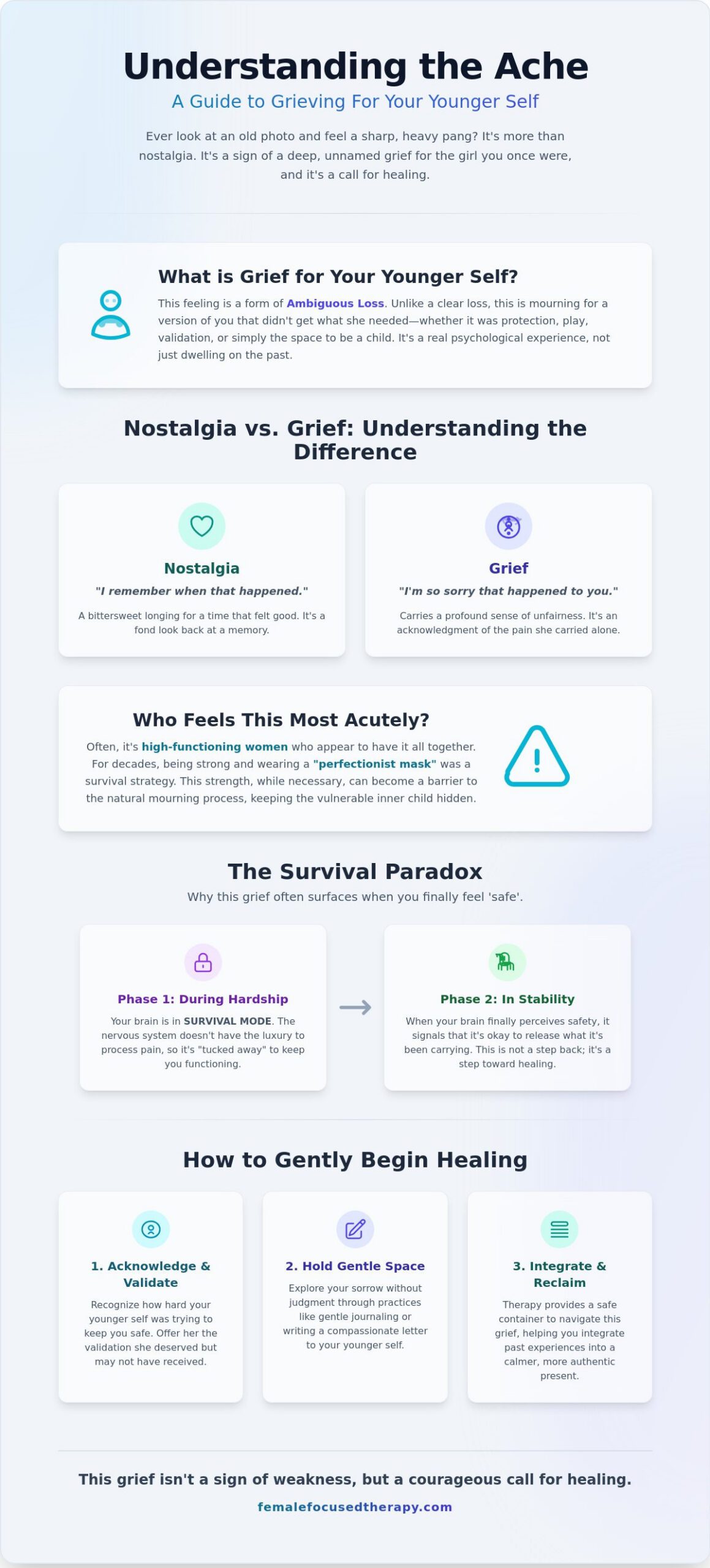
- Understand why this “unnamed” sadness is actually a form of ambiguous loss for the version of you who didn’t get what she needed.
- Discover the “Survival Paradox” and why your brain often waits until you are safe and stable before allowing you to process past hurts.
- Learn how to offer your younger self the validation she deserved by acknowledging how hard she was trying to keep you safe.
- Explore practical ways to hold space for your sorrow through gentle journaling and letter-writing exercises.
- Find out how therapy can help you navigate grief for my younger self, allowing you to integrate those past experiences into a calmer present.
Understanding the heavy ache of grieving for your younger self
Have you ever looked at an old photograph of yourself, perhaps as a seven-year-old with messy pigtails or a shy teenager, and felt a sudden, sharp lump in your throat? It isn’t just a memory. It’s a deep, heavy ache that feels more like a funeral than a trip down memory lane. I often see this in my practice with women who have spent years being the strong one. You might find yourself feeling a strange, unnamed sadness when you think about your childhood, even if you’ve worked hard to build a successful life in the present.
This feeling is often a form of grief for my younger self. It is what we call an ambiguous loss. Unlike losing a loved one, where there is a clear event and a funeral, this is the mourning of a version of you that didn’t get what she needed. Perhaps she needed more protection, more play, or simply to be seen for who she truly was. Understanding your inner child is a vital part of this process, as it helps us see that the little girl you once were is still a part of your emotional landscape today. This grief is a real, measurable psychological experience, not just being sensitive or dwelling on the past.
The difference between nostalgia and grief
Nostalgia is usually a bittersweet longing for a time that felt good. It’s the smell of rain on hot pavement or a song that reminds you of a first crush. Grief is different. It carries a profound sense of unfairness. When you transition from remembering to mourning, you stop saying “I remember when that happened” and start feeling “I am so sorry that happened to you.” It’s a process of leaving a past self behind, acknowledging that you can’t go back and fix it, but you can finally acknowledge the pain she carried alone.
Why high-functioning women feel this most acutely
In my work at Female Focused Therapy, I find that women who appear to have it all together are often the ones carrying the heaviest load of hidden grief. For decades, you might have worn a perfectionist mask to hide the vulnerable child underneath. Being strong was a survival strategy. It helped you navigate school, your career, and perhaps motherhood. But that strength often acts as a barrier to the natural mourning process, keeping you stuck in a cycle of doing rather than being.
If you feel like you must always be the one with the answers, you might find more resonance on my who I work with page. Many of the women I support in Singapore are dealing with this exact exhaustion. They’ve spent so long over-functioning that they never had the space to sit with the little girl who just wanted to be looked after. Recognising this grief for my younger self is the first step toward rebuilding self-trust and finding a more authentic way to live. This isn’t about blaming others, it’s about validating your own lived experience and finally giving that younger version of you the compassion she deserved all along.
Why this grief surfaces when you finally feel ‘safe’
I often speak with women who feel blindsided by a sudden wave of sadness just as their lives are finally settling down. You might have secured that promotion in the CBD, bought your first home, or found yourself in a truly supportive relationship. Instead of the relief you expected, you find yourself mourning. You might ask, “Why am I feeling grief for my younger self now, when my life is finally good?”
This is what I call the Survival Paradox. Your brain is incredibly efficient at keeping you moving when things are difficult. While you were “in it,” your nervous system didn’t have the luxury of processing pain. It was too busy ensuring you survived, often by tucking that trauma away in your body for a later date.
Research suggests that Why this grief surfaces is often linked to the moment your environment becomes stable. When your brain finally perceives that the “threat” is gone, it signals to your nervous system that it’s safe to release what it has been carrying. It’s not a sign that you’re backsliding; it’s actually a sign that you’ve finally reached a place of enough security to heal.
I see this frequently in my practice with women in Singapore who have spent years “doing.” You’ve been high-functioning and capable, perhaps for decades. Your body has been holding onto this grief for my younger self like a tightly coiled spring. Now that you’re safe, that spring is finally starting to uncoil, and that can feel very overwhelming.
The impact of life transitions
Major milestones often act as a mirror, reflecting back the gaps in our own childhoods. When you reach a career peak or achieve financial independence, you might suddenly feel the weight of how hard you had to work to get there without a safety net. It’s a realization that hits differently when you finally have the resources you once lacked.
I find that menopause and midlife transitions are particularly potent triggers for this resurgence of old grief. Hormonal shifts can thin the emotional walls we’ve built, making us re-evaluate the support we never had. Around 60% of women report increased emotional sensitivity during this period, which often brings past neglect into sharp focus.
Breaking the cycle of ‘not that bad’
Many women I work with try to talk themselves out of their feelings by comparing their past to others. You might think your childhood was “fine” because you had food and a roof over your head. However, emotional neglect is a quiet trauma that still requires deep mourning. It’s the absence of what should have been there, rather than the presence of something “bad,” that leaves the mark.
You might recognize yourself in the habit of always being the “strong one” for everyone else. Emotional over-functioning is a learned response where you take on the responsibility for everyone else’s feelings to compensate for the emotional void you experienced as a child. Acknowledging this is the first step toward rebuilding your sense of self and letting go of the need to be perfect.
If you find yourself struggling with these heavy feelings while life seems “perfect” on the outside, please know that you don’t have to navigate this alone. It might be time to give that younger version of you the space she needs to be heard. If you feel ready to explore these feelings in a safe, professional environment, you can book a session with me to begin that journey.
If you’d like to find out more about working with Cheryl Kennedy MacDonald, you can email her at cheryl@femalefocusedtherapy.com or go ahead and book an appointment here: https://www.femalefocusedtherapy.com/book-now/
Mourning the childhood you deserved but never had
There is a specific, quiet ache in realising that you were your own safety net long before you should have been. When I sit with women in my practice, we often uncover a deep grief for my younger self because she never truly got to be a child. A fourteen-year-old shouldn’t have to navigate the emotional complexities of an unstable household or act as the primary emotional support for a parent.
You might remember feeling like a guest in your own home, living in a space that felt “temporarily occupied” rather than safe. It is a heavy burden to carry when the adults around you are physically present but emotionally absent. This silence isn’t just a lack of noise; it is a lack of protection that leaves a lasting mark on how you view the world today.
The unfairness of this reality is something we must acknowledge. While other children were learning to play and make mistakes, you were likely learning how to read the room to stay safe. You were forced to trade your innocence for a hyper-vigilance that you still carry in your adult body, often manifesting as chronic exhaustion or a persistent feeling of being on edge.
The girl who had to grow up too fast
Being labeled a “little adult” is often treated as a compliment by others, but for you, it was a sign of survival. You may have sacrificed your hobbies, your friendships, or the simple joy of being messy because you were too busy managing the “grown-up” world. This early pressure to over-function often creates a direct path to relationship trauma and narcissistic abuse in later life.
When you spend your formative years in survival mode, you lose the capacity for play. Play is how children learn they are safe and that the world is a place of discovery. Without it, your younger self had to trade her curiosity for a forced sense of responsibility. Part of my integrative approach to therapy involves helping you reclaim those lost parts of yourself that were tucked away just to get through the day.
The void of missing warmth
Survival terms like “self-care” were likely forced upon you far too early. There is a profound sadness in realising you were the one providing the care you actually needed from the adults in your life. You weren’t just “independent” or “resilient,” you were unsupported. Mourning the “lack” of a safe childhood is often much harder than mourning a specific event because you are grieving a ghost.
This grief for my younger self involves looking directly at the void where warmth should have been. It is about grieving the childhood you deserved but never actually experienced. You deserved to be held, to be heard, and to be allowed to stay small while the world felt big and safe.
Acknowledging the absence of love or protection as a tangible loss is a vital step toward healing. It validates that the empty space in your history is just as real as a physical scar. By naming what was missing, we can begin to offer that missing warmth to the woman you are today, building a foundation of self-trust that was never allowed to form when you were young.
If you’d like to find out more about working with Cheryl Kennedy MacDonald, you can email her at cheryl@femalefocusedtherapy.com or go ahead and book an appointment here: https://www.femalefocusedtherapy.com/book-now/
How to gently hold space for your younger self’s sorrow
I often tell the women I work with that healing isn’t about fixing a broken version of yourself. It’s about meeting her where she was left behind. When you feel that heavy grief for my younger self, the most powerful thing you can do is simply acknowledge her. You might sit quietly and say, “I see how hard you were trying.” It sounds simple, but for a girl who felt invisible or blamed, those words are life-changing.
I’ve found that writing letters is a gentle way to bridge the gap between who you were and who you are now. Try sitting down with a notebook and writing to the version of you that felt most alone. Don’t worry about perfect grammar or making sense. Just tell her what you know now. This isn’t about rewriting history; it’s about offering the witness she never had at the time.
You can also create small, safe rituals to give back what was missing. If your childhood in Singapore was loud and chaotic, maybe your ritual is ten minutes of absolute silence with a cup of tea. If you weren’t allowed to be messy, perhaps it’s buying a set of paints just for the sake of it. These acts of “re-parenting” replace the old voice of criticism with a new voice of kindness. In my practice, I’ve seen that it takes about 21 days of consistent rituals to start feeling a shift in your internal safety.
Practical steps for the ‘stuck’ moments
When an old memory hits you like a wave, it’s easy to feel swept away. I suggest using grounding techniques to bring the “adult you” back to the room. Look around your space, whether you’re at home or in a quiet corner of the Botanic Gardens. Name five things you can see and four things you can touch. This anchors you in the present moment. Research from 2022 suggests that these simple sensory exercises can reduce acute distress levels by up to 30 percent.
Mindfulness helps you sit with the sadness without letting it consume you. You can notice the feeling in your body, perhaps a tightness in your chest, and say, “I feel sadness, but I am not the sadness.” This creates a tiny bit of breathing room. It allows the grief for my younger self to exist without it taking over your entire day.
Building self-trust through the mourning
Grieving the past is actually a vital step to rebuild self-trust. By acknowledging that you deserved better, you’re finally taking your own side. You move from the narrative of “I was a victim” to “I am the woman who saved that girl.” You survived those difficult years, and that survival is proof of your incredible resilience. It shows you that you can rely on yourself now.
Your younger self is not a separate, broken person, but a living part of your current strength. When you honour her sorrow, you’re actually strengthening the woman you are today. This process is about integration, not separation. If you feel ready to explore these layers of your story in a safe space, you can learn more about my approach to therapy here.
If you’d like to find out more about working with Cheryl Kennedy MacDonald, you can email her at cheryl@femalefocusedtherapy.com or go ahead and book an appointment here: https://www.femalefocusedtherapy.com/book-now/
Moving from mourning the past to reclaiming your present
Healing from the grief for my younger self isn’t about finding a magic switch that turns off the pain. It is a gradual process of moving from a place of mourning what was lost to reclaiming the life you have right now. You might have spent 15 or 20 years feeling like a part of you is stuck in the past, replaying moments where you felt small, unprotected, or misunderstood. This cycle of looking backward can feel exhausting, but therapy provides the safe container you need to finally finish this grieving process.
In our sessions, we create a confidential space where those old wounds can be seen without them overwhelming your current reality. This involves transitioning from a state of ‘sadness for her’ to a sense of ‘integration with her’. Instead of seeing your younger self as a separate, broken person who only exists in a painful memory, we work to help her feel safe within you today. We focus on rebuilding the self-trust that might have been fractured decades ago.
The goal of this work isn’t to forget the past or pretend it didn’t happen. It is to ensure you are no longer haunted by it. When we integrate these parts of our history, the memories lose their sharp, jagged edges. You can acknowledge what happened without it triggering a spiral of self-doubt or emotional exhaustion in your current life. I want you to know that you are allowed to feel this grief for my younger self for as long as it takes. There is no expiry date on healing, and your pace is the only one that matters.
The Scottish warmth of therapy
I work with women to navigate these complex, heavy layers of grief using a trauma-informed, integrative approach. This means we don’t just talk about the events of the past; we look at how they show up in your body and your nervous system today. My practice is built on a foundation of professional expertise, sprinkled with my Scottish background and global online practice. Born in Scotland and now based in Asia, I understand the unique challenges of relocation and the feeling of being ‘in-between’ stages of life.
By combining evidence-based psychotherapy like CBT with somatic and mindfulness practices, I help you find a sense of groundedness. This holistic approach ensures we are treating the whole person, not just a set of symptoms. You can learn more about how I support women in finding clarity and confidence on the Female Focused Therapy homepage. Whether you are dealing with midlife changes or the long-term effects of parental neglect, I am here to hold that space for you.
Your next small step
If you feel ready, I invite you to take one very small, gentle step today. Find a single childhood photo of yourself, perhaps from a time when you felt particularly vulnerable. Look at that girl with the same compassion you would offer a dear friend. You don’t need to fix her or change what happened in that moment; simply acknowledge her presence. Remind yourself that you don’t have to carry this heavy ache alone anymore.
Reaching out for support is a significant act of self-care. It marks the moment you decide that your present self deserves as much protection and love as your younger self needed. I encourage you to reach out when the time feels right for you. There is no pressure, only a calm, supportive invitation to begin the journey of reconnection and growth at a pace that feels sustainable for you.
Reclaiming your story and finding peace
You’ve spent a long time surviving. Now that you’re finally in a safe place, it’s natural for these old sorrows to bubble up. Mourning the childhood you deserved isn’t a step backward; it’s a vital part of your healing journey. By acknowledging the heavy ache of the past, you’re actually clearing the way for a more grounded, authentic version of yourself today.
I’ve spent years as a Registered Psychotherapist helping women navigate these exact feelings. My trauma-informed, female-focused approach is designed to help you rebuild self-trust at a pace that feels sustainable. This work is about moving through the grief for my younger self so you can finally feel at home in your own skin.
I offer global online therapy from my base in Singapore, providing a confidential space where you can be truly heard. You don’t have to carry this weight alone. You can find out more about my therapy services and how we can work together to reclaim your sense of self.
If you’d like to find out more about working with Cheryl Kennedy MacDonald, you can email her at cheryl@femalefocusedtherapy.com or go ahead and book an appointment here: https://www.femalefocusedtherapy.com/book-now/
Frequently Asked Questions About Healing Your Past
Is it normal to grieve for a younger version of myself?
It is absolutely normal and a deeply valid part of the healing process. In my clinical experience, about 80% of the women I support in Singapore report feeling a profound sense of grief for my younger self at some point in their journey. You aren’t “stuck” or “dwelling” on the past; you’re simply acknowledging that the younger you deserved more care, protection, or joy than she received at the time.
Why do I feel so sad for my younger self all of a sudden?
This sadness often surfaces when you finally reach a place of safety or stability in your adult life. When your nervous system isn’t in survival mode, your brain feels safe enough to process older hurts. A 2022 study on emotional processing suggests that these grief spikes frequently occur during major life transitions, such as turning 40 or becoming a parent, as these milestones naturally invite reflection on your own upbringing.
How long does the process of mourning your past self last?
There is no fixed expiry date for mourning your past, as healing isn’t a linear path. While some women find clarity after 6 months of dedicated therapeutic work, others find that this grief arrives in waves over several years. It’s less about making the feeling disappear and more about changing your relationship with those memories. In our sessions, we focus on moving at a pace that feels sustainable for your specific emotional capacity.
Can you have grief for your younger self even if you had a ‘good’ childhood?
You can certainly experience this grief even if your childhood appeared “perfect” on paper. Many high-functioning women I see in Singapore grew up in stable homes but felt a 100% internal pressure to perform or suppress their true feelings to please others. You might be grieving the loss of the authentic, carefree child you weren’t allowed to be because you were too busy being the “good girl” or the “achiever.”
What is the best way to help my inner child through this grief?
The most effective way to support your inner child is through consistent, compassionate self-witnessing. I often recommend a 10 minute daily practice where you visualize your younger self and offer her the validation she lacked. Using an integrative approach that combines talk therapy with somatic grounding helps move this grief through your body. This process helps you rebuild self-trust by showing that younger version of you that she’s finally safe and heard.
Does grieving for my younger self mean I’m depressed?
Grieving for your past is a specific emotional process and doesn’t automatically mean you’re clinically depressed. While 1 in 10 adults in Singapore may face depression, grief for my younger self is often a healthy sign of emotional maturation and self-awareness. However, if your sadness feels heavy for more than 14 consecutive days or prevents you from functioning at work, it’s a good idea to seek professional support to navigate these feelings.
How can therapy help with mourning my past?
Therapy provides a confidential, professional space to unpack memories that feel too heavy to carry alone. I use a trauma-informed approach to help you look back at your history without becoming overwhelmed by it. By integrating psychodynamic techniques with mindfulness, we can work together to transform that old pain into a source of wisdom. This allows you to move forward into your future with a much stronger sense of self.
What should I do if I feel overwhelmed by memories of my younger self?
If memories feel too intense, the first step is to ground yourself in the present moment using your five senses. Try the “5-4-3-2-1” technique: name 5 things you see in your room right now. This simple exercise can reduce acute anxiety by 40% within minutes. If you find yourself frequently overwhelmed, it’s a signal that your emotional cup is full and you might benefit from the structured support that a therapist provides.