
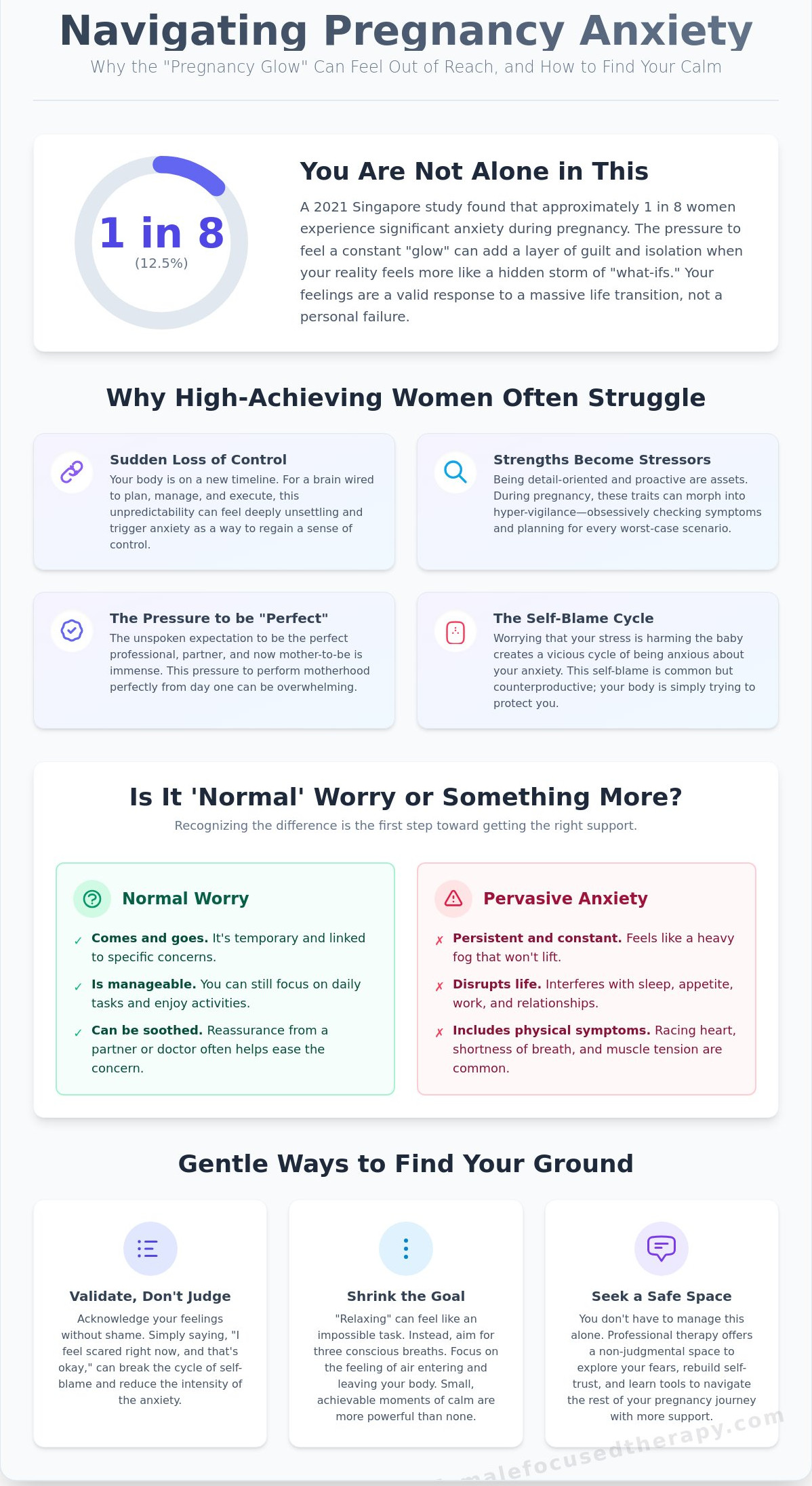
You might be sitting in a quiet cafe in Orchard or resting at home after a long day, looking down at your growing bump and waiting for that famous “glow” to arrive. Instead of joy, you feel a tightening in your chest and a mind that won’t stop racing with “what-ifs.” A 2021 study published in the Singapore Medical Journal found that approximately 12.5% of women here experience significant anxiety during pregnancy, yet many feel they must suffer in silence while everyone around them expects celebration.
I know how heavy that guilt feels, and how lonely it is to be under the constant care of medical professionals who check your physical health but might miss the emotional storm you’re weathering. You may worry that your fear is somehow failing your baby, but I want to reassure you that your feelings are a real, manageable response to a massive life transition. You aren’t doing anything wrong, and you certainly aren’t alone in this.
I will help you understand these heavy feelings and show you how we can gently navigate them together to rebuild your sense of calm. We’ll explore why your nervous system is on high alert and look at small, practical ways to help you feel safe and supported in your body again as you move toward motherhood.
Key Takeaways
- Understand why the “pregnancy glow” might feel out of reach and how to validate your emotions during this major life transition.
- Discover why high-functioning women often experience anxiety as a way to “plan” for uncertainty and regain a sense of control.
- Learn to identify the subtle line where natural worries shift into anxiety during pregnancy that feels like a persistent, heavy fog.
- Explore gentle, integrative tools to help you ground your body and find realistic moments of calm that don’t feel like another chore.
- Find out how a safe, professional therapeutic space can help you navigate the harder parts of motherhood and rebuild your self-trust.
Understanding the heavy weight of anxiety during pregnancy
I want to start by acknowledging that the “glow” everyone talks about can feel very far away when you are struggling. You might look at the glossy images of smiling expectant mothers and wonder why your experience feels so much heavier. It is a lonely place to be, and I want you to know that your feelings are valid. You are not doing anything wrong by feeling this way.
Anxiety during pregnancy isn’t just “worrying” in the traditional sense. It is a profound physiological and emotional response to a massive life transition. Your entire identity is shifting while your body undergoes rapid changes. We often feel we “should” be happy, which adds a painful layer of shame to the existing anxiety. This shame can make the weight of the experience feel almost unbearable.
In my practice in Singapore, I see many high-functioning women who feel they must perform motherhood perfectly from day one. In a society that values achievement and composure, the pressure to be the “ideal” pregnant woman is overwhelming. This pressure often masks the reality of Understanding Pregnancy-Related Anxiety as a real, lived experience that requires compassion, not just a “positive attitude.”
Why we often hide our anxious thoughts
The fear of being judged by family, friends, or even medical professionals is a significant barrier to speaking up. You may worry that admitting to intrusive thoughts or constant dread will make you look like an unfit mother. The “perfect mother” myth tells us we should be naturally intuitive and endlessly patient. This myth prevents us from seeking the support we actually need to feel better.
I often hear women say they feel like they are already failing their baby by being stressed. They worry that their cortisol levels are somehow damaging the pregnancy, which only increases the panic. This self-blame creates a cycle where you are anxious about being anxious. It is vital to remember that you are a human being navigating a complex journey, not a perfect vessel that must remain undisturbed.
The physical reality of a nervous system on high alert
Your body is working overtime right now. It is growing a human life, and that physical demand leaves less room for emotional regulation. When you experience a racing heart or shallow breath, it is not a sign of weakness. It is your body trying to protect you. Your nervous system is on high alert because it perceives the massive changes of pregnancy as a period of heightened vulnerability.
This is why being told to “just relax” is often the least helpful advice you can receive. It suggests that you can simply switch off a biological survival response with willpower alone. Dealing with anxiety during pregnancy means recognising that your body is doing its best to navigate a period of intense change. You deserve a professional space where you can be honest about that struggle without being told to simply “calm down.”
Why your high-functioning brain might be struggling right now
If you have always been the person who “has it all together,” pregnancy can feel like an unexpected loss of control. You are likely used to navigating complex projects or managing a busy household with ease. Suddenly, your body is doing something entirely on its own timeline, and your mind is racing to keep up. For many high-achieving women, anxiety during pregnancy starts as a way to plan for every possible negative outcome. It is a survival mechanism you have used for years to ensure success, but here, it feels like it is working against you.
Your natural strengths, like being incredibly detail-oriented, can sometimes flip into hyper-vigilance during these nine months. You might find yourself obsessively checking symptoms or worrying about things that haven’t happened yet. This shift from “doing” and fixing to simply “being” is incredibly hard when your brain is wired for action. It is exhausting to feel like you must perform even when you are physically tired.
The pressure of the “High-Functioning” label
Living in a fast-paced environment like Singapore adds a specific layer of performance pressure. There is often an unspoken expectation to be the perfect professional, the perfect partner, and now, the perfect mother-to-be. I’ve noticed that women who are used to being in charge find the inherent unpredictability of pregnancy particularly triggering. You might be “emotional over-functioning” for everyone else, making sure your colleagues and family are comfortable, while you are quietly struggling inside.
This constant need to maintain a composed exterior can lead to deep fatigue. When you are carrying a child, the mental load of managing everyone’s expectations becomes a heavy burden. It is okay to admit that you don’t have all the answers right now. You are allowed to take up space without having to provide a solution for every problem.
Rebuilding self-trust when your mind feels like an enemy
Anxiety often makes us stop trusting our own instincts and intuition. You might find yourself second-guessing every choice you make for your body and your baby. This is where the process of rebuilding self-trust becomes so vital. In my work with women, we focus on quietening that loud, critical inner voice so you can hear your own wisdom again.
Therapy provides a grounded space to explore these patterns without judgment. It helps you understand that anxiety during pregnancy is not a sign of weakness or a preview of your parenting skills. Research from the National Institutes of Health highlights that managing anxiety during pregnancy is a crucial part of self-care that benefits both you and your baby. By learning to step back from the need to fix everything, you can begin to feel more connected to yourself.
If you find yourself stuck in a cycle of overthinking, it might be time to offer yourself some of the compassion you usually reserve for others. You can explore more about my integrative approach to therapy to see if it feels like the right fit for you.
The difference between ‘normal’ worry and needing more support
It is entirely natural to wonder if your baby is healthy or how your life will change once they arrive. These thoughts are part of the huge transition you are making. However, there is a line where these thoughts stop being useful and start becoming a heavy burden that weighs you down every day.
I want to help you identify when your anxiety during pregnancy has moved from a passing cloud to a permanent fog. You don’t need a clinical label or a formal diagnosis to acknowledge that you are suffering. If you feel like you are struggling, that is enough of a reason to reach out for help.
One clear sign that your system needs a bit of help to settle is your sleep pattern. If you find yourself unable to sleep even when you are completely exhausted, your body is likely stuck in a state of high alert. This physical restlessness is often your nervous system telling you it needs more support to find its way back to calm.
Signs that your anxiety is asking for attention
Sometimes anxiety shows up as intrusive thoughts. I often describe these as “sticky” thoughts because they won’t leave your mind, no matter what you do. You might find yourself playing out worst-case scenarios on a loop, unable to find the “off” switch.
You may also notice a sense of dread about the future. Instead of feeling a sense of curiosity or anticipation about meeting your baby, you feel a heavy weight. If you are withdrawing from friends because the energy required to “mask” your anxiety during pregnancy is simply too high, your mind is asking for a safe space to rest.
Anxiety vs. Depression in pregnancy
Anxiety and depression often walk hand-in-hand during this time. While they can feel similar, they often require slightly different approaches in our sessions. Anxiety is usually characterized by high energy, racing thoughts, and tension, while depression can feel like a heavy, low-energy stillness or a loss of interest in things you once loved.
Both experiences are incredibly common, treatable, and are never your fault. Understanding your feelings is the first step toward healing and rebuilding your self-trust. Exploring psychotherapy in Singapore offers many paths to feeling like yourself again, allowing you to move through your pregnancy with more confidence and ease.
Gentle ways to find your ground when things feel overwhelming
In my practice, I use an integrative approach that looks at both your mind and how your body holds onto stress. When you are navigating anxiety during pregnancy, it often feels like your thoughts are running a marathon while your body is trying to build a human. I want to help you find small, realistic moments of calm that don’t feel like another “task” on your already heavy to-do list. We aren’t looking for a perfect “fix” here; we are simply trying to create a little more breathing room in your day.
I often encourage women to speak to themselves with the same deep kindness they are already preparing to give their child. If you wouldn’t expect a friend to carry a heavy load without a break, why expect it of yourself? My goal is to help you move toward a stronger sense of self by acknowledging that your feelings are valid and manageable.
Somatic grounding for the expectant mother
Connecting with your physical body is a powerful way to lower anxiety during pregnancy. Even when your body feels unfamiliar or uncomfortable, using your senses can pull you out of an anxious spiral. I recommend a quick “Five Senses” check-in tailored for this season of your life. Start by noticing five things you can see in your room, like the soft curve of a pillow or the light on the wall. Find four things you can touch; perhaps the cool surface of a water bottle or the weight of your own hands on your lap. Identify three sounds, two smells, and one thing you can taste. This simple 60-second exercise helps anchor your nervous system when the “what ifs” start to take over.
Setting boundaries for your mental wellbeing
Learning to say “no” is an essential act of self-care. In Singapore, the pressure to maintain a high-functioning pace at work or meet every social obligation can be draining. You have a limited emotional battery right now, and it is okay to protect it. This might mean stepping away from “horror stories” about birth or politely declining unsolicited advice from well-meaning relatives.
When communicating with your partner or family, try to be direct about what you need. Instead of feeling like a burden, remember that you are providing them with a roadmap to support you. You might say, “I’m feeling a bit overwhelmed today, and I need thirty minutes of quiet time.” Setting these boundaries now is excellent practice for when your little one arrives. If you feel you need more tailored support in setting these limits, you can learn more about who I work with and how we can address these challenges together.
If you’d like to find out more about working with Cheryl Kennedy MacDonald, you can email her at cheryl@femalefocusedtherapy.com or go ahead and book an appointment here: https://www.femalefocusedtherapy.com/book-now/
How we can navigate this together in a safe space
I want you to know that therapy isn’t about ‘curing’ you or fixing something that is broken. You aren’t a project to be completed. Instead, I see our work as creating a safe, quiet space where you can finally be honest about the heavy parts of this journey. It is a place where your anxiety during pregnancy can be spoken out loud without fear of judgment or the pressure to put on a brave face for your family.
I offer a confidential, professional environment, whether you prefer to meet me in-person here in Singapore or through online sessions. This is a dedicated time for you to begin the vital work of rebuilding your self-trust. When your mind is racing with ‘what-ifs,’ it’s easy to lose touch with your own intuition. Together, we will work at a pace that feels sustainable and safe for both you and your baby. We won’t rush the process; we will honor where you are right now.
You don’t have to wait until you feel you are at a total breaking point to reach out for a conversation. In fact, many women find that starting these sessions early helps them feel more grounded before the baby even arrives. It’s about giving yourself the same care you are already preparing to give your child. Taking care of your mental health is a practical, loving step for your entire household.
My approach to pregnancy and life transitions
My Female Focused lens allows us to look beyond the surface symptoms. We explore the deeper shifts in your identity that happen when you move from being an individual to being a mother. This is one of the most significant life transitions and therapy for women can help you navigate these changes with more clarity. We focus on your lived experience, helping you move forward with a stronger sense of self and the confidence to handle the unknowns of parenthood.
Taking the first small step
Reaching out for support is a profound sign of strength. It shows a deep commitment to your own wellbeing and the health of your growing family. If you’re nervous about the first session, please know there is no pressure to have all the answers. It’s simply a calm, welcoming space where you can be heard. We will talk about what you are facing, and you can decide if this feels like the right fit for you.
We might spend our time talking through your current fears or simply sitting with the feelings you’ve been carrying alone. You already possess an incredible amount of resilience. Sometimes you just need a steady, professional hand to help you find it again amidst the noise of anxiety during pregnancy. You are doing a difficult thing, and you don’t have to do it by yourself.
If you’d like to find out more about working with Cheryl Kennedy MacDonald, you can email her at cheryl@femalefocusedtherapy.com or go ahead and book an appointment here: https://www.femalefocusedtherapy.com/book-now/
Moving forward with gentle support
You don’t have to carry this heavy weight alone, and you certainly don’t need to feel guilty for struggling. Whether your mind is racing with what-ifs or you’re feeling physically drained by constant worry, please know that anxiety during pregnancy is a deeply human experience. It is often your high-functioning brain’s way of trying to protect you, even if it feels overwhelming right now. Recognising the difference between everyday worry and a need for deeper support is a brave first step toward feeling like yourself again.
We can work together to help you find your ground. As a registered psychotherapist with an integrative, trauma-informed approach, I provide a safe, confidential space where your feelings are truly heard. I’ve spent years helping women navigate these delicate life transitions, offering support in person at my Singapore office or through online sessions globally. You can find out more about my approach as we navigate this journey together. You deserve to feel supported and held during this time.
If you’d like to find out more about working with Cheryl Kennedy MacDonald, you can email her at cheryl@femalefocusedtherapy.com or go ahead and book an appointment here: https://www.femalefocusedtherapy.com/book-now/
Frequently Asked Questions
Is it normal to have panic attacks during pregnancy?
Yes, it’s more common than you might think. Data from the Singapore Medical Journal shows that about 10% of pregnant women experience panic episodes. I see many women in my Singapore practice who feel overwhelmed by the physical sensations of a racing heart or shortness of breath. While it’s a common response to the massive physiological shifts you’re undergoing, it’s something we can work through together at Female Focused Therapy to help you feel safe in your body again.
Can my anxiety affect my baby’s development?
While your baby is incredibly resilient, chronic and unmanaged stress can lead to higher cortisol levels, which research from the KK Women’s and Children’s Hospital suggests may influence birth weight or early temperament. However, please don’t let this add to your worry. The most important thing is that you’re seeking support now. Taking steps to care for your mental health is actually one of the kindest things you can do for your baby’s development.
How can I tell the difference between pregnancy hormones and an anxiety disorder?
The main difference lies in how much these feelings interfere with your daily life and for how long. Hormonal shifts might cause fleeting tearfulness, but an anxiety disorder often involves persistent worry that lasts for more than 14 days. In Singapore, clinical guidelines suggest that if you’re unable to sleep even when the baby isn’t kicking, or if your thoughts are constantly racing, it’s likely more than just hormones. I’m here to help you navigate these feelings with clarity.
What are some safe ways to manage anxiety while pregnant without medication?
There are several effective, non-medical ways to find calm, such as somatic grounding and prenatal mindfulness. Research indicates that just 20 minutes of guided relaxation can lower heart rates in both mother and baby. I often suggest focusing on gentle breathwork or exploring how I support women with anxiety therapy to reconnect with your body. These tools empower you to rebuild self-trust and manage anxiety during pregnancy at a pace that feels sustainable for you.
Will my anxiety go away once the baby is born?
For some women, the physical relief of birth helps, but for about 15% of mothers in Singapore, prenatal anxiety can transition into postnatal anxiety. It’s not a sign of failure; it’s simply a sign that your nervous system needs extra support during a major life transition. By starting therapy now, you’re building a toolkit that will help you move into motherhood with more confidence and a stronger sense of self.
How can I talk to my midwife or doctor about my mental health?
You can be direct and honest about how you’re feeling, as they’re trained to support your whole wellbeing. I recommend saying, “I’ve been feeling more anxious than joyful lately, and I’d like to discuss my mental health options.” In Singapore, doctors at clinics like NUH or SGH use the Edinburgh Postnatal Depression Scale to help start these conversations. Remember, your mental health is just as important as your blood pressure or glucose levels.
Is online therapy as effective as in-person for pregnancy anxiety?
Yes, studies published in the Lancet have shown that online Cognitive Behavioural Therapy is just as effective as face-to-face sessions for managing anxiety. Many of the women I work with in Singapore prefer online sessions because it removes the stress of commuting to a clinic when they’re feeling exhausted or nauseous. It allows us to create a confidential, professional space right in the comfort of your own home, where you feel most at ease.
What should I do if I feel like I’m not bonding with my bump because of stress?
Please know that this is a very common experience and it doesn’t mean you won’t be a wonderful mother. When your nervous system is in “fight or flight” mode due to anxiety during pregnancy, your brain prioritises survival over bonding. We can work on lowering that internal alarm so you can begin to feel a gentle reconnection with your baby. Taking small moments to place your hand on your belly and breathe can be a simple, pressure-free start.
If you’d like to find out more about working with Cheryl Kennedy MacDonald, you can email her at cheryl@femalefocusedtherapy.com or go ahead and book an appointment here: https://www.femalefocusedtherapy.com/book-now/

Article by
Cheryl Kennedy MacDonald MA BA (Hons) Pg. Dip. SAC BACP
Cheryl Kennedy MacDonald is a psychotherapist specialising in women’s mental health, relationships, and life transitions. She works with women navigating trauma, relationship breakdown, identity shifts, and midlife change, helping them rebuild self-trust, emotional stability, and a clear sense of who they are and what they want.
With over 20 years’ experience working with women internationally, Cheryl is the founder of YogaBellies, a global women’s yoga school, and the creator of the Birth ROCKS method. Her work sits at the intersection of psychotherapy and embodiment, integrating evidence-based therapeutic approaches with somatic, body-based practices that support deep, lasting change.
Known for her grounded and direct approach, Cheryl moves beyond surface-level insight to address the patterns held in the body and nervous system. Her work supports women to regulate, reconnect, and respond to their lives from a place of clarity, strength, and self-respect.
She is a published author in academic journals and has written multiple books on women’s health, pregnancy, and midlife wellbeing, available on Amazon and leading book retailers worldwide.