
Imagine sitting in your kitchen in Singapore at midnight, the rest of the house finally quiet, yet you feel a heavy, inexplicable ache that has nothing to do with your to-do list. You look at your life and realise you don’t quite recognise the woman staring back from the reflection in the window. I know how isolating it is to be feeling lost in midlife while everyone around you thinks you’re handling it all perfectly. You’ve likely spent years over-functioning for your family or career, and now, between the mental fog of perimenopause and a sense of mourning for younger versions of yourself, you feel emotionally depleted.
It’s a common experience for the women I see in my practice, yet it often feels like a private failure. In this post, I want to offer you a compassionate space to understand why this disorientation happens and how you can begin to rebuild your sense of self-trust. We will explore why this isn’t a sign that you’ve lost your way, but rather a profound transition that invites you to find a more authentic way of being. I’ll share how you can move from this place of confusion toward a renewed sense of clarity and confidence.
Key Takeaways
- Understand that the quiet hum of dissatisfaction you’re feeling is a valid, shared experience among many intelligent, high-functioning women.
- Recognise how the physical shifts of menopause and the pressures of the “sandwich generation” often contribute to feeling lost in midlife.
- Look beyond the “sports car” stereotypes to understand the deeply reflective and internal nature of a woman’s midlife transition.
- Learn why the goal isn’t to “fix” yourself, but to create space to listen to what your feelings are trying to tell you.
- Discover how an integrative approach to therapy can help you rebuild self-trust and find a renewed sense of clarity.
Understanding that heavy feeling of being lost in midlife
I have sat with many women in Singapore who describe a heavy, dull ache they can’t quite name. It isn’t usually a sudden, sharp pain or a loud explosion. Instead, it feels more like a quiet, persistent hum of dissatisfaction that sits in the background of your daily life. You might find yourself looking at your reflection and feeling a sense of “WTF” about how you got here. I want you to know that feeling lost in midlife is an incredibly common experience for intelligent, self-aware women.
This phase often arrives when the roles you’ve played for decades no longer feel like enough. You may have spent years being the dependable daughter, the nurturing mother, or the high-functioning professional. When these roles shift or lose their spark, it can leave a void. It’s not a sign that you’ve squandered your life or made the wrong choices. It’s simply a signal that your current way of being has reached its capacity.
I view this period as a time of deep re-evaluation rather than a failure. In my practice, I see women between the ages of 40 and 60 navigating these waters every day. Research by psychologist Elliott Jaques in 1965 first brought this concept to light, and modern data suggests about 20% of adults experience a significant period of self-doubt during these years. It is a natural part of the human journey to pause and ask, “Who am I now?”
When the ‘old you’ no longer fits
In our 20s and 30s, we often build our lives based on a long list of “shoulds.” You should get that degree; you should climb the career ladder; you should maintain a perfect home. By the time we reach midlife, we’ve often ticked all those boxes, yet the identity we built feels like a coat that is two sizes too small. It is uncomfortable and restrictive. When you visit my homepage, you’ll see that I focus on helping women navigate exactly this kind of emotional exhaustion.
Outgrowing your previous identity often feels like grief. You are mourning the woman you used to be, the one who had it all figured out, while not yet knowing who is taking her place. Maintaining the facade of “having it all together” takes an incredible amount of energy. This exhaustion isn’t just physical; it’s the weight of carrying an old version of yourself that no longer serves your soul’s needs.
Is it a crisis or a transition?
The “midlife crisis” trope is often portrayed as something erratic or impulsive. However, I prefer to reframe this as a midlife transition. This transition is a bridge between who you were and who you are becoming. Understanding what a midlife crisis is helps us see it as a developmental stage rather than a disaster. It is an invitation to begin rebuilding self-trust and finding a path that feels authentic to you today.
While feeling lost in midlife is a normal part of growth, it’s important to recognize when these feelings might signal something more. If your low mood lasts for more than 14 consecutive days or prevents you from performing daily tasks, it may be clinical depression rather than just a life shift. My role is to help you distinguish between the two and provide a safe, professional space to explore these heavy emotions without judgment.
If you’d like to find out more about working with Cheryl Kennedy MacDonald, you can email her at cheryl@femalefocusedtherapy.com or go ahead and book an appointment here: https://www.femalefocusedtherapy.com/book-now/
Why midlife feels like a collision of everything at once
I often hear women in my practice describe this stage of life as a “perfect storm.” It isn’t just one thing that changes; it’s a simultaneous shift in your body, your family role, and your career. When you find yourself feeling lost in midlife, it’s rarely because of a single event. It’s the cumulative weight of several decades of “doing” finally catching up with you.
In Singapore, we often face unique cultural and societal pressures. Many of us are part of the “sandwich generation,” balancing the high costs of supporting children’s university education while managing the complex health needs of aging parents. This isn’t just a financial burden. It’s an emotional one that leaves very little room for your own needs or identity.
The biological shift you can’t ignore
Your body is often the first to signal that something is changing. Perimenopause isn’t just about physical symptoms like hot flushes. The decline in estrogen and progesterone, which often begins in the early 40s, can lead to intense anxiety and a sudden drop in your tolerance for people-pleasing. I see so many women who feel they are losing their minds, but actually, their bodies are forcing an emotional reckoning.
The hormonal shift can manifest in ways that feel deeply unsettling:
- A sharp increase in daily anxiety that feels “new” or unprovoked
- Persistent brain fog that makes professional tasks feel daunting
- A significant drop in your capacity to tolerate “emotional over-functioning”
- Sleep disturbances that leave you emotionally frayed by morning
These life transitions and menopause can trigger a deeper questioning of your purpose. You might find that the strategies you used to cope in your 30s no longer work. Research into midlife crisis challenges for women shows that these biological changes are deeply intertwined with our social roles and psychological health. Your physical state is not a separate issue; it is the backdrop to your mental wellbeing.
The weight of everyone else’s needs
For years, you may have been the “glue” for everyone else. You’ve been the one who remembers every appointment, manages the household, and stays late at the office to ensure everything is perfect. In Singapore’s high-pressure environment, the expectation to excel in every role is exhausting. When children leave the nest or parents require more intensive care, that familiar external structure begins to crumble.
This loss of role can leave you feeling lost in midlife and untethered from your own sense of self. You might have reached a career goal you set years ago, perhaps a senior position or a specific salary bracket, only to realise it feels strangely empty. Without the constant noise of other people’s immediate needs, you’re forced to look inward, perhaps for the first time in 20 years.
This period of grief and transition is a logical response to an overwhelming set of circumstances. It is a time for rebuilding self-trust and finding a new way forward. You don’t have to carry this weight alone. At Female Focused Therapy, I help women navigate these complex years with more clarity and confidence.
If you’d like to find out more about working with Cheryl Kennedy MacDonald, you can email her at cheryl@femalefocusedtherapy.com or go ahead and book an appointment here: https://www.femalefocusedtherapy.com/book-now/
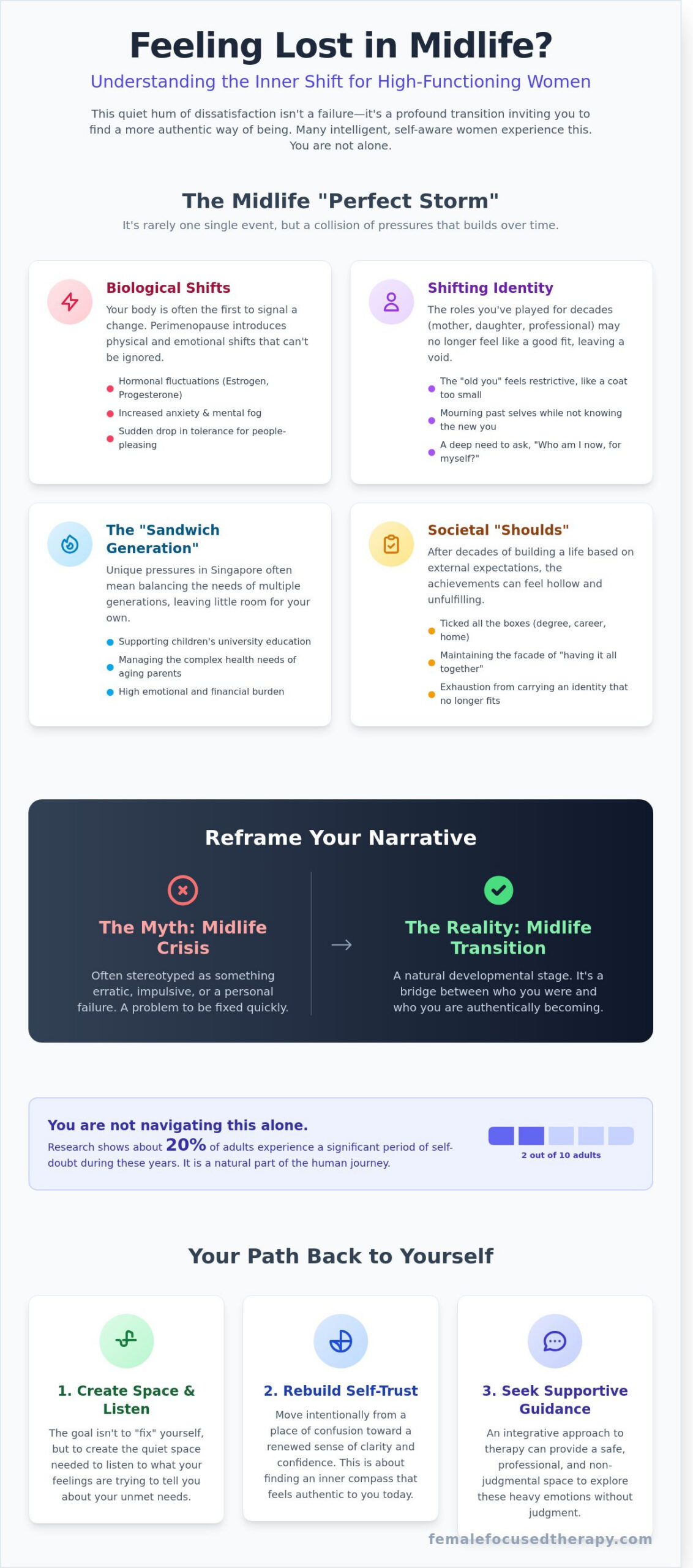
The myth of the midlife crisis vs. the reality for women
When we hear the term “midlife crisis,” the images that usually come to mind are loud and external. We think of the cliché of the red sports car, the sudden career pivot into something flashy, or the abrupt divorce. This narrative is heavily male-centric and focuses on a frantic attempt to grab onto youth. For the women I work with, the experience is rarely that noisy. It is usually much quieter, deeper, and more reflective.
For you, feeling lost in midlife might feel like a slow fading of colour from your world. It isn’t a sudden explosion; it’s a quiet “unravelling” of the roles you’ve played for decades. You might feel a sense of guilt for even feeling this way. In a city like Singapore, where we are often conditioned to keep striving and “keep face,” admitting you feel empty can feel like a betrayal of your hard work.
I want to reassure you that this isn’t a “first-world problem” or a sign of being selfish. It is a necessary reckoning. Brené Brown famously calls this period the midlife unraveling, a time when the universe reaches down and says, “I’m going to take all this stuff you’re using to protect yourself and hide your true self, and I’m going to take it away.” This is the time to look at the parts of yourself you’ve suppressed to keep others happy.
Moving past the ‘shoulds’ and self-blame
Many high-functioning women I meet carry a heavy burden of chronic self-blame. You might look at your life, your family, or your career and tell yourself you should be happy. When that happiness doesn’t arrive, you assume the fault lies with you. This perfectionism makes the transition feel like a personal failure rather than a natural life stage.
You’ve likely spent years “checking the boxes” that society, your parents, or your culture set out for you. However, checking boxes doesn’t guarantee a sense of belonging in your own life. If you’ve been living a life designed by others, it’s no wonder you eventually feel like a stranger in your own home. I often help women see that their “failure” to feel content is actually their inner self demanding something more authentic.
Reclaiming your voice in the silence
There is a specific kind of nihilism that can creep in during this time. You might find yourself wondering what the point of it all is, especially as children grow up or career peaks are reached. When this “nothingness” hits, I encourage you to meet it with kindness instead of fear. It’s a signal that your current life has become too small for the person you’ve grown into.
Feeling stuck is often the precursor to a significant expansion. I see this often in who I work with; these are women who are tired of the surface-level fixes and are ready to look beneath the skin of their daily routines. They want to move beyond just surviving the day. They are looking for a deeper reconnection with themselves through therapy.
This period of feeling lost in midlife is your opportunity to stop being who you were told to be. It is a transition from living for others to finally living for yourself. It requires courage to sit in the silence and listen to what your own voice is trying to say, but I promise you that your voice is still there, waiting to be heard.
If you’d like to find out more about working with Cheryl Kennedy MacDonald, you can email her at cheryl@femalefocusedtherapy.com or go ahead and book an appointment here: https://www.femalefocusedtherapy.com/book-now/
How to begin finding your way back to yourself
I want you to know that you don’t need to be fixed. When you’re feeling lost in midlife, it’s easy to treat your emotions like a broken appliance that needs a quick repair. I see this often in my practice. Women come to me exhausted, wanting a map and a compass immediately. But this feeling isn’t a malfunction. It’s a signal. It’s your inner self trying to get your attention after years of putting everyone else’s needs before your own.
Instead of a desperate search for answers, I encourage you to adopt a sense of gentle curiosity. This means asking “What is this feeling trying to tell me?” rather than “How do I make this stop?” You might start by carving out just ten minutes of protected time each day. Whether it’s a short walk or sitting quietly with a coffee before the house wakes up, this space is for your thoughts alone. You also need to set firm boundaries to protect your energy. This transition requires internal resources, so it’s okay to say no to social obligations that leave you feeling depleted.
Step 1: Name the feelings without judgment
When you name an emotion like “resentment,” “emptiness,” or “invisibility,” you immediately reduce its power to overwhelm you. I often suggest keeping a simple log on your phone or using voice notes to track your days. Notice your “glimmers,” which are those tiny moments of peace or joy, versus your “triggers” that spark anxiety. Validating your experience is the first step toward any meaningful change because you cannot move forward if you’re still busy shaming yourself for how you feel.
Step 2: Reconnect with your body
Many of the women I work with in Singapore live entirely from the neck up. You might be so busy overthinking and planning that you’ve lost touch with your physical self. Somatic practices are a gentle way to get back into your body. When you feel that “midlife hum” of anxiety, try a simple breathing exercise or a mindful body scan to ground yourself. Reconnecting with your body is a vital part of rebuilding self-trust. When you listen to what your body needs, whether it’s rest or movement, you start to believe in your own agency again.
Step 3: Seek a different kind of support
While friends are wonderful, they’re often navigating the same choppy waters. Sometimes, talking to someone in the same boat can leave you both feeling more adrift. There is immense value in a confidential, professional space where you don’t have to be the “strong one” or the “fixer.” In my work at Female Focused Therapy, I help women perform what I call a “midlife audit.” We look at your current life, your roles, and your burdens to decide what stays and what goes in this next chapter. Dealing with feeling lost in midlife is much easier when you have a dedicated space to unpack your thoughts without judgment.
If you’re ready to start your own midlife audit and find more clarity, you can explore how therapy can support your midlife transition with me.
If you’d like to find out more about working with Cheryl Kennedy MacDonald, you can email her at cheryl@femalefocusedtherapy.com or go ahead and book an appointment here: https://www.femalefocusedtherapy.com/book-now/
Rebuilding self-trust and clarity through therapy
When you’re feeling lost in midlife, it often feels like the ground beneath you has shifted. I see many women in my practice who find that this transition acts like a spotlight, illuminating old wounds they once thought were healed. Therapy can be a form of ‘re-parenting’ for yourself. It’s a chance to give that younger version of you the validation and safety she missed, which is essential when your current life feels chaotic or unrecognisable.
I use an integrative approach because one size never fits all. We might use Cognitive Behavioural Therapy (CBT) to challenge those loud, self-critical thoughts that tell you it’s ‘too late’ to change. We could bring in mindfulness to help you stay present when your mind starts racing about the future. Psychodynamic work allows us to look back at your earlier patterns, helping you understand why you react the way you do now. It’s about creating a toolkit that works for your specific life, whether you are balancing a high-pressure career in the CBD or managing a busy household in Singapore.
We move at a pace that is safe and sustainable for you. There’s no rush to fix everything in a single session. I’m here to be your grounded guide, someone who can hold space for those ‘WTF’ moments when you feel like you don’t recognise your own life. You don’t need to perform or have it all figured out when we talk; you just need to show up as you are.
The journey toward a stronger sense of self
The goal of our work isn’t to create a ‘new’ version of you. Instead, it’s about uncovering the ‘truer’ you that’s been buried under years of people-pleasing, motherhood, or career pressure. For many women, midlife is when undiagnosed ADHD or the impact of past relationship trauma finally peaks. In fact, some studies suggest that women in their 40s and 50s are the fastest-growing demographic seeking ADHD assessments. Therapy helps filter out that external noise, allowing you to find the clarity and confidence to make decisions that actually align with your own values.
- Identify and soften the ‘inner critic’ that fuels self-doubt.
- Process the grief of ‘what might have been’ to make room for what is.
- Develop boundaries that protect your energy and time.
- Learn to trust your intuition again after years of second-guessing.
Taking the next small step
You don’t have to navigate this transition alone. If you’ve been relying on self-help books or podcasts but still feel stuck, trust your gut. It might be time for more personalised, professional support. This stage of life doesn’t have to be a crisis, even if you are currently feeling lost in midlife. It can be the beginning of your most authentic chapter yet. Whether you’re looking for support with midlife and menopause or just need a space to breathe, my Female Focused Therapy practice is here to help.
I’ve seen women transform their ‘lost’ feeling into a deep sense of purpose after just a few months of consistent, gentle work. You deserve to feel like yourself again, perhaps for the very first time. Trust that you already have the answers inside you; we just need to clear the path so you can see them clearly.
Taking your first step toward clarity
You don’t have to carry the heavy weight of these changes alone. This season of life is often a complex collision of roles and expectations, but it’s also a vital invitation to listen to your own needs again. By shifting the focus from the myth of a crisis to the reality of a meaningful transition, you can begin the gentle process of rebuilding self-trust. We can work at a pace that feels safe for you, using an integrative approach to help you move from exhaustion to a stronger sense of self.
If you’re feeling lost in midlife, please know that your feelings are valid and professional support is available. I am a registered psychotherapist with specialized experience in women’s life transitions, offering a trauma-informed and confidential space. Whether you prefer to meet in person at my Singapore practice or connect online from another global location, we can navigate this journey together. You deserve to feel grounded and understood. You can explore how we might work together at femalefocusedtherapy.com.
If you’d like to find out more about working with Cheryl Kennedy MacDonald, you can email her at cheryl@femalefocusedtherapy.com or go ahead and book an appointment here: https://www.femalefocusedtherapy.com/book-now/
Common questions about feeling lost in midlife
Is it normal to feel lost in my 40s or 50s even if my life is ‘good’?
It is completely normal to feel this way, and you aren’t alone in this experience. Research from the London School of Economics shows that life satisfaction often hits its lowest point in the late 40s, a phenomenon known as the “U-bend” of happiness. You might have the career and the family you worked for, yet still feel a quiet sense of “is this it?”. I see this often in my practice in Singapore; it is not a sign of failure, but a signal that your inner self is ready for a new chapter.
How do I know if I’m having a midlife crisis or if I’m actually depressed?
A midlife transition usually feels like a search for meaning, while depression often feels like a loss of capacity for joy. If you find your sleep, appetite, or ability to function at work are impacted for more than 14 days, it may be clinical. Feeling lost in midlife is frequently about questioning your identity rather than a biological “low.” I can help you untangle these feelings in a safe, confidential space at Female Focused Therapy.
Can menopause cause me to feel like I’m losing my mind or my identity?
Hormonal changes during perimenopause and menopause directly impact your sense of self and brain chemistry. A 2022 study in the Journal of Women’s Health found that 60 percent of women experience “brain fog” or anxiety during this time. It’s not just in your head; your biology is shifting. This transition often forces a re-evaluation of who you are beyond your roles as a mother or professional. I believe understanding this connection is the first step toward feeling like yourself again.
What are the first signs of a midlife transition in women?
The first signs are often subtle, like a persistent restlessness or a feeling that your current life fits like a suit that’s too small. You might find yourself more irritable with people you love or daydreaming about a completely different life. In my experience, these feelings of feeling lost in midlife usually peak between ages 45 and 55. It’s your psyche’s way of asking you to pay attention to your own needs again after years of looking after everyone else.
I feel like it’s too late to change my career or my life path. Is it?
It is never too late to pivot; in fact, the average age for successful entrepreneurs is actually 45 according to data from the MIT Sloan School of Management. Many women in Singapore fear that a career change at 50 is impossible, but your experience is a massive asset. Whether it is starting a small business or returning to study, your second act can be more aligned with your true values than your first. I believe your best years of growth are still ahead of you.
How can therapy help me if I don’t even know what’s wrong, just that I feel ‘off’?
You don’t need a crisis or a specific diagnosis to benefit from therapy. Often, the most profound work happens when we simply explore that “off” feeling together. I use an integrative approach to help you name the unspoken pressures you’re carrying. We will work at a pace that feels safe for you, slowly rebuilding your self-trust and finding clarity in the fog. You can learn more about my therapeutic approach here.
What is ’emotional over-functioning’ and why does it peak in midlife?
Emotional over-functioning is when you take on the responsibility for everyone else’s well-being and “fix” things so others don’t have to. This peaks in midlife because you’re often the “sandwich generation,” caring for aging parents and growing children simultaneously. About 75 percent of caregivers in Singapore are women, leading to deep exhaustion. Learning to step back from this role is a vital part of your healing journey and finding your own purpose again.
How do I deal with the guilt of wanting something more for myself?
Guilt is often just a sign that you’re breaking an old habit of self-sacrifice. You’ve likely spent decades putting everyone else’s needs first, so choosing yourself feels “wrong” initially. I encourage you to see this desire for more as a healthy urge for growth. When you are fulfilled, you actually have more genuine warmth to offer the people you care about. It is an act of kindness to yourself and your family to prioritise your own wellbeing.
If you’d like to find out more about working with Cheryl Kennedy MacDonald, you can email her at cheryl@femalefocusedtherapy.com or go ahead and book an appointment here: https://www.femalefocusedtherapy.com/book-now/