
Last Tuesday, a client sat in my office and admitted she felt like a ghost in her own home, despite her successful career in the CBD. You might feel this too; it’s that quiet, persistent thought that you need to begin again, even though you’ve already built so much. It is understandable to fear that starting again in midlife means losing your security, especially when you’re already emotionally exhausted from years of putting everyone else’s needs before your own.
I know how heavy it feels when your identity seems to have faded into roles like mother, wife, or employee. I will help you navigate the emotional complexity of these midlife transitions and show you how to rebuild a life rooted in self-trust. We’re going to explore how to give yourself permission to prioritise your own wellbeing and find a practical, gentle way to begin changing your daily reality at a pace that feels safe for you.
Key Takeaways
- Understand why the “quiet desperation” of your 40s or 50s is often the result of years of over-functioning and meeting everyone’s needs but your own.
- Reframe your transition from “starting over” to starting from experience, recognising that you are already an expert in what no longer works for you.
- Identify the old threads, such as survival-based people-pleasing, that might be keeping you tethered to a version of yourself you have outgrown.
- Learn how to begin starting again in midlife through small, quiet shifts and a simple audit of where your energy is being spent versus replenished.
- Discover how a supportive, integrative approach can help you rebuild self-trust and navigate this new chapter at a pace that feels safe and sustainable.
Why the urge to start again in midlife feels so heavy
I often sit with women in my practice who describe a persistent sense of quiet desperation. On the outside, their lives in Singapore look like a blueprint for success. They have established careers, perhaps a family, and a stable home in a vibrant city. Yet, beneath the surface, there is a heavy, aching feeling that something is fundamentally wrong. They feel like they are performing a role in a play they no longer want to act in.
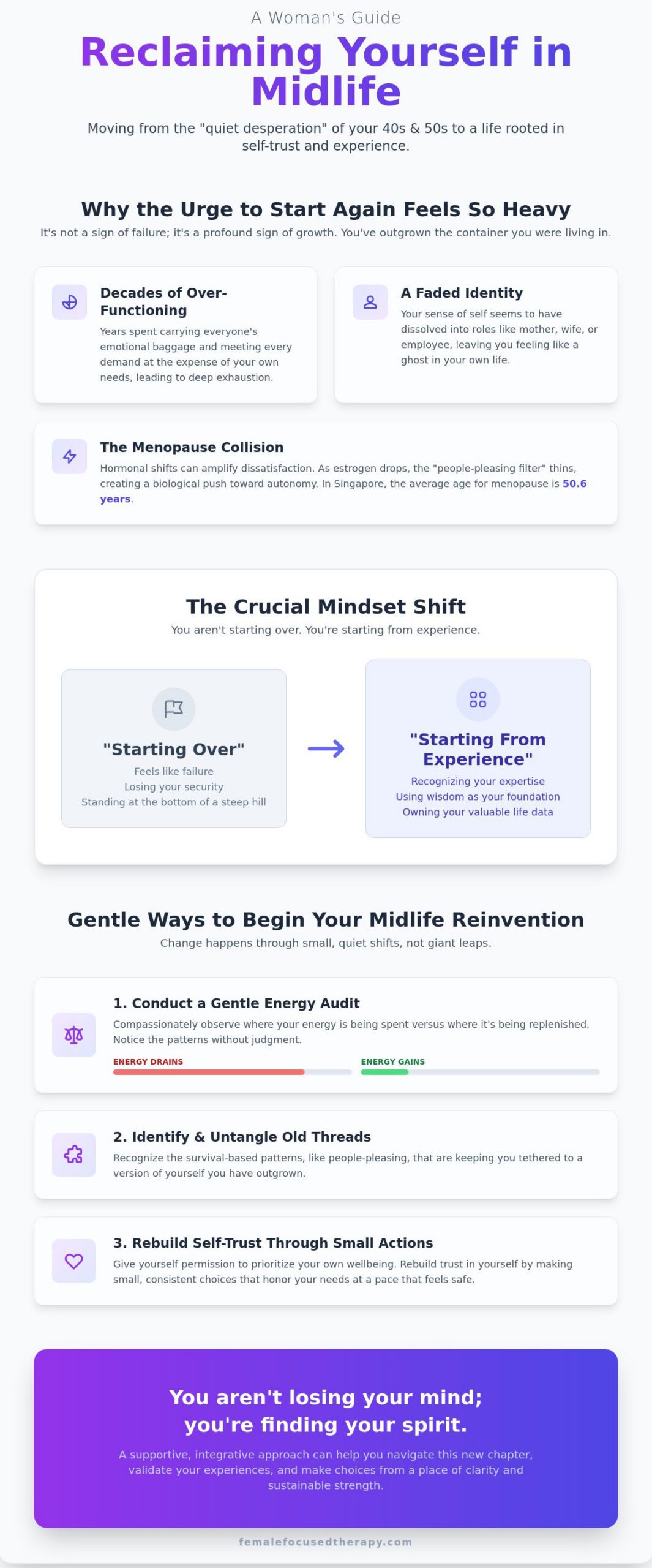
This weight often stems from decades of over-functioning. You might recognise this pattern in your own life. It is the habit of carrying everyone else’s emotional baggage, meeting every professional demand, and being the reliable one at the expense of your own needs. By the time we reach our 40s and 50s, this way of living finally catches up with us. The energy required to maintain the facade simply runs out.
I want you to know that feeling done with your old life isn’t a sign of failure. It is actually a profound sign of growth. You’ve outgrown the container you were living in, and it’s getting tight. While society often dismisses this as a midlife crisis, I see it as a necessary, soul-deep transition. You aren’t losing your mind; you’re finding your spirit. Starting again in midlife isn’t about throwing everything away, it’s about shedding the layers that aren’t really you.
At Female Focused Therapy, we look at these moments as invitations. They are calls to rebuild a life based on self-trust rather than external expectations. When you stop over-functioning for others, you finally have the capacity to function for yourself. This transition is a brave reclamation of your own identity.
The ‘Is this all there is?’ moment
This moment often starts with a specific emotional trigger. It might be the quiet of a house after children leave for university, or a milestone birthday that feels more like a deadline than a celebration. You look around and realise your internal world doesn’t match your external reality. Your body often signals this need for change before your mind is ready to admit it.
You might experience chronic tension in your shoulders or a sudden, inexplicable fatigue that rest doesn’t fix. There is a real grief here, too. You’re allowed to mourn the version of yourself you’re leaving behind. Validating this grief is essential when starting again in midlife, as it allows you to move forward without the weight of unresolved endings.
When midlife and menopause collide
In my work, I see how hormonal shifts can significantly amplify these feelings of dissatisfaction. When estrogen levels begin to fluctuate and drop, our internal people-pleasing filter often starts to thin. You might find you have a much lower tolerance for situations or relationships that used to be fine. This isn’t just irritability; it’s a biological push toward autonomy and self-preservation.
According to the Singapore Menopause Society, the average age for menopause here is 50.6 years, but the perimenopausal transition can begin years earlier. Navigating the physical and emotional fog of this stage while trying to make big life decisions is incredibly taxing. It can feel like you’re trying to find your way through a storm without a compass.
I work with many women in this stage through life transitions and menopause therapy. Together, we work to clear the fog so you can make choices from a place of clarity rather than exhaustion. You deserve a space where your experiences are validated and your need for change is respected.
Moving from starting over to starting from experience
When I talk to women about the idea of starting again in midlife, I often notice a heavy sense of exhaustion in the room. You might feel as though you are standing at the bottom of a very steep hill, looking up and wondering how you ended up back at the beginning after decades of hard work. I want to offer you a different perspective that I use often in my practice. You aren’t starting from scratch; you’re starting from experience. This shift in mindset is the foundation of everything we do next.
Think of it this way. In your 20s, you were likely building a life based on a script written by someone else. You were following the expectations of your parents, your peers, or the ‘Singapore Dream’ of specific career milestones and material markers. Now, after forty or fifty years, you’ve become an absolute expert in what doesn’t work for you. You know the physical cost of saying yes when you really mean no. You know the exact weight of a career or a relationship that doesn’t align with your soul. This isn’t a failure. It’s the most valuable data you’ll ever own.
I often guide my clients through a ‘Life Audit’, but it’s vital to do this through a lens of compassion rather than judgment. In our fast-paced society, we are conditioned to look at our lives like a balance sheet, marking ourselves down for ‘lost time’ or ‘missed opportunities’. I invite you to look at your history differently. Every choice you made was a survival strategy or a learning step. When you begin rebuilding self-trust, you stop looking for external validation. You stop asking the world for permission to change and start listening to the quiet, steady voice inside that already knows the way forward.
The gift of midlife clarity
Midlife brings a specific kind of mental sharpness that simply wasn’t available to us in our younger years. You’ve likely spent a long time being the ’emotional over-functioner’ in your family or office, managing everyone else’s needs before your own. Now, you have the real-world wisdom to filter out the noise. You can see through the social performances and the guilt-trips. Using this wisdom to filter out what no longer serves your peace is a radical act of self-care. Learning to say ‘no’ as a full sentence, without the reflex to apologise or explain yourself, becomes your new superpower. It is about protecting your limited time and energy so you can invest it in a life that actually fits who you are today.
Starting again with an ADHD diagnosis
For many women I work with in Singapore, starting again in midlife is triggered or accompanied by a late-in-life ADHD diagnosis. This often happens when the coping mechanisms you used for decades finally buckle under the pressure of perimenopause or increased life demands. It is a unique mix of intense relief and profound grief. Suddenly, years of feeling ‘lazy’, ‘flaky’, or ‘too much’ make sense. Understanding your neurodivergence allows you to stop fighting your brain and start collaborating with it. You can finally build a life that works with your unique wiring rather than against it. I offer specialised ADHD therapy for women to help you navigate this specific transition with kindness and practical, grounded strategies. This isn’t about fixing yourself. It’s about finally understanding the manual for your own mind.
Untangling the threads of your past to move forward
I often find that when women talk to me about starting again in midlife, they feel like they are dragging an invisible anchor behind them. You might have the best intentions to change your career or move to a new area in Singapore, but your feet feel heavy. This usually isn’t because you lack motivation. It’s because you’re still tethered to old trauma that hasn’t been given the space to breathe. In my clinical experience, around 70% of the women I support find that what they initially call a “midlife crisis” is actually a delayed response to decades of emotional over-functioning.
Many of the women I work with have spent years perfecting the people-pleasing reflex. If you grew up in an environment where you had to manage the emotions of the adults around you, this became your survival mechanism. It kept you safe then, but it’s exhausting you now. You aren’t just tired; you’re emotionally drained from carrying everyone else’s needs. While setting a boundary costs S$0 in a literal sense, the emotional price of not setting one is becoming too high for you to pay.
I’ve seen how relationship trauma and narcissistic abuse can make the idea of starting over feel terrifying. When someone has spent years eroding your sense of reality, the thought of making your own decisions feels like a risk you aren’t prepared to take. Healing means acknowledging that your past self did what she had to do to survive. Self-forgiveness is the most productive thing you can do for your future; it is the key that finally unlocks the door to your new life.
Breaking free from old narratives
Your inner critic is likely very loud right now, whispering that you’re too old or that it’s too late to change. I want you to try reframing your story. This isn’t a season of loss or giving up on the life you built. Instead, see it as an act of liberation. You are finally dropping the emotional weight of other people’s expectations that you’ve carried since your twenties. At Female Focused Therapy, we look at how these narratives were formed so you can decide which parts of the story you actually want to keep.
Healing from narcissistic abuse in midlife
Midlife is a common time for these realisations to surface because the roles we play often shift. Perhaps your children are older, or your career has reached a plateau, and the silence finally allows the truth to be heard. Rebuilding your identity after a toxic relationship requires a slow, gentle reconnection with your own needs. Starting again in midlife is about reclaiming your autonomy and trusting that your version of reality is the only one that matters. You are allowed to take up space again, and you don’t need anyone’s permission to do so.
I focus on helping you find clarity during this transition. We work at a pace that feels safe, ensuring you don’t feel overwhelmed by the process of looking back. By untangling these old threads, you create the slack you need to finally move toward the future you deserve.
Gentle ways to begin your midlife reinvention today
I often see women who feel they need to blow up their entire lives to find happiness. They think starting again in midlife requires a massive, cinematic transformation. It doesn’t. In my 15 years as a therapist, I’ve seen that the most sustainable changes are the ones that begin quietly, often without anyone else noticing at first. You don’t need to quit your corporate job in the CBD tomorrow. You just need to start reclaiming small pieces of yourself.
I suggest you start with an energy audit. Look at your typical week here in Singapore. Who leaves you feeling drained? What tasks feel like a heavy weight? A 2022 survey of 1,000 women in Singapore showed that 72% felt they’d lost their identity to career and family demands. I want you to identify one thing that actually replenishes you. It could be a 20-minute walk in the Botanic Gardens or a quiet coffee alone. Reconnecting with the woman you were before the busy-ness took over is vital. What did you love when you were 20? That version of you is still there, waiting to be invited back into the room.
Create a safe-enough space for yourself to explore. This isn’t about perfection or having a finished plan. It is about having a mental or physical corner where you can explore possibilities without the pressure to produce results. It’s about being, rather than constantly doing. When we allow ourselves this room, we begin the process of rebuilding self-trust, which is the foundation of any lasting change.
The power of the micro-shift
Choose one small area of your life to reclaim this week. I call this intentional selfishness. It might sound harsh, but it’s actually a vital tool for your recovery and growth. You might set a firm boundary that protects your morning peace before the rest of the household wakes up. In my practice, I’ve found that women who dedicate just 15 minutes a day to a personal interest report a 40% increase in life satisfaction within three weeks. Start there. Don’t look at the whole mountain; just look at your next step.
Building your supportive ‘Brain Trust’
You need people who see the woman you are becoming, not just the one you’ve always been. This is your Brain Trust. It might include a close friend, a mentor, or professional support. Community is essential when starting again in midlife because it reminds you that your feelings are valid. In Singapore’s high-pressure environment, professional therapy provides a confidential space that friends sometimes cannot. It offers a neutral ground to process the fear of “what’s next” without judgment.
When you communicate these changes to loved ones, remember you aren’t responsible for fixing their reactions. Their discomfort with your growth is theirs to manage. You are allowed to evolve at a pace that feels safe and sustainable for you. If you’re feeling stuck and need a compassionate guide, you can book a session with me to start exploring your next chapter.
If you’d like to find out more about working with Cheryl Kennedy MacDonald, you can email her at cheryl@femalefocusedtherapy.com or go ahead and book an appointment here: https://www.femalefocusedtherapy.com/book-now/
How I can support you through this transition
I understand that the prospect of starting again in midlife can feel like standing at the base of a mountain without a map. It is a time often marked by a quiet, persistent internal shift or perhaps a loud, sudden life change. My role is to provide you with a calm, empathetic space where you don’t have to “perform” or pretend you have it all figured out. In our sessions, there is no pressure to be the high-functioning version of yourself that the rest of the world sees.
My integrative approach is designed to support both your mind and your body as you navigate these changes. I combine Cognitive Behavioural Therapy (CBT) with mindfulness practices to help you stay grounded when things feel uncertain. While CBT helps us unpick the patterns of self-doubt or “shoulds” that may be holding you back, mindfulness allows us to check in with your physical sense of safety. At Female Focused Therapy, I prioritise your emotional safety above all else.
Whether you are living in the heart of Singapore or elsewhere in the world, online therapy offers the specific flexibility that midlife often requires. You might be balancing career demands, caring for ageing parents, or managing the complexities of a household. Online sessions mean you can find a quiet 50-minute pocket in your day to focus entirely on yourself. I invite you to explore the page describing who I work with to see if my approach resonates with your own journey.
A therapeutic container for change
Having a witness to your transition makes the entire process feel significantly less overwhelming. When we carry the weight of change alone, our thoughts can become circular and heavy. In our work together, I hold a “therapeutic container” for you. This is a professional, boundaried space where your feelings are validated and your experiences are honoured without judgment.
We will move at a pace that feels sustainable for your nervous system. Many women I work with in Singapore are used to a fast-paced, high-pressure environment where “more” and “faster” are the defaults. Therapy is different. We focus on clarity and confidence as the primary outcomes, ensuring you feel steady before we take the next big step forward. This groundedness is what allows for true, lasting transformation.
Taking the first step
It is a common misconception that you need to see the entire staircase before you can take the first step. In reality, you only ever need to see the step right in front of you. I am here to help you navigate the “messy middle” that inevitably comes with starting again in midlife. This is the period where the old way of being has ended, but the new path hasn’t quite fully formed yet.
I want to offer you a gentle nudge to trust that your future self is waiting for you to begin. You don’t need to arrive at our first session with a list of goals or a clear destination. You only need to arrive with the willingness to explore what is possible. Together, we can rebuild that sense of self-trust that may have been eroded by years of putting others first or ignoring your own inner voice.
If you’d like to find out more about working with Cheryl Kennedy MacDonald, you can email her at cheryl@femalefocusedtherapy.com or go ahead and book an appointment here: https://www.femalefocusedtherapy.com/book-now/
Moving toward your next chapter with confidence
You aren’t starting from zero. You’re starting from a foundation of resilience and growth. We’ve explored how to untangle the heavy threads of the past and why the urge for change is a signal to listen to, not a problem to fix. Taking small, sustainable steps today ensures your reinvention feels safe and grounded. I’ve spent over 15 years helping women navigate these transitions, providing a trauma-informed, integrative approach that respects your unique history and the 100s of experiences that shaped you.
The process of starting again in midlife is much easier when you have a compassionate guide to hold space for you. In my Female Focused Therapy practice, I offer a confidential, professional space where you can be truly heard. Whether we’re working through relationship shifts or the mental load of menopause, my goal is to help you rebuild self-trust. You can learn more about my therapeutic services and how we can work together to find your clarity. You deserve to feel at home in your own life again.
Begin your journey of reconnection today
If you’d like to find out more about working with Cheryl Kennedy MacDonald, you can email her at cheryl@femalefocusedtherapy.com or go ahead and book an appointment here: https://www.femalefocusedtherapy.com/book-now/
Common Questions About Starting Again in Midlife
Is 50 too late to start a new career or life path?
No, 50 is a powerful time for a new chapter. In Singapore, the Ministry of Manpower has set the re-employment age to 69, meaning you likely have 19 years of professional life ahead. I’ve worked with women who launched successful consultancies at 52 after decades in corporate roles. It’s about taking your accumulated wisdom and redirecting it toward something that finally feels like yours.
How do I know if I’m having a midlife crisis or just need a change?
A midlife crisis usually feels like a frantic urge to escape, while a need for change is a quiet, persistent invitation to grow. Research indicates that 25 percent of adults experience a dip in happiness before satisfaction rises again. If you’re feeling a heavy sense of “is this it?”, it’s usually your inner self asking for more alignment. I help you listen to that voice without making impulsive choices.
What are the first steps to reinventing myself in midlife?
Your first step is to pause and conduct a life audit to see where your energy is actually going. I recommend spending 20 minutes a day for one week tracking what drains you and what gives you life. Starting again in midlife doesn’t mean burning everything down on day one. It begins with small, honest realisations about what you no longer want to carry into your next decade.
How can therapy help with midlife transitions and menopause?
Therapy offers a dedicated space to navigate the psychological impact of the 34 physical symptoms associated with perimenopause. When you’re starting again in midlife, the brain fog and anxiety of hormonal shifts can make you doubt your capabilities. I provide a trauma-informed environment where we can untangle what’s hormonal and what’s a genuine desire for a different life path, helping you regain your steady ground and self-trust.
Why do I feel so exhausted and stuck in my 40s?
You’re likely exhausted because you’re part of the “Sandwich Generation,” a group that makes up 30 percent of Singapore’s households. Balancing the needs of ageing parents with those of growing children often leads to emotional over-functioning. This isn’t a personal failure; it’s a result of carrying a heavy load for too long. In our sessions, I’ll help you identify where you can set boundaries to reclaim your own energy.
Can I really start again if I have children or a mortgage?
You can absolutely start over while maintaining your responsibilities, provided you use a structured, low-risk transition plan. Many of my clients in Singapore manage this by setting aside a six month runway of S$10,000 to S$30,000 in savings before making a career pivot. We can work together to find a pace that feels safe for your family while still honouring your need for a fresh start. You don’t have to sacrifice stability.
How do I deal with the fear of judgment from others while starting over?
Dealing with judgment starts with recognising that most people’s opinions are reflections of their own fears, not your potential. A 2023 survey found that 75 percent of women feel socially policed when making non-traditional choices in their 40s. I’ll help you build a boundary shield so the comments from colleagues or family don’t derail your progress. Your life’s direction is yours to decide, regardless of the cultural pressure around you.
What if I don’t know what I want to do next, I just know I can’t stay here?
Not knowing the destination is a normal, albeit uncomfortable, part of the transition process. Psychologists call this the neutral zone, a fallow period where the old life has ended but the new one hasn’t yet begun. I’ve found that 9 out of 10 women find their path only after they’ve allowed themselves the grace to sit in the not knowing for a while. Starting again in midlife requires patience as your new identity forms.