
Last Tuesday, a client sat in my consulting room and described the exact moment she realised she was an overwhelmed mother; she was hiding in the pantry for 12 minutes just to hear herself think. If you’ve found yourself doing something similar, please know your feelings are completely valid. Being an overwhelmed mother often comes with a deep sense of guilt for not enjoying every second, or a feeling of being erased by the constant noise. It’s a heavy burden to carry when you feel like you’ve lost the woman you used to be.
I know you want to feel present and joyful, but your nervous system is likely stuck in a state of chronic sensory overload. At Female Focused Therapy, I help every overwhelmed mother I work with to navigate this exact type of emotional exhaustion. I want to help you understand why you feel so depleted and how we can begin to lighten the load together. In this post, we will explore the root causes of your fatigue and find gentle, realistic ways to help you feel like yourself again.
Key Takeaways
- Understand the difference between being just “busy” and feeling truly erased by the sensory overload of daily demands.
- Explore how deeper factors, such as adult ADHD or past experiences, might be contributing to your experience as an overwhelmed mother.
- Deconstruct the myth of the “perfect mother” and move past the social media illusions that leave you feeling inadequate.
- Learn gentle, practical ways to reconnect with your body’s signals and begin to reclaim your sense of self.
- Discover how a safe, professional space can help you move from simply coping to finding a way to thrive again.
Understanding the Quiet Exhaustion of the Overwhelmed Mother
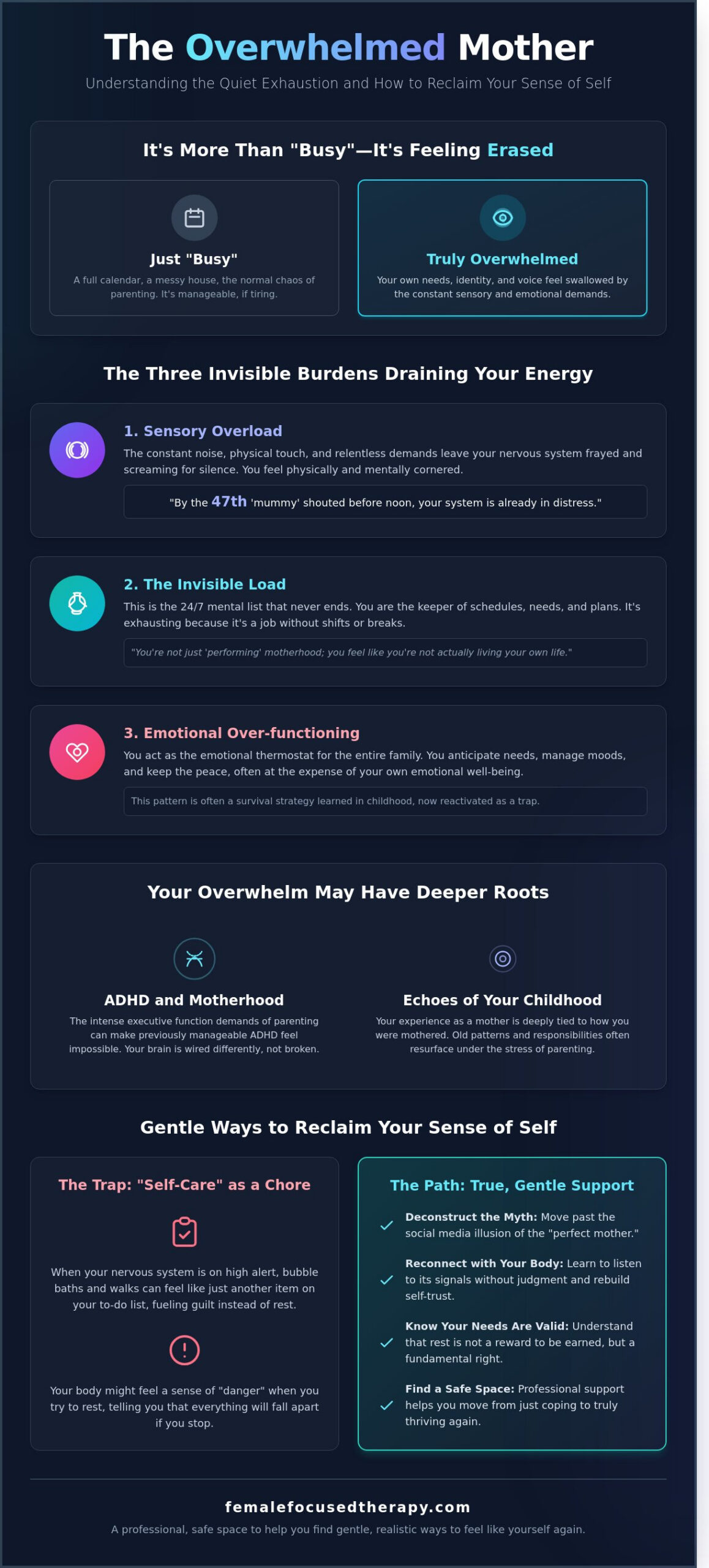
I want to start by acknowledging something you might be feeling but haven’t yet put into words. There’s a profound difference between being a busy parent and being an overwhelmed mother who feels like she’s slowly being erased. It isn’t just about having a full calendar or a messy house. It’s the feeling that your own needs, identity, and voice have been swallowed whole by the roles you play every day.
You might find yourself in a state of constant sensory overload. By the time the 47th “mummy” has been shouted before noon, your nervous system is often screaming for silence. The constant physical touch, the background noise of toys, and the relentless demands for your attention can leave you feeling frayed. This Parenting stress is a heavy, physical weight that settles in your shoulders and chest.
Then there’s the invisible load. This is the mental list that runs 24 hours a day in your head. You’re the one who knows when the library books are due, which child needs new shoes, and what’s for dinner on Tuesday. It’s exhausting because it never ends. At Female Focused Therapy, I often hear women describe this as “performing” motherhood. You’re going through the motions and saying the right things, but you don’t feel like you’re actually living your own life.
The weight of emotional over-functioning
You might find yourself acting as the emotional thermostat for your entire home. If your partner is stressed or your child is upset, you feel it’s your job to fix it immediately. This emotional over-functioning means you’re constantly anticipating needs before they’re even spoken. You’re scanning faces for signs of discontent and adjusting your own behaviour to keep the peace.
This pattern often didn’t start with motherhood. It’s a survival strategy you likely learned much earlier, perhaps in a childhood where you felt responsible for a parent’s happiness. Now, as an overwhelmed mother, that old habit has become a trap. You’ve become so focused on everyone else’s emotional well-being that you’ve lost touch with your own.
When self-care feels like just another chore
We’re often told that a bubble bath or a quick walk will solve everything. But when your nervous system is on high alert, these things can feel like just another item on your to-do list. You might even feel a sense of “danger” when you try to rest. The guilt creeps in, telling you that you’re being selfish or that everything will fall apart if you stop for ten minutes.
True support is deeper than a temporary break. It’s about rebuilding self-trust and recognising that your needs are valid, not a burden. We need to move away from the idea that you have to “earn” your rest. Healing begins when you realise that you don’t have to carry the entire world on your own to be worthy of love and care.
If you’d like to find out more about working with Cheryl Kennedy MacDonald, you can email her at cheryl@femalefocusedtherapy.com or go ahead and book an appointment here: https://www.femalefocusedtherapy.com/book-now/
Why Your Overwhelm Might Go Deeper Than Your To-Do List
I often hear from women who feel they’re failing because they can’t seem to keep up with the basics of daily life. If you’re an overwhelmed mother, it’s easy to assume the problem is your schedule or a lack of discipline. I’ve built my Female Focused Therapy practice to help women understand that these heavy feelings often have much deeper roots than a simple to-do list.
Motherhood through the lens of ADHD
For many women, a diagnosis of ADHD only arrives after they have children. The sudden increase in executive function demands, such as managing multiple schedules and sensory overload, can make a previously manageable life feel impossible. You aren’t lazy or scattered; your brain is simply wired to process information and transitions differently than the neurotypical standard.
This neurodivergence can make the emotional intensity of parenting feel magnified. When your brain struggles to filter out the noise of a crying toddler or the mental load of meal planning, your nervous system stays in a state of high alert. This constant “on” mode is physically exhausting and often leads to the chronic self-blame that I see so frequently in my therapy room.
The echoes of your own childhood
Your experience as a mother is deeply tied to how you were mothered yourself. If you grew up with parental neglect or had to “parent” your own caregivers, you might find yourself over-functioning today. You’re trying to give your children everything you lacked, which is a beautiful but draining goal. It’s helpful to consider a global perspective on maternal mental health to see how our early environments shape our current resilience.
That inner critic who tells you you’re not doing enough often sounds remarkably like a voice from your past. Breaking this cycle involves recognising that your current stress is often a reaction to old wounds. If you’d like to explore how your history impacts your present, you can look at the different ways I support women and who I work with in my practice.
The “perfect mother” myth suggests we should be able to do it all with a smile. In reality, a 2023 study by Ohio State University found that 66% of parents meet the criteria for parental burnout. When you understand that your brain and your history play a role in how you experience stress, you can begin to replace shame with self-compassion. You are doing a difficult job with a complex set of tools.
If you’d like to find out more about working with Cheryl Kennedy MacDonald, you can email her at cheryl@femalefocusedtherapy.com or go ahead and book an appointment here: https://www.femalefocusedtherapy.com/book-now/
Moving Beyond the Myth of the Perfect Mother
I see so many women between the ages of 25 and 65 trying to live up to a cultural narrative that simply isn’t human. We’re told mothers should be tireless and entirely selfless. But when you’re an overwhelmed mother, these expectations feel like a weight you can’t possibly lift.
In 1953, the paediatrician Donald Winnicott coined the term “good enough mother.” He suggested that children actually benefit from a mother who isn’t perfect, as it helps them navigate a world that won’t always cater to their every need. This shift from perfection to presence offers a path to true psychological freedom.
Admitting you’re at your limit is an act of bravery, not a confession of failure. It’s the first step toward reclaiming your sense of self. Sometimes, this weight is tied to deeper clinical issues. If you’re struggling to find joy, understanding depression can help you see that your feelings aren’t a personal flaw.
The danger of comparison
Social media encourages you to compare your “insides” to everyone else’s “outsides.” You see a curated 5 percent of a friend’s life while you’re living 100 percent of your own messy reality. This “Supermom” image is a performance that leaves everyone involved feeling lonely and inadequate.
Finding community requires us to lead with honesty rather than perfection. When we share our struggles, we create a space where it’s safe to be human. You can find a safe space at Female Focused Therapy where we can explore these feelings without judgment.
Why asking for help isn’t a sign of weakness
Reframing “help” as a necessary part of the human experience is a vital shift. It isn’t a failure of your independence or your role as an overwhelmed mother. I know how hard it is to let go of control when you’ve always been the “strong one” in your family or career.
Allowing others in actually benefits your children too. It teaches them that they don’t have to carry the world alone when they grow up. You can explore who I work with to see how we can start lightening that load together at a pace that feels sustainable for you.
If you’d like to find out more about working with Cheryl Kennedy MacDonald, you can email her at cheryl@femalefocusedtherapy.com or go ahead and book an appointment here: https://www.femalefocusedtherapy.com/book-now/
Gentle Ways to Reclaim Your Sense of Self
When you feel like an overwhelmed mother, the idea of “self-care” often feels like just another chore on a list that is already too long. I want to offer you something different. This isn’t about expensive spa days or radical life changes; it’s about finding small, quiet ways to come back to yourself in the middle of the noise.
Reclaiming your sense of self starts with lowering the volume of daily stress. This doesn’t require an hour of meditation. Instead, it involves making tiny, sustainable shifts in how you interact with your day. It is about moving from a state of constant “doing” into a gentle state of “being,” even if only for a few minutes at a time.
Building a ‘Motherhood Map’ that works for you
I often suggest looking at your day through the lens of energy rather than time. Start by identifying what actually drains your battery versus what gives you a tiny spark of recharge. You might find that a specific social media feed or a “should” about house cleanliness is taking more than it gives. Learning to say “no” to these drains is a vital step for your wellbeing.
- Identify three “micro-recharges” that take less than five minutes, such as drinking a cup of tea while it is still hot.
- Notice which tasks feel like a heavy weight and see if they can be paused or delegated.
- Create pockets of “me-time” that don’t require leaving the house, like sitting in the car for five minutes after you arrive home.
Listening to your body’s wisdom
Your body usually knows you’re reaching your limit before your mind catches up. You might feel a sudden tightness in your throat, a shallow breath, or a heavy sensation in your limbs. Recognising these physical signs early can help you pause before you reach the point of “snapping” at those around you. This somatic awareness is a key part of managing emotional exhaustion.
You can practice grounding even while standing at the kitchen sink. Notice the weight of your feet on the floor. Feel the temperature of the soapy water on your skin. These small moments of presence help regulate your nervous system. When an overwhelmed mother begins to listen to these signals, she can start to respond to her own needs for hunger, thirst, or rest before the crisis point hits.
If you feel stuck in a cycle of exhaustion, you might find it helpful to explore how therapy can support your journey toward a more sustainable way of living. Rebuilding self-trust starts with these small, compassionate choices.
If you’d like to find out more about working with Cheryl Kennedy MacDonald, you can email her at cheryl@femalefocusedtherapy.com or go ahead and book an appointment here: https://www.femalefocusedtherapy.com/book-now/
Finding a Space to Process Your Experience
You’ve spent so long looking after everyone else. It’s easy to lose sight of where their needs end and yours begin. I offer a confidential, professional space that belongs entirely to you. It’s a place to set down the heavy bags you’ve been carrying and finally look inside them.
We move beyond just ‘getting through the day’. Using an integrative therapeutic approach, we look at how your past experiences and current patterns intersect. This helps an overwhelmed mother move from a state of constant survival into a life where she can actually thrive.
Working with someone who understands the specific pressures women face makes a significant difference. I’ve spent over 15 years helping women navigate these exact feelings. We’ll focus on rebuilding your self-trust and working toward emotional stability that feels solid, not just like a temporary fix.
A safe space where you are heard
I want to offer you a place where you don’t have to be the ‘strong one’. You don’t have to be the caregiver here. In our 50-minute sessions, your needs are the absolute priority. We work at a pace that feels safe for your nervous system, ensuring you never feel rushed to ‘fix’ everything at once.
There’s no pressure to perform or have all the answers. You can explore who I work with to see if my approach feels like the right fit for your current journey. It’s about finding a rhythm that supports your healing without adding to your stress.
Lightening the load, together
Talking to a friend is wonderful, but professional psychotherapy is different. It provides objective, evidence-based tools to help you navigate deep-seated feelings of exhaustion. It’s a structured way to understand why you feel this way and how to change the internal narrative.
Investing in your mental health isn’t a luxury. It’s the kindest thing you can do for your family. When an overwhelmed mother feels supported and regulated, the whole home environment begins to shift. It creates a ripple effect of calm that everyone in your life will eventually feel.
I invite you to imagine what your life might look like with a little more space to breathe. You can find more information on my homepage about how we can start this process together. You don’t have to carry this weight alone anymore.
If you’d like to find out more about working with Cheryl Kennedy MacDonald, you can email her at cheryl@femalefocusedtherapy.com or go ahead and book an appointment here: https://www.femalefocusedtherapy.com/book-now/
Finding your way back to yourself
I want you to know that the heavy feeling you’re carrying isn’t a sign of failure. It’s often a sign that you’ve been holding too much for too long. We’ve explored how the overwhelmed mother often struggles with a myth of perfection that simply doesn’t exist. You can start to let that go today by choosing self-compassion over self-blame.
Reclaiming your identity happens in tiny, quiet moments of reconnection. I’m a Registered Psychotherapist with years of experience supporting women through these transitions. I combine my Scottish warmth with a trauma-informed and ADHD-aware approach to help you feel safe. You deserve a professional space where you can find clarity and confidence again through specialised support.
You don’t have to carry this weight alone. If you’re ready to move forward, I’m here to help you navigate the path ahead at a pace that feels sustainable. You’ve already taken the first step by acknowledging your experience. To begin, you can book an appointment here.
If you’d like to find out more about working with Cheryl Kennedy MacDonald, you can email her at cheryl@femalefocusedtherapy.com or go ahead and book an appointment here: https://www.femalefocusedtherapy.com/book-now/
Frequently Asked Questions
Is it normal to feel like I don’t like being a mother sometimes?
Yes, it’s very normal and more common than you might think. A 2021 study published in the Journal of Family Psychology found that 8.3% of parents experience frequent feelings of regret or intense dislike for their role. You aren’t failing; you’re likely just exhausted by the relentless demands of the job rather than the children themselves. I often see women who love their children deeply but feel trapped by the repetitive, thankless nature of daily caregiving.
How do I know if I’m just tired or if I’m a truly overwhelmed mother?
Tiredness usually goes away after a solid 7 hour stretch of sleep, but being an overwhelmed mother feels like a heavy weight that rest doesn’t lift. If you find yourself snapping at small noises or feeling a sense of dread when you wake up, it’s more than physical fatigue. According to researchers at UCL, chronic stress in mothers often manifests as cognitive fog and a persistent feeling of being “on edge” even when things are quiet.
Can ADHD make me feel more overwhelmed by my children?
Yes, ADHD can significantly amplify the sensory and organisational load of parenting. For the 3.4% of adult women living with ADHD, the constant noise, touch, and mental switching required by children can lead to rapid sensory overload. I work with many women who find that their executive function struggles make the “mental load” of motherhood feel physically painful. This often leads to a much quicker path to total burnout.
What is the difference between motherhood burnout and postnatal depression?
While they share 4 or 5 key symptoms like exhaustion and irritability, burnout is usually tied directly to the “job” of parenting. Postnatal depression often includes a pervasive low mood that stays even when you’re away from your children. A 2022 report by the PANDAS Foundation noted that while depression involves a loss of interest in everything, burnout often resolves temporarily when the mother gets a genuine break from caregiving duties.
How can I set boundaries with my children without feeling like a ‘bad’ mum?
Setting boundaries is actually an act of love that teaches your children about healthy relationships. You can start by saying, “Mummy needs 10 minutes of quiet time so I can be a better listener for you.” Research from the University of Sussex suggests that children who see their parents model self-care develop better emotional regulation themselves. It’s not about being “bad”; it’s about being sustainable for the long haul.
What should I do if my partner doesn’t understand my overwhelm?
It’s helpful to move away from “you don’t do enough” to “I feel like I’m drowning.” In a 2023 survey of 2,000 parents, 62% of mothers felt their partners underestimated their mental load. I suggest sitting down during a calm moment to list the 20 or 30 “invisible” tasks you handle daily. Sometimes, seeing the sheer volume of tiny decisions you make every hour helps a partner grasp why you’re so emotionally depleted.
How can therapy help me when I don’t even have time to shower?
Therapy provides a dedicated 50 minute space where you are the only priority. It might feel like another “to-do,” but it actually helps you clear the mental clutter that makes daily life feel so heavy. By carving out this time once a week, we can work together to rebuild your self-trust. This mental clarity often helps women find hours of “lost” time by reducing the energy spent on self-blame and rumination.
Is it possible to enjoy motherhood again after feeling this burnt out?
Yes, it is absolutely possible to find joy in your family again. A 2020 study on parental burnout recovery showed that with targeted support and lifestyle shifts, 75% of parents reported a significant return of positive feelings toward their children within 6 months. We focus on small, manageable steps to lower your stress levels so that the moments of connection can start to feel light and nourishing again.