
What happens when the life you’ve so carefully built starts to feel like it belongs to someone else? It’s that jarring moment when you catch your reflection and don’t quite recognise the person staring back. You’ve spent years being a mother, a partner, a leader, a friend, and now, the roles feel heavier than the person wearing them. This sense of disconnection is a common, though often unspoken, part of the midlife identity crisis for so many women. I want you to know that it’s not just you, and you’re not imagining it.
I understand how emotionally exhausting it can be to feel like you’re performing a life rather than truly living it. In this article, my promise is to gently explore this feeling with you and offer a real sense of hope. Together, we’ll navigate why this transition feels so heavy and how you can begin the quiet, steady work of reconnecting with your own values, reclaiming your sense of self with clarity and confidence.
Key Takeaways
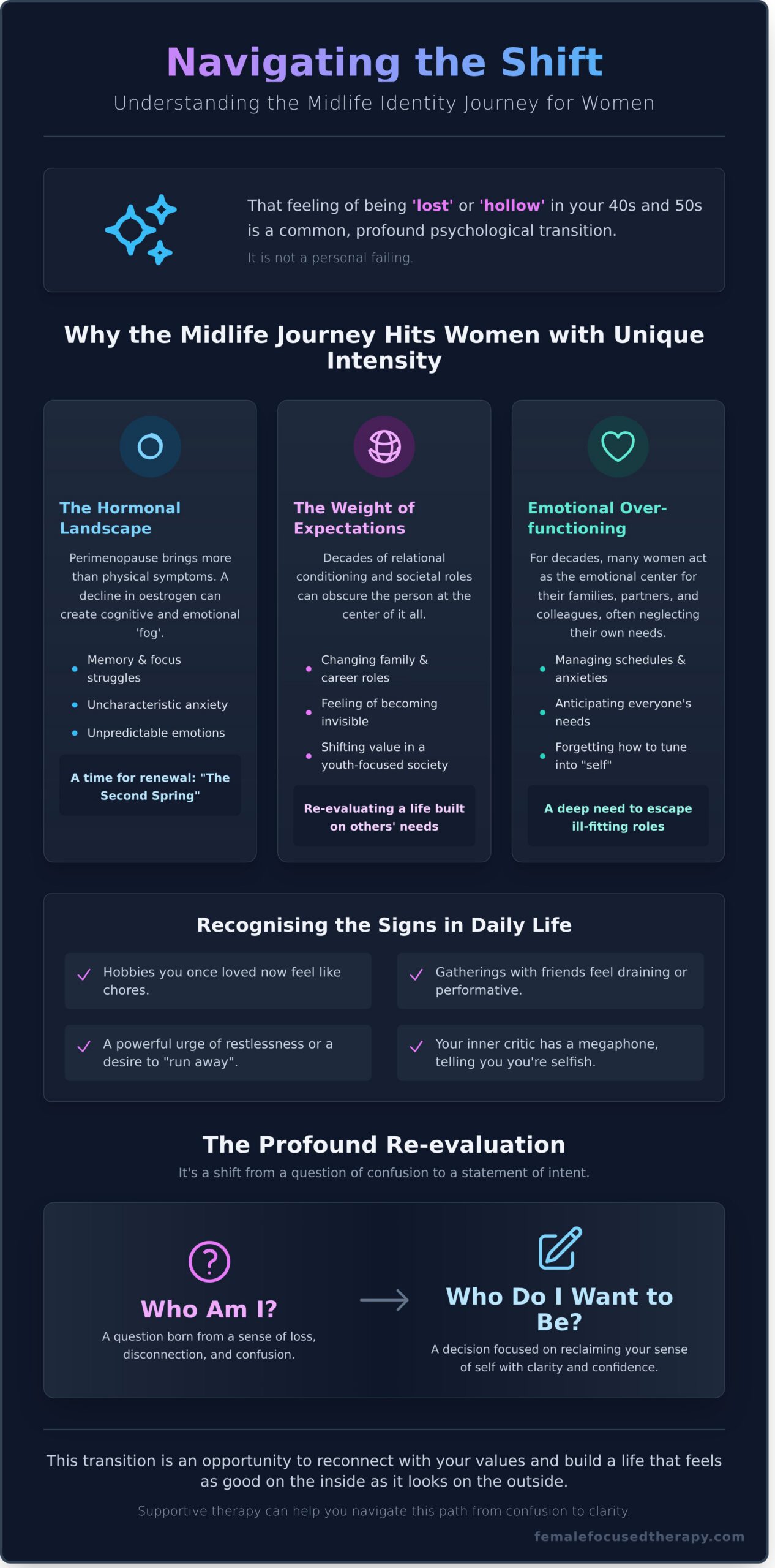
- Understand why the feeling of being ‘lost’ or ‘hollow’ in your 40s and 50s is a common psychological transition, not a personal failing.
- Learn about the specific societal and biological factors, like perimenopause, that can make this midlife journey feel particularly intense for women.
- Discover how to gently navigate your midlife identity crisis by shifting your focus from what’s been lost to what you can reclaim through small, sustainable changes.
- Explore how a supportive space can help you move from asking ‘Who am I?’ to confidently deciding ‘Who do I want to be?’
The Quiet Unravelling: What a Midlife Identity Crisis Really Feels Like
It often arrives without a sound. On the surface, your life might look exactly as it should. You have the career, the family, the home you worked so hard for. Yet, a quiet, persistent hollowness has settled in. It’s a strange feeling of disconnection, as if you’re watching someone else live your life. You go through the motions, meet your responsibilities, and smile at the right times, but underneath it all, a question echoes: “Is this really it?”
For many high-functioning women, especially in their 40s and 50s, this question feels both terrifying and a little ungrateful. You feel you shouldn’t be asking it. But this isn’t a sign of failure. This is often the beginning of a profound psychological transition. The term midlife crisis has become a bit of a cliché, often pictured as something loud and disruptive. In my experience, however, a woman’s midlife identity crisis is usually a much quieter, more internal unravelling.
It’s also important to gently distinguish this experience from clinical depression. While they can share symptoms like low mood or a lack of motivation, the feeling I’m describing is often more existential. It’s less about an inability to feel pleasure and more about a deep, searching question for meaning, purpose, and a connection to a more authentic self. It’s a yearning for a life that feels as good on the inside as it might look on the outside.
Recognising the Signs in Your Daily Life
You might notice that the hobbies you once loved now feel like chores. Perhaps gatherings with old friends feel draining because you’re tired of playing a role you’ve outgrown. It can feel like you’re performing a version of yourself that was created years ago, and the costume has become heavy and uncomfortable. This isn’t a breakdown; it’s a profound re-evaluation of the self.
Why It Often Feels Like a Loss of Control
This period can feel so unsettling because of the growing tension between who the world expects you to be and the person you are becoming. For years, you’ve likely been a partner, a mother, a daughter, a leader. These roles, while important, can sometimes obscure the person at the centre of them all. When that person starts to stir, it can feel like you’re losing your grip.
During this uncertainty, the inner critic often gets a megaphone. It tells you you’re being selfish, foolish, or that you’re about to ruin everything. This internal noise is exhausting. It’s no wonder so many women describe a physical sensation of restlessness, a powerful urge to just run away from it all. This feeling isn’t a desire to escape your life, but a deep need to escape the roles that no longer fit and finally find yourself. It’s a key part of the support I offer here at Female Focused Therapy.
Why the Midlife Journey Hits Women with Unique Intensity
While a midlife identity crisis can affect anyone, I find in my practice that it often lands with a unique weight for women. It’s not just one thing. Instead, it’s the convergence of several powerful currents: societal expectations, profound biological shifts, and decades of relational conditioning. You may feel as though you’re becoming invisible, your value shifting in a society that often overlooks women as they age.
This experience is so common that a great deal of focus on the Midlife Crisis in Women highlights these intersecting pressures. It’s a period where the roles you’ve held for years may be changing, your body feels unfamiliar, and the question “Who am I, really?” becomes impossible to ignore.
The Hormonal Landscape and Your Identity
Perimenopause and menopause aren’t just about physical symptoms. The decline in oestrogen can create a cognitive and emotional ‘fog’ that makes clear self-reflection incredibly difficult. You might struggle with memory, feel uncharacteristically anxious, or find your emotional responses are unpredictable. It’s easy to feel like you’re losing your mind, and with it, your sense of self.
There’s often a deep grief that comes with this. It’s a mourning for the person you used to be, the body you knew, and the energy you once had. However, I encourage you to see this differently. In many cultures, this transition is seen as a ‘second spring’-a time of renewal and wisdom, not an ending. Navigating these changes is a core part of the work I do in life transitions and menopause therapy, helping women find their footing again.
The Burden of Emotional Over-functioning
For decades, you may have been the emotional centre of your family. You’ve likely managed schedules, soothed anxieties, and anticipated the needs of your partner, children, and perhaps even your colleagues. This pattern, which I call emotional over-functioning, means you’ve had very little practice in tuning into your own needs.
This becomes particularly acute when your primary role shifts. The children may have left home, creating an ’empty nest’. For many, this happens while they are also part of the ‘sandwich generation’, caught between the demands of growing children and the needs of ageing parents. When that intense caregiving phase finally subsides, the silence can be deafening. The identity of ‘carer’ is gone, and you’re left wondering what remains.
Suddenly, the thought of doing something ‘just for me’ can trigger immense guilt. It feels selfish and unfamiliar. Yet, this is the very work of midlife: to finally turn that incredible capacity for care inward. This journey back to yourself is at the heart of the support I offer at Female Focused Therapy, creating a space where your needs can finally take centre stage.
When Past Trauma or ADHD Complicates Your Midlife Experience
For many of us, the questions that surface in midlife feel deeply personal. Yet for some women, this period is more than a simple re-evaluation of life choices. It can feel like a seismic shift, where old, unresolved pain suddenly demands your attention. If you have a history of trauma or live with neurodivergence, your midlife identity crisis might feel particularly intense and confusing.
This isn’t because you’re doing anything wrong. It’s because the mental and emotional scaffolding you’ve used to hold everything together for decades may no longer be working. Midlife, with its hormonal changes and natural shifts in perspective, often acts as a catalyst, bringing everything to the surface. It’s a time when we need to approach ourselves with immense kindness and a trauma-informed lens.
The ‘Second Wave’ of Healing
Perhaps you find yourself feeling a deep, familiar ache of loneliness or responsibility. For women who experienced childhood neglect or were ‘parentified’ (made to take on adult emotional roles as a child), midlife can trigger a second wave of grief. The realisation that you’ve spent your entire life caring for others, or trying to earn love from a toxic person, can be staggering. This is especially true for survivors of narcissistic abuse, who may look at the life they’ve built and see someone else’s reflection. The good news is, with the wisdom of age comes a new clarity. Midlife often provides the perspective and courage needed to finally set the boundaries you always deserved.
ADHD and the Midlife Overwhelm
If you’re a woman with ADHD, you may have spent a lifetime ‘masking’ your symptoms to fit in. This constant effort to appear organised, calm, and focused is exhausting. During the hormonal shifts of perimenopause and menopause, declining oestrogen levels can significantly impact executive function, making focus, memory, and emotional regulation feel nearly impossible. The coping strategies that once worked may suddenly fail you. That feeling of being ‘broken’ is often just your brain needing a different kind of support as your biology changes. It’s not a personal failure; it’s a signal that it’s time to find new, more compassionate ways to support yourself.
Ultimately, whether you’re grappling with the echoes of the past or the new challenges of a neurodivergent brain in midlife, the path forward involves recognising that you can’t push through in the same old way. This transition asks for a gentler, more informed approach to your own wellbeing, one that honours all of who you are and everything you’ve been through.
Moving from ‘Who Am I?’ to ‘Who Do I Want to Be?’
That question, ‘Who am I?’, can feel like standing in a house where all the furniture has been removed. It’s disorienting and empty. For so long, your identity was likely tied to your roles: partner, parent, professional, caregiver. A midlife identity crisis often begins with the grief for those fading roles, but its true potential lies in the next question: ‘Who do I want to be now?’
This isn’t about what you’ve lost. It’s about what you can finally reclaim.
There can be an immense pressure to make a dramatic change. To sell the house, quit the job, or move to a new country. While those big moves work for some, I’ve found that real, sustainable change often comes from micro-changes. These are the small, consistent shifts that slowly rebuild a foundation of self-trust. It’s about gently turning the ship, not capsizing it.
Practical Steps for Self-Discovery
This exploration doesn’t require a year-long sabbatical. It can begin right here, in the small moments of your day. The first step is to quiet the outside noise and listen to your own inner wisdom, which has probably been whispering to you for a long time.
A simple way to start is with a ‘Values Audit’. Take a piece of paper and write down what truly matters to you today. Not the values you inherited or the ones that defined you ten years ago. Perhaps ‘ambition’ was at the top of your list in your thirties, but now, ‘peace’, ‘creativity’, or ‘connection’ feel far more important. Seeing it on paper is a powerful act of validation.
Your body is also a source of incredible information. I often encourage clients to practice somatic awareness, which is simply learning to listen to the body’s signals. Notice the tightening in your chest when you agree to something out of obligation. Feel the sense of lightness or expansion when you think about trying a new pottery class. Your body knows your ‘yes’ and ‘no’ long before your mind does.
Finally, make space for unstructured play. This isn’t about achieving a goal; it’s about reconnecting with curiosity and joy. It could be 20 minutes spent doodling, walking through your neighbourhood without a destination, or creating a playlist of songs you loved as a teenager. Play reminds you of the person you are underneath all the responsibilities.
The Courage to Disappoint Others
As you begin to honour your own needs, you may find that it makes others uncomfortable. The people in your life are used to the ‘old’ you, the one who perhaps put her own needs last. Your growth might feel like a disruption to them, and that’s okay. Giving yourself permission to disappoint others is one of the most radical acts of self-care you can perform.
Communicating these shifts to a partner or family requires gentleness and clarity. It can be helpful to use ‘I’ statements, like: “I’m realising I need more quiet time to recharge, so I won’t be able to host dinner every Sunday anymore.” You are not asking for permission; you are stating a need. This process is a core part of the work we do at Female Focused Therapy, helping you find the words to reshape your relationships with confidence and kindness.
It’s also vital to find your ‘tribe’-other women who understand this journey. Whether it’s a book club, a walking group, or an online community, connecting with others who are also navigating this second act can make you feel seen and supported. You realise you aren’t alone in this. This journey of rediscovery can feel challenging, and having a safe space to begin is key. My list of free therapy resources offers some gentle prompts that can help you start this reflection on your own terms.
Rebuilding Your Sense of Self Through Therapeutic Support
If you feel like you’re navigating the choppy waters of midlife without a map, therapy can be the safe harbour you need. It’s a dedicated space, just for you, to pause, reflect, and make sense of the internal shifts that can feel so disorienting. You don’t have to figure this all out alone. Having a professional, compassionate guide can provide the stability and perspective needed to find your way through this transition.
My approach is built on a deep understanding of the female experience. I combine practical, evidence-based tools like Cognitive Behavioural Therapy (CBT) with grounding mindfulness practices. This integrative method helps us work with both your thoughts and your body, creating a holistic path towards healing. Together, we can untangle the patterns that are keeping you stuck and gently build new ones that serve the woman you are becoming.
The goal is not to go back to who you were before. It’s to move forward with a renewed sense of who you are now. It’s about cultivating clarity in your decisions, rebuilding your confidence from the inside out, and forging a stronger, more trusting relationship with yourself. This is your opportunity to redefine your life on your own terms.
This journey is deeply personal, and finding the right therapist is a crucial first step. You can explore who I work with to see if my approach and specialisms feel like a good fit for you and what you’re going through right now.
What to Expect in Our Sessions
You can expect a confidential, professional space where you can be completely, unapologetically honest without fear of judgment. We will always work at a pace that feels safe and sustainable for you. At the heart of our work will be the gentle process of rebuilding self-trust, which can often be eroded during a challenging midlife identity crisis. It’s about learning to listen to your own inner voice again.
Taking the First Step Toward Clarity
Sometimes the most profound relief comes from finally saying the words ‘I’m not okay’ out loud to someone who can hold that truth with you. It’s an act of courage that marks the beginning of change. You might be surprised by how a few initial sessions can provide the perspective needed to stop feeling so ‘stuck’ and see a glimmer of the path forward. When you feel ready, I’m here to help you begin that journey back to yourself. You can learn more about my practice at Female Focused Therapy.
Embracing the Woman You’re Becoming
That stranger in the mirror doesn’t have to feel like an adversary. She is simply a sign that you’re ready for a new chapter. Moving through this time isn’t about finding the person you used to be; it’s about having the courage to decide who you want to become next. It’s a shift from questioning your identity to consciously creating it.
Navigating a midlife identity crisis is a profound journey, and you don’t have to walk it alone. If you feel you need a safe, confidential space to explore these feelings, I’m here to support you. As a Registered Psychotherapist, I specialise in trauma-informed therapy for women, using an integrative approach that blends CBT with mindfulness to help you reconnect with yourself.
This process is about rebuilding self-trust at a pace that feels right for you. If you’re ready to take a gentle step forward, you can learn more about my work at Female Focused Therapy. Remember, this is your story to write.
Your Questions About Midlife Transitions, Answered
Is it normal to have a midlife crisis at 40?
Yes, it’s completely normal to experience this around age 40. This milestone often acts as a natural point for reflection, prompting us to evaluate our careers, relationships, and overall life satisfaction. It’s not a sign that you’ve done anything wrong; rather, it’s your mind and spirit signalling that it’s time to check in and see if your current life truly aligns with your deeper values and desires.
What are the first signs of a midlife identity crisis in women?
The initial signs are often internal and subtle. You might feel a deep sense of dissatisfaction or boredom with a life that looks perfectly fine from the outside. Many women I support describe questioning past decisions, feeling a new urgency to make a big change, or feeling invisible after years of focusing on others. This inner questioning is a key part of a midlife identity crisis and a sign that you’re ready for a new chapter.
How long does a midlife crisis typically last?
There is no fixed schedule, but this period of intense self-reflection can last anywhere from three to ten years. The duration depends entirely on your personal circumstances and how you choose to engage with the questions that arise. The goal isn’t to speed through it. Instead, it’s about allowing yourself the time and space to explore your feelings and consciously build a life that feels more authentic to who you are today.
Can menopause cause an identity crisis?
Yes, the profound hormonal shifts during perimenopause and menopause can absolutely be a catalyst for an identity crisis. These changes affect your mood, energy, and even how you think, which can leave you feeling disconnected from yourself. This biological transition marks a significant life stage, often forcing you to confront questions about your purpose, femininity, and what you want from the years ahead. It’s a psychological journey layered on a physical one.
Is a midlife crisis the same as depression?
No, they are different, though their symptoms can sometimes overlap. A midlife crisis is primarily a psychosocial transition focused on questioning your identity, purpose, and life choices. Depression, on the other hand, is a clinical mood disorder with specific diagnostic criteria, such as a persistent low mood and loss of pleasure. While the stress of a midlife transition can sometimes lead to depressive feelings, they are not the same condition and may require different approaches to support.
How can I help my partner understand what I’m going through?
Helping your partner understand begins with open and gentle communication. Try using “I” statements to explain your feelings, such as, “I’m feeling lost and am trying to figure out what I need,” which is less confrontational than “You don’t understand me.” It can also be helpful to reassure them that your self-exploration is about your own growth and not necessarily a rejection of them or your shared life. Patience is key for both of you.
When should I seek professional help for my midlife transition?
You might consider seeking professional support when your feelings of confusion, sadness, or restlessness begin to impact your daily life. If you feel stuck, overwhelmed, or find that your work and relationships are suffering, therapy can offer a confidential, supportive space. You don’t have to wait for a breaking point. A therapist can help you navigate your thoughts and emotions, providing tools to move forward with clarity and confidence.
Can a midlife crisis actually be a positive thing?
Absolutely. Though it feels challenging, I prefer to reframe it as a ‘midlife awakening’. It’s a powerful opportunity to pause, reassess, and consciously design the next phase of your life. This period can be the catalyst for profound personal growth, leading you to reconnect with your true self, pursue dormant passions, and create a future that is more aligned with your authentic values, leading to greater long-term fulfilment.