
You stand in the kitchen at 7:00 AM, looking at a cereal box that no one is going to touch, and the silence feels heavy enough to bruise. For 18 years, your internal clock was set by their needs, their schedules, and their noise. Now that the front door has closed for the final time, you might feel like you’ve vanished along with the chaos. It’s common to feel a deep, unsettling empty nest identity crisis when the role that defined you for decades suddenly feels redundant.
I know how confusing it is to feel a sense of grief instead of the freedom everyone promised you’d enjoy. You’ve spent so long looking outward that looking inward feels foreign, perhaps even a little selfish. In this post, I want to offer you a compassionate space to understand why losing your primary mothering role feels like losing your very soul. We’ll explore how to move through this transition without the weight of guilt or the pressure to just get over it.
We’ll look at the psychological shift that happens in midlife and discuss three gentle, practical ways to begin the journey back to your own needs and desires. By the end, you’ll have a clearer sense of how to rebuild a life that feels purposeful, even when the house is quiet.
Key Takeaways
- Understand why the sudden silence in your home feels so heavy and why this transition is a natural, albeit difficult, response to a major life shift.
- Explore how the “double transition” of menopause and your children leaving can amplify feelings of invisibility and emotional exhaustion.
- Learn practical ways to sit with the quiet and create new, gentle rhythms that focus on your own wellbeing instead of immediate busyness.
- Discover how to navigate an empty nest identity crisis by reclaiming your sense of self beyond the daily role of “mother.”
- Find out how professional support can provide a safe, compassionate space to process these complex emotions and rebuild your self-trust.
Understanding the Empty Nest Identity Crisis in 2026
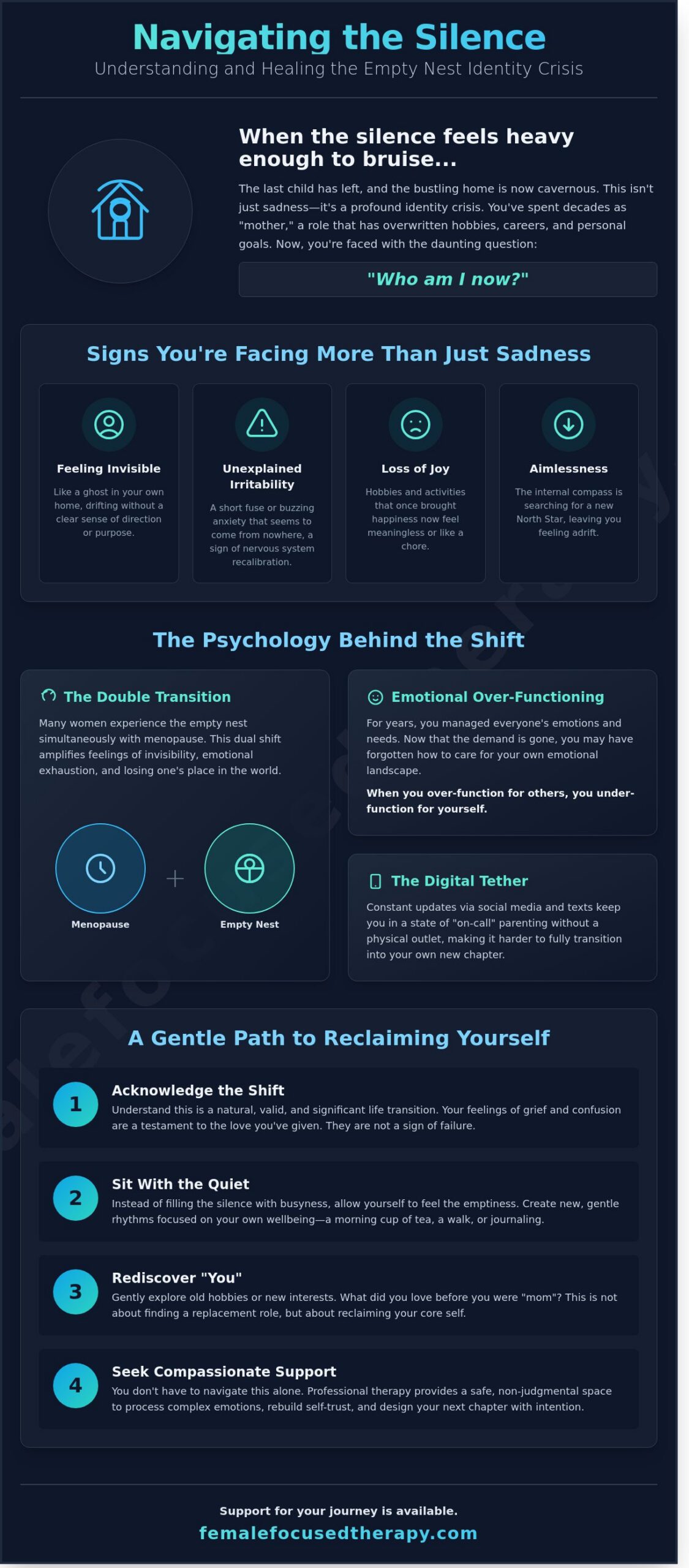
The silence in your home can feel like a physical weight, can’t it? I have sat with many women in my practice here in Singapore who describe this exact sensation. The last child has moved out, perhaps to university overseas or a flat in Tiong Bahru, and suddenly the house feels cavernous. It isn’t just a bit of peace and quiet. It’s a thunderbolt of silence that triggers a deep, buzzing anxiety in your chest. You might find yourself wandering into their empty bedroom, staring at the desk where they used to study for exams, feeling like a stranger in your own life. This is the beginning of an empty nest identity crisis, and it is a completely natural response to one of life’s most significant shifts.
I want you to know that what you’re feeling is valid. There is a profound difference between the normal sadness of missing your child and a deep loss of self. Sadness is about them; an identity crisis is about you. It’s the feeling that the ground has shifted beneath your feet. You’ve spent years, perhaps decades, being the person who knows where the spare keys are, what’s for dinner, and how to soothe a broken heart. When those daily tasks vanish, it’s common to feel a sense of aimlessness. This transition is a testament to the depth of your love and the energy you’ve poured into your family. You can find more about the general symptoms of What is empty nest syndrome to see how these feelings often manifest in others.
The “Who Am I Now?” Question
For many of us, decades of “mothering” have slowly overwritten our original identities. You may have started your journey as a woman with specific hobbies, career goals, or a certain spark that belonged only to you. Over time, those things were set aside to make room for the needs of your children. In my work at Female Focused Therapy, I see how the psychological impact of losing your primary daily role can be jarring. You aren’t just losing a housemate; you’re losing the version of yourself that you’ve known best for twenty years.
In 2026, this transition carries new pressures. We live with a “digital tether” to our adult children. You might see their life updates on Instagram or receive a WhatsApp message at 2 a.m., yet you aren’t there to help them. This constant, low-level connection can prevent you from fully moving into your next chapter. It keeps you in a state of “on-call” parenting that no longer has a physical outlet, making the search for a new identity even more complex. If you’re struggling with this shift, you might find my midlife support services helpful as we navigate these changes together.
Signs You Are Facing an Identity Crisis
You might feel like a ghost in your own home, drifting from room to room without a clear sense of direction. An empty nest identity crisis is a psychological recalibration of one’s core purpose. This often shows up as unexplained irritability or a sudden, confusing lack of interest in things that used to bring you joy. Perhaps your morning yoga or your book club suddenly feels meaningless. These aren’t signs that something is “wrong” with you, but rather signals that your internal compass is searching for a new North Star. It’s a period of intense transition that requires patience and a gentle hand as you rebuild your sense of self-trust.
If you’d like to find out more about working with Cheryl Kennedy MacDonald, you can email her at cheryl@femalefocusedtherapy.com or go ahead and book an appointment here: https://www.femalefocusedtherapy.com/book-now/
The Psychology of the Motherhood Role Shift
I often see women in my practice who feel as though they have lost their internal compass. This is not just a case of feeling a bit down; it is a profound biological and psychological transition. Attachment theory tells us that the bond you have nurtured for decades is designed to be fierce and protective. When that physical proximity changes, your nervous system can go into a state of high alert. This motherhood role shift is a physiological event as much as an emotional one.
Many of the women I work with have fallen into the trap of emotional over-functioning. You may have spent years managing everyone’s emotions, anticipating problems before they happen, and smoothing over conflicts. While this kept your household running, it likely left you feeling empty once the noise subsided. When you over-function for others, you often under-function for yourself. You might find that you have forgotten how to care for your own emotional landscape because you were so busy tending to theirs.
I find that high-achieving women often struggle the most with an empty nest identity crisis. If you are used to being a “manager” in your professional life, you likely applied those same skills to parenting. You were the Chief Operating Officer of your family. Now that your “employees” have moved on to start their own ventures, your role feels redundant. The challenge now is moving from manager to consultant. You are still a vital resource, but you only provide input when you are asked for it. This shift requires a massive amount of restraint and self-reflection.
The Burden of the Default Parent
Being the primary caregiver in Singapore often involves an intense mental load. A 2021 report by AWARE found that women here spend 4.3 hours a day on unpaid care work, nearly triple the time spent by men. You have likely spent years tracking tuition schedules, health checkups, and NS enlistment dates. When that mental load suddenly vanishes, it leaves a cavernous void. You may find yourself grieving the “last times,” such as the last school run or the last shared weekday meal, without even realising it. If you’re feeling overwhelmed by this quiet, Female Focused Therapy can help you process these transitions.
Rebuilding Self-Trust After Decades of Caregiving
After twenty years of focusing on what “they need,” it is completely normal to lose the ability to hear your own voice. You might find it difficult to make even simple decisions, like what to eat for dinner or how to spend a Saturday afternoon. This is because your “want” muscle has atrophied. The first steps in rebuilding self-trust involve getting quiet enough to hear your own preferences again. It is about moving away from the “shoulds” that have governed your life for so long.
I encourage you to start small. Instead of asking what the family wants for the weekend, ask yourself what would bring you peace or joy. This is not being selfish; it is a necessary part of navigating an empty nest identity crisis. You are learning to make decisions based on “I want” rather than “they need.” It takes time to trust that your needs are valid without being tied to your productivity as a mother. We can work together to help you find that confidence again at a pace that feels sustainable for you.
If you’d like to find out more about working with Cheryl Kennedy MacDonald, you can email her at cheryl@femalefocusedtherapy.com or go ahead and book an appointment here: https://www.femalefocusedtherapy.com/book-now/
The Double Transition: Empty Nest and Menopause
It is rarely just one thing that brings a woman to my therapy room. Usually, it is a layering of life events that finally feels too heavy to carry alone. For many of us in Singapore, the quiet of the house coincides exactly with the biological shift of perimenopause or menopause. This creates a “perfect storm” where your physical and emotional worlds are changing at the same time.
According to the Health Promotion Board, the average age for menopause here is around 51. This is often the same year your youngest might be heading off to university or starting their first job. It is a biological and emotional collision that can trigger a profound empty nest identity crisis. You are mourning the loss of your daily mothering role while your body is fundamentally changing how it functions.
When your hormones are fluctuating, your internal “shock absorbers” aren’t as effective as they once were. You might find that a small comment or a photo of your child as a toddler leaves you feeling completely undone. This isn’t a sign of weakness; it is a physiological reality. The drop in oestrogen can make you feel invisible, not just in your home, but in society too.
Sleep disturbances and the dreaded “brain fog” only add to the struggle. If you have spent three nights awake with night sweats, you won’t have the cognitive energy to process the grief of your child leaving. It becomes a cycle of exhaustion and emotional fragility that makes finding your new self feel impossible. It is hard to imagine a future when you’re too tired to focus on the present.
Hormones and Emotional Resilience
As oestrogen levels decline, the part of our brain responsible for regulating emotions becomes more reactive. I often hear women describe feeling “raw” or as if they have lost their protective outer shell. You might feel more vulnerable to criticism or find yourself weeping at things that would not have bothered you five years ago.
This biological shift can make the empty nest identity crisis feel much more aggressive than it actually is. Understanding that your brain is physically changing can be a huge relief. Seeking specialised menopause therapy can help you distinguish between hormonal shifts and the genuine grief of this life transition, allowing you to move forward at a pace that feels safe.
The Myth of the “Selfless Mother”
We live in a culture that often praises women for disappearing into their roles as mothers. There is a lingering societal expectation that we should suffer through midlife transitions in silence, as if our own needs are secondary to the family unit. I want to tell you that choosing yourself now is not an act of abandonment. It is an act of survival.
You have spent decades over-functioning for others. Now, the “midlife unraveling” is actually an invitation to rebuild. It is a time of reclaiming power that has been redirected elsewhere for years. Reframing this period as a necessary growth phase allows you to move from a place of loss to one of potential. You aren’t just a mother whose job is done; you’re a woman whose next chapter is finally beginning, and that is a powerful place to be.
Practical Steps to Reclaim Your Identity
Living in a quiet house for the first time in two decades can feel jarring. In Singapore, where our culture often prizes constant productivity and family-centric roles, the sudden drop in domestic demands leaves a significant void. You might feel a frantic urge to fill every spare hour with new commitments just to avoid the stillness. I encourage you to resist this impulse. Reclaiming your identity during an empty nest identity crisis isn’t about finding more things to do. It’s about learning who you are when no one is asking you for a meal, a lift to the MRT, or help with their life admin.
I suggest creating new rhythms that prioritise your physical and emotional wellbeing. This might mean reclaiming your mornings for a walk at Bukit Timah Nature Reserve or simply enjoying a cup of tea without interruption. Handling the quiet is a practice. When the silence feels heavy, try to stay with it for just five minutes before reaching for your phone or turning on the television. This space is where your new self begins to breathe.
Setting healthy boundaries with your adult children is also vital. Whether they are away at university, serving National Service, or moving into their own flat, you are no longer on 24-hour standby. I’ve seen many women find peace by scheduling specific times for calls rather than waiting by the phone. This protects your space and allows you to focus on your own growth without feeling like an emotional concierge.
Finding Your New Purpose
Think back to who you were before the school runs and tuition schedules dominated your calendar. I often suggest a gentle exercise: look at photos of yourself from your early 20s. What did that woman love? Maybe she enjoyed pottery, hiking, or reading historical fiction. You don’t need to commit to a five-year plan. Try small, low-pressure experiments. Attend one trial class or buy one book on a subject that used to fascinate you. If you don’t enjoy it, you haven’t failed; you’ve simply gathered information about your current self. Remember, volunteering isn’t always the answer. Sometimes, after years of giving to others, you just need to “be” for a while.
Nurturing Your Relationship with Yourself
Sitting with the discomfort of silence is where mindfulness becomes a practical tool. It allows you to observe the feelings of loss or uncertainty without being swept away by them. Journaling can help you process this shift. Try writing down three things you’ve learned about yourself since the house became quiet. It’s also a time to look at how your home life is changing if you have a partner. The “buffer” of the children is gone, which can feel exposing. Be honest with them about your need for self-discovery. If you’re feeling stuck in this transition, exploring these feelings in therapy can help you rebuild your sense of self-trust at a pace that feels safe.
How Therapy Supports This Life Transition
You might feel that your empty nest identity crisis isn’t “serious” enough to warrant professional help. Perhaps you tell yourself that this is just a natural part of life and you should simply get on with it. I want to reassure you that the shift from a full, busy household to a quiet one is a significant psychological event. It involves the loss of a primary role you have held for twenty years or more. It’s completely valid to seek support when the foundations of your daily life have shifted so dramatically.
I provide a dedicated space to help women navigate these life transitions with grace and self-compassion. In my practice at Female Focused Therapy, I see many women in Singapore who have spent decades balancing demanding careers with the intense pressures of the local education system. When the final school run is over and the tuition schedules vanish, the resulting silence can feel heavy. I offer a safe, confidential environment where you can explore who you are outside of being “mum” or a “fixer” for everyone else.
My approach is integrative, meaning I draw on different therapeutic tools to suit your specific needs. We often use Cognitive Behavioural Therapy (CBT) to identify the “stuck” thought patterns that fuel your anxiety or low mood. We then weave in mindfulness practices to help you stay grounded in the present moment. This combination is effective; research suggests that even 8 to 10 sessions of integrative therapy can significantly reduce the symptoms of situational depression. We work together to move you from a place of emotional exhaustion to one of renewed clarity and confidence.
What to Expect in Our Sessions
Our sessions are a compassionate, non-judgmental environment where you can finally voice your “taboo” feelings. You might feel a secret sense of relief that the daily grind is over, followed immediately by intense guilt. Or you might feel deep resentment that your life feels empty while your child’s life is just beginning. These feelings are normal. We will look at them honestly without any fear of judgment.
We always work at a pace that feels sustainable and grounded for you. I don’t believe in rushing the healing process. Whether we are meeting online or in person, my goal is to ensure you feel held and supported. We focus on the future you want to build, rather than just ruminating on the past you miss. A standard 50 minute session in my Singapore practice costs S$220, providing you with a dedicated hour focused entirely on your wellbeing and growth.
Taking the First Step
Please remember that you don’t have to do this alone. An empty nest identity crisis can feel isolating, but it’s actually a bridge between who you were and who you are becoming. Therapy provides the structural support for that bridge. It helps you rediscover the interests, passions, and parts of your personality that may have been dormant since 2004 or earlier.
If you feel overwhelmed by the quiet in your home or the uncertainty of your future, I invite you to reach out. Making that first connection is often the hardest part, but it’s also the most empowering. You deserve to feel excited about this next chapter of your life. We can work together to rebuild your self-trust and find a new sense of purpose that belongs solely to you.
If you’d like to find out more about working with Cheryl Kennedy MacDonald, you can email her at cheryl@femalefocusedtherapy.com or go ahead and book an appointment here: https://www.femalefocusedtherapy.com/book-now/
Finding Your Way Back to You
The quiet in your hallway doesn’t have to feel like a void. It’s actually an invitation to rediscover who you are outside of your role as a mother. Whether you’re navigating the empty nest identity crisis alongside menopause or simply feeling the weight of a changing home, remember that your value hasn’t left the house with your children. In my 15 years of experience as a Registered Psychotherapist, I’ve seen how this transition can become a powerful catalyst for growth when approached with kindness and patience.
We can work together to process these feelings of loss and rebuild your sense of self-trust at a pace that feels sustainable for you. My approach combines evidence-based therapy with a bit of my natural Scottish warmth to ensure you feel held and understood. You don’t have to figure this out alone. I’m here to help you reclaim your confidence and clarity through this life shift.
If you’d like to find out more about working with Cheryl Kennedy MacDonald, you can email her at cheryl@femalefocusedtherapy.com or go ahead and book an appointment here: https://www.femalefocusedtherapy.com/book-now/
Common questions about navigating this new chapter
Is an empty nest identity crisis a real psychological condition?
While an empty nest identity crisis isn’t a formal clinical diagnosis in the DSM-5, it’s a very real and significant psychological transition that I see frequently in my practice. It occurs when your primary role as a caregiver suddenly shifts, leaving a void that can make you feel untethered or unsure of who you are without daily mothering duties. This experience is a recognized life stage transition that requires patience and self-compassion to navigate.
How long does empty nest syndrome typically last for mothers?
Research from the Mayo Clinic suggests that while the most acute feelings of loss often peak within the first 6 months, the full adjustment to this new life stage can take between 18 months and 2 years. Every woman’s timeline is different, but I usually find that the first year is the most challenging as you move through all the “firsts” without your child at home. Giving yourself permission to grieve during this period is a vital part of the healing process.
Why do I feel guilty for being sad when my child is successful and happy?
You’re likely experiencing what psychologists call “ambiguous loss,” where you grieve the end of a familiar daily routine even though your child is thriving. It’s completely normal to feel this duality; 100% of the mothers I work with in Singapore struggle with the conflict between pride in their child’s independence and the quiet ache of an empty home. Your sadness doesn’t mean you’re unhappy for them; it simply means you’re processing the end of a beautiful era.
Can an empty nest cause problems in my marriage or partnership?
Yes, this transition often acts as a spotlight on the relationship you’ve built over the last 20 years. Statistics from the Singapore Department of Statistics show that “grey divorces” among those aged 50 and above have risen by over 100% since 2004, often because couples realize they’ve focused solely on parenting rather than their partnership. This is a common time to seek support to help you and your partner reconnect as individuals again.
What is the difference between normal grief and clinical depression during an empty nest?
Normal grief feels like waves of sadness that come and go, whereas an empty nest identity crisis that has shifted into clinical depression feels like a heavy, persistent blanket. If you find yourself unable to find joy in anything for 14 consecutive days or if your low mood interferes with your ability to work or eat, it may be time for professional support. I help women distinguish between these feelings so they can get the specific care they need.
How can I support my adult child without losing myself in the process?
The key is shifting your role from a “manager” to a “consultant” who only offers advice when it is specifically requested. I suggest setting a specific “check-in” time once a week, which allows you to stay connected while dedicating the other 6 days to your own interests and self-reconnection. This boundary protects your energy and encourages your child’s independence, which is the ultimate goal of parenting.
Are there specific therapies that help with midlife identity crises?
I find that an integrative approach works best, combining Cognitive Behavioural Therapy (CBT) to challenge negative thoughts with psychodynamic work to explore your changing identity. These methods help you rebuild self-trust and find a new sense of purpose that exists independently of your children. We focus on somatic practices too, helping you process the physical sensations of anxiety or loss that often accompany this stage.
Should I wait until I am “in crisis” before booking a therapy session?
You don’t need to be in a full-blown crisis to benefit from a session; in fact, 40% of my clients start therapy when they first feel the “niggle” of unease or sadness. Booking an appointment early allows us to build your resilience and coping tools before the feelings become overwhelming. Taking this small step now can prevent a deeper sense of burnout later and helps you start your journey of self-discovery sooner.