
Last week, a woman sat in my room and whispered that she felt like a total fraud because she wasn’t enjoying her pregnancy. You might be feeling that same heavy, suffocating cloud right now, wondering why the “glow” everyone promised hasn’t arrived. It’s a silent, isolating experience to face depression during pregnancy when you’re expected to be at your happiest.
I agree that the pressure to be a perfect, joyful mother-to-be is overwhelming, especially when you’re battling an exhaustion that feels much deeper than just physical tiredness. Please know that these feelings don’t mean you’re broken or that you’re already a “bad” mother. It’s a health condition, not a personality flaw or a sign of weakness, and it is something we can navigate together.
My promise to you today is a safe space at Female Focused Therapy where your feelings are validated without any judgement. We’re going to look at why these low moods happen and how we can gently start the process of rebuilding your sense of self. You don’t have to carry this weight alone, and there is a very clear, supportive path forward for us to walk together.
Key Takeaways
- Learn why feeling a sense of “stolen joy” is a valid experience and how to acknowledge the disconnection you might be feeling.
- Discover how high-functioning habits can mask the early signs of depression during pregnancy, often leaving you feeling empty while still “doing it all.”
- Find out how to gently release the guilt of not “glowing” by reframing your difficult emotions as a sign of your deep capacity to care.
- Explore small, sustainable ways to support your mental health through somatic awareness without adding more chores to your daily life.
- Understand how an integrative, female-focused approach can help you rebuild self-trust and navigate this transition at a pace that feels safe for you.
Understanding the Heavy Cloud of Depression During Pregnancy
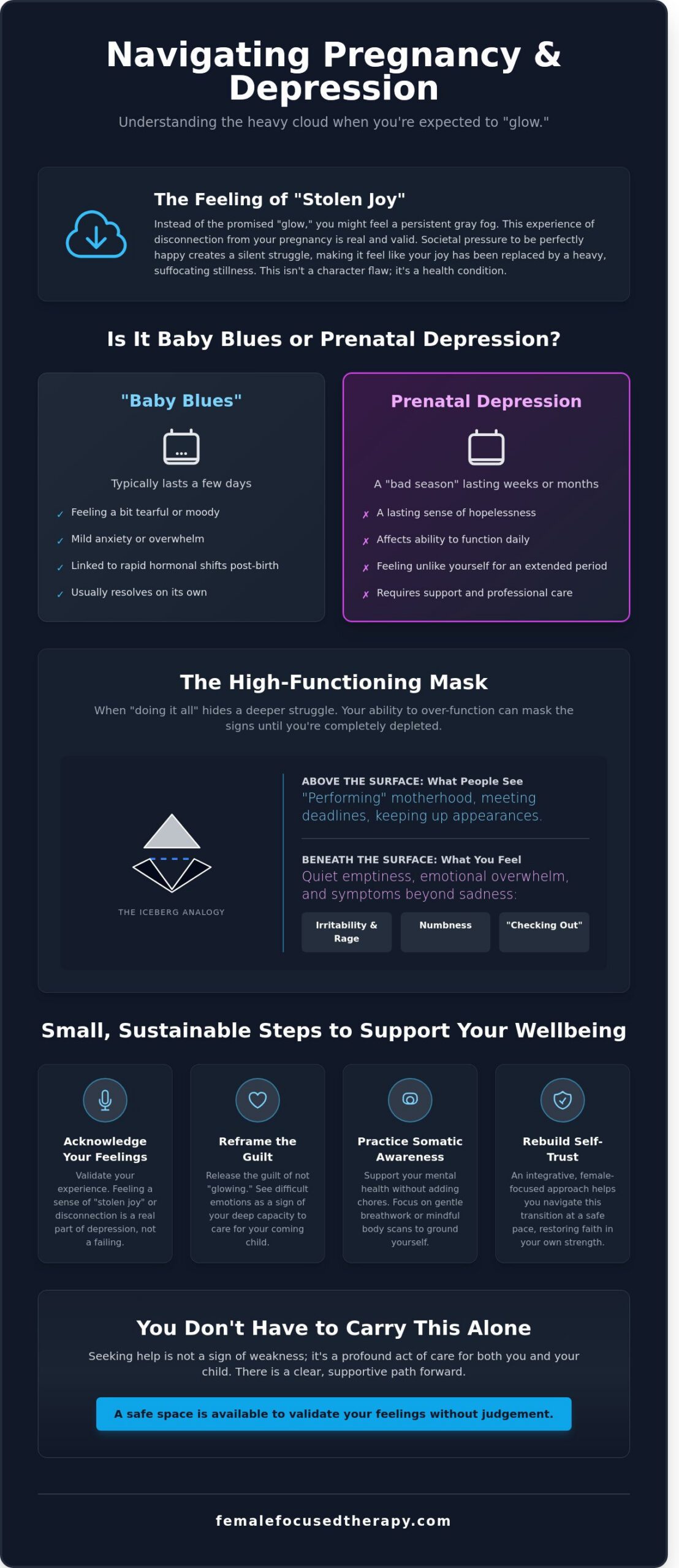
When you look at your growing bump in the mirror, you might expect to feel a rush of warmth or anticipation. Instead, you might feel a heavy, suffocating stillness. I often hear women describe this as “stolen joy.” It’s the feeling that the experience you were promised, the one filled with glow and excitement, has been replaced by a persistent gray fog. As a therapist, I want you to know that this heaviness isn’t a flaw in your character; it’s a real and valid experience of depression during pregnancy.
Living in a fast-paced environment like Singapore adds a unique layer of pressure. Here, we often prize productivity and the “perfect” family image. You might feel you have to keep performing at work, managing your household, and preparing for the baby without missing a beat. When your internal reality doesn’t match the high-energy pace of the city, the sense of disconnection can feel overwhelming. I see so many women who are high-functioning on the outside but feel like they are drowning on the inside.
The Difference Between “Baby Blues” and True Depression
It’s normal to feel a bit tearful or overwhelmed when your hormones are shifting rapidly. However, there is a point where the “blues” become something much deeper. While baby blues usually pass within a few days, a more persistent low mood needs deeper care. Prenatal depression is a lasting sense of hopelessness that affects daily life. You can tell your “bad days” have turned into a “bad season” when you no longer feel like yourself, or when the things that used to bring you comfort now feel like a chore. If you find yourself struggling to connect with your life, it may be time to seek a safe space for support.
Why We Often Stay Silent About Our Struggle
Societal expectations of “pregnancy joy” act like a muzzle. We are taught that this should be the happiest time of our lives, which makes admitting to sadness feel like a betrayal. You might fear that if you speak up, people will think you won’t be a good mother or that you don’t want your baby. These fears are common, but they are also untrue. I want to normalise the fact that you can love your baby and still struggle with your mental health. In my practice, I focus on helping women rebuild their self-trust during these difficult transitions. Seeking help isn’t a sign of weakness; it is a profound act of care for both you and your child. You deserve to be heard without judgment, especially when the weight of depression during pregnancy feels too heavy to carry alone.
Why High-Functioning Women Often Struggle in Silence
You might be the woman who has the nursery perfectly decorated and is still meeting every deadline at work. On the outside, you are “doing it all.” On the inside, you feel a heavy, quiet emptiness that you can’t quite explain. I see this often in my practice. When you’re used to being the person who holds everything together, your habit of over-functioning can actually mask the early signs of depression during pregnancy. You’re so good at pushing through that you don’t even realize how much you’re struggling until you’re completely depleted.
This often stems from a deep-rooted perfectionism. You’ve likely spent years relying on your ability to control your environment and your output. Pregnancy, however, is a time of profound physical and emotional change that you cannot control. When your usual coping mechanisms, like staying busy or “fixing” things, start to fail, it leads to a sense of panic. Your old tools aren’t working anymore. You aren’t failing; your system is simply overloaded by the weight of expectations and hormonal shifts.
The Pressure to “Perform” Motherhood
There is a specific kind of exhaustion that comes from the “Instagram-perfect” pregnancy. You see the glowing photos and the curated highlight reels, then compare them to your own internal mess. In a fast-paced environment like Singapore, the pressure to stay productive and “positive” is relentless. You might find yourself pretending to be okay for your partner or your colleagues. This performance is draining. It creates a painful gap between who you’re pretending to be and how you actually feel, which only makes the isolation feel deeper.
Recognising the Signs of Emotional Overwhelm
We often talk about depression as sadness, but for high-functioning women, it often looks different. It might feel like a sharp, sudden irritability or even a sense of rage. Other times, it’s a total numbness, as if you’ve simply “checked out” emotionally to survive the day. For many of the women I work with, these feelings are even more complex if they are navigating ADHD or previous trauma. The sensory changes of pregnancy can feel like a constant crisis, making it even harder to find your footing.
If you’re feeling this way, please know that you don’t have to carry it alone. Recognising that your current state is a form of depression during pregnancy is the first step toward finding relief. Reaching out for support is a way to start rebuilding your sense of self during this transition, at a pace that feels safe for you.
Moving Past the Guilt of Not Feeling the “Glow”
You might feel like you’re failing because you don’t feel that radiant “glow” everyone talks about. The most common thing I hear in my practice is, “I should be happy, Cheryl.” This “should” is a heavy burden. It creates a gap between your reality and a societal fantasy that rarely exists for anyone. When you’re navigating the complexities of depression during pregnancy, it’s easy to feel like you’ve lost the compass that usually guides you.
I want you to look at your guilt differently. You feel guilty because you care. It’s actually a sign of your deep love for your baby and your desire to be the best parent you can be. If you didn’t care, the guilt wouldn’t be there. I use an integrative approach to help you navigate these conflicting feelings. We look at your thoughts, your physical sensations, and your history to help you feel like yourself again. Together, we work on rebuilding self-trust, helping you realize that your mind isn’t betraying you; it’s simply overwhelmed.
Unpacking the “Bad Mother” Myth
There is a persistent, harmful idea that your mood during these nine months dictates your future as a parent. This is simply not true. Your current struggle with depression during pregnancy is a health condition, not a personality flaw. Clinical studies consistently show that women who seek support during pregnancy actually protect and even strengthen their bond with their baby. You are taking a brave step by acknowledging your feelings. Suffering is not a required part of motherhood, and you don’t have to “tough it out” to prove your worth.
Identity and the Transition to Motherhood
Pregnancy is one of the most significant life transitions you will ever experience. It’s natural to feel a sense of loss for your “old self” and the independence you once had. In my work at Female Focused Therapy, I see how this shift can often act as a catalyst for deeper issues. The hormonal and life changes can trigger old wounds or memories of relationship trauma and narcissistic abuse. If you’ve spent years “over-functioning” or people-pleasing, the vulnerability of pregnancy can feel especially threatening. We will work at a pace that feels safe for you, acknowledging these past experiences while focusing on your current wellbeing.
If you’d like to find out more about working with Cheryl Kennedy MacDonald, you can email her at cheryl@femalefocusedtherapy.com or go ahead and book an appointment here: https://www.femalefocusedtherapy.com/book-now/
Small, Sustainable Ways to Support Your Wellbeing Today
When you are navigating depression during pregnancy, your to-do list can feel like an enemy. I understand that the last thing you need is another set of chores disguised as wellness. Instead of adding to your burden, I want to invite you to look at support through the lens of somatic awareness. This simply means checking in with what your body is telling you. Perhaps your chest feels tight when you think about the nursery; perhaps your breath becomes shallow when family members ask how you’re feeling. These are not signs of failure. They are your body’s way of asking for a softer, more compassionate approach.
True self-care is often less about scented candles and more about firm boundaries. In a high-pressure environment like Singapore, it is easy to feel you must keep up with every social obligation or work deadline. However, protecting your energy is a necessity for your mental health. This might look like turning your phone on “Do Not Disturb” at 7 PM or declining an invitation to a social gathering at Robertson Quay that feels emotionally taxing. By saying no to others, you are saying a vital yes to your own healing process.
Gentle Practices for the Hard Days
On the days when the clouds feel particularly low, try a simple grounding exercise. Place your feet flat on the floor and notice the texture of the rug or the coolness of the tiles. This small act can pull you out of a spiralling mind and back into the present moment. I also encourage you to find one safe person in your life. This is someone you don’t have to perform for; someone who can hear you say “I’m not okay today” without trying to fix you immediately. For those moments when you need quiet, immediate support, you can access my free therapy resources to help you find a bit of calm and reconnection.
When to Consider Professional Support
While friends and family mean well, they are often too close to the situation to provide the objective holding space you deserve. A 2023 report from health practitioners indicated that approximately 12 percent of expectant mothers in Singapore experience significant mood changes, yet many hesitate to seek help for depression during pregnancy. Talking to a professional who is female focused means you don’t have to explain why these transitions feel so complex. Therapy provides a boundaried, confidential environment where your feelings are the sole priority, away from the expectations of your daily life. If you feel ready to explore this, you can learn more about who I work with on my main website at Female Focused Therapy.
If you’d like to find out more about working with Cheryl Kennedy MacDonald, you can email her at cheryl@femalefocusedtherapy.com or go ahead and book an appointment here: https://www.femalefocusedtherapy.com/book-now/
How We Can Gently Navigate This Season Together
I want you to know that you don’t need to arrive at our first session with all the answers. You don’t need to fix your mood or find a spark of joy before you’re allowed to seek support. My role is to meet you exactly where you are today; even if that place feels heavy or confusing. I offer a calm, empathetic space where your feelings are validated rather than diagnosed.
My approach is deeply personal and grounded in your lived experience. I combine the practical structure of Cognitive Behavioural Therapy (CBT) with a warm, intuitive understanding of the unique pressures women face. While CBT helps us look at the patterns in your thoughts, we do so with kindness. We aren’t just ticking boxes; we’re working to rebuild your sense of self-trust during this transition.
It is important to remember that you’re not alone in this. Statistics from the KK Women’s and Children’s Hospital suggest that up to 10 percent of women in Singapore experience significant mood changes during the prenatal period. This is a season of your life, and while it feels all-consuming right now, it is not your permanent state. Together, we can find a way through the fog.
What to Expect in a Session with Me
In my professional space in Singapore or through our online sessions, I provide a confidential environment where you can speak the unspoken. We focus on moving at a pace that feels sustainable for both you and your baby. I never want you to feel rushed or overwhelmed by the therapeutic process itself.
The primary goal of our work is reconnection. When you’re struggling with depression during pregnancy, it’s easy to feel like you’ve lost the woman you used to be. We’ll work together to help you find your way back to yourself. We focus on your wellbeing as an individual, not just as an expectant mother, ensuring you feel seen and supported.
Taking That First Small Step
If you’re feeling emotionally exhausted, even the thought of reaching out can feel like a mountain. Please know there’s no pressure here. You’ve already taken a significant step by reading these words and acknowledging your feelings today. That awareness is the beginning of the healing process.
I invite you to send me a gentle email or book a consultation when you feel ready. There are no expectations for you to be “on” or to have a perfect narrative of your struggles. Professional support for depression during pregnancy provides a sturdy anchor when the waves feel too high. You deserve to be held in a space that is as nurturing as the one you are creating for your baby.
Finding your way back to yourself
It’s okay if this season feels more like a heavy storm than a celebration. You aren’t failing because you don’t feel that expected glow. Many of the women I’ve supported in my Singapore practice struggle with depression during pregnancy while trying to keep their lives perfectly on track. Releasing the guilt of not feeling joyful is a vital first step toward your healing.
We can work together to find specific, sustainable ways to rebuild your self-trust and clarity. As a Registered Psychotherapist with 15 years of experience, I use a trauma-informed, integrative approach to help you navigate these clouds at a pace that feels safe. You don’t have to carry this weight alone. I invite you to explore how Female Focused Therapy can support you. You can also learn more about my warm, Scottish therapeutic presence based here in Singapore. You deserve to feel supported and seen during this transition.
If you are ready to prioritize your mental health, you can book an appointment today.
If you’d like to find out more about working with Cheryl Kennedy MacDonald, you can email her at cheryl@femalefocusedtherapy.com or go ahead and book an appointment here: https://www.femalefocusedtherapy.com/book-now/
Common Questions About Depression During Pregnancy
Is it normal to feel depressed while pregnant?
It is more common than you might think, even if it doesn’t feel that way when you’re looking at social media. Research from the KK Women’s and Children’s Hospital (KKH) shows that about 12% of women in Singapore experience depression during pregnancy. While society often expects you to be glowing, many women find themselves struggling with heavy emotions or a sense of detachment. You aren’t alone in this, and your feelings don’t make you a bad mother.
Will my depression during pregnancy hurt my baby?
Seeking support is the best way to protect both you and your baby during this time. While prolonged, untreated depression during pregnancy can lead to lower birth weights or early delivery in about 15% of cases, getting help changes that trajectory. When you take care of your mental health, you’re creating a calmer environment for your baby to grow. I’m here to help you navigate these feelings so you can feel more connected and safe.
How is prenatal depression different from the baby blues?
The baby blues usually occur in the first 3 to 10 days after birth and involve brief crying spells or irritability. In contrast, prenatal depression happens while you’re still pregnant and lasts for more than 14 days. It feels much deeper than a passing mood or a difficult afternoon. If you’ve felt a persistent low for two weeks or more, it’s a sign that you need more than just a bit of extra rest or a nap.
Can I go to therapy for depression during pregnancy in Singapore?
Yes, there are many safe, confidential spaces for you to talk here in Singapore. You can access specialized support through private practices like mine at Female Focused Therapy or through hospital clinics at KKH and NUH. Therapy provides a steady anchor during this major life transition. We can work together to rebuild your sense of self-trust at a pace that feels sustainable for your life, your career, and your growing family.
What are the most common signs that I should seek help?
You should reach out if you feel a persistent emptiness or a loss of interest in things you usually love for more than 14 days. Other signs include significant changes in your appetite, sleeping too much but still feeling exhausted, or withdrawing from your partner and friends. If you find yourself thinking “I can’t do this” several times a day, let’s talk about how we can lighten that emotional load together in a gentle way.
Does having depression now mean I will definitely have postnatal depression?
It isn’t a certainty, but having depression now does increase the likelihood of postnatal depression by about 50% if left unsupported. However, engaging in therapy during your pregnancy is a proactive step that significantly lowers this risk. By processing your feelings now, you’re building the emotional resilience and tools you’ll need for the first few months with your newborn. It’s about preparing your internal world just as much as your nursery.
How can I tell my partner that I’m struggling without worrying them?
Start by choosing a quiet moment and using “I” statements to describe your internal weather. You might say, “I’ve been feeling quite low lately and I need some extra support,” which focuses on your needs rather than a crisis. It’s natural for them to feel concerned, but sharing your truth actually strengthens your partnership. It allows them to be part of your support system instead of guessing why you have become quiet or withdrawn.
What kind of therapy is best for depression during pregnancy?
I find that an integrative approach works best because it looks at you as a whole person, not just a list of symptoms. We might use Cognitive Behavioural Therapy to manage intrusive thoughts, while also using somatic practices to help you feel safe in your changing body. This combination helps 80% of women feel a significant improvement in their mood. We focus on what feels most grounding for you as you prepare for this next chapter.

Article by
Cheryl Kennedy MacDonald MA BA (Hons) Pg. Dip. SAC BACP
Cheryl Kennedy MacDonald is a psychotherapist specialising in women’s mental health, relationships, and life transitions. She works with women navigating trauma, relationship breakdown, identity shifts, and midlife change, helping them rebuild self-trust, emotional stability, and a clear sense of who they are and what they want.
With over 20 years’ experience working with women internationally, Cheryl is the founder of YogaBellies, a global women’s yoga school, and the creator of the Birth ROCKS method. Her work sits at the intersection of psychotherapy and embodiment, integrating evidence-based therapeutic approaches with somatic, body-based practices that support deep, lasting change.
Known for her grounded and direct approach, Cheryl moves beyond surface-level insight to address the patterns held in the body and nervous system. Her work supports women to regulate, reconnect, and respond to their lives from a place of clarity, strength, and self-respect.
She is a published author in academic journals and has written multiple books on women’s health, pregnancy, and midlife wellbeing, available on Amazon and leading book retailers worldwide.