
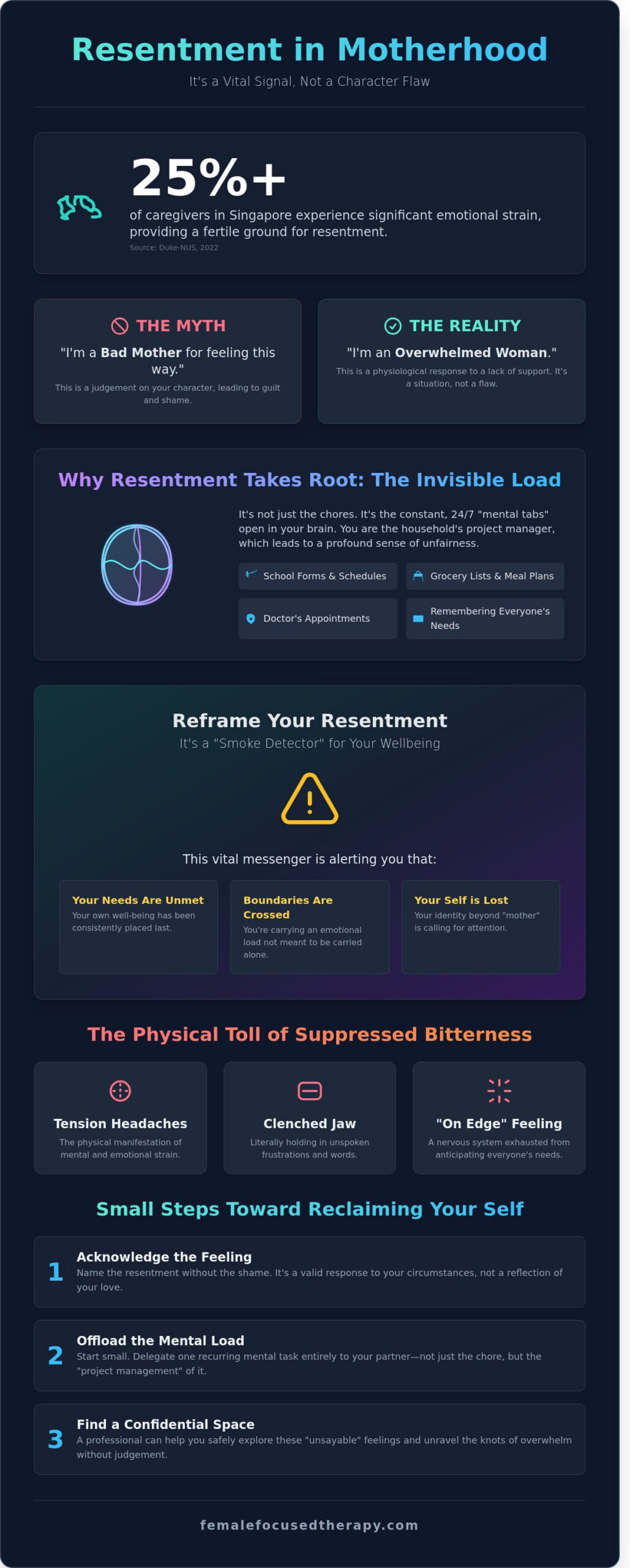
What if the bitterness you feel while folding that third load of laundry isn’t a sign that you’re a “bad” mum, but actually a vital survival signal? You likely believe that being a good mother means being endlessly patient, yet a 2022 study by Duke-NUS found that over 25 percent of caregivers in Singapore experience significant emotional strain. It’s draining to be the invisible manager of your household, constantly tracking school schedules while your own spark fades. I know how heavy that secret ache can feel, but I want you to see that your resentment in motherhood is not a character flaw. It’s a signal that your own needs are calling for your attention, and they’ve been ignored for too long.
I often work with women who feel stuck in this cycle of emotional exhaustion, and I want you to know there’s a way through. In this post, we will look at why you feel this way and how you can start to reduce the bitterness without the crushing weight of guilt. I’ll share how you can begin reconnecting with your own identity, moving beyond the roles you play for everyone else. At Female Focused Therapy, we focus on helping you rebuild your self-trust so you can move forward with a stronger, more confident sense of self.
Key Takeaways
- Understand that the heavy secret you’re carrying isn’t a personal failure, but a signal that your own needs deserve your attention.
- Explore how the “invisible load” of being the one who knows where everything is can cause bitterness to take root in your daily life.
- Learn to reframe resentment in motherhood as a vital “smoke detector” that alerts you when your boundaries have been crossed.
- Discover small, gentle steps to begin offloading the mental load and reclaiming a sense of your individual self.
- Recognise how a confidential, professional space can help you safely explore “unsayable” feelings and start unraveling the knots of overwhelm.
The quiet weight of resentment in our daily lives
I want to start by acknowledging the heavy secret you might be carrying right now. It’s a weight that sits quietly in your chest, often ignored but never truly gone. You love your children and your partner deeply, but there’s a stinging feeling that you’ve been forgotten in the middle of your own life. Navigating resentment in motherhood is not a sign of failure; it is a sign that you are human.
We often confuse this feeling with a lack of love, but that isn’t the case. When we look at the definition of resentment, we find it is less about “hatred” and more about the bitter sense of being overlooked. It is the emotional tax paid for being the one who carries the mental load without recognition. Resentment in motherhood is the quiet ache of your own needs constantly coming last.
You likely hide this behind a mask of being high-functioning. You’re the one who manages the school forms, handles the S$200 grocery run, and keeps the household moving. You’re “doing it all,” yet you feel invisible. Resentment is a boundary alarm that signals a loss of self.
Naming the feeling without the shame
It is so difficult to admit we feel resentful toward our children or our partners. We’ve been taught that a “good mother” is a martyr, someone who never tires and never complains. When we feel that spark of anger, we immediately feel guilty. We worry that admitting the feeling makes us “bad.”
There is a vital difference between being a “bad mother” and being an overwhelmed woman. One is a character flaw; the other is a physiological response to a lack of support. I see this struggle frequently in my work with women from all walks of life at Female Focused Therapy. Whether you are a corporate professional in the CBD or a stay-at-home mum, the feeling of being “poured out” is a shared experience.
The physical toll of suppressed bitterness
Resentment doesn’t just live in your mind. It lives in your body. It shows up as a clenched jaw, tension headaches, or that “on edge” feeling where every noise feels like an intrusion. This is the direct result of emotional over-functioning, where you take on the emotional labour of everyone else at the expense of your own wellbeing.
When you spend your days anticipating everyone else’s needs, your own nervous system never gets to rest. You might find your patience tank runs dry over something small, like a toy left on the floor or a forgotten chore. This isn’t because you’re “difficult.” It’s because your body is exhausted from carrying a load it wasn’t meant to carry alone.
If you’d like to find out more about working with Cheryl Kennedy MacDonald, you can email her at cheryl@femalefocusedtherapy.com or go ahead and book an appointment here: https://www.femalefocusedtherapy.com/book-now/
Why resentment takes root in motherhood
I often see women in my Singapore practice who feel a deep, quiet shame about the anger they carry. You might find yourself snapping at your partner over a dish left in the sink, or feeling a sudden surge of irritation when your child asks for the tenth snack of the morning. This isn’t because you are unkind or “failing” at your role. It’s often because resentment in motherhood grows in the gaps where your own needs have been ignored for too long.
Societal expectations of the “perfect mother” set an impossible bar. We are told we should be endlessly patient and completely selfless. When we inevitably feel tired or frustrated, we turn that anger inward. This internalised pressure, combined with the daily grind of caregiving, creates a perfect environment for resentment to take hold. It is a signal from your body and mind that the current balance is unsustainable.
The invisible labour and the mental load
It isn’t just the physical chores that wear you down; it’s the “mental tabs” that stay open in your brain 24/7. You are likely the one remembering when school forms are due, which child needs new shoes, and what is left in the fridge for dinner. When a partner asks “how can I help?”, it can actually add to the burden because you still have to be the project manager.
This imbalance creates a slow-burning fuse. It’s vital to recognise that these are normal emotions of parenting, but they are also a sign of emotional over-functioning. Over months and years, carrying the vast majority of the emotional responsibility leads to a profound sense of unfairness that erodes your wellbeing.
When your identity feels like it is slipping away
There is a specific kind of grief that comes with becoming “the one who knows where the socks are.” You might miss the woman you were before children; the one who had hobbies, spontaneous evenings, and a clear sense of her own name. For many women I work with, these feelings are amplified during midlife transitions.
The physical and emotional shifts of menopause can make the weight of caregiving feel even heavier. You might feel a painful conflict between the fierce love you have for your children and a desperate mourning for your lost freedom. If you feel like you’ve lost your way, we can work together to find a stronger sense of self that exists alongside your role as a mother.
Sometimes, this resentment in motherhood is an echo of our own history. If you experienced parental neglect as a child, you might find yourself over-compensating now. You try to be the perfect parent to heal your own wounds, but this drive for perfection only hastens your emotional exhaustion. Acknowledging these echoes is the first step toward breaking the cycle.
If you’d like to find out more about working with Cheryl Kennedy MacDonald, you can email her at cheryl@femalefocusedtherapy.com or go ahead and book an appointment here: https://www.femalefocusedtherapy.com/book-now/
Reframing your resentment as a vital messenger
I often tell my clients that resentment is actually a very useful, if uncomfortable, friend. It acts as the smoke detector for your boundaries. It doesn’t go off to annoy you or make you feel like a “bad” mother. It sounds the alarm because something in your environment is no longer sustainable for your spirit.
When we look at research on maternal anger, we see that these heavy feelings often stem from violated expectations and compromised needs. It isn’t a character flaw. It’s a data point. I want you to move away from self-blame and toward a place of gentle, honest curiosity about what that bitterness is trying to tell you.
Resentment as a signal for boundaries
Where in your life are you saying “yes” when your soul is screaming “no”? Resentment in motherhood often grows in the gap between what we give and what we actually have left to offer. It might be the extra school committee task you accepted or the way you’ve become the default parent for every single night wake-up.
Try to identify the specific people or situations that trigger the strongest feelings. Is it a partner who doesn’t see the mental load? Is it a friend who only takes and never gives? Learning to see your anger as a protective force is a vital part of your wellbeing. It’s your inner self trying to shield you from further depletion.
The power of self-compassion over self-criticism
Many women I see in my practice try to “fix” their feelings by being more organised or simply trying harder. This is never the answer to resentment. Trying to “optimise” your way out of emotional exhaustion only leads to deeper burnout. You cannot schedule your way out of a boundary problem.
Instead, try to speak to yourself with the same kindness you would offer a dear friend. Validate your own experience before you try to change it. Acknowledge that your feelings make sense given the weight you’re carrying. You can find more about how we can work through these feelings together on my homepage.
If you’d like to find out more about working with Cheryl Kennedy MacDonald, you can email her at cheryl@femalefocusedtherapy.com or go ahead and book an appointment here: https://www.femalefocusedtherapy.com/book-now/
Small steps toward reclaiming your sense of self
I want you to know that we don’t fix resentment in motherhood overnight. It is a process of shifting your internal weather, moving slowly from a heavy, grey storm toward a space where the sun can actually peek through. I often see women in my practice who feel they must make a huge, sweeping life change to feel better. However, I’ve found that 90% of the time, it is the tiny, sustainable shifts that actually stick and create lasting relief.
You can start offloading the mental load without feeling like you are failing. It begins by acknowledging that you are human and were never meant to carry the weight of an entire household’s emotional and physical needs alone. I encourage you to look for “micro-moments” of reconnection. These are three or four minutes throughout your day where you step out of your role as “Mum” and simply exist as yourself, perhaps while the kettle boils or during your commute.
Small, sustainable changes are always better than grand gestures that leave you feeling more depleted. If you can change just one small habit this week, you are already moving in the right direction.
Setting boundaries that feel safe and sustainable
Setting boundaries often feels scary, but it is actually an act of love for your family. When you say “no” to the small things that drain your energy, like an extra volunteer commitment or a late-night work email, you are preserving your capacity to be present. It is about protecting your peace so you don’t reach a breaking point.
When you communicate your needs to your partner, try to do so when you aren’t already in the middle of a “resentment spiral.” Use clear, kind language to explain what you need, rather than focusing on what they haven’t done. This prevents a conversation from turning into a battle and keeps the focus on your wellbeing. I’ve seen that couples who have these 10-minute check-ins twice a week often report much lower levels of household tension.
Finding your way back to you
I invite you to identify one thing that belongs only to you, something that has nothing to do with your children or your home. It might be a specific book, a 15-minute yoga flow, or a hobby you haven’t touched in years. Having something that is “just mine” provides an essential anchor when the demands of motherhood feel like they are pulling you out to sea.
Mindfulness plays a huge role in catching the “resentment spiral” before it takes over. By noticing the physical sensations of frustration in your body, you can pause and breathe before the feeling becomes an outburst. I believe that rebuilding self-trust starts with honouring your own small promises, like actually taking that five-minute break you told yourself you would take. Each time you keep a promise to yourself, you strengthen your sense of identity.
If you feel like you’ve lost sight of who you are, you might find it helpful to explore how I support women through motherhood and life transitions.
Finding a safe space to unravel the knots
Sometimes, the resentment in motherhood grows so heavy that you can no longer carry it alone. That is okay. You might feel like you are failing because you cannot simply think your way out of the exhaustion. In a fast-paced city like Singapore, where the pressure to excel in every role is intense, these feelings can become deeply knotted and difficult to untangle by yourself.
Therapy provides a confidential, professional space where you can finally say the things you have kept hidden. It is a dedicated place for the unsayable thoughts, the ones that make you feel guilty or like a bad person. When we bring these feelings into the light, they often lose their power to overwhelm you. A 2021 study published in the Journal of Affective Disorders highlighted that maternal burnout is significantly linked to a lack of emotional support, confirming that you were never meant to carry this load in isolation.
My approach is never about rushing you toward a quick fix. We work together to find clarity and confidence at a pace that feels sustainable for you. You don’t have to wait until you are in a full-blown crisis to ask for support. You deserve to feel well right now, not just when the children are older or when life feels less busy. Taking care of your mental health is a valid priority today.
How psychotherapy can help you move forward
In our sessions, we move beyond clinical labels and focusing on your lived, human experience. I use an integrative approach that looks at both your mind and your body, because emotional stress often shows up as physical tension or chronic fatigue. This holistic view helps us understand how resentment in motherhood might be affecting your physical well-being too.
Having a specialised therapist for women makes a significant difference. It means you are talking to someone who understands the specific societal and biological pressures women face in modern life. Whether it is managing the mental load or the shift in identity that comes with parenting, you are supported by someone who truly understands the nuance of your experience.
Your next gentle step
I want to encourage you to do one small thing today. Acknowledge one single feeling you are honestly experiencing, and try to do it without any judgment. If you feel resentful, just name it: “I feel resentful right now.” This simple act of honesty is a powerful start toward rebuilding self-trust. It acknowledges your reality without the weight of shame.
Support is always available at Female Focused Therapy whenever you feel ready to reach out. Remember that you are so much more than your roles as a mother, partner, or employee. You are a woman who deserves to be heard, valued, and supported in your own right. You don’t have to navigate the secret ache of resentment in motherhood alone anymore.
If you’d like to find out more about working with Cheryl Kennedy MacDonald, you can email her at cheryl@femalefocusedtherapy.com or go ahead and book an appointment here: https://www.femalefocusedtherapy.com/book-now/
Moving from resentment toward reconnection
Acknowledging that the weight you carry is real is the first step toward lightness. I’ve supported hundreds of women in Singapore through these complex transitions since starting my practice, and I’ve seen how resentment in motherhood isn’t a sign of failure; it’s a signal that your own needs have been sidelined for too long. We’ve explored how this feeling takes root and why reframing it as a messenger can help you reclaim your identity. You can start small by setting one gentle boundary today or simply admitting that you need more support. My trauma-informed, integrative approach as a Registered Psychotherapist focuses on helping you move forward with clarity and confidence. I offer a specialised focus on women’s mental health to help you navigate these life transitions. You can find more information on my homepage. You don’t have to navigate this alone, and there’s a safe, professional space waiting for you to unravel the knots at a pace that feels sustainable. You’re capable of rebuilding a life that feels like your own again.
If you’d like to find out more about working with Cheryl Kennedy MacDonald, you can email her at cheryl@femalefocusedtherapy.com or go ahead and book an appointment here: https://www.femalefocusedtherapy.com/book-now/
Common Questions About Resentment in Motherhood
Is it normal to feel resentment toward my children even though I love them?
Yes, it is entirely normal to feel this way. In my practice in Singapore, I often see mothers who feel a profound sense of guilt because they experience resentment alongside deep love. This doesn’t mean you’re a bad mother; it means your needs aren’t being met. Research into maternal ambivalence suggests that these conflicting feelings are a common part of the human experience when we are physically and emotionally stretched too thin.
How do I tell my partner I feel resentful without starting a huge argument?
You can start by using “I” statements to describe your own internal state rather than focusing on their failings. For example, instead of saying “You never help,” try “I’m feeling overwhelmed by the mental load and I’m starting to feel resentful, which I don’t want.” This invites your partner into a conversation about your wellbeing rather than putting them on the defensive, making it easier to find a sustainable way forward together.
Can resentment in motherhood lead to clinical depression or anxiety?
Yes, chronic resentment in motherhood can certainly contribute to or mirror symptoms of clinical depression and anxiety. When you constantly suppress your own needs, it can lead to a sense of hopelessness or a persistent “low” mood. If you find your resentment is accompanied by a loss of interest in things you once enjoyed or physical symptoms like heart palpitations, it may be helpful to explore these feelings in a safe, professional space.
Why do I feel more resentful now that my kids are older or I am in midlife?
Midlife often brings a “perfect storm” of hormonal shifts, such as perimenopause, and the exhaustion of the “sandwich generation” caring for both children and ageing parents. You might feel resentful because, after years of putting others first, your body and mind are finally demanding that you reclaim your own identity. It’s a significant transition point where the old ways of over-functioning simply don’t work anymore, leading to a natural desire for more personal space.
Will this feeling ever go away, or am I stuck feeling bitter forever?
This feeling is not permanent, and you are definitely not stuck. Resentment is often a signal that a boundary has been crossed or a need is being ignored. By working through these feelings in therapy, we can identify the root causes and implement changes that bring back a sense of joy. Many women I work with find that once they start prioritising their own wellbeing, the bitterness begins to lift and is replaced by a renewed sense of self.
How is resentment different from maternal burnout or “mum rage”?
Resentment is often the quiet, simmering precursor to more explosive feelings like “mum rage” or the total exhaustion of burnout. While burnout is a state of physical and emotional depletion, resentment is specifically tied to a sense of unfairness or lack of appreciation. Understanding resentment in motherhood is key because it acts as an early warning system. If we can address the resentment early on, we can often prevent it from escalating into full-blown burnout or rage.
Does feeling resentful mean I am experiencing the effects of narcissistic abuse?
Not necessarily, but resentment can be a common response if you are in a relationship where your needs are consistently dismissed. If you feel you are walking on eggshells or that your partner lacks empathy for your experience, it’s worth exploring if these patterns align with narcissistic abuse. In my sessions, I help women navigate these complex dynamics to determine if their resentment stems from everyday parenting stress or a more harmful, one-sided relationship structure.
How can therapy help me if I don’t have time for myself as it is?
Therapy is an investment that actually helps you reclaim time by reducing the mental energy spent on rumination and conflict. Even a 50-minute weekly session can provide the clarity and confidence needed to set boundaries that protect your schedule. Many of my clients in Singapore find that online therapy fits into their busy lives, offering a confidential space to breathe and rebuild their sense of self-trust without the need for a long commute.