
You might be sitting in your living room in Singapore right now, watching the sun rise while feeling a deep, heavy sense of dread. It’s 4 AM; the baby is finally settled, yet you’re wide awake, haunted by the thought that you aren’t the mother you expected to be. I understand the crushing weight of that secret shame and the physical exhaustion that no amount of sleep seems to touch.
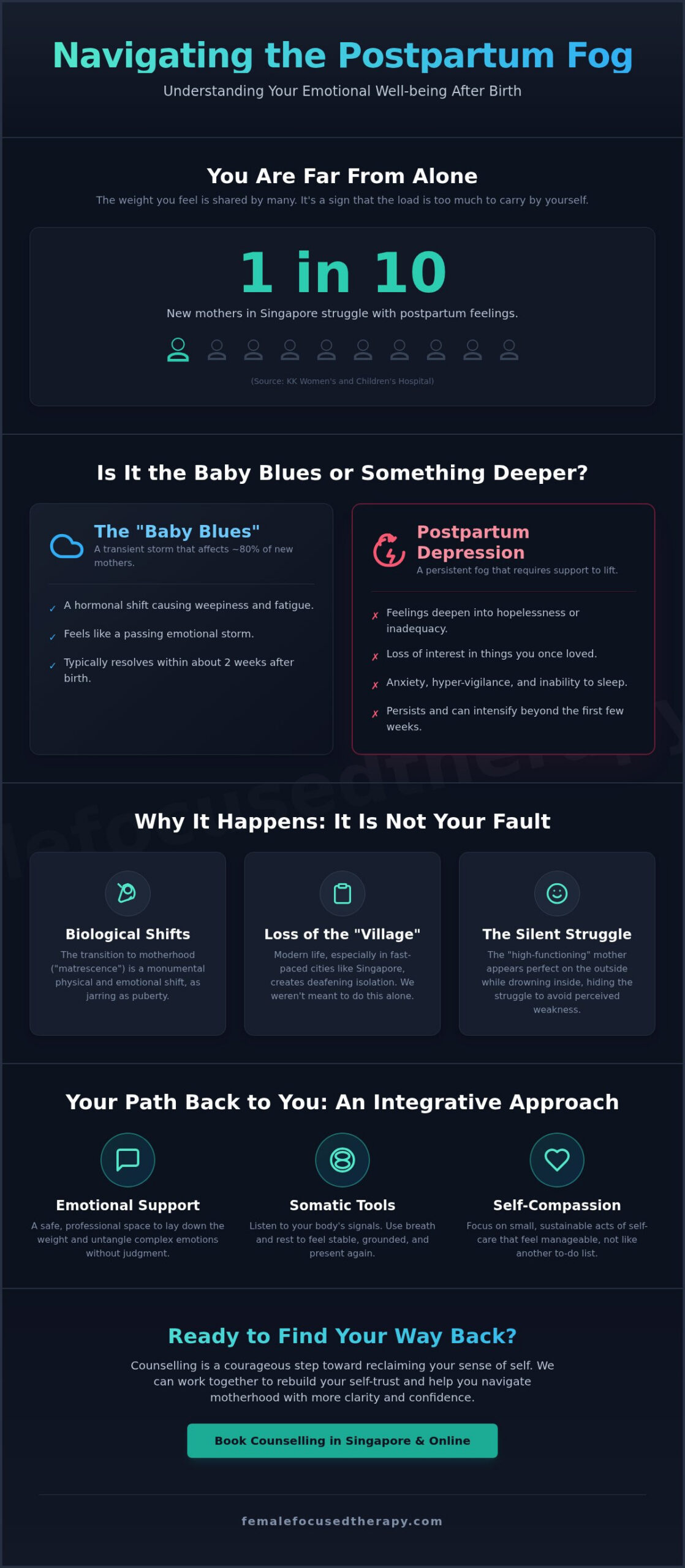
Statistics from KK Women’s and Children’s Hospital show that about 10 percent of new mothers in Singapore struggle with these feelings, so please know you’re far from alone. My approach to postpartum depression counselling is designed to be a safe, professional space where we can untangle these complex emotions together. I want to help you move through this fog and start the gentle process of reclaiming your sense of self-trust.
This article offers a gentle, integrative look at how we can work together to move through the heaviness and find your way back to yourself. I’ll explain how we combine emotional support with somatic tools like breath and rest to help you feel stable, grounded, and present with your child again.
Key Takeaways
- Understand that the “heavy” feelings you are experiencing are a natural response to overwhelming change, helping you shift from self-blame toward gentle validation.
- Explore how the absence of a modern “village” contributes to maternal distress and why your struggle is a result of environmental factors, not a personal failure.
- Discover how an integrative approach to postpartum depression counselling supports your recovery by listening to both your emotional narrative and your body’s somatic signals.
- Identify small, sustainable acts of self-compassion that make the early days of recovery feel manageable, focusing on your well-being rather than an overwhelming to-do list.
- Learn how we can work together, either in-person in Singapore or through online therapy, to rebuild your self-trust and help you find your way back to yourself.
Understanding the Weight of Postpartum Depression and Anxiety
I often sit with women who feel a deep sense of confusion when the promised “new mother glow” never arrives. Instead of the soft, golden haze they were told to expect, they find themselves beneath a heavy, grey fog that feels impossible to lift. This weight isn’t a sign of failure or a lack of love for your baby. It’s a natural, albeit incredibly difficult, response to the monumental shifts happening in your body and mind during this time.
I want you to hear me when I say this: these feelings do not make you a “bad” mother. You aren’t broken, and you haven’t done anything wrong. We live in a world that often ignores “matrescence,” the physical and emotional transition into motherhood, which is as jarring as puberty. When you feel overwhelmed, your system is simply signalling that the load has become too much to carry alone. Seeking postpartum depression counselling is a courageous step toward reclaiming your sense of self and finding your way back to a place of calm.
I’ve found that when we stop fighting the feelings and start understanding them, the fog begins to thin. It’s about creating a safe, professional space where you can lay that weight down without judgment. By addressing these emotions early, we can work together to rebuild your self-trust and help you navigate the early days of motherhood with more clarity and confidence.
Is it the Baby Blues or Something Deeper?
The “baby blues” are a transient hormonal shift that affects about 80 percent of new mothers and typically resolves within roughly two weeks after birth. It’s that period of weepiness and fatigue that feels like a passing storm. However, when those feelings persist or deepen into a sense of hopelessness, it’s time to look closer at what’s happening.
Understanding Postpartum Depression means recognizing markers like a loss of interest in things you once loved or a crushing sense of inadequacy. Often, anxiety joins the mix, masking itself as “over-preparedness” or hyper-vigilance. You might find yourself unable to sleep even when the baby is resting, because your mind is constantly scanning for potential threats, leaving you in a state of emotional exhaustion.
The Silent Struggle of the ‘High-Functioning’ Mother
In Singapore, the pressure to “snap back” and return to “normal” life is intense, with many women feeling they must excel at home and work almost immediately. I see many mothers who appear to be coping beautifully on the outside while drowning on the inside. You might be the one who has the nursery perfectly curated and the feeding schedule managed, yet you feel entirely detached from the experience.
This “over-functioning” is often a survival mechanism used by those who value perfectionism. You might feel that asking for help is a sign of weakness, but I believe that acknowledging the struggle is the highest form of self-trust. Women who seem to be “coping” well are often the ones most in need of support, as they carry the double burden of the depression itself and the effort required to hide it from the world. You don’t have to wait until you’ve reached a breaking point to reach out for postpartum depression counselling.
Why Postpartum Depression Happens: It is Not Your Fault
I often sit with women who carry a heavy weight of shame, believing their low mood is a personal flaw. I want to tell you clearly: it is not. What you are experiencing is a complex intersection of biological shifts and environmental pressures. In our modern lives, especially in a fast-paced environment like Singapore, we have lost the “village” that historically supported new mothers. When you are navigating the 4am feeds alone in a high-rise apartment, the isolation can be deafening.
I see how the lack of consistent, hands-on community support contributes to maternal distress. We weren’t meant to do this in isolation. Whether you are an expat far from home or a local mother feeling the pressure of “having it all,” the vulnerability of the postpartum period is real. This is why postpartum depression counselling focuses on rebuilding your sense of self within this new, often overwhelming reality.
You might feel confused if you had what seemed like a “perfect” birth. Perhaps everything went to plan, yet you still feel a profound sense of darkness. This happens because your brain and body are processing a massive transition that goes far beyond the delivery room. It is a total identity shift that requires time, patience, and often, professional support to navigate safely.
The Biological and Hormonal Shift
After you give birth, your body undergoes one of the most significant endocrine changes a human can experience. Within just 48 hours, levels of oestrogen and progesterone drop by approximately 90 percent. This sudden plummet can impact your brain chemistry significantly. For more context, you can read this Postpartum Depression Information from WomensHealth.gov which explains these triggers in detail.
Sleep deprivation acts as a severe neurobiological stressor. When you aren’t sleeping, your nervous system stays in a state of high alert, making it nearly impossible to regulate your emotions. Your physical recovery from birth is also deeply linked to your emotional well-being. If your body is in pain or exhausted, your mind struggles to find its usual resilience.
The Impact of Birth Trauma and Unmet Expectations
If your birth didn’t go to plan, your body may hold onto somatic imprints of fear. Even if you and the baby are physically “fine,” the emotional shock of a traumatic delivery can linger. I often help women process the grief of losing their “old self.” Motherhood is a beautiful transition, but it is also a secondary loss of the independence and identity you held before.
Comparing your real, messy life to the filtered perfection on social media only fuels a cycle of shame. It’s easy to feel like you’re the only one struggling when everyone else seems to be thriving. If you feel like you are drowning in these expectations, I offer a safe space to explore these feelings without any judgement or pressure to be “perfect.”
The Integrative Path: Healing Through Mind and Body
I don’t see you as a collection of symptoms or a diagnosis code to be “fixed.” In my practice, I look at you as a whole person with a unique story. This is why my approach to postpartum depression counselling is integrative. We don’t just focus on the thoughts in your head; we look at the way your life, your history, and your body all intersect to create your current experience.
I believe that healing happens when we create a safe, grounded space for both the mind and the body. If we only talk about the “mental load” without addressing the physical exhaustion in your bones, we are only doing half the work. My goal is to help you rebuild self-trust at a pace that feels sustainable for you.
Moving Beyond Traditional Talk Therapy
Talk therapy is a wonderful foundation, but it is often more effective when we combine different evidence-based tools. I use Cognitive Behavioural Therapy (CBT) to help you gently challenge the “I am a failure” narrative that often accompanies low mood. In my experience, replacing these harsh internal scripts with compassionate thoughts can reduce emotional distress by as much as 50% within the first few sessions.
We also look at psychodynamic elements to understand how your own upbringing influences your mothering. This isn’t about blaming the past; it’s about gaining clarity on why certain triggers feel so intense now. The Mayo Clinic on Postpartum Depression Symptoms highlights how both emotional and physical factors contribute to this condition. To manage the daily overwhelm, I integrate mindfulness practices that help you stay present when the mental load feels too heavy to carry.
Reconnecting with Your Body through Somatic Awareness
Your body often remembers what your mind tries to push away. Many mothers I work with in Singapore feel like their nervous system is permanently stuck in “fight or flight” mode. You might feel a constant buzzing of anxiety in your chest or a heavy, leaden feeling in your limbs. Somatic awareness is about learning to read these physical signals rather than ignoring them.
I will guide you through gentle ways to use breath and movement to release the physical tension of anxiety. This is where somatic movement and yoga for women becomes such a vital supporting tool in our work together. It allows you to process emotions that words cannot always reach.
- Using rhythmic breathing to calm a racing heart.
- Identifying where you “hold” stress in your shoulders or jaw.
- Learning that “resting” is a radical and necessary part of your therapy.
In a culture that often demands mothers “bounce back” instantly, choosing to rest is a powerful act of recovery. By listening to your body’s signals, we can move from a state of constant depletion toward a sense of grounded wellbeing.
Practical Steps to Navigate the Early Days of Recovery
I know that when you are in the thick of it, even a simple list of tasks feels like a mountain you cannot climb. Recovery from this heavy season is not about a total life overhaul. It’s about the tiniest, most sustainable shifts that allow you to breathe again.
I encourage you to start with the most basic acts of self-compassion. This means letting go of the “shoulds” that clutter your mind. In my work with women, I often see how much energy is wasted trying to meet invisible standards. Finding a path through postpartum depression counselling helps you identify which burdens are yours to carry and which you can gently set down.
Identifying “safe” people is a vital part of this journey. These are the friends or family members who don’t offer unsolicited advice or tell you to “enjoy every moment.” They are the ones who bring a meal, sit in the silence with you, or hold the baby so you can nap without asking questions. If someone feels draining, it is okay to step back from them for now.
Creating a Sustainable Self-Care ‘Minimum’
We need to move away from the idea that self-care is a luxury or a reward. When you are struggling, self-care is functional and necessary. It might look like a five-minute hot shower where you focus only on the feeling of the water, or a quiet cup of tea before the house wakes up.
I want you to embrace the power of “good enough” mothering. Perfection is an impossible weight that keeps you stuck. A ‘minimum’ is a non-negotiable daily anchor for your mental health that keeps you tethered when the waves feel too high. It is the one small thing you do just for your own nervous system every single day.
Communicating Your Needs to Your Support System
In Singapore, the pressures can feel unique. Whether you are navigating the expectations of local family structures or the isolation of expat life without your usual village, being direct is your best tool. Many women I support feel they must “perform” wellness, but saying “I’m fine” when you aren’t only prolonging the struggle.
Try using clear scripts to ask for what you actually need. Instead of hoping your partner notices your exhaustion, try saying, “I need you to take the baby for two hours so I can sleep,” or “I need you to handle dinner tonight because I’m feeling overwhelmed.” Being specific removes the guesswork for them and the resentment for you.
Sometimes, the transition to parenthood puts immense strain on your relationship. You might find that couples therapy is a helpful way to strengthen your partnership. It provides a safe space to rebuild your connection and ensures you are both pulling in the same direction. Professional postpartum depression counselling can also provide the tools you need to communicate these boundaries to well-meaning but draining relatives.
If you feel ready to start rebuilding your sense of self in a safe, supportive space, you can book a session with me today.
Finding Your Way Back: Postpartum Counselling in Singapore and Online
I know how heavy and isolating these days can feel. My role is to walk beside you as we navigate the fog of early motherhood together. In my practice, I provide a boundaried, professional space where you can speak the words you might be afraid to say out loud. There is no judgment here; there is only a commitment to helping you find your footing again. We work together to rebuild your self-trust and emotional stability, ensuring you feel held while you learn to hold yourself and your baby.
Living in Singapore, you have the choice of meeting me in person for that face-to-face connection, or choosing the flexibility of online therapy. For many mothers, the logistics of leaving the house with a newborn or toddler are simply too much to manage. Online sessions allow you to access postpartum depression counselling from the comfort of your own sofa, perhaps while your baby naps or a helper steps in. If you prefer a physical change of scenery, my Singapore office offers a quiet sanctuary away from the demands of home life. Research from KK Women’s and Children’s Hospital indicates that 1 in 10 women in Singapore experience postnatal depression, so please know you are far from alone in this experience.
What to Expect in Our Sessions Together
We start with a simple conversation. Our initial consultation is a getting to know you phase where there is absolutely no pressure to have all the answers or to perform. I use an integrative psychotherapy approach, which means I tailor our work to your specific needs by blending traditional talk therapy with somatic awareness. We move at your pace. If you are feeling particularly fragile, we slow down. We pace the work to ensure you never feel overwhelmed by the therapeutic process itself. It is a collaborative journey where your safety is the priority.
Rebuilding Your Sense of Self and Trust
The goal of our work is not just to get you back to who you were, but to help you grow into a more resilient version of yourself. We focus on rebuilding that lost self-trust that often dissolves during postpartum depression counselling. We celebrate the glimmers of joy as they return, those tiny moments where you feel a flash of your old self or a spark of connection. These small wins are the building blocks of your recovery. This period of your life is a chapter, not the whole story. You are doing the best you can with the resources you have, and that is more than enough.
If you feel ready to talk, a gentle next step is to book an initial consultation. We can explore how I can support you in a way that feels safe and sustainable.
Moving Forward with Compassion and Support
The transition into motherhood is one of the most profound shifts you’ll ever experience. If you’re feeling weighed down right now, please remember that this heaviness isn’t a reflection of your worth as a mother. It is a health condition that responds to the right support. By embracing an integrative approach that honours both your mind and your body, you can begin to rebuild your sense of self-trust and find your footing again.
Recovery doesn’t happen overnight, but you don’t have to navigate this path in isolation. Whether you are looking for postpartum depression counselling in Singapore or seeking support online, there is a safe, non-clinical space waiting for you. As a Registered Integrative Psychotherapist specializing in female-centric transitions, I offer a warm and trauma-informed environment for women aged 25 to 65 where your experiences are validated without judgement.
I invite you to book a confidential consultation with me to begin your journey back to yourself. You deserve to feel supported, heard, and whole as you move through this season of your life. Better days are ahead, and I’m here to help you reach them.
Frequently Asked Questions
How do I know if I have postpartum depression or just the ‘baby blues’?
The “baby blues” affect about 80 percent of new mothers in Singapore and typically fade within 10 to 14 days after birth. You might feel tearful or irritable, but these feelings pass quickly. If your low mood, intense anxiety, or sense of hopelessness lasts longer than two weeks, it’s likely you’re experiencing postpartum depression. I’m here to help you distinguish between the two and provide a safe space to navigate these heavy emotions.
Is postpartum depression counselling effective if I’m also struggling with ADHD?
Yes, postpartum depression counselling is incredibly effective and often essential for women with ADHD. Research indicates that neurodivergent women are significantly more likely to experience PPD due to sensory overload and executive function challenges. In our sessions, I use an approach that respects your ADHD brain. We’ll work on practical strategies to manage the chaos of a newborn while gently rebuilding your self-trust and emotional regulation.
Will my therapist judge me if I admit to having scary or intrusive thoughts about my baby?
I will never judge you for these thoughts; they are a common symptom that affects approximately 91 percent of all new parents. These “scary thoughts” are usually a sign of high anxiety rather than a desire to cause harm. I provide a confidential, professional space where you can speak the “unspeakable” without fear. Together, we’ll work to lower your anxiety levels so these thoughts lose their power over you.
How long does postpartum depression counselling usually last before I feel better?
Most women I work with begin to feel a noticeable shift in their clarity and confidence within 8 to 12 weekly sessions. Healing isn’t a linear process, and we’ll move at a pace that feels safe and sustainable for you. While some find the support they need in three months, others choose to continue our work as they navigate the return to work or other major life transitions.
Can I do postpartum therapy online if I can’t leave the house with my newborn?
You can absolutely access postpartum depression counselling online from your home in Singapore. I understand that the logistics of packing a diaper bag and commuting can feel impossible when you’re exhausted. Online sessions allow you to stay in your comfortable “nest,” perhaps even with your baby sleeping nearby. This ensures you get consistent support without the added stress of travel or finding childcare.
What should I do if my partner doesn’t understand why I need counselling for PPD?
It’s common for partners to feel helpless or confused, as PPD affects roughly 1 in 10 fathers and partners in Singapore too. I often suggest sharing a simple fact sheet or inviting them to a brief portion of a session so I can explain the physiological nature of what you’re experiencing. When they understand that this is a health condition and not a personal choice, it often opens the door for deeper connection and support.
Is it possible to have postpartum depression months after my baby was born?
It’s very possible to experience the onset of PPD up to 12 months after your baby arrives. Many women feel “fine” initially but struggle when they stop breastfeeding, return to work, or when the cumulative sleep deprivation finally takes its toll. If you don’t feel like yourself at six or nine months postpartum, your feelings are valid. It’s never too late to reach out for professional support and start your journey toward recovery.
How does somatic therapy differ from just talking about my feelings as a new mum?
Somatic therapy focuses on the “felt sense” in your body rather than just the stories in your head. While talking is helpful, motherhood is a deeply physical experience that can leave your nervous system stuck in a state of fight-or-flight. I incorporate gentle somatic themes like breath and movement to help your body feel safe again. This mind-body approach ensures that healing happens at a cellular level, not just an intellectual one.

Article by
Cheryl Kennedy MacDonald MA BA (Hons) Pg. Dip. SAC BACP
Cheryl Kennedy MacDonald is a psychotherapist specialising in women’s mental health, relationships, and life transitions. She works with women navigating trauma, relationship breakdown, identity shifts, and midlife change, helping them rebuild self-trust, emotional stability, and a clear sense of who they are and what they want.
With over 20 years’ experience working with women internationally, Cheryl is the founder of YogaBellies, a global women’s yoga school, and the creator of the Birth ROCKS method. Her work sits at the intersection of psychotherapy and embodiment, integrating evidence-based therapeutic approaches with somatic, body-based practices that support deep, lasting change.
Known for her grounded and direct approach, Cheryl moves beyond surface-level insight to address the patterns held in the body and nervous system. Her work supports women to regulate, reconnect, and respond to their lives from a place of clarity, strength, and self-respect.
She is a published author in academic journals and has written multiple books on women’s health, pregnancy, and midlife wellbeing, available on Amazon and leading book retailers worldwide.