
Last Tuesday, you might have found yourself sitting in your car outside your home in Orchard, taking a long breath before going inside because you just didn’t have the energy to face another “fix-it” comment from your partner. It’s incredibly lonely when the person who usually feels like home suddenly feels like a stranger who doesn’t understand why you’re so angry or why your libido has seemingly vanished. You aren’t “crazy,” and you certainly aren’t alone in feeling that menopause and relationship problems are currently defining your life.
I know how heavy the guilt feels when you want to reach out but find yourself pulling away instead. It’s a confusing time where your body and emotions feel like they’ve been hijacked, leaving you exhausted by the constant effort of just trying to “be okay” for everyone else. You deserve a space where you can be honest about the emotional volatility and the fear that your connection is slipping away.
In this post, I will help you understand why these hormonal shifts strain your connection and how we can work together to rebuild your self-trust and intimacy. We will explore ways to explain your experience to your partner and find a path back to the woman you remember being, at a pace that feels safe and sustainable for you.
Key Takeaways
- Recognise that the “invisible shift” you’re feeling is a valid relational crisis, helping you understand why your current life might suddenly feel like it no longer fits.
- Learn to navigate the emotional “whiplash” and the sense of heartbreak that comes with mourning your pre-menopausal self.
- Identify the patterns of irritability and withdrawal that often lead to menopause and relationship problems, and learn how to break the wall of silence at home.
- Discover practical, gentle shifts in self-talk that allow you to rebuild the foundation of self-trust necessary for any relationship repair.
- Understand how a safe, integrative therapeutic space can help you bridge the gap between your physical changes and your emotional wellbeing.
The invisible shift: Why menopause feels like a relational crisis
I often sit with women in my therapy practice here in Singapore who feel like they’ve woken up in a life that no longer fits. You might look around your living room, watch your partner drink their tea, and feel a sudden, inexplicable sense of detachment. It isn’t just about the physical symptoms you read about in brochures. It’s a deeper, more unsettling feeling that the emotional contract of your marriage or partnership has been rewritten without your consent.
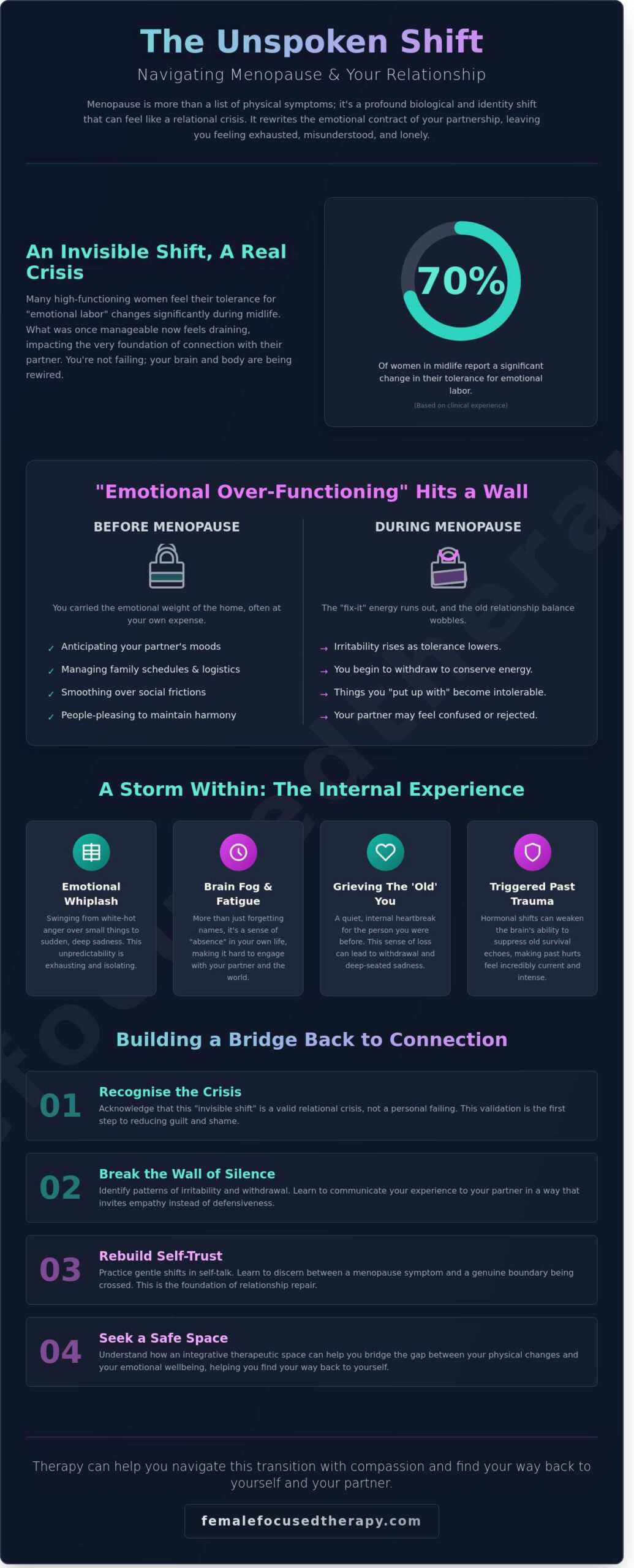
We often talk about menopause and relationship problems as if they’re a simple side effect of a hormonal dip. In reality, for the high-functioning women I support, this period feels like a full-scale relational crisis. You aren’t going crazy, and you aren’t “failing” at your life. You’re navigating a significant biological and identity shift that changes how you process emotion and connection. In my clinical experience, approximately 70% of women in midlife report that their tolerance for “emotional labor” changes significantly during this time.
To understand the breadth of these changes, it’s helpful to look at the foundational physiological shifts. Gaining a clearer picture of what is menopause? can help you see that your brain is literally being rewired. The pressure to remain “high-functioning” in a fast-paced environment like Singapore often makes these changes feel shameful. You feel you should be able to “handle” it, yet the internal landscape is shifting too fast to keep up with.
When your ’emotional over-functioning’ hits a wall
For decades, you’ve likely been the person who carries the emotional weight of the home. You’ve anticipated your partner’s moods, managed the children’s schedules, and smoothed over social frictions. I call this “emotional over-functioning.” Menopause often strips away the ability to mask these efforts or continue people-pleasing at your own expense.
There is a specific moment when the “fix-it” energy simply runs out. When you stop over-functioning, the balance of the relationship naturally wobbles. This can be jarring for a partner who has grown used to you holding everything together. It’s a pivotal point where menopause and relationship problems often peak, as the old ways of relating no longer work for your changing needs.
The intersection of midlife and past trauma
This biological transition can also act as a spotlight on old wounds. I’ve found that menopause can sometimes trigger intense feelings related to past relationship trauma or family-of-origin issues. As oestrogen levels decline, the brain’s ability to “dampen down” old survival echoes often weakens, making past hurts feel incredibly current.
It’s important to recognize the difference between a menopause symptom, like increased irritability, and a genuine boundary being crossed. You might find that things you “put up with” for twenty years are now intolerable. Rebuilding self-trust is a core part of the work we do at Female Focused Therapy, helping you discern which feelings belong to the present and which are echoes of the past that need healing.
If you’d like to find out more about working with Cheryl Kennedy MacDonald, you can email her at cheryl@femalefocusedtherapy.com or go ahead and book an appointment here: https://www.femalefocusedtherapy.com/book-now/
Hormones, heartbreak, and the loss of the ‘old’ you
I have sat with many women in my practice who feel like they are grieving. They aren’t mourning a person, but rather the version of themselves that existed before perimenopause arrived. It feels like a quiet, internal heartbreak. You might experience a sudden whiplash, feeling white-hot anger about a misplaced set of keys one minute and sobbing into a tea towel the next. This unpredictability is exhausting. It makes you feel like a stranger in your own skin, and that’s a very lonely place to be.
Brain fog and deep fatigue do more than just make you forget names. They create a sense of “absence” within your partnership. You are physically present at the dinner table, but your mind is miles away, struggling to process the conversation or find the energy to engage. In a 2010 study, researchers explored how menopausal symptoms affect relationships, noting that depressed mood and cognitive changes often lead to significant withdrawal. Your partner might mistake this cognitive lag for disinterest, which is where many menopause and relationship problems begin to take root.
The most destructive part of this transition is often the self-blame. You might tell yourself you are being “difficult” or “dramatic.” You may feel guilty for not being the “fun” or “easy-going” partner you used to be. In reality, your nervous system is simply trying to recalibrate during a massive biological shift. If you feel like you’ve lost your way, finding a safe space to talk can help you stop the cycle of self-criticism and start the process of reconnection.
The ADHD factor in midlife
If you live with ADHD, menopause can feel like your symptoms have suddenly doubled in intensity. This happens because the drop in oestrogen directly impacts your dopamine levels, making it much harder to regulate your emotions and stay organised. Tasks that were once manageable now feel impossible. Your partner might see your struggle to focus as a lack of care or effort, but it’s actually a biological hurdle. Understanding this link is vital for reducing the friction in your home life.
Mourning your reproductive identity
There is a specific weight to the “closing of the door,” even if you never wanted more children. This shift changes how you see yourself as a woman and as a partner. It’s a transition out of the reproductive years that can leave you feeling less “relevant” or feminine. It is okay to grieve this loss. Finding a way to acknowledge these feelings without feeling like you are “complaining” is a necessary step in moving forward. You aren’t just losing something; you are evolving, but that evolution requires a period of honest reflection.
If you’d like to find out more about working with Cheryl Kennedy MacDonald, you can email her at cheryl@femalefocusedtherapy.com or go ahead and book an appointment here: https://www.femalefocusedtherapy.com/book-now/
Navigating the wall of silence and misunderstanding at home
I hear from so many women in my practice that their partners simply “don’t get it.” It is an incredibly isolating feeling. You are dealing with a changing body and a shifting sense of self, yet the person closest to you feels like a stranger. This gap often leads to menopause and relationship problems that feel insurmountable at 11 pm when you are both exhausted.
The cycle is often predictable but painful. You might feel a flash of irritability, and in response, your partner withdraws or becomes defensive. This creates a loop where you feel invisible and they feel attacked. What we often call “menopause rage” is rarely about the burnt toast. In my experience, it is usually years of unheard needs finally bubbling to the surface. It is the result of emotional over-functioning for decades.
There is often a deep, quiet fear that if you speak your full truth, the relationship will crumble. You worry that your anger or your sadness is too much for the container of your marriage to hold. This silence only builds the wall higher. Breaking it requires a gentle, honest approach that starts with your own needs.
When intimacy feels like another chore
Physical changes like vaginal dryness or a plummeting libido can make sex feel like another item on a long to-do list. It is common to feel “touched out” after a day of managing work and domestic life. I want you to know it is okay to communicate that you need physical space without it being a rejection. Research into menopausal symptoms’ impact on marriage shows these physical shifts are deeply tied to how we feel about our connection. We can move away from “performance” and toward genuine reconnection.
Breaking the ‘fix-it’ cycle
When you share your struggle, a partner’s instinct is often to “solve” it. They might suggest a specific supplement or a new cooling pillow. While they mean well, it can feel dismissive. You don’t need a project manager; you need to be held and validated. Learning to ask for “holding” rather than “fixing” is a vital skill during this transition.
However, it’s also important to look at the patterns in your home. Sometimes, a partner’s reaction isn’t just a misunderstanding but a form of narcissistic abuse. If you feel consistently belittled or manipulated when you express your vulnerability, that is something we need to look at closely. At Female Focused Therapy, I help women find the clarity to see their relationships for what they truly are.
If you’d like to find out more about working with Cheryl Kennedy MacDonald, you can email her at cheryl@femalefocusedtherapy.com or go ahead and book an appointment here: https://www.femalefocusedtherapy.com/book-now/
Practical ways to rebuild intimacy and self-trust in midlife
Rebuilding self-trust is the foundation of any repair work we do in our relationships. When your body feels like it’s behaving in ways you don’t recognise, it’s natural to feel disconnected from your own instincts. I suggest starting with small, sustainable shifts in how you talk to yourself. Instead of “I’m losing my mind,” try “My nervous system is under a lot of pressure right now.” This isn’t just about being positive; it’s about being accurate and kind to the woman you are becoming.
I often encourage women to check in with their bodies before they check in with their partners. If your chest feels tight or your jaw is clenched, it’s probably not the best time to discuss the household budget or a sensitive family issue. Taking five minutes to breathe or simply sitting in a quiet room can change the trajectory of an entire evening. In a fast-paced environment like Singapore, where we’re often expected to be “on” constantly, these micro-moments of somatic awareness are essential for managing menopause and relationship problems.
Setting boundaries is another vital tool for protecting your energy during this transition. This might mean saying no to a late-night social commitment or choosing to spend a Saturday morning alone rather than at a crowded mall. Protecting your energy isn’t selfish; it’s a form of relationship maintenance. When you aren’t running on absolute empty, you have more capacity for genuine connection and intimacy with the people you love.
Communicating the ‘uncommunicable’
Explaining “menopause brain” or sudden irritability to a partner can feel daunting. I find that using “I” statements helps keep the conversation safe and reduces defensiveness. You might try a script like: “I’m feeling very overwhelmed right now and I’m struggling to find my words. It isn’t about anything you’ve done; I just need a little space to ground myself.” This level of honesty prevents your partner from feeling blamed and creates a bridge for mutual understanding.
Prioritising your own wellbeing
In this stage of life, self-care is a survival strategy rather than a luxury. It involves identifying your sensory triggers, such as being sensitive to loud noises or the intense Singapore heat, and managing them proactively. Finding joy in this new version of yourself comes from clarity and the confidence to say what you need without apology. As you begin to trust your own needs again, you’ll find that menopause and relationship problems become much easier to navigate together.
If you’d like to find out more about working with Cheryl Kennedy MacDonald, you can email her at cheryl@femalefocusedtherapy.com or go ahead and book an appointment here: https://www.femalefocusedtherapy.com/book-now/
How therapy helps you find your way back to yourself
I know you’re used to holding it all together. For years, you’ve likely been the one everyone else leans on at home and at work. In my practice, I provide a safe space where you finally don’t have to be “the strong one.” You can let the mask slip and just be exactly as you are, without the pressure to perform or please. We often spend so much time looking after others that we lose sight of our own needs; here, the focus is entirely on your restoration.
My integrative approach is specifically designed to bridge the gap between your changing body and your mind. During midlife, it can feel like your physical self is speaking a language you no longer understand. This disconnect often triggers deep-seated anxieties or old wounds that you thought were healed. We work together to reconnect these parts of yourself using both talk therapy and somatic awareness so you feel whole again. By acknowledging the physical sensations alongside your thoughts, we create a more resilient foundation for your mental health.
It’s important to understand that menopause therapy is about much more than just managing physical symptoms. While hot flashes and sleep issues are real, we focus on the emotional landscape underneath. We look at the grief for the past, the fear of the future, and the profound shift in your identity that occurs during this transition. This is about reclaiming your narrative and deciding who you want to be in this next chapter.
When we look at couples therapy, we aren’t just trying to “fix” a single argument. We are creating a new relational contract for this stage of life. Menopause and relationship problems often peak because the old ways of relating, perhaps based on you over-functioning, no longer fit who you are becoming. We build a framework that allows for honesty, boundaries, and a different kind of intimacy that honours your current needs.
Moving forward with clarity and confidence
Whether we meet at my office in Singapore or through online sessions, our work is centered on your unique experience. The goal is to rebuild a stronger sense of self that isn’t tied to being “needed” by everyone around you. We work at a pace that feels safe and sustainable, ensuring you never feel pushed. Many women I work with find that after 8 to 12 sessions, they feel a renewed sense of self-trust they haven’t felt in decades. Our sessions include:
- A confidential environment to explore your changing identity.
- Practical strategies to bridge the mind-body gap during hormonal shifts.
- Support in renegotiating boundaries within your family and career.
Your next small step
You don’t have to navigate this heavy season alone. If you feel like you’re drowning in a sea of hormonal shifts and emotional distance, please know your feelings are valid. You deserve support that is as nuanced as the life you’ve lived. Menopause and relationship problems can feel like an impossible weight, but they also offer a chance to redefine how you show up for yourself.
Reach out when you feel ready. There is no pressure to have it all figured out before we talk. Sometimes, the bravest thing you can do is simply admit that things are difficult and that you deserve a helping hand to find your way back to yourself.
Finding your way back to yourself and your partner
I know how heavy this season feels. It’s rarely just about physical shifts; it’s about the quiet distance growing between you and the person you love. I’ve shared how to break the silence and why rebuilding self-trust is the first step toward reclaiming your joy.
As a Registered Psychotherapist in Singapore with over 10 years of experience, I use an integrative, trauma-informed approach to help you navigate these transitions. We can work together to ensure menopause and relationship problems don’t define your future. You can find more information about my Female Focused Therapy services on my homepage.
You don’t have to carry this weight alone. There’s a path through the fog toward a life that feels grounded again. You can learn more about my support for midlife transitions to see how we can work together. I’m here to help you find clarity at a pace that feels safe.
If you’d like to find out more about working with Cheryl Kennedy MacDonald, you can email her at cheryl@femalefocusedtherapy.com or go ahead and book an appointment here: https://www.femalefocusedtherapy.com/book-now/
Common questions about menopause and relationship problems
Can menopause cause a relationship to end?
Yes, research shows that nearly 60% of divorces in the 45 to 55 age bracket are initiated by women, often coinciding with the menopausal transition. Menopause and relationship problems frequently emerge when hormonal shifts act as a catalyst, making it harder to tolerate long standing imbalances. I’ve worked with many women in Singapore who find that this phase brings a new clarity, leading them to prioritize their own wellbeing over a relationship that no longer feels supportive.
How do I explain my menopause symptoms to my husband without him getting defensive?
I recommend starting the conversation during a calm moment when you both feel relaxed, rather than in the heat of a symptom. Use “I” statements to explain your internal experience, such as “I’m feeling very overwhelmed by these physical changes,” which helps him listen without feeling attacked. Sharing a simple fact sheet from a trusted source can depersonalize the issue. This shifts the focus from his behavior to a biological challenge you’re navigating together as a team.
What if I’ve lost all interest in sex because of menopause?
Low libido affects approximately 70% of women during this transition due to significant drops in oestrogen and testosterone. It’s a physiological shift, not a sign that you’ve stopped loving your partner. I often suggest focusing on non-sexual intimacy and “outercourse” to maintain your bond while your body adjusts. Rebuilding intimacy in a way that feels safe and low pressure is a core part of the support I offer at Female Focused Therapy.
Is ‘menopause rage’ real, or am I just unhappy in my marriage?
Menopause rage is a documented biological experience caused by fluctuating hormones affecting the brain’s emotional regulation centres. However, it often acts as a truth serum that highlights genuine issues you’ve suppressed for years. If you find yourself feeling 8 out of 10 angry over a 2 out of 10 problem, it’s usually a mix of both. We can explore these feelings together to help you distinguish between hormonal irritability and deep seated marital dissatisfaction.
How can therapy help with relationship problems during perimenopause?
Therapy provides a confidential, professional space to untangle your hormones from your heart. We use an integrative approach to help you communicate your needs without the emotional over-functioning that often leads to burnout. In my Singapore practice, women find that having a neutral professional to validate their experience helps them rebuild self-trust. It’s about learning to navigate menopause and relationship problems with clarity rather than reacting from a place of pure exhaustion.
What should I do if my partner thinks I’m using menopause as an excuse?
This perception often comes from a lack of education or a fear of the changes they see in you. I suggest sharing specific data, such as the fact that 1 in 4 women experience severe symptoms that impact their daily functioning. If they remain dismissive after you’ve shared your reality, it might indicate a deeper issue with empathy in the relationship. You deserve to feel heard and supported, not judged for a natural biological process.
Can menopause trigger symptoms of past relationship trauma?
Yes, the neurological changes during midlife can make it much harder to “box up” old wounds or memories of narcissistic abuse. When your nervous system is already sensitized by night sweats and insomnia, past traumas often resurface with new intensity. I work with many women to process these memories using trauma-informed techniques. This helps you move forward with a stronger sense of self and prevents the past from dictating how you feel in your current relationship.
How long do the emotional relationship challenges of menopause usually last?
The perimenopause transition typically lasts between 4 and 10 years, but the emotional impact on your relationship depends on how you manage the shift. While the biological storm eventually settles, the relationship changes made during this time are often permanent. Seeking support early can shorten the period of conflict significantly. By visiting my homepage, you can learn more about how to navigate this transition at a pace that feels safe and sustainable.
If you’d like to find out more about working with Cheryl Kennedy MacDonald, you can email her at cheryl@femalefocusedtherapy.com or go ahead and book an appointment here: https://www.femalefocusedtherapy.com/book-now/