
You might be here because you’ve spent years feeling emotionally exhausted, constantly second-guessing your own reality. It’s a quiet confusion that can linger long into adulthood, a persistent hum of self-doubt that you can’t quite shake. This feeling is so common for women who grew up with a narcissistic parent. The experience can be difficult to name because the emotional landscape is often so complex and contradictory, leaving you with a sense of guilt or responsibility that isn’t yours to carry.
My intention with this article is to offer a safe, gentle space to explore these feelings. We will softly unpack some of the emotional patterns that can follow you from childhood, not to place blame, but to bring understanding and compassion to your experience. It’s about finding the language for what you went through and giving you permission to finally trust what you feel. This is often the first, most important step on the path toward healing.
Key Takeaways
- Learn to validate the quiet, nagging feeling that something in your childhood felt different and what that might mean for you today.
- Recognise the connection between your experience with a narcissistic parent and adult patterns like people-pleasing or feeling responsible for others’ emotions.
- Understand why it’s completely normal to feel guilt or loyalty when questioning your upbringing, and how to navigate these complex feelings gently.
- Discover a small, internal first step you can take towards reclaiming your story, one that begins with self-awareness rather than confrontation.
The Quiet Search That Brought You Here
First, I want to acknowledge the quiet courage it took for you to be here. Typing certain words into a search bar is a significant step, often taken after years of a nagging feeling that something in your childhood was different. It’s a moment of reaching for clarity, and I’m glad you’ve found this space.
You may not have the words for it yet. It might just be a sense of unease, a lifelong pattern of feeling not quite good enough, or a memory of always treading carefully. Please know that seeking to understand this is not about assigning blame; it is about beginning your own journey of healing and reconnection with yourself.
Think of this article as a gentle, confidential space to explore these feelings without judgment. It’s a place to make sense of your story, at a pace that feels safe for you.
It’s Often a Feeling, Not a Fact
This journey rarely begins with certainty. More often, it starts with a deep sense of confusion. You might find yourself questioning your own memories, wondering if you were being too sensitive or dramatic. It’s completely normal for your recollections to feel blurry or even contradictory, especially if you were taught to doubt your own perceptions.
Moving Beyond Labels
My goal here is not to help you diagnose anyone. While resources can provide a clinical definition of a Narcissistic parent, our focus is much more personal. It’s about gently turning the focus back to you: to the impact their behaviours have had on your life and your relationships today.
This is about understanding your own story, honouring your experiences, and beginning the important work of rebuilding self-trust. It’s about your path to feeling whole.
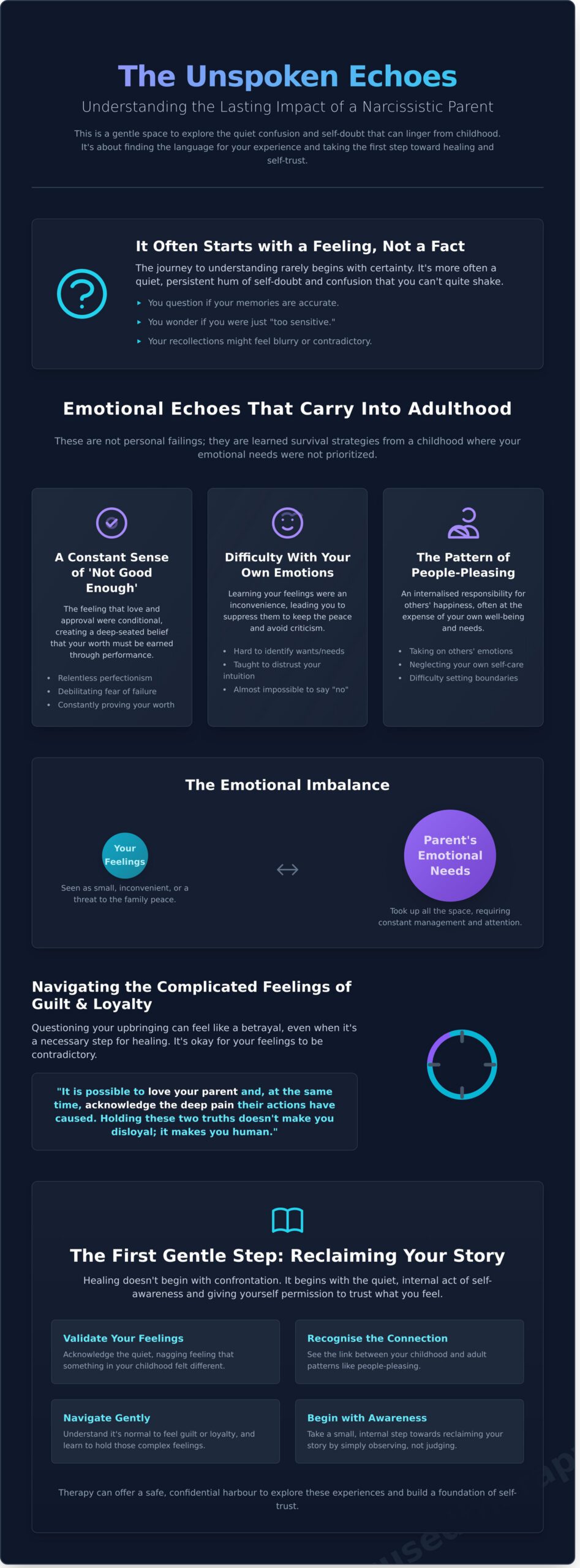
The Emotional Echoes You Might Carry With You
Instead of focusing on a checklist of their behaviours, let’s gently turn our attention to you. The experience of growing up with a parent who couldn’t see past their own needs often leaves deep imprints on how we see ourselves and navigate the world. These internalised patterns are often profound, and research into the long-term Impacts of a Narcissistic Parent shows just how deep these roots can go.
You may feel a constant pull to please others, taking on responsibility for their happiness while neglecting your own. You might carry a harsh inner critic or find it incredibly difficult to trust your own instincts and set boundaries. These aren’t personal failings; they are learned survival strategies.
A Constant Sense of ‘Not Good Enough’
Did you grow up feeling that love and approval were conditional? That they had to be earned through achievements, perfect behaviour, or by making your parent look good? This creates a deep-seated belief that you are only worthy when you are performing.
In adult life, this can show up as relentless perfectionism, a debilitating fear of failure, or a feeling that you must constantly prove your worth in your career and relationships. That nagging inner voice telling you you’ve fallen short is often an echo of a parent you could never quite please. This experience is a common theme in what I see in cases of relationship trauma and narcissistic abuse.
Difficulty with Your Own Emotions
When a narcissistic parent’s emotional needs take up all the space in a family, a child learns that their own feelings are an inconvenience or a threat. You may have learned to suppress your anger, sadness, or even joy to keep the peace and avoid criticism.
As an adult, this can make it incredibly difficult to even identify what you truly want or need. You might have been told you were ‘too sensitive’ or ‘dramatic’, a message that taught you to distrust your own emotional responses. This can make it feel almost impossible to say “no,” because your needs were never treated as valid in the first place.
Navigating the Complicated Feelings of Guilt and Loyalty
If you’re beginning to recognise the impact of your upbringing, you might also be feeling a heavy sense of guilt. It’s completely normal. From a young age, we’re taught to honour our parents, and questioning their behaviour can feel like a profound betrayal. This feeling is often one of the biggest hurdles in healing from a narcissistic parent.
I want you to know that your feelings are valid, even when they feel contradictory. It is possible to love your parent and, at the same time, acknowledge the deep pain their actions have caused you. Holding these two truths doesn’t make you disloyal; it makes you human.
De-tangling Love from Hurt
Your mind might be a confusing mix of memories. You might remember moments of genuine connection or times they provided for you, and these can sit uncomfortably alongside memories of emotional neglect or criticism. This is one of the most complex parts of the healing journey, and extensive research on the effects of narcissistic parents confirms just how confusing these emotional ties can be.
Feeling loyal to the person who raised you is a natural, deep-seated instinct. Acknowledging the hurt doesn’t erase the good moments or the love you felt. It simply means you are creating space for your own experience to be true as well.
Giving Yourself Permission
Here, I want to give you gentle permission to put your own emotional wellbeing first. For the adult child of a narcissistic parent, this can feel incredibly difficult. But this isn’t about blaming or punishing; it’s about tending to your own wounds. Your healing is not an act of betrayal. It is a profound act of self-compassion.
By choosing to understand your past, you are taking responsibility for your future happiness and health. You are learning to re-parent yourself with the kindness and validation you may have missed. This is a courageous step towards building a life that feels authentic and whole, and you can learn more about this process on my homepage.
The First Gentle Steps Towards Reclaiming Your Story
When you imagine healing from the effects of a narcissistic parent, you might picture a grand confrontation or a dramatic moment of closure. But in my experience, true healing rarely starts that way. It begins quietly, inside you, with small, gentle shifts that no one else might even notice.
It’s not about changing them; it’s about coming home to yourself.
The journey can begin with three simple, internal practices:
- Simply Notice: Start by noticing your feelings without judgment. Notice the flicker of anxiety when the phone rings or the wave of sadness that comes from nowhere. You don’t need to fix it. Just acknowledge it with a quiet, “Ah, there you are.”
- Practice Self-Compassion: When that familiar inner critic starts its monologue, try offering yourself a single kind thought. Something as simple as, “This is hard, and I’m doing my best.” It’s a powerful antidote to years of criticism.
- Honour One Small Need: Each day, identify one small need of your own and meet it. It could be stretching for two minutes, making that cup of tea you wanted, or taking five minutes to sit in silence. This is a tiny act that affirms, “I matter, too.”
Learning to Trust Yourself Again
Growing up with a narcissistic parent often erodes your trust in your own perceptions. A core part of your recovery is gently rebuilding that self-trust. Journaling can be a beautiful, private way to explore your thoughts and validate your feelings without fear of dismissal. Remember, this is a slow and tender process. There is no rush.
Finding ‘Safe’ People
As you start to trust yourself, you also learn what safety feels like in relationships. A safe person-a trusted friend, a partner, or a therapist-is someone you don’t have to shrink for. They allow you to take up space. These connections are vital, as they mirror back the acceptance you’re learning to give yourself. Building these supportive relationships is central to the work we explore in therapy for women, creating a space where you can finally exhale.
How Therapy Can Offer a Safe Harbour
Untangling the complicated web of feelings left by a difficult childhood can feel incredibly isolating. You might question your own memories, feel a deep-seated loyalty that makes it hard to speak honestly, or simply feel exhausted by it all. I want you to know that you don’t have to navigate this alone.
Therapy offers a confidential, professional space where your story can unfold at a pace that feels safe for you. It’s a harbour in the storm. My work at Female Focused Therapy is dedicated to helping women make sense of these exact experiences. It’s a space where you can finally feel heard, validated, and supported as you begin the gentle, steady work of reconnecting with your own needs and your true self.
A Space Without Judgment
One of the greatest gifts of therapy is having a space entirely free from judgment. My role isn’t to take sides, lay blame, or tell you what to do. It’s to sit with you, listen with genuine warmth, and help you understand the patterns that have shaped you. We can explore how growing up with a narcissistic parent may be impacting your life today-from people-pleasing tendencies to a harsh inner critic. This is a place where all of your feelings are welcome, especially the conflicting ones like guilt, anger, and love.
Building a New Foundation
While understanding the past is vital, healing is also about building a new foundation for your future. Therapy is a collaborative process where we can support you in learning the practical skills of setting healthy boundaries, perhaps for the first time in your life. It’s a space to gently challenge old beliefs-like the idea that your worth is conditional-and cultivate a sense of self-worth that comes from within. Step by step, our work together is about helping you build a life that feels steady, calm, and authentically yours, guided by your own values and desires.
Your Story Deserves to Be Heard
If the experiences I’ve described in this article resonate with you, please know that your feelings are valid. Untangling the emotional echoes from your childhood and navigating the complex sense of loyalty you might feel is a significant journey. Recognising these patterns is a brave first step towards reclaiming your own story.
The experience of having a narcissistic parent can leave you feeling isolated, but you are not alone in this. Simply by seeking to understand, you are beginning to honour your own experiences and trust your feelings again. This is where true healing begins.
Remember, you don’t have to have all the answers right now. The next step can be as simple as taking a deep breath and giving yourself credit for getting this far. If you feel you need a warm, non-judgmental space to explore this further, you can learn more about my specialist work in narcissistic abuse recovery here at Female Focused Therapy. Your story matters.
Frequently Asked Questions About Healing From a Narcissistic Parent
Can a narcissistic parent ever change?
This is a question I hear so often, and it comes from a place of deep hope. While anyone can change, true, lasting change for someone with deep-seated narcissistic traits is very rare. It requires a level of self-awareness and a willingness to engage in intensive therapy that they often lack. I find it’s more empowering for you to focus on what you can control: your own healing, your boundaries, and how you choose to respond to their behaviour.
How do I deal with my narcissistic parent as an adult?
Navigating this relationship as an adult is about protecting your own emotional wellbeing. The most powerful tool you have is setting and maintaining firm boundaries. This might look like limiting the length of your phone calls, keeping conversations on safe, superficial topics, or deciding not to share personal details of your life. It isn’t about punishing them; it’s about creating a safe space for yourself so you can thrive.
Is it okay to reduce contact or cut ties with a narcissistic parent?
Yes, it is absolutely okay. Giving yourself permission to reduce contact (low contact) or end it completely (no contact) can be a profound act of self-preservation and self-love. It’s a decision you make for your own mental health, not to hurt your parent. This choice can bring up complex feelings of guilt and grief, and it’s important to have support from a therapist or trusted friends as you navigate this difficult but often necessary step.
Why do I still seek approval from a parent who always criticises me?
Please know that this is an incredibly common and understandable pattern. As a child, your survival and sense of self-worth were tied to seeking your parent’s approval. That longing for validation doesn’t simply vanish when you become an adult. It’s a deep, early emotional wound. Recognising this pattern is the first step toward healing and learning to find that validation and approval from within yourself.
How do I explain my experience to a partner or friend who doesn’t understand?
It can feel lonely when those closest to you don’t grasp the complexity of your experience. I suggest focusing on your feelings rather than their actions. Instead of saying, “My mother is a narcissist,” you could try, “When my mum criticises my choices, I feel hurt and exhausted.” This helps others connect with your emotional reality. Remember, their role is to support you, not to perfectly understand your parent.
What’s the difference between a strict parent and a narcissistic parent?
This is a crucial distinction. A strict parent sets firm rules and high standards out of love and a desire for their child’s wellbeing and success. Their actions are child-centred. A narcissistic parent, however, sets rules to serve their own needs for control and admiration. Their actions are parent-centred, lacking empathy and viewing the child as an extension of themselves rather than as an individual.
Am I a narcissist myself if I had a narcissistic parent?
This is a very common fear for adult children of narcissists. The very fact that you are worried about this, that you have the capacity for self-reflection and concern for others, is a strong indicator that you are not a narcissist. You may have learned some unhelpful coping mechanisms or patterns of behaviour to survive your childhood, but these are not the same as a personality disorder. These patterns can be unlearned with gentle awareness and support.