
You try to explain the subtle disconnection, the emotional void in your relationship, but the words fall flat. To friends and family, your partner is charming and your marriage looks perfect. But behind closed doors, you feel invisible, unheard, and increasingly isolated-a lonely voice in your own home. This profoundly confusing and painful dynamic, where your valid warnings and concerns are consistently dismissed until you begin to question your own perception, is the modern-day experience of the Cassandra Syndrome in marriage.
If you feel emotionally starved and are exhausted from being disbelieved, please know that your experience is real, and you are not alone. This guide offers a compassionate space to understand this profound exhaustion. We are here to help validate your feelings, explore gentle steps toward healing, and help you navigate the path to rebuilding your self-trust, so you can find your voice and finally be heard, seen, and respected within your relationship.
Key Takeaways
- Understand that the profound feeling of being disbelieved has a name, helping you to validate your own reality and know you are not alone.
- Explore the relational dynamics that contribute to Cassandra Syndrome in a marriage, moving beyond blame to gain clarity on the situation.
- Discover compassionate, actionable steps to begin rebuilding the self-trust that has been eroded and reclaim your voice.
- Learn why specialized support is so crucial and how a therapist who truly validates your experience can be the turning point in your healing journey.
Understanding Cassandra Syndrome: When Your Reality is Doubted
You may be here because you feel a deep, persistent sense of being unheard in your relationship. You voice your concerns, share your perceptions, and describe your reality, only to be met with dismissal, doubt, or a gentle, “you’re being too sensitive.” This profoundly isolating experience has a name, and simply knowing it can be the first step toward clarity and rebuilding your self-trust.
The term ‘Cassandra Syndrome’ originates in Greek mythology with the story of Princess Cassandra, who was blessed with the gift of prophecy but cursed by the god Apollo so that no one would ever believe her. In a modern psychological context, it describes a painful relational dynamic where your valid insights and feelings are consistently invalidated by those closest to you. While not a formal clinical diagnosis, the experience of cassandra syndrome in marriage is very real. It’s the chronic pattern of having your reality denied, leaving you feeling powerless and alone.
The Agony of Being Disbelieved
This constant invalidation creates a painful ‘double reality’-the private truth you experience versus the public narrative your partner maintains. Over time, being disbelieved chips away at your confidence and sense of self. It’s more than a simple disagreement; it’s a fundamental challenge to your perception and sanity, making you question the very ground you stand on. This emotional erosion is often the most damaging part of the experience.
Cassandra Syndrome vs. Gaslighting: What’s the Difference?
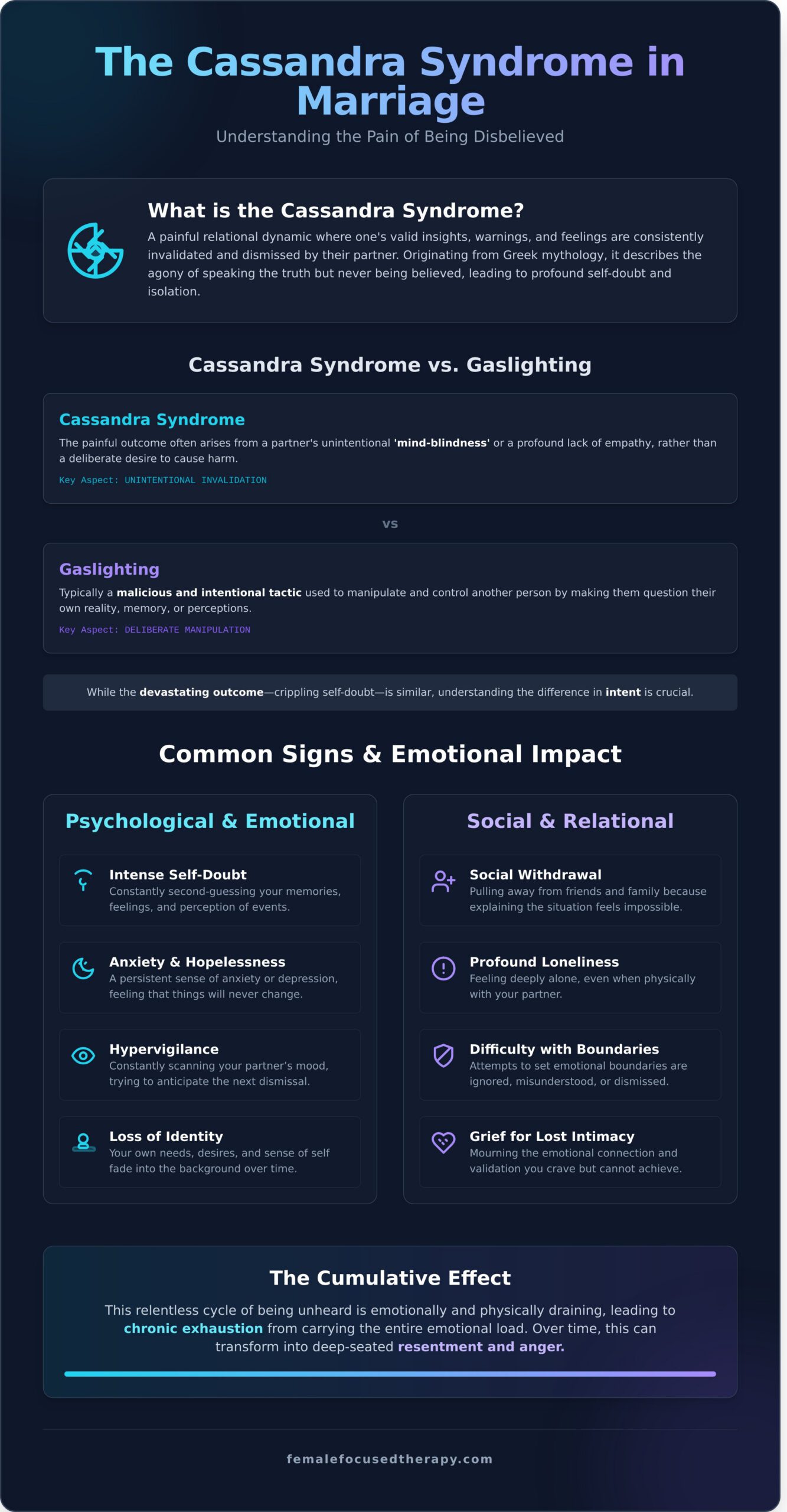
While gaslighting is often a component of this dynamic, there is a key distinction. Gaslighting is typically a malicious and intentional tactic used to manipulate and control you. The experience of cassandra syndrome in marriage can sometimes arise from a partner’s unintentional ‘mind-blindness’ or a profound lack of empathy, rather than a deliberate desire to cause harm. The devastating outcome-crippling self-doubt-is similar, but understanding the potential difference in intent is crucial for navigating your path forward.
The Common Signs and Emotional Impact of Cassandra Syndrome
Living with Cassandra Syndrome in marriage is an isolating and deeply confusing experience. It’s not about a single argument, but a persistent pattern of emotional invalidation that chips away at your sense of self. You may feel like you’re walking on eggshells, unsure if your perceptions are real or if you’re the one causing the problem. This internal turmoil is the hallmark of the syndrome, and recognising its signs is the first step toward reclaiming your clarity.
Psychological and Emotional Symptoms
The internal landscape of someone experiencing this syndrome is often fraught with anxiety and self-doubt. You may be here because you recognise some of these feelings in your own life:
- Intense self-doubt: You constantly second-guess your memories, feelings, and perceptions of events, a phenomenon often described as gaslighting.
- Anxiety and hopelessness: A persistent feeling of anxiety or a low-grade depression may follow you, coupled with a sense of hopelessness that your relationship will ever change.
- Hypervigilance: You find yourself constantly scanning your partner’s mood and words, anticipating the next dismissal or misunderstanding in an attempt to prevent it.
- A loss of identity: Over time, your own needs, desires, and sense of self fade into the background. Your identity becomes enmeshed with the role of a caretaker, and rebuilding self-trust is a core part of the journey toward Healing from Cassandra Syndrome.
Social and Relational Symptoms
The impact of Cassandra Syndrome extends beyond your internal world, affecting how you connect with your partner and others. This emotional disconnect can feel incredibly lonely.
- Social withdrawal: You may pull away from friends and family because explaining your situation feels impossible, or you fear they won’t understand or will judge you.
- Profound loneliness: You feel deeply alone, even when you are physically with your partner. The person you should feel closest to feels the most distant.
- Difficulty with boundaries: Attempts to set emotional boundaries are often ignored, misunderstood, or dismissed, leaving you feeling powerless.
- Grief for lost intimacy: You are in a constant state of mourning for the emotional connection, validation, and true partnership you crave but cannot seem to achieve.
This relentless cycle of being unheard and invalidated is emotionally and physically draining, leading to chronic exhaustion from carrying the entire emotional load of the relationship. Over time, this exhaustion can curdle into deep-seated resentment and anger. For many, the ongoing relational trauma of Cassandra Syndrome in marriage can contribute to symptoms consistent with Complex PTSD (C-PTSD), making professional support essential for navigating the path to recovery.
Why Does It Happen? Exploring the Contexts of This Dynamic
When you feel consistently unheard and disbelieved, it’s natural to search for a reason. Understanding the ‘why’ behind this painful dynamic is not about assigning blame, but about gaining clarity. The experience of cassandra syndrome in marriage often arises when one partner’s inner world-their thoughts, feelings, and experiences-is ‘hidden’ from the other due to specific, underlying factors.
This emotional disconnect isn’t born from a lack of love, but often from a fundamental mismatch in communication or emotional processing. Let’s gently explore some of the common contexts where this dynamic takes root.
Neurodiverse Relationships (Autism & ADHD)
In relationships where one partner is neurotypical and the other is neurodivergent (e.g., autistic or with ADHD), communication styles can be vastly different. A neurotypical partner may seek nuanced emotional validation, while an autistic partner might communicate more directly and logically. This gap can be widened by alexithymia-a common trait in autism involving difficulty identifying and describing one’s own emotions. When a partner cannot easily articulate their inner emotional state, it can leave the other feeling unseen and disconnected, a core experience for those Understanding Cassandra Syndrome in this context.
Partnerships with Narcissistic or Dismissive Traits
Sometimes, the dynamic is less about a neurological difference and more about personality traits. A partner with narcissistic or highly dismissive tendencies may invalidate your feelings as a way to maintain control and protect their own fragile self-image. Your reality is denied because it threatens their narrative of perfection. Their focus remains entirely on their own needs, leaving no space for your perspective to be heard or validated. This pattern is a painful form of emotional abuse, and you can learn more about navigating relationship trauma and narcissistic abuse in our dedicated guide.
Beyond Blame: Acknowledging the Two-Sided Struggle
It is vital to hold a compassionate view and recognise that your partner is often struggling, too. An autistic partner, for example, may be deeply exhausted from a lifetime of ‘masking’ to fit into a neurotypical world. Their withdrawal or seeming lack of empathy might be a sign of overwhelm, not a lack of care. Acknowledging that the communication breakdown is a shared challenge-not just one person’s fault-is the first, most crucial step. This mutual understanding creates the foundation needed to begin healing the patterns of cassandra syndrome in marriage and start building a new way of relating.
Healing from Cassandra Syndrome: Steps to Reclaim Your Voice and Self
Moving beyond the pain of being chronically disbelieved is a journey of reconnection-not with your partner, but with yourself. Healing from the emotional erosion of cassandra syndrome in marriage begins with the courageous decision to trust your own reality again. The goal is to gently rebuild the self-trust that has been chipped away, one small, sustainable step at a time. This path is yours to walk, whether or not your partner ever joins you on it.
Step 1: Radical Self-Validation
The first and most powerful step is to give yourself the validation you have been denied. Start by quietly acknowledging the truth of your own experiences. Journaling can be a profoundly helpful practice, creating a private space to explore your thoughts and feelings without judgment or debate. Practice affirming your reality with simple, powerful statements, even if you just say them to yourself: ‘My perception is real. My feelings are valid.’
Step 2: Build Your ‘Sanity Squad’
You do not have to navigate this alone. Intentionally seek out a small circle of trusted friends, family, or a support group who can listen with empathy. Finding even one person who believes you can be a lifeline. When you reach out, be specific about the support you need. You might say, ‘I really need you to listen right now, not to offer solutions. I just need to feel heard.’ This creates a safe space for you to share without fear of being dismissed.
Step 3: Learn to Set Gentle But Firm Boundaries
Boundaries are not walls to punish your partner; they are loving fences to protect your emotional wellbeing. Start with small, manageable boundaries focused on your own actions. For example: ‘I will not participate in this conversation if voices are raised.’ The focus is on what you will do, which empowers you to protect your peace. If both partners are willing to work on communication, couples therapy can provide a structured, neutral space to practice setting and respecting these boundaries together.
Reclaiming your voice is a process of gentle but consistent action. If you need support navigating this journey and rebuilding your sense of self, professional therapy can provide a safe, confidential space to heal.
How Specialized Therapy Can Be Your Lifeline
When you’re living with the profound emotional exhaustion of Cassandra Syndrome, reaching out for help is a courageous step. Yet, standard therapy can sometimes feel like another room where you’re not fully understood, especially if a therapist lacks experience with the specific dynamics of neurodiverse relationships or emotional neglect. The turning point in your healing journey often comes when a professional finally looks at you and says, “I see it. Your experience is real.” This validation is more than just comforting; it’s the foundation upon which you can begin to heal.
Therapy provides a confidential, non-judgmental space to untangle the complex web of confusion, self-doubt, and grief. It’s a sanctuary dedicated to you-where you can safely explore your feelings, reconnect with the person you were before the exhaustion set in, and begin to rebuild your sense of self and find clarity on your path forward.
Finding a Therapist Who Understands
The right therapist makes all the difference. When searching, look for a professional with experience in relationship trauma, emotional neglect, or neurodiversity. Don’t hesitate to ask potential therapists directly about their familiarity with the challenges of cassandra syndrome in marriage. A therapist who uses a trauma-informed approach is essential, as this ensures they understand how to create the deep sense of safety you need to open up and heal.
What to Expect in Therapy for Cassandra Syndrome
Specialized therapy is a collaborative process focused on empowering you. Together, we can work on:
- Rebuilding self-trust and reconnecting with your intuition, which may have been eroded over time.
- Developing practical coping strategies to manage emotional exhaustion, anxiety, and hypervigilance.
- Exploring your options for the future-whether that involves finding new ways to navigate your relationship or considering a different path-with clarity and confidence.
Ultimately, the goal is to help you find your voice, restore your wellbeing, and feel empowered in your own life again.
Ready to Be Heard? We Can Help
Our practice is dedicated to supporting women navigating these exact challenges. We provide a warm, compassionate space where your experiences are validated, not questioned. You do not have to walk this path alone. It’s time to feel truly seen and heard. If you’re ready to start your journey toward healing, we invite you to book a consultation with us.
Your Path Forward: From Being Unheard to Being Understood
Navigating the emotional landscape of feeling unseen and unheard in your relationship is a profoundly isolating experience. Recognizing the signs of this dynamic is the first powerful step toward validating your own reality and understanding that the erosion of your self-trust is not your fault. Healing from cassandra syndrome in marriage is a journey of reclaiming your voice, rebuilding that essential connection with yourself, and learning to trust your own perspective once more.
You do not have to walk this path alone. At Female Focused Therapy, we specialize in supporting women through relationship trauma. Our trauma-informed, empathetic approach provides a safe, confidential space to help you process your experiences and find clarity. With support available through both online and in-person sessions here in Singapore, you can begin to navigate your way forward. You deserve to be heard. Book a confidential therapy session today.
Remember, taking the first step towards being truly seen is an act of profound self-compassion. A future filled with confidence and connection is possible.
Frequently Asked Questions
Is Cassandra Syndrome only experienced by women in relationships with men?
While anyone in any relationship can feel unheard, this dynamic is most frequently discussed in the context of women partnered with men, particularly when neurodivergence like autism is a factor. This is often due to differing communication styles and societal gender roles. The core experience is one of being consistently disbelieved or dismissed-a painful pattern that transcends gender and can appear in various relational structures. The focus remains on the impact of feeling invalidated.
Can a marriage survive Cassandra Syndrome?
Yes, a marriage can navigate and heal from this painful dynamic, but it requires a mutual commitment to change and growth. Healing often begins when the unheard partner seeks validation and support, which is a vital step in rebuilding self-trust. For the relationship to survive, both individuals must be willing to explore new communication strategies and foster genuine empathy. Professional guidance can provide the essential tools and a safe space to facilitate this reconnection.
How do I explain what I’m going through to friends and family who don’t believe me?
It can feel incredibly isolating when loved ones don’t understand. Instead of focusing on your partner’s behaviour, try to explain your own emotional experience. Use “I” statements, such as, “I feel lonely and exhausted when my perspective isn’t acknowledged.” You might share a trusted article on the topic, but remember that your priority is your wellbeing. It is okay to set boundaries and seek support from those who can offer the empathy you deserve.
Is it my fault for not communicating my needs clearly enough?
It is completely understandable to ask this question, as self-blame is a common response to feeling consistently unheard. However, the core of Cassandra Syndrome in marriage is not a failure to communicate clearly; it is a persistent pattern of not being believed or validated by your partner. You may have tried countless ways to express yourself, only to be met with dismissal. The issue lies in the dynamic of disbelief, not your ability to articulate your needs.
If my partner has undiagnosed autism or ADHD, what is the first step?
The most empowering first step is often to seek support and education for yourself. Learning about how adult autism or ADHD can present in relationships can provide immense clarity and compassion for both you and your partner. This allows you to approach the situation with understanding rather than frustration. From there, you might gently suggest your partner explore resources for their own wellbeing, framing it as a path to greater self-awareness for them.