
Do you find yourself constantly striving, yet always feeling like you’re not quite good enough, no matter what you achieve? Perhaps you recognise a pattern of difficult romantic relationships or a persistent need to please others, often at your own expense. These feelings are not a reflection of your worth, but may be the long-lasting echoes of growing up with a narcissistic father. For many women, this experience leaves a quiet but profound mark, shaping self-perception and adult relationships for years to come.
This guide is here to offer a safe, supportive space for understanding and healing. We will gently navigate the connection between your childhood and the woman you are today, providing the clarity you need to finally feel seen and validated. Together, we will explore the first manageable steps you can take to set meaningful boundaries, break painful cycles, and begin the empowering journey of rebuilding your confidence and reconnecting with your most authentic self. You deserve to feel whole, and the path forward starts with this first step.
Key Takeaways
- Learn to identify the subtle emotional patterns of a narcissistic father, which often go far beyond surface-level arrogance or vanity.
- Discover the common survival roles daughters are often shaped into and understand the ’emotional blueprint’ that may be guiding your adult life.
- Understand how your upbringing connects to present-day challenges like people-pleasing or self-doubt, and find validation that these patterns are not your fault.
- Explore tangible first steps you can take to begin setting healthy boundaries, rebuilding your self-trust, and gently rewriting your personal story.
Recognizing the Signs: What a Narcissistic Father Looks and Sounds Like
You may be here because something about your relationship with your father feels deeply unsettling, yet difficult to put into words. Navigating the emotional landscape created by a narcissistic father is a confusing and often painful journey. The signs go far beyond the common stereotypes of vanity or arrogance; they are woven into the very fabric of your daily interactions, creating a pattern of emotional harm.
At the core, his behaviour is driven by a profound need to be the center of attention, a lack of genuine empathy for your feelings, and an extreme sensitivity to criticism while being highly critical of you. While these traits are hallmarks of what is clinically known as Narcissistic Personality Disorder, for a daughter, they manifest as a painful and confusing pattern of emotional neglect and control.
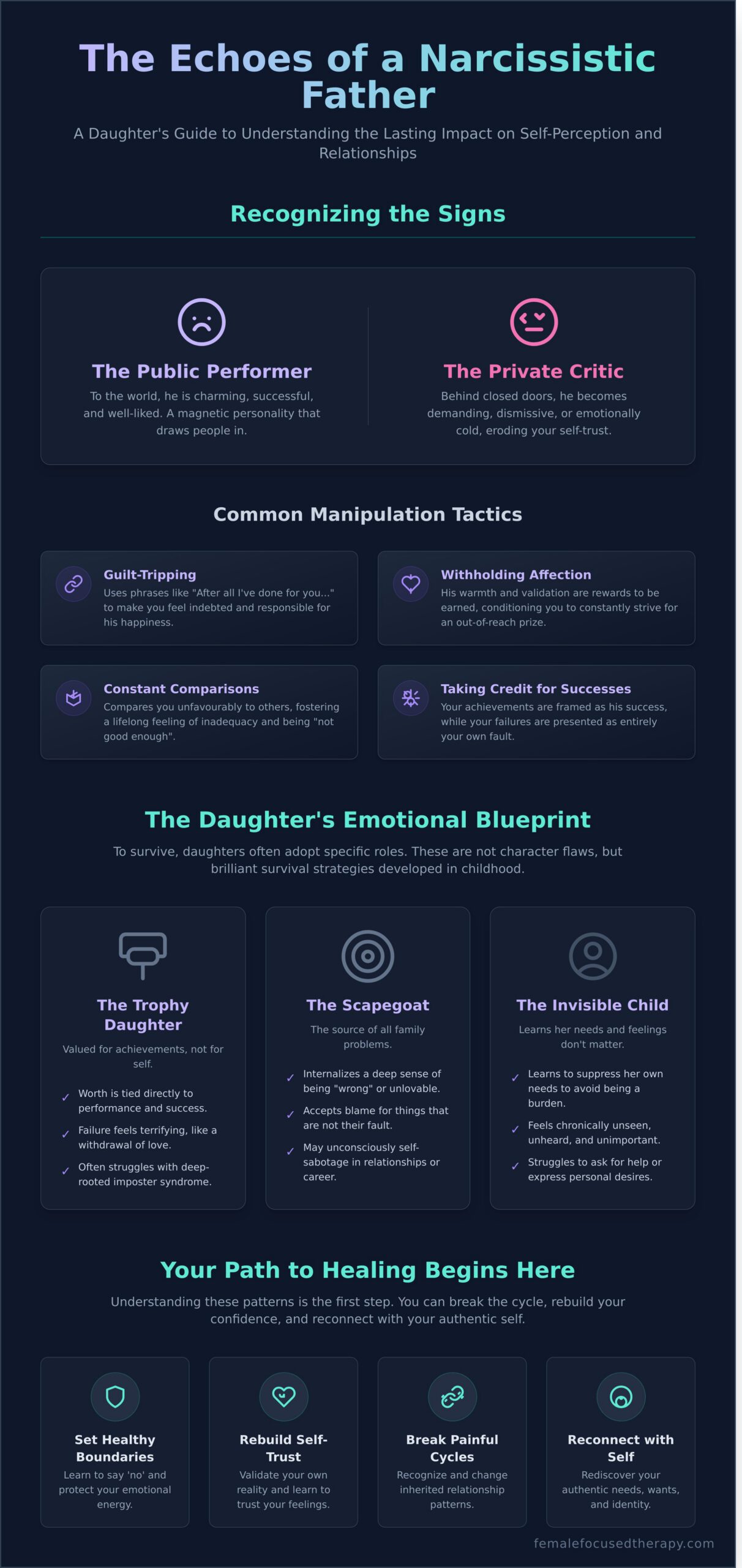
The Public Performer vs. The Private Critic
One of the most disorienting experiences is the stark contrast between his public persona and his private behaviour. To the outside world, he may be charming, successful, and well-liked. Behind closed doors, however, that warmth vanishes, replaced by a demanding, dismissive, or emotionally cold presence. This constant contradiction can be incredibly isolating, teaching you from a young age to doubt your own reality and eroding your self-trust.
Common Manipulation Tactics He Uses
To maintain his position of control and keep the focus on himself, a narcissistic father often relies on a set of predictable manipulation tactics. These behaviours are designed to keep you feeling off-balance, insecure, and perpetually seeking his approval.
- Guilt-tripping: Using phrases like, “After all I’ve done for you…” to make you feel indebted and responsible for his happiness.
- Withholding affection or approval: His warmth and validation are treated as rewards to be earned, not given freely. This conditions you to constantly strive for a prize that is always just out of reach.
- Constant comparisons: He may compare you unfavourably to siblings, friends, or even his own idealized version of you, fostering a lifelong feeling of inadequacy.
- Taking credit for your successes: Your achievements are framed as a reflection of his good parenting, while any failures or setbacks are presented as entirely your own fault.
The Daughter’s Blueprint: 3 Roles Forged by a Narcissistic Father
Growing up, we all develop an ‘emotional blueprint’—a set of ingrained beliefs about ourselves, our worth, and how we must behave to earn love and safety. For the daughter of a narcissistic father, this blueprint is not built on a foundation of unconditional love, but on the unstable ground of his needs. Because his behaviour is often driven by the core symptoms of narcissistic personality disorder, such as a profound need for admiration and a lack of empathy, you learned to adapt in specific ways to survive. These adaptations become roles that can define how you see yourself and operate in the world long into adulthood.
These are not character flaws; they are brilliant survival strategies you developed as a child to navigate a challenging emotional landscape. Recognizing which role you learned to play is a powerful and validating first step toward breaking free and beginning the journey of reconnection with your authentic self.
The Trophy Daughter: Valued for Achievements, Not for Self
As the Trophy Daughter, you learned that your father’s love and approval were conditional, tied directly to your performance. Your value was measured in accolades, good grades, career success, or physical appearance—anything that reflected well on him. This creates a relentless internal pressure to be perfect.
- You feel your worth is entirely dependent on what you achieve.
- Failure is terrifying because it feels like a withdrawal of love and validation.
- You may struggle with imposter syndrome, constantly feeling like you are not truly good enough, despite your successes.
The Scapegoat: The Source of All Family Problems
If you were cast as the Scapegoat, you became the container for your father’s frustrations, anger, and shame. You were blamed for his moods, family conflicts, and anything else that went wrong. This constant criticism taught you to believe that you were inherently flawed or difficult.
- You internalized a deep-seated sense of being ‘wrong’ or fundamentally unlovable.
- As an adult, you might find yourself accepting blame for things that are not your fault.
- This can lead to patterns of self-sabotage in relationships and careers, as you unconsciously recreate this familiar dynamic.
The Invisible Child: Learning to Stay Small and Unseen
The Invisible Child learns that the safest way to exist is to not exist at all. Your needs, feelings, and desires were consistently ignored or dismissed, so you learned to suppress them. To avoid being a burden, you became quiet, compliant, and highly self-reliant.
- You became fiercely independent and find it extremely difficult to ask for help or support.
- As an adult, you may feel disconnected from your own emotions, wants, and needs.
- You often feel unseen or unheard in your relationships, because you learned that your inner world didn’t matter.
How His Legacy Shows Up in Your Adult Life
The emotional blueprint created in childhood doesn’t simply disappear when you leave home. For adult daughters of a narcissistic father, that early conditioning often replays itself in subtle yet profound ways, shaping your relationships, career, and inner world. You may find yourself stuck in patterns that feel confusing or self-sabotaging, but please know this: these are not character flaws. They are learned survival strategies from an environment where your needs were secondary. Recognizing these echoes is the first powerful step toward reclaiming your narrative.
Impact on Romantic Relationships and Friendships
Your earliest model of love was conditional and self-serving, which can deeply skew your understanding of healthy connection. You might find yourself:
- Attracting similar partners: It can feel frustratingly familiar to find yourself in relationships with people who are emotionally unavailable, self-absorbed, or even narcissistic themselves.
- Struggling with boundaries: Saying “no” can feel impossible or dangerous, leading to people-pleasing behaviours where you over-give to earn affection and avoid conflict.
- Fearing true intimacy: You may keep others at a distance to protect yourself, or conversely, cling tightly out of an intense fear of being abandoned. This is a form of relationship trauma that requires healing and support to navigate.
Challenges in Your Career and With Self-Worth
The constant need for your father’s approval and the persistent criticism can leave a lasting mark on your professional life and sense of self. This legacy often manifests as a harsh inner critic—a voice that sounds suspiciously like his—that undermines your confidence. Research into the long-term effects of narcissistic parents confirms how deeply this can impact adult life. You may struggle with perfectionism that leads to burnout, feel terrified to ask for a raise because you don’t believe you deserve it, or experience imposter syndrome, feeling like a fraud no matter how much you accomplish. This internal struggle is a direct echo of being raised by a narcissistic father, where your worth was always externally defined and never truly your own.
Your Path to Healing: 4 Steps to Reclaiming Your Story
Beginning the journey of healing from a relationship with a narcissistic father is a profound act of self-love. It’s important to remember that this is a gentle process, not a race to a finish line. There will be moments of clarity and moments of difficulty, and all of it is part of your path. These steps are tangible starting points, grounded in self-compassion, designed to help you navigate this reconnection with your most authentic self.
Step 1: Acknowledge and Grieve
Your first step is to give yourself permission to feel. Allow yourself to grieve the loving, supportive father you needed and deserved but never had. Your childhood experiences are valid, even if others try to deny or downplay them. Feeling anger, sadness, or confusion is not a sign of weakness; it is a healthy and necessary response to the pain you endured. Holding space for these emotions is the foundation of healing.
Step 2: Start Setting Boundaries
Boundaries are not about punishment; they are about self-preservation. Start with small, low-stakes boundaries to build your confidence. This could be as simple as ending a phone call when it becomes draining or saying ‘no’ to a request without offering a lengthy explanation. A healthy boundary protects your energy, while an ultimatum tries to control another’s behaviour. It’s a subtle but powerful distinction. Explore our free resources on building healthy habits to support this practice.
Step 3: Cultivate Your Own Voice
For years, his voice may have been the loudest one in your head. Now is the time to tune into your own. Start a journaling practice to untangle his critical narrative from your true feelings and thoughts. Begin making small, everyday decisions—like what to eat for lunch or what movie to watch—based purely on what you want, not what is expected of you. Each choice is an act of reclaiming your identity and rebuilding self-trust.
Step 4: Find Your Support System
Healing from the complex dynamics of a narcissistic father does not have to be a solitary journey. Surround yourself with people who validate your experiences and celebrate your growth—be it trusted friends, a partner, or a support group. Professional therapy can also provide a confidential, safe space to unpack these challenging emotions with a guide who understands. If you feel ready, we are here to support you in this deeply important work.
How Therapy Helps You Rebuild: A Safe Space for a New Blueprint
The relational patterns and emotional responses you learned in childhood are like a deeply ingrained blueprint. When this blueprint has been shaped by a narcissistic father, trying to redraw it on your own can feel overwhelming and isolating. You might read books and understand the concepts, but putting them into practice amidst triggers and self-doubt is another challenge entirely.
This is where therapy offers a guiding hand. It provides a confidential, professional space to do this delicate work—not by blaming, but by understanding the impact and empowering you to build something new. It’s a collaborative process where we work together to navigate your experiences and create a future defined by you.
What Trauma-Informed, Female-Focused Therapy Looks Like
A trauma-informed approach recognizes the profound and lasting effects of your upbringing. It is a space free from judgment, where your feelings are validated and your story is heard with compassion. Together, we can explore the ‘why’ behind your current struggles—why you might people-please, struggle with boundaries, or feel emotionally exhausted. We focus specifically on your experience as a woman and a daughter, acknowledging the unique dynamics at play. Learn more about who I work with and my approach to see if it resonates with you.
Rebuilding Self-Trust and Inner Strength
One of the most significant wounds left by a narcissistic father is the erosion of self-trust. Therapy is a space to reclaim it. You’ll learn to listen to and honour your intuition again, validating your own feelings without needing external approval. We will also work with practical, evidence-based tools to help you manage anxiety, quiet your harsh inner critic, and build emotional resilience. The ultimate goal is to empower you to move forward with clarity and confidence, building a life that is authentically aligned with your own values, needs, and desires. Ready to start building a new blueprint? Book a consultation today.
Your Path Forward Begins With You
Understanding the legacy of a narcissistic father is the first courageous step. Recognizing the roles you were conditioned to play and seeing how those patterns affect your adult life are powerful milestones on your journey. But the most important takeaway is this: your past does not have to write your future. Healing and reconnection with your authentic self are entirely possible.
Rebuilding your inner blueprint requires a safe, supportive space. At Female Focused Therapy, we offer specialized support for women recovering from narcissistic abuse. Our confidential, trauma-informed approach is designed to help you navigate this journey with professional guidance. With global online therapy available, you can access this support from anywhere, including right here in Singapore.
If this resonates with you, you don’t have to navigate it alone. Let’s talk.
Your story is yours to write now. A future filled with clarity, confidence, and a stronger sense of self is waiting.
Frequently Asked Questions
Can a narcissistic father ever really love his daughter?
This is a deeply painful question many daughters navigate. A narcissistic father’s capacity for love is often conditional and transactional; he may show affection when you reflect well on him by meeting his expectations. However, this is tied to his need for admiration, not your intrinsic worth. True, unconditional love, which nurtures you for who you are, is something a person with narcissistic personality disorder struggles to provide, which can be incredibly difficult to accept.
What’s the difference between a strict father and a narcissistic one?
The key difference lies in motivation. A strict but healthy father sets boundaries out of love and a desire for your safety and growth. His rules are about your well-being. In contrast, a narcissistic father’s rules are about control and serving his own ego. His discipline often feels personal, inconsistent, and aimed at asserting his dominance rather than genuinely guiding you. The focus shifts from your development to his own emotional needs and validation.
Is it possible to have a relationship with a narcissistic father?
It is possible to maintain a relationship, but it requires strong boundaries and realistic expectations. The goal shifts from seeking his approval to protecting your own emotional wellbeing. This often means limiting contact, choosing neutral topics for conversation, and learning to disengage when his behaviour becomes toxic. A modified, low-contact relationship can work for some, but it is a personal decision that must prioritise your mental health and sense of self-trust above all else.
What does ‘going no contact’ with a narcissistic parent mean?
‘Going no contact’ is a self-protective measure where you cease all forms of communication with your father. This includes blocking phone numbers, emails, social media, and not responding to any attempts to reach you, even through other family members. It is not a punishment but a powerful boundary set to create a safe space for your own healing and recovery. It’s a significant step often taken when all other methods of managing the relationship have failed.
Why do I still seek approval from my narcissistic father as an adult?
You may find yourself seeking his approval because it’s a deeply ingrained childhood pattern. As children, we are biologically wired to seek love and validation from our parents for survival. When that approval was inconsistent or conditional, the pursuit can continue into adulthood. It’s the inner child still hoping to finally receive the validation and unconditional love they always needed. Recognising this is the first step toward learning to source your self-worth from within.
Can a narcissistic father change or get better with therapy?
While change is theoretically possible, it is unfortunately very rare for individuals with narcissistic personality disorder. True change requires deep self-awareness and a genuine desire to alter core patterns of thinking, which contradicts the nature of the disorder itself. Therapy can sometimes help manage certain behaviours, but only if the individual is fully committed to the process for their own reasons—not just to win back favour or control. It is wise to manage your expectations for change.
How do I cope with family gatherings involving my narcissistic father?
Navigating family gatherings requires a clear strategy to protect your peace. Plan ahead: set a firm time limit for your attendance and have an exit plan. You might bring a supportive partner or mentally prepare responses using the ‘grey rock’ method—being factual and emotionally unreactive. You do not need to engage in arguments or justify your feelings. Your priority is to support your own emotional safety and wellbeing throughout the event, not to manage his behaviour.