
You may be here because the question, “Should I leave my marriage?” has moved from a fleeting thought to a constant, quiet hum in the background of your life. It’s a question heavy with confusion, the fear of regret, and a profound sense of emotional exhaustion. You might find yourself swinging between hope and despair, feeling guilty for even considering it, and wondering if these challenges are a normal rough patch or a sign that the end is near.
If this feels familiar, take a gentle breath. Your feelings are valid, and you don’t have to navigate this overwhelming crossroad alone. This guide is created to be a safe, supportive space for you to untangle your thoughts. We will walk you through a calm, structured process to help you gain the clarity and confidence you need. Our goal isn’t to give you the answer, but to empower you to find your own, helping you move towards a decision that feels grounded, informed, and right for your future wellbeing.
Key Takeaways
- Learn to create a calm mental space to process your feelings without the pressure to find an immediate answer.
- Discover a gentle framework for evaluating your relationship’s core strengths, moving beyond a simple list of pros and cons.
- Before you can answer the question “Should I leave my marriage?”, this guide helps you look inward to understand your own needs, patterns, and contributions.
- Gain clarity on the realistic pathways forward-whether that involves repair or separation-and identify one small, manageable next step you can take with confidence.
Before You Decide: Creating a Safe Space for Clarity
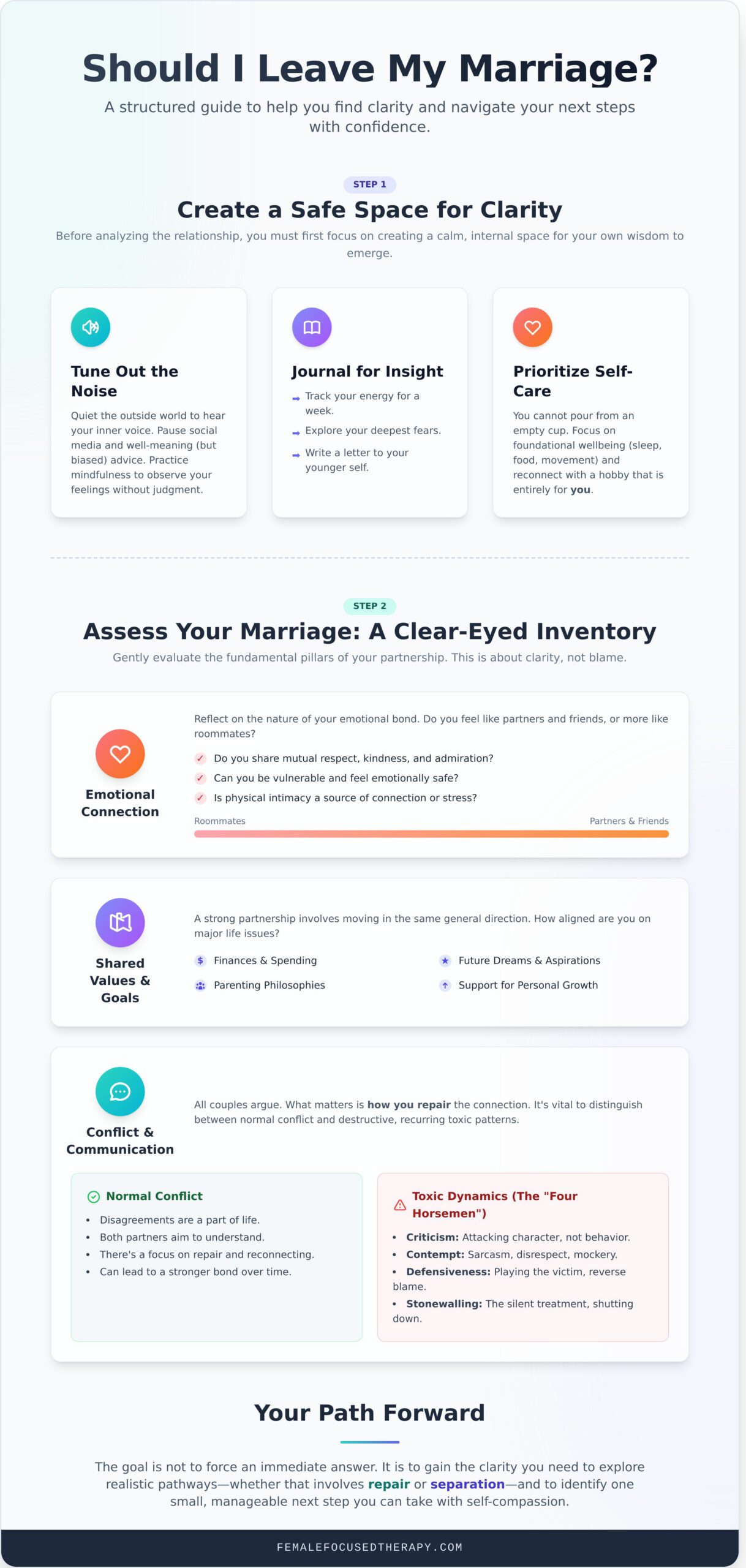
If you are reading this, the question “Should I leave my marriage?” is likely a heavy weight on your mind and heart. Please know, it is completely okay to feel lost, confused, or overwhelmed. This is one of life’s most profound and complex decisions, and you don’t have to navigate it alone or in a hurry. Our first goal is not to find an immediate answer, but to gently create a safe, internal space where your own wisdom can emerge.
Making a life-altering choice from a place of crisis, exhaustion, or high stress often leads to regret. To truly understand your feelings and the potential path ahead, which may involve understanding the process of divorce, requires a clear and grounded mind. Before analyzing the relationship, we must first focus on you.
Tuning Out the Noise
To hear your own inner voice, you must first quiet the noise from the outside world. Well-meaning friends and family have their own biases and histories that colour their advice. Take a conscious break from social media, films, or shows that either glorify dramatic breakups or shame the idea of ending a marriage. Instead, try practicing mindfulness. This simply means observing your thoughts and feelings with gentle curiosity, not judgment. This creates a pause between a feeling and a reaction, which is where clarity begins to grow.
Journaling for Insight
Your journal can become a confidential space for unfiltered exploration. It allows you to untangle the knotted thoughts in your head without needing to perform or explain yourself to anyone. Try these gentle prompts to begin:
- Track your energy for one week. Note when you feel most alive and joyful, and when you feel most drained, sad, or anxious. What people, places, or situations correlate with these feelings?
- What are you truly afraid of? What do you fear losing if you stay, and what do you fear losing if you go?
- Write a compassionate letter to the woman you were on your wedding day. What were her hopes for marriage? What would you want her to know now?
Prioritizing Self-Care
You cannot pour from an empty cup, and navigating this question requires immense emotional energy. Chronic stress clouds judgment and keeps your nervous system in a state of high alert, making thoughtful decision-making nearly impossible. Focus on the foundational pillars of wellbeing: adequate sleep, nourishing food, and gentle movement. More importantly, reconnect with an interest or hobby that is entirely for you. Painting, hiking, reading, or learning a new skill helps you reconnect with your own identity, rebuilding self-trust and reminding you of who you are outside of your relationship.
Assessing Your Marriage: Is It Good Enough to Stay?
When the question, “Should I leave my marriage?” takes root, the path forward can feel shrouded in fog. Before making any decisions, it’s helpful to gently shift your focus from searching for faults to taking a clear-eyed inventory of your relationship’s core strengths and weaknesses. This process isn’t about assigning blame; it’s about gaining the clarity you need to navigate your next steps. A ‘good enough’ marriage looks different for everyone, and this is your chance to define what that means for you by looking at the fundamental pillars of your partnership.
Evaluating Emotional Connection and Intimacy
At its heart, a partnership is an emotional bond. Take a moment to reflect on the nature of your connection. Do you feel like true partners and friends, or has the dynamic shifted to feel more like roommates sharing a space? Consider these questions:
- Is there a foundation of mutual respect, kindness, and admiration, even when you disagree?
- Can you be vulnerable with your partner and feel emotionally safe sharing your true self?
- How is your physical intimacy? Does it feel like a source of connection and warmth, or has it become a source of stress and disconnection?
Analyzing Shared Values and Life Goals
A strong partnership often involves moving in the same general direction. While you don’t need to agree on everything, alignment on major life issues is crucial for long-term harmony. Experts agree that shared visions and mutual support are key elements of a healthy marriage. How do you and your partner align on big topics like finances, parenting philosophies, and future dreams? Do you feel supported in your personal growth and individual aspirations?
Recognizing Toxic Dynamics vs. Normal Conflict
All couples argue-disagreement is a normal part of sharing a life. What matters most is how you repair the connection afterward. However, some patterns go beyond normal conflict. Watch for recurring cycles of criticism, contempt, defensiveness, or stonewalling (the silent treatment). It’s vital to understand the difference between a difficult season and the ongoing emotional distress that can come from relationship trauma, which erodes your sense of self and safety over time.
Understanding Yourself: Your Needs, Patterns, and External Pressures
While a marriage involves two people, finding clarity often begins by gently turning the focus inward. This step isn’t about assigning blame, but about empowering yourself with self-awareness. Understanding your own contributions, needs, and reactions is a compassionate and crucial step in navigating the profound question, “Should I leave my marriage?”.
What Are Your Unmet Needs?
At the heart of relationship distress are often unmet core needs. We all seek certain fundamentals from a partnership, and feeling chronically unseen or unheard can create deep fractures. Consider what you truly need to feel fulfilled:
- Emotional safety and connection
- Physical affection and intimacy
- A sense of shared partnership and teamwork
- Intellectual and personal growth
Have you been able to clearly and vulnerably communicate these needs to your partner? It’s also worth exploring if there are ways you can begin to meet some of these needs for yourself, rebuilding a foundation of self-reliance and worth.
Are External Factors at Play?
Sometimes, the pressure cooker of life can make our marriage feel like the source of all our stress. The demands of a career, financial pressures, or the exhaustion of parental burnout can easily bleed into our closest relationship, colouring our perception of our partner. Major life transitions like midlife or menopause can also trigger a crisis of identity that gets projected onto the marriage. It’s vital to ask whether underlying anxiety, depression, or even undiagnosed ADHD could be impacting how you experience your relationship.
Reflecting on Your Own Patterns
Our past often informs our present relational dynamics. Do you recognise patterns of people-pleasing or conflict avoidance that stop your needs from being heard? Perhaps you engage in emotional over-functioning, taking on all the emotional labour in the relationship. As you reflect on these dynamics, exploring expert-backed questions to consider can provide a structured way to deepen your insight. This self-reflection is about gaining the clarity you need to move forward with confidence and self-trust, whether that is within the marriage or beyond it.
Pathways Forward: Exploring Repair vs. Separation
As you move from the overwhelming question of, “Should I leave my marriage?” toward a place of greater clarity, you can begin to explore the potential pathways forward. This is a deeply personal process of weighing your options with honesty and compassion for yourself. It’s important to remember that there is no universal right or wrong path-only the one that honours your wellbeing and aligns with your truth. Both staying to rebuild and choosing to separate require immense courage, careful planning, and dedicated support.
Signs a Marriage May Be Worth Fighting For
Sometimes, the foundation of a relationship is still strong, even if it’s obscured by current challenges. Reconnection may be possible if you recognise some of these signs:
- A Foundation of Respect: Beneath the conflict, there is still a core of friendship, mutual respect, and care for one another as people.
- Shared Responsibility: Both you and your partner are willing to stop blaming, take ownership of your roles in the dynamic, and commit to doing the necessary work.
- A Glimmer of Hope: You can both genuinely envision a happy, fulfilling future together if the core issues were resolved.
- Situational vs. Fundamental Issues: The conflict stems from situational stressors like grief, job loss, or parenting challenges, rather than a fundamental mismatch in core values or the presence of abuse.
When Is It Time to Seriously Consider Leaving?
Conversely, some situations erode the safety and health of a relationship to a point where leaving becomes the most compassionate choice for yourself. Your safety and mental health are paramount. It may be time to consider separation when you experience:
- The Presence of Abuse: This is non-negotiable. Emotional, verbal, financial, or physical abuse creates an unsafe environment where repair is not possible. Your safety comes first.
- Consistent Betrayal: A pattern of deep deception, infidelity, or untreated addiction that repeatedly breaks trust and demonstrates a lack of commitment to change.
- Complete Apathy: Your partner shows a consistent and profound lack of respect, care, or interest in your life, feelings, and wellbeing.
- Emotional Depletion: You have tried everything you can, and you feel your spirit diminishing. Staying feels like a betrayal of your own self.
The Role of Professional Help
Navigating this decision alone can feel isolating. Professional support offers a confidential, non-judgmental space to find your own way forward. Individual therapy can help you untangle your feelings and connect with your own needs and desires, empowering you to make a choice that feels right for you. For those considering repair, couples therapy can provide tools to improve communication and explore whether rebuilding is a viable path. A therapist will not tell you what to do, but will support you in finding the clarity and self-trust to navigate your next chapter with confidence.
Taking Your Next Step with Courage and Self-Compassion
You have journeyed through deep reflection and emotional honesty. The goal now is not to have a perfect, five-year plan, but to identify one small, next step. Remember, this process is a marathon, not a sprint. Please offer yourself the same kindness and patience you would give to a dear friend walking this path. Clarity often doesn’t arrive in a single moment of insight; it is built, step by step, through small, intentional actions.
Whatever you decide, building a strong support system is the most crucial foundation you can lay for your future wellbeing. The immense question of “should I leave my marriage” is not one you have to answer in isolation.
If You’re Leaning Towards Repair
If your intuition is guiding you toward reconnection, your next step might be to open a new kind of dialogue. Plan a time to speak with your partner when you are both as calm as possible. Using ‘I’ statements (e.g., “I feel lonely when…”) can express your experience without blame. You might also suggest working with a couples therapist, who can provide a neutral, structured space to help you both navigate these difficult conversations and rebuild your connection.
If You’re Leaning Towards Leaving
If separation feels like the healthier path, your next step is about gathering information and support. You can begin to gently research the legal and financial practicalities in Singapore to demystify the process. Confide in one or two trusted, non-judgmental friends who can simply listen. Importantly, allow yourself to start envisioning what a positive, independent future could look and feel like for you. This isn’t about final decisions; it’s about planting seeds of hope.
No Matter What, Seek Support
Navigating this journey alone can be incredibly challenging and isolating. Whether you are working to repair your relationship or preparing to leave, having dedicated support is essential. Professional therapy can provide the confidential guidance and safe space you need to process your feelings, build resilience, and gain confidence in your decisions. You deserve to feel heard, validated, and empowered as you move forward with clarity and self-trust.
If you feel you would benefit from a compassionate, professional space to explore your next steps, you can learn more about how we can support you on your journey.
Your Path Forward: Finding Clarity with Confidence
The journey to answering the question, should I leave my marriage, is one of the most profound you may ever undertake. It is rarely a simple yes or no. As we’ve explored, the path to your truth begins with creating a safe internal space for reflection, away from external pressures. It requires an honest assessment of your relationship’s health and a deep, compassionate understanding of your own needs. Remember, both exploring repair and considering separation are valid pathways deserving of careful thought.
Navigating this complex life transition requires immense courage, and you do not have to do it alone. If you are seeking specialized support tailored to the unique challenges women face in relationships, we are here to provide a warm, non-judgmental, and professional therapeutic space. Our expertise is in helping you find your footing during these uncertain times, empowering you to move forward with clarity.
Book a confidential session to explore your path forward.
Whatever you decide, trust that you have the inner strength to build a future that honours your true self and your wellbeing.
Frequently Asked Questions
What if we have children? How do I factor them into my decision?
This is a deeply important and sensitive question. The focus often shifts from simply staying together to creating the most stable and nurturing environment for your children’s wellbeing. A home filled with unresolved conflict can be more damaging than a respectful co-parenting relationship across two homes. The goal is to model emotional health and resilience for them, and a supportive therapist can help you navigate what that looks like for your unique family situation.
How do I know if this is just a midlife crisis or a real problem with my marriage?
While they can feel similar, a midlife crisis is often an internal struggle with your own identity, purpose, and mortality, which you may project onto your marriage. A core marital problem, however, is typically rooted in long-standing, unresolved patterns of disconnection, conflict, or a fundamental mismatch in values. Gaining clarity involves exploring whether your unhappiness stems from the relationship dynamic itself or from personal dissatisfaction that needs to be addressed within yourself first.
I’m financially dependent on my spouse. How can I even think about leaving?
Financial dependence is a very real and valid concern that can feel trapping. A gentle first step is to gather information to feel empowered. In Singapore, you can seek a preliminary legal consultation to understand your rights regarding assets under the Women’s Charter. You can also explore resources like SkillsFuture for career development. Creating a quiet, practical plan can help you navigate this fear from a place of strength and possibility, not panic.
What’s the difference between being unhappy and the relationship being over?
Unhappiness can be a season in a marriage-a symptom of stress, poor communication, or external pressures that can be worked through. A relationship may be over when there is a fundamental breakdown of trust, respect, and emotional safety, with no genuine willingness from one or both partners to rebuild. The question of should I leave my marriage often hinges on whether the foundation is simply cracked and in need of repair, or if it has crumbled completely.
I’m terrified of being alone. Is that a good enough reason to stay?
The fear of being alone is a powerful and deeply human emotion, and it deserves to be treated with kindness. However, staying in a deeply unfulfilling marriage to avoid this fear can often lead to a profound sense of loneliness within the relationship itself. Therapy offers a safe space to explore this fear, build your inner resilience, and reconnect with yourself, allowing you to make a choice based on self-trust rather than anxiety.
My partner refuses to go to therapy. What can I do on my own?
You cannot control your partner’s choices, but you can always take steps to support your own wellbeing. Attending individual therapy is a courageous and powerful act. It provides you with a confidential space to process your feelings, gain insight into the relationship dynamics, and build your own emotional strength. This personal work is invaluable for gaining clarity on the difficult question of whether you should leave your marriage, regardless of your partner’s participation.

Article by
Cheryl Kennedy MacDonald MA BA (Hons) Pg. Dip. SAC BACP
Cheryl Kennedy MacDonald is a psychotherapist specialising in women’s mental health, relationships, and life transitions. She works with women navigating trauma, relationship breakdown, identity shifts, and midlife change, helping them rebuild self-trust, emotional stability, and a clear sense of who they are and what they want.
With over 20 years’ experience working with women internationally, Cheryl is the founder of YogaBellies, a global women’s yoga school, and the creator of the Birth ROCKS method. Her work sits at the intersection of psychotherapy and embodiment, integrating evidence-based therapeutic approaches with somatic, body-based practices that support deep, lasting change.
Known for her grounded and direct approach, Cheryl moves beyond surface-level insight to address the patterns held in the body and nervous system. Her work supports women to regulate, reconnect, and respond to their lives from a place of clarity, strength, and self-respect.
She is a published author in academic journals and has written multiple books on women’s health, pregnancy, and midlife wellbeing, available on Amazon and leading book retailers worldwide.