
Have you spent years feeling like you’re working twice as hard as everyone else just to keep up? Perhaps you’ve been labelled ‘too sensitive,’ ‘disorganised,’ or ‘lazy,’ all while wrestling with a constant inner sense of overwhelm and self-doubt. If these feelings resonate deeply, please know you are not alone, and your struggles are valid. These experiences are often hallmarks of the misunderstood adhd symptoms in women in singapore, which present very differently from the classic stereotypes we’ve been shown.
This guide was created to offer the clarity and validation you deserve. Together, we will gently navigate the subtle signs of ADHD in adult women, from emotional dysregulation and rejection sensitivity to chronic overwhelm. Our goal is to help you find a name for your lifelong challenges and, most importantly, to illuminate a clear path forward. You will learn about practical coping strategies and discover how to access compassionate, professional support here in Singapore, empowering you to finally feel seen, understood, and confident in who you are.
Key Takeaways
- Understand why common adhd symptoms in women singapore are often misdiagnosed as anxiety or personality traits due to outdated, male-centric research.
- Learn to recognise the internal signs, such as overwhelming emotions and a constant feeling of being ‘too much,’ which are core to understanding adhd symptoms in women singapore and go far beyond simple forgetfulness.
- Discover how adhd symptoms in women singapore can manifest as struggles with daily ‘adulting,’ amplified by the country’s fast-paced culture.
- Your experiences are valid; the path forward is about building personalised strategies to help you navigate life with clarity and confidence, not finding a ‘cure’.
Why ADHD in Women Looks Different (And Is Often Missed)
You may be here because you’ve long felt that something was “off,” but never had a name for it. For decades, the popular image of ADHD was that of a hyperactive young boy, unable to sit still in a classroom. This historical research bias created a diagnostic model that often fails to recognise how the condition presents in girls and women. While you can find a comprehensive overview of ADHD and its official criteria, the lived experience for women is often a story of quiet, internalised struggle.
The ‘Daydreaming Girl’ vs. The ‘Hyperactive Boy’
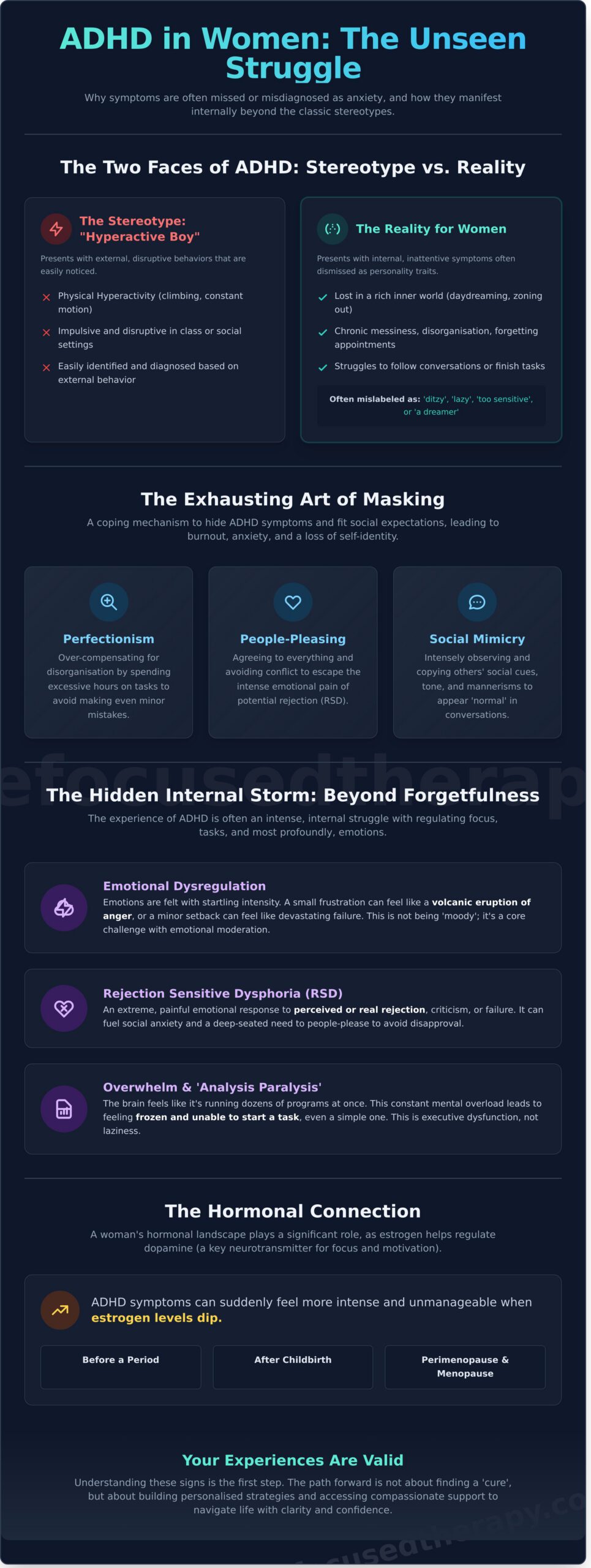
Instead of disruptive external behaviours, ADHD in girls often manifests internally. While the boy was climbing the furniture, the girl was likely staring out the window, lost in a rich inner world. Her challenges weren’t about physical hyperactivity, but about inattention: chronic messiness, forgetting homework, or struggling to follow conversations. These signs were, and often still are, dismissed as personality traits-being ‘ditzy,’ ‘chatty,’ or ‘a dreamer’-rather than recognised as legitimate symptoms.
The Exhausting Art of Masking and Camouflaging
From a young age, girls are often socialised to be agreeable and accommodating. This pressure can lead to “masking”-the conscious or subconscious effort to hide ADHD symptoms to fit in. Masking can look like:
- Perfectionism: Over-compensating for disorganisation by spending excessive hours on tasks to avoid making mistakes.
- People-pleasing: Agreeing to everything to avoid the intense emotional pain of rejection (Rejection Sensitivity Dysphoria).
- Social Mimicry: Intensely observing and copying others’ social cues to appear ‘normal’ in conversations.
The immense energy required for masking often leads to anxiety, burnout, and a profound loss of self-identity. It’s a key reason why the true adhd symptoms in women singapore go unseen for so long.
Hormones, Life Transitions, and ADHD
A woman’s hormonal landscape plays a significant role in her ADHD experience. Estrogen helps regulate dopamine, a key neurotransmitter for focus and motivation. When estrogen levels dip-as they do before a period, after childbirth, or during perimenopause and menopause-ADHD symptoms can suddenly feel more intense and unmanageable. These major life transitions can be the tipping point that finally makes a woman seek answers, and they require specialised support for women navigating complex challenges.
Beyond Forgetfulness: The Hidden Internal & Emotional Symptoms
When we think of ADHD, we often picture hyperactivity or a simple inability to focus. However, for many women, the experience is far more internal and nuanced. ADHD is not just a deficit of attention; it’s a lifelong challenge with regulation-regulating focus, tasks, and most profoundly, emotions. For many, the most challenging adhd symptoms in women in Singapore are not the lost keys but the overwhelming internal storms. This emotional intensity is frequently misdiagnosed as anxiety or a mood disorder, leaving the root cause unaddressed. Understanding these hidden symptoms is the first, most compassionate step toward navigating your experiences with clarity and building effective strategies for wellbeing.
Emotional Dysregulation: More Than Just Mood Swings
You may experience emotions with a startling intensity. A small frustration can feel like a volcanic eruption of anger, or a happy moment can bring euphoric, overwhelming joy. This isn’t just being ‘moody’; it’s emotional dysregulation. It’s the difficulty in moderating your emotional responses and the struggle to calm down once you’re upset. This can impact impulse control, leading to decisions made in the heat of the moment that you later regret.
Rejection Sensitive Dysphoria (RSD): The Intense Fear of Rejection
Do you find yourself devastated by a hint of criticism or the perception that someone is upset with you? This could be Rejection Sensitive Dysphoria (RSD), an extreme emotional pain tied to perceived or real rejection. This intense response, often misunderstood, is a key feature highlighted in a clinical review of ADHD in women and girls from the National Institutes of Health. It’s more than just sensitivity; it’s a profound, painful reaction that can fuel social anxiety and a deep-seated need to people-please to avoid the risk of disapproval.
A Constant Sense of Overwhelm and ‘Analysis Paralysis’
Your to-do list might be simple, but your brain feels like it’s running a dozen complex programs at once. This constant sense of being mentally overwhelmed is one of the most challenging adhd symptoms in women in Singapore, often leading to ‘analysis paralysis’-you know exactly what you need to do, but you feel frozen, unable to start. This is not laziness. It is a common experience of executive dysfunction that contributes to chronic stress and erodes your self-worth over time.
How ADHD Symptoms Manifest in Daily Life for Women in Singapore
For many women, ADHD doesn’t present as the stereotypical hyperactivity we often see portrayed. Instead, it quietly weaves itself into the fabric of daily life, appearing as a constant struggle with ‘adulting’. In Singapore’s fast-paced, high-achievement culture, these challenges can feel particularly amplified, leading to burnout and self-doubt. The immense ‘mental load’ of managing a career, household, and social life can become overwhelming. For many, these difficulties are internalised as personal failings-laziness or incompetence-when they are, in fact, neurological. This experience is supported by extensive research on ADHD in women, which highlights how symptoms often manifest as anxiety and low self-esteem. Recognising these patterns is the first, most compassionate step toward finding support.
Challenges in the Workplace and at Home
You might find yourself procrastinating on major work projects, yet able to hyperfocus for hours on a task that genuinely interests you. This inconsistency can be confusing for both you and your colleagues. At your desk, you may struggle with a mountain of paperwork or an overflowing email inbox, feeling paralyzed by the disorganisation. This difficulty with executive function extends home, making it hard to keep up with household chores, pay bills on time, or manage essential life admin, which is a core part of understanding the real-world impact of adhd symptoms in women Singapore residents face.
Impact on Friendships and Romantic Relationships
In your social life, ADHD can create unintentional friction. You may forget a friend’s birthday or leave messages unread for days, not from a lack of care, but from difficulties with object permanence and time management. In conversations, you might find yourself interrupting or ‘zoning out’, which can be misinterpreted as disinterest. In romantic partnerships, some women with ADHD over-function to compensate, taking on an unsustainable amount of responsibility, which often leads to burnout, exhaustion, and resentment.
The ‘ADHD Tax’: Impulsive Spending and Financial Stress
The “ADHD tax” refers to the hidden financial costs of ADHD. This can manifest as impulsive online shopping for a quick dopamine hit, leading to credit card debt. It also includes the money lost on late-payment fees for bills you forgot to pay or auto-renewing subscriptions you meant to cancel, costing hundreds of dollars (S$) each year. This cycle of impulsive spending and financial disorganisation can create profound feelings of shame and instability, further impacting your mental wellbeing.
Recognising yourself in these patterns is not a sign of failure, but a powerful first step toward understanding. It’s an invitation to seek clarity and support in navigating these challenges with kindness and effective strategies.
The Path to Support: What to Do If This Resonates With You
If reading about the unique presentation of ADHD in women has felt like discovering a missing piece of your own story, please take a moment to honour that feeling. Your experiences are valid, whether you have an official diagnosis or not. The goal is not to find a ‘cure’ for who you are, but to build supportive strategies and understanding so you can navigate life with more ease, confidence, and self-compassion. It’s about learning to work with your wonderfully wired brain, not against it.
Understanding the Assessment Process in Singapore
Exploring a formal diagnosis can be a deeply validating step. In Singapore, this journey typically involves either a clinical psychologist, who can conduct comprehensive assessments, or a psychiatrist, who can provide a medical diagnosis and discuss medication options. A formal diagnosis can unlock access to resources and accommodations, but remember: self-recognition is the most powerful first step. Simply understanding the potential reasons behind your struggles with ADHD symptoms in women in Singapore can begin the process of healing.
How Therapy Helps You Thrive with ADHD
Therapy provides a confidential, safe space to untangle the threads of ADHD from the years of shame, anxiety, or low self-esteem that may have accompanied it. It’s a place to be truly heard and understood. Together, we can explore how your brain works and develop practical, personalised skills for managing time, emotional regulation, and executive functions. We offer specialised ADHD therapy for women to help you on this journey toward self-acceptance and growth.
Building a Neurodivergent-Friendly Life
Living a fulfilling life with ADHD is less about fixing your perceived flaws and more about creating an environment where you can flourish. This means letting go of the need for neurotypical standards of perfection and embracing what works for you.
- Create supportive systems: Focus on building routines and using tools (like visual timers, body doubling, or noise-cancelling headphones) that support your executive functions, rather than fighting against them.
- Embrace your strengths: Your ADHD brain likely comes with incredible gifts, such as creativity, hyperfocus on your passions, innovative problem-solving, and deep empathy. Learn to lean into these superpowers.
- Practice self-compassion: Let go of the harsh inner critic. You are doing your best with the brain you have. Every day is an opportunity to offer yourself the same kindness and patience you would offer a dear friend.
Embracing Your Unique Mind: Your Path Forward in Singapore
If the experiences shared in this guide resonate deeply, please know that you are not alone. For too long, the narrative around ADHD has overlooked the internalised struggles many women face-from emotional dysregulation and rejection sensitivity to chronic overwhelm. Understanding how the unique adhd symptoms in women in Singapore often manifest differently is the first, most powerful step towards self-compassion and renewed clarity.
Taking that next step can feel daunting, but you don’t have to navigate it by yourself. Female Focused Therapy offers a warm, non-judgmental, and confidential space dedicated to supporting adult women with ADHD. Through specialised therapy available both online and in-person in Singapore, we can work together to build strategies that work for your unique brain, helping you move from overwhelm to a stronger sense of self.
Your journey to understanding yourself more deeply is a testament to your strength. A more balanced and fulfilling life is not just possible-it’s waiting for you.
Frequently Asked Questions About ADHD in Women
Do I need an official diagnosis to get therapy for ADHD symptoms?
No, you do not need an official diagnosis to begin therapy. If you are struggling with challenges like emotional dysregulation, executive dysfunction, or overwhelm, therapy provides a safe, supportive space to explore these experiences. We can work together to develop practical coping strategies and build self-awareness, helping you navigate your life with more clarity and confidence, regardless of a formal label.
How is ADHD in women different from the classic symptoms seen in men?
ADHD in women often presents more internally. While men may display more overt hyperactivity, women are more likely to experience internal restlessness, racing thoughts, and significant emotional sensitivity. Inattentive symptoms-like being easily distracted, chronic disorganisation, and feeling overwhelmed-are also more common. These differences are why understanding the specific ADHD symptoms in women in Singapore is so crucial, as they are often misdiagnosed as anxiety or depression.
Can ADHD symptoms get worse with age or hormonal changes like menopause?
Yes, absolutely. Oestrogen plays a key role in regulating neurotransmitters that impact focus and mood. As oestrogen levels fluctuate and decline during perimenopause and menopause, many women find their ADHD symptoms intensify. You might notice increased brain fog, memory challenges, and heightened emotional reactivity. This is a common experience, and support is available to help you navigate these changes.
What is ‘masking’ and why is it so exhausting for women with ADHD?
Masking is the process of hiding one’s ADHD traits to meet societal expectations. This can look like forcing eye contact, suppressing the urge to fidget, or meticulously over-planning to avoid mistakes. This constant self-monitoring requires immense mental and emotional energy, often leading to burnout, anxiety, and a feeling of being disconnected from your authentic self. It’s a survival strategy that comes at a very high personal cost.
Is it possible to be a high-achiever and still have ADHD?
Yes, it is very common for high-achieving women to have ADHD. Many develop excellent coping mechanisms or use their ability to hyperfocus to excel in their careers or personal projects. However, this success often requires an unsustainable level of effort, leading to chronic stress, imposter syndrome, and eventual burnout. On the outside you may appear successful, while on the inside you are struggling to keep everything together.
What are some simple, practical coping strategies I can try today?
Begin with small, compassionate steps. Try ‘body doubling’-working quietly alongside a friend or colleague-to stay on task. Use visual timers to make time more tangible and less abstract. To combat overwhelm, practice the ‘one-minute rule’: if a task takes less than a minute, do it immediately. These small adjustments can help reduce daily friction and build a foundation for more sustainable habits and self-trust.