
You may be here because you feel that something needs to change, but the path forward seems unclear. The words themselves-psychotherapy, counselling, psychology-can be confusing, and the thought of a first session can feel daunting. Navigating the landscape of psychotherapy in Singapore can add another layer of complexity, leaving you wondering where to even begin. Please know, it’s completely normal to feel this way, and taking this moment to seek information is a courageous first step towards your wellbeing.
This gentle guide was created to support you on that journey. We will walk you through what psychotherapy truly is, demystify what happens in a session, and explore how to find a therapist who genuinely understands your unique needs. Our aim is to provide the clarity and confidence you deserve, helping you navigate everything from the different therapeutic approaches to the typical costs involved. By the end, you’ll have a clear, compassionate roadmap to finding a safe, supportive space for your own healing and growth.
Key Takeaways
- View psychotherapy as a supportive, collaborative journey designed to help you understand your thoughts and feelings, empowering you to navigate challenges with greater clarity.
- Finding the right fit is essential for your journey with psychotherapy singapore. Learn the key factors to consider beyond qualifications to ensure you feel truly supported.
- Demystify your first appointment by understanding its core purpose: a gentle, two-way conversation to establish safety and see if the therapist is the right partner for you.
- Effective therapy is not one-size-fits-all. Discover how therapists often use an ‘integrative approach’ to tailor support specifically to your unique needs and goals.
- For women facing distinct life stages or challenges, specialised therapy provides a validating space that deeply understands and addresses these unique experiences.
What is Psychotherapy? A Clear and Simple Explanation
You may be wondering what psychotherapy actually involves. It’s a term we hear often, but it’s surrounded by myths. Forget the image of lying on a couch talking endlessly about your childhood. At its heart, psychotherapy is a collaborative journey you take with a trained professional. It’s far more than just ‘talking about problems’; it’s a structured process designed to help you understand your feelings, thoughts, and behaviours in a profound way. For a comprehensive overview, you can read the Wikipedia article on What is Psychotherapy?, but put simply, think of it as having a skilled, compassionate guide for your inner world.
This process unfolds in a confidential and completely non-judgmental space, created entirely for your healing and growth. It’s a powerful resource not just for those in crisis, but for anyone seeking to navigate life’s complexities with greater clarity and self-awareness. It’s for the woman feeling overwhelmed by work, the mother adjusting to a new phase of life, or anyone looking to break free from patterns that no longer serve them.
How is Psychotherapy Different from Counselling?
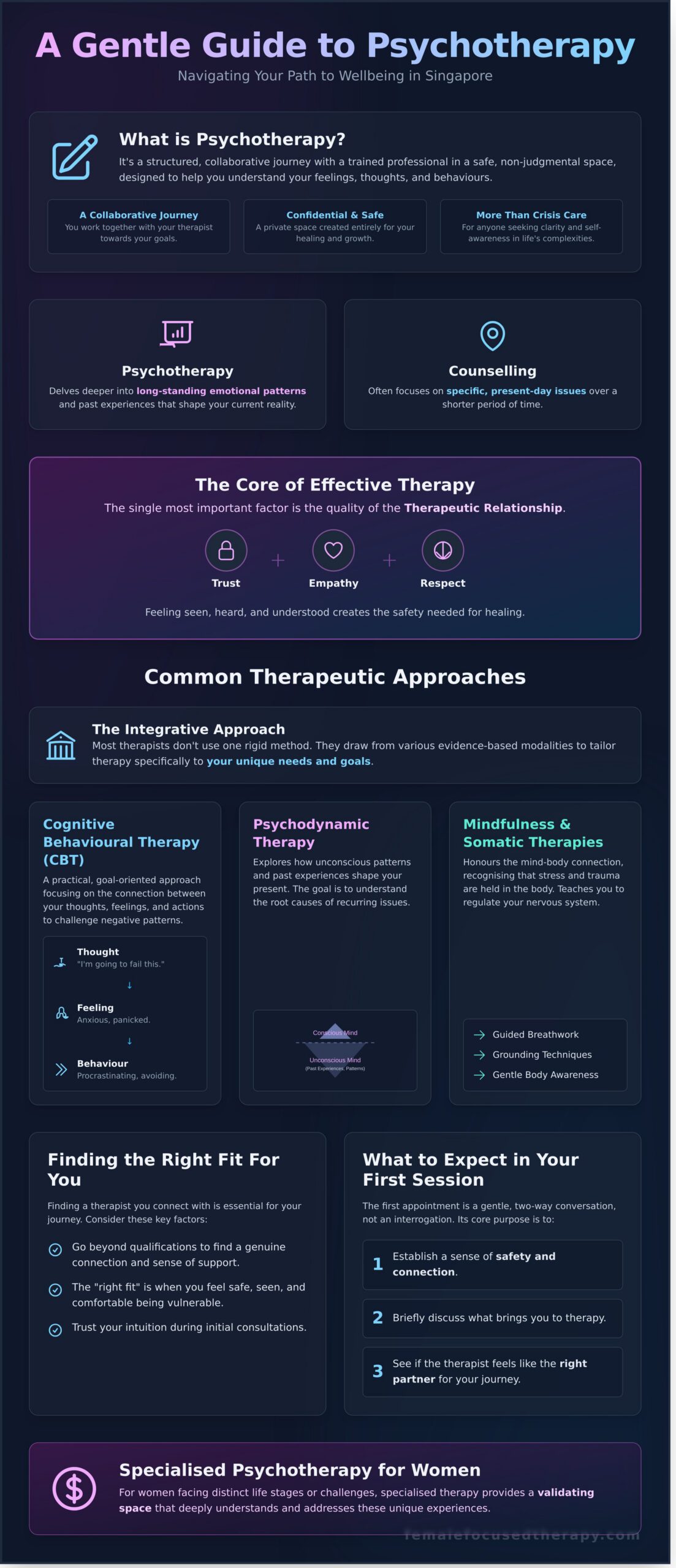
When you start exploring options for psychotherapy in Singapore, you’ll also see the term ‘counselling’. While the terms are sometimes used interchangeably here, there is a subtle difference. Counselling often focuses on specific, present-day issues over a shorter period. Psychotherapy, on the other hand, tends to delve deeper into long-standing emotional patterns and past experiences that shape your current reality. Both, however, share the ultimate goal of supporting your wellbeing. For those whose needs align with addressing present-day issues, it can be helpful to explore Individual Counselling services.
The Core of Effective Therapy: The Therapeutic Relationship
The single most important factor in successful therapy isn’t the specific technique used, but the quality of the relationship you build with your therapist. This is the therapeutic relationship-a unique partnership built on a foundation of trust, empathy, and mutual respect. Feeling genuinely seen, heard, and understood by your therapist is what creates the safety needed to explore vulnerable parts of yourself and begin the powerful work of change and healing.
Common Types of Psychotherapy Available in Singapore
Stepping into therapy can feel like entering a new world with its own language. You might hear terms like CBT, psychodynamic, or somatic, and it can be confusing. The good news is that you don’t need to be an expert. Many therapists in Singapore, myself included, use an ‘integrative approach’. This simply means we don’t rely on just one rigid method. Instead, we draw from various evidence-based modalities to create a therapeutic journey that is uniquely tailored to you, your history, and your goals for growth.
The landscape of psychotherapy in Singapore is wonderfully diverse, but most approaches are designed to help you build self-awareness and gain practical tools for navigating life’s challenges. Here are a few common and effective types of therapy you may encounter.
Cognitive Behavioural Therapy (CBT)
CBT is a practical, goal-oriented therapy focused on the powerful connection between your thoughts, feelings, and actions. It helps you identify and challenge recurring negative thought patterns that may be keeping you stuck. It’s particularly effective for managing anxiety and depression by giving you concrete strategies to change your responses to stressful situations. For example, we might explore a cycle together:
- Thought: “I’m going to fail this presentation.”
- Feeling: Anxious, panicked.
- Behaviour: Procrastinating or avoiding preparation.
CBT helps you gently interrupt this cycle, supporting you in building more balanced thoughts and confident behaviours.
Psychodynamic and Psychoanalytic Therapy
This approach invites a deeper exploration of how your past experiences, particularly from childhood, unconsciously shape your present-day behaviours, relationships, and emotions. The goal isn’t to dwell on the past, but to increase your self-awareness and understand the root causes of recurring patterns. If you find yourself in similar difficult relationship dynamics time and again, psychodynamic therapy can provide profound clarity and help you break free from those cycles to form healthier connections.
Mindfulness-Based and Somatic Therapies
These therapies honour the deep connection between your mind and body. They recognise that stress, anxiety, and trauma are not just stored in our thoughts, but also held in our physical selves. Through practices like guided breathwork, grounding techniques, and gentle body awareness, you can learn to regulate your nervous system and process difficult emotions. This approach is incredibly empowering for managing stress and healing from trauma, as it helps you feel safer and more at home in your own body. These practices beautifully complement the self-care tools found in many official mental well-being resources from Singapore’s Health Promotion Board.
How to Find the Right Psychotherapist for You
Beginning your search for a therapist is a deeply personal and courageous step. The goal isn’t just to find any professional, but to find the right person for you-someone you can trust to create a safe space for your growth. This process is about connection and compatibility, and navigating it with intention can make all the difference on your healing journey.
Understanding Qualifications in Singapore
When looking for professional psychotherapy in Singapore, you’ll encounter titles like Counsellor, Psychotherapist, and Psychologist. While there’s overlap, Counsellors and Psychotherapists often focus on talk therapy. A key indicator of credibility is registration with professional bodies like the Singapore Association for Counselling (SAC), which ensures they meet stringent ethical and educational standards. Always feel empowered to ask about their master’s level qualifications and specific training.
Considering Specialisation and Approach
A therapist’s specialisation is crucial. Someone skilled in navigating trauma will have a different approach than an expert in adult ADHD or relationship dynamics. Take a moment to reflect on what you hope to address. Do you want to work through past experiences, manage anxiety, or rebuild self-trust after a difficult period? Reading a therapist’s website can offer immense clarity. You can learn more about a therapist’s personal journey by understanding their background and approach to see if their philosophy resonates with you.
The Importance of the Initial Consultation
Think of the first session or consultation call as a two-way interview. It’s your opportunity to gauge compatibility and the therapist’s chance to understand if they are the right person to support your needs. It is perfectly acceptable to come prepared with questions.
- What is your experience helping women with issues like [your specific concern]?
- How would you describe your therapeutic style?
- What can I expect in our first few sessions together?
Most importantly, trust your intuition. After the call, ask yourself: Did I feel heard? Did I feel a sense of safety and warmth? This connection is the foundation upon which effective therapy is built.
What to Expect in Your First Psychotherapy Session
Stepping into a therapist’s office for the first time can feel daunting. You might wonder what to say, how much to share, or if you’re even ‘doing it right.’ Please know, there is no right or wrong way to begin. The first session is simply a gentle, confidential conversation designed to help you feel safe and understood. You are in control, and you can navigate this new space at a pace that feels comfortable for you.
The ‘Getting to Know You’ Phase
This initial part of the session is a two-way introduction. I’ll invite you to share what’s on your mind and what brought you to therapy. To help me understand your world, I may ask gentle questions about your personal history, relationships, and current challenges. We will also cover important practicalities, such as our confidentiality agreement and the potential frequency of our sessions, ensuring you feel clear and secure in the process.
Setting Your Therapeutic Goals
You don’t need to have a perfect plan. Together, we will gently explore what you hope to achieve. This collaborative goal-setting is a core part of effective psychotherapy in Singapore. Your goals can be specific, like, “I want to manage my anxiety in social situations,” or broader, such as, “I want to rebuild my self-trust.” These goals are not set in stone; they are living guides that we can revisit and refine as your journey unfolds.
Leaving the First Session
As the session concludes, many women feel a sense of relief or a glimmer of hope. It’s also completely normal to feel tired or emotional-you’ve taken a significant and courageous step. The only thing to do next is decide if it feels like the right fit for you. If it does, we can schedule our next appointment. This journey is yours to lead, and the first step is often the most powerful.
When you feel ready, you can book a confidential consultation to begin your own journey of healing and growth.
Specialised Psychotherapy for Women in Singapore
A woman’s journey through life is often shaped by unique psychological and social challenges, from navigating complex relationship dynamics to managing significant hormonal and identity shifts. Recognising this, female-focused therapy provides a safe, validating space where these specific experiences are not just acknowledged, but deeply understood. This specialised approach ensures that the support you receive is relevant, empathetic, and truly transformative.
Navigating Relationship Trauma and Narcissistic Abuse
Healing from emotionally damaging relationships requires more than just talk therapy; it demands trauma-informed care. The goal is to move beyond the cycle of self-blame and people-pleasing that often accompanies such experiences. Together, we work to rebuild the most crucial foundation: your trust in yourself. This process involves learning to set and maintain healthy boundaries, empowering you to create safer, more authentic connections in the future. We offer dedicated support for relationship trauma and narcissistic abuse to guide this journey.
Support Through Major Life Transitions
Whether you’re facing midlife changes, menopause, relocating to a new country like Singapore, or making a significant career shift, life transitions can feel unsettling and destabilising. Your sense of identity may feel uncertain, and the path forward unclear. Therapy offers a grounded, supportive space to navigate these changes, helping you process the loss of old roles while exploring a renewed sense of purpose and direction with clarity and confidence.
Understanding Adult ADHD in Women
Attention-Deficit/Hyperactivity Disorder (ADHD) often presents differently in women, leading to years of being misdiagnosed with anxiety or depression. You may struggle with chronic overwhelm, intense emotions, and a deep-seated fear of rejection (Rejection Sensitive Dysphoria). Specialised therapy helps you understand the nuances of your neurodivergent brain, developing personalised strategies to manage daily tasks, regulate emotions, and build self-compassion. The focus is on working with your brain, not against it.
Finding a therapist who understands these female-centric issues is a critical part of making your investment in mental wellbeing worthwhile. If these challenges resonate, exploring specialised psychotherapy Singapore offers could be a powerful step towards profound healing and growth. You can learn more about our integrative, female-focused approach at femalefocusedtherapy.com.
Your Path to Wellbeing Begins Today
Beginning therapy is a profound act of self-care. As we’ve explored, understanding what psychotherapy is and finding the right therapist are the foundational steps to healing. For many women, navigating life’s complexities requires a space that truly understands their unique experiences. This is where specialised psychotherapy in Singapore can offer a path to genuine growth and reconnection with yourself.
At Female Focused Therapy, we are dedicated to providing this exact support. Led by registered psychotherapist Cheryl Kennedy MacDonald, we offer a warm, confidential, and trauma-informed approach. We believe in creating a safe space where you feel heard and supported as you navigate challenges unique to women, from midlife transitions to rebuilding self-trust after difficult experiences.
You don’t have to walk this path alone. If you’re ready to move forward, we’re here to support you. Take the first step towards clarity and confidence. Book a consultation today. Your journey towards a more empowered life is waiting.
Frequently Asked Questions About Therapy in Singapore
What is the difference between a psychologist and a psychiatrist in Singapore?
Understanding this distinction can help you find the right support for your journey. In Singapore, a psychiatrist is a medical doctor who specialises in mental health and can prescribe medication. A psychologist primarily uses talk therapy (psychotherapy) to help you navigate emotional challenges and rebuild self-trust. They work collaboratively with you in a supportive space to foster insight and growth, but they do not prescribe medication.
How much does psychotherapy typically cost in Singapore?
Investing in your wellbeing is an important consideration. For private psychotherapy in Singapore, session costs typically range from S$180 to S$300+ per hour. This fee often reflects the therapist’s experience and qualifications. Some practitioners may offer packages for multiple sessions. It is always a good idea to inquire about fees during your initial consultation to ensure the investment feels sustainable for you.
Are psychotherapy sessions in Singapore confidential?
Absolutely. Confidentiality is the cornerstone of a safe and trusting therapeutic relationship. In Singapore, mental health professionals are bound by strict ethical codes to protect your privacy. What you share is kept completely confidential, creating a secure space for you to explore freely. The only exceptions are rare situations where there is an immediate risk of serious harm to yourself or others, as ensuring safety is paramount.
How long does psychotherapy usually take to see results?
The path of therapy is unique to each woman, so there is no set timeline. Some begin to feel a sense of relief or clarity within a few sessions, while deeper, more lasting change unfolds over time. The pace depends on your personal goals and the issues you’re navigating. The focus is on sustainable growth at a pace that feels safe, allowing you to move forward with genuine confidence and a stronger sense of self.
Do I need a referral from a doctor to see a psychotherapist?
Taking the first step is a courageous one, and you generally do not need a referral from a doctor to access private psychotherapy Singapore. You can empower yourself by reaching out and scheduling an appointment directly. A referral may only be necessary if you are seeking services through a public hospital system or if you intend to make a claim through a specific insurance policy that requires it.
Is online psychotherapy as effective as in-person sessions?
Many women find online therapy to be a wonderfully supportive and effective option. Research shows that for many concerns, online sessions are just as impactful as meeting in person. It offers greater flexibility and accessibility, allowing you to connect from a space where you feel most comfortable. The quality of the therapeutic connection is what truly matters for healing and growth, whether that connection is built online or face-to-face.