
You may feel a constant, quiet exhaustion from putting everyone else’s needs before your own. Perhaps the word ‘no’ feels trapped in your throat, followed by a wave of guilt whenever it manages to escape. If you find yourself constantly shaping your feelings and desires just to keep the peace, please know you are not alone and what you are feeling is valid. This pattern is often a deeply rooted survival response, and understanding the connection of people pleasing after childhood trauma is a powerful first step toward self-compassion. It is not a flaw in your character; it is a testament to what you have endured.
This guide is here to offer a safe, supportive space to explore this connection. We will gently navigate the reasons you feel this powerful compulsion to please others, validating your experience as a real trauma response. More importantly, we will provide clear, actionable steps to help you begin setting healthy boundaries, reconnecting with your own needs, and starting the quiet, courageous journey of rebuilding your self-trust. It is possible to find your voice again and build a life filled with genuine confidence and clarity.
Key Takeaways
- Understand that people-pleasing isn’t a character flaw, but a learned survival response (the ‘fawn’ response) developed to navigate challenging childhood environments.
- Discover how an unpredictable or emotionally volatile upbringing can teach you to prioritise others’ needs over your own as a way to maintain safety.
- Learn to recognise the signs of people pleasing after childhood trauma in your adult life and take the first gentle step towards healing by simply noticing the impulse before you act.
- Explore actionable strategies to begin setting small, sustainable boundaries, helping you to rebuild self-trust and reconnect with your authentic needs and desires.
What is People-Pleasing as a Trauma Response?
If you find yourself constantly saying ‘yes’ when you mean ‘no,’ or feeling emotionally exhausted from anticipating everyone’s needs but your own, please know this: you are not weak, and this is not a character flaw. It is a deeply ingrained survival strategy. For many who have navigated difficult childhoods, this pattern is a brilliant adaptation that once kept you safe. This tendency is a core aspect of people pleasing after childhood trauma, and understanding its roots is the first step toward reclaiming your sense of self.
This behaviour is not a choice you consciously made, but a skill your nervous system learned to ensure connection and de-escalate threats in an environment that felt unpredictable or unsafe. It’s a testament to your resilience, and now, you have the opportunity to gently update that programming.
The ‘Fawn’ Response Explained
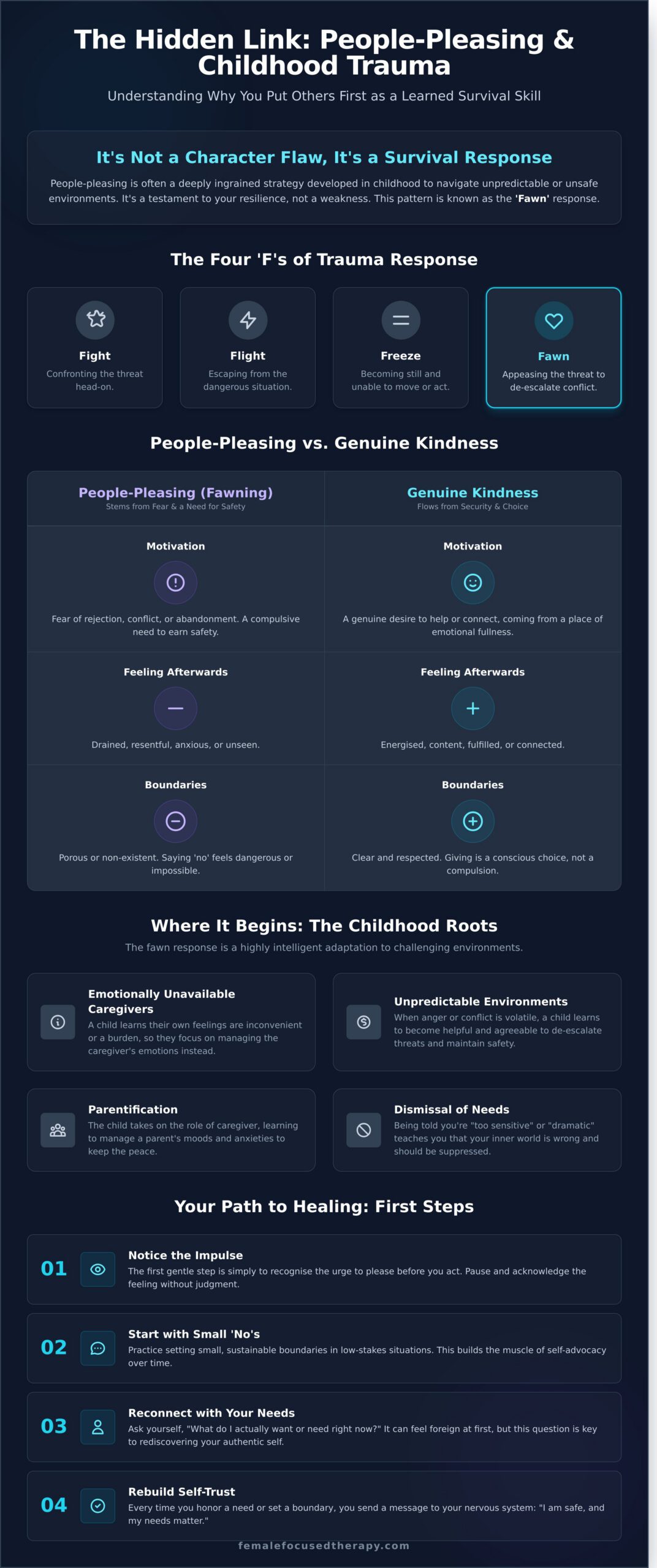
In the world of trauma-informed care, this behaviour is known as the ‘fawn’ response. It’s the fourth, and often overlooked, trauma response alongside fight, flight, and freeze. Fawning is an instinctive attempt to seek safety by appeasing and catering to the needs of a perceived threat. When a child grows up in an environment where anger is unpredictable or connection feels conditional, they learn to de-escalate conflict by becoming helpful, agreeable, and attuned to the caregiver’s emotional state. This pattern of appeasement is a common feature in what is known as Complex post-traumatic stress disorder (C-PTSD), where the nervous system adapts to prolonged threats by prioritising the safety of connection above all else.
People-Pleasing vs. Genuine Kindness
It’s crucial to distinguish between people-pleasing and genuine kindness, as they come from entirely different internal places. Genuine kindness is an act of generosity that flows from a place of emotional fullness and choice. People-pleasing, however, stems from a place of fear and a perceived deficit-a deep-seated belief that you must earn your safety and belonging. Recognising your own patterns without judgment is a powerful step in your journey of healing.
The Childhood Roots: Why Trauma Teaches You to People-Please
People-pleasing is not a character flaw; it is a highly intelligent survival strategy learned in childhood. When a child’s world feels unsafe or unpredictable, they must adapt to survive. The fawn response-appeasing others to avoid conflict, anger, or abandonment-becomes a powerful tool to navigate environments where their emotional and physical safety is at risk. The complex nature of Understanding Child Trauma shows us that these adaptations are born from a deep need for connection and security.
The tendency for people pleasing after childhood trauma is a direct echo of these early experiences, where your needs were secondary to the needs of those around you. Let’s explore the environments where this response often takes root.
When Your Needs Weren’t a Priority
In a home with emotionally unavailable, dismissive, or volatile caregivers, a child quickly learns that their feelings are inconvenient or even dangerous. You may have been told you were “too sensitive” or “dramatic,” teaching you that your inner world was a burden. This often leads to parentification, where the child instinctively takes on the role of the caregiver, learning to manage a parent’s moods and anxieties to keep the peace. You became an expert at monitoring their emotional state, because your safety depended on it.
The Role of Unpredictable Environments
Growing up amidst chaos-perhaps due to a parent’s addiction, mental health challenges, or constant conflict-teaches a child to become hyper-vigilant. You learned to scan for subtle shifts in tone and mood, always anticipating the next emotional storm. In these environments, fawning isn’t just about being “nice”; it’s a profound attempt to create stability and exert some control. By making yourself agreeable and helpful, you could de-escalate tension and carve out moments of desperately needed calm.
Learning to ‘Earn’ Love and Safety
When affection and approval are conditional, a child internalises a painful belief: “I must earn my place here.” Love isn’t given freely; it becomes a reward for being quiet, helpful, or achieving. You learn that your worth is tied to your performance and your ability to meet others’ needs. This foundational belief doesn’t simply vanish in adulthood. It follows you into friendships and romantic relationships, creating a draining cycle where you constantly strive to prove your value, often at the expense of your own wellbeing and happiness.
How People-Pleasing Shows Up in Your Adult Life
The survival strategies that helped you navigate a difficult childhood often follow you into adulthood, showing up in ways that can be subtle yet deeply draining. What was once a way to stay safe can become a pattern that disconnects you from your authentic self. Recognizing these behaviours is the first compassionate step toward change.
Recognizing the Signs in Daily Life
People-pleasing isn’t just about being nice; it’s a compulsive drive to put others’ needs and feelings before your own, often at a great personal cost. Does any of this feel familiar?
- You find yourself constantly apologising, even for things that are not your fault.
- You agree with others on the outside while a different opinion screams on the inside.
- Making simple decisions, like what to eat for dinner, feels impossible without someone else’s validation.
- You feel utterly exhausted after social interactions, as if you’ve just performed on a stage.
The High Cost: Burnout, Anxiety, and Lost Identity
Constantly scanning your environment for signs of disapproval is a state of hyper-vigilance. This emotional labour is exhausting and a direct path to burnout and chronic anxiety. For many women navigating people pleasing after childhood trauma, the heaviest cost is the erosion of self. When your life is built around accommodating others, you can lose touch with your own desires, values, and needs, leading to a painful feeling of not knowing who you truly are.
The physical toll of this hyper-vigilance is significant, and addressing it is a key part of healing. A comprehensive, whole-person approach, like that of a Holistic Family Practice, can be incredibly supportive in treating the physical symptoms of trauma like burnout and anxiety.
Impact on Your Relationships
In relationships, this pattern can create one-sided dynamics where you are always the giver and your needs go unmet. This deep-seated need for approval can unfortunately attract unhealthy or narcissistic relationship dynamics, where your kindness is mistaken for weakness. Over time, this can breed deep resentment and prevent true intimacy, as you’re not allowing your partner to know the real you-the person with needs, boundaries, and a voice of her own.
Your Path to Healing: First Steps to Setting Boundaries
Beginning to heal from people pleasing after childhood trauma is not about sudden, drastic change. Instead, it is a gentle process of unlearning and self-discovery, taken one small step at a time. It starts with the quiet power of simply noticing the impulse to say ‘yes’ before you act on it. This journey is about reclaiming your space and learning that setting a boundary is a profound act of self-respect, not selfishness. The first step is often the most difficult, but it is also the most empowering.
Step 1: Cultivate Self-Awareness
Before you can change a pattern, you must first learn to see it clearly. This begins with turning your attention inward. Start by noticing the physical sensations in your body-a tight chest, a knot in your stomach-when someone asks something of you. Keep a small journal to track when you say ‘yes’ and how it truly made you feel afterwards. This gentle practice helps you identify your personal triggers and understand the true cost of your ‘yeses’.
Step 2: Understand and Reframe Boundaries
Think of a boundary as the gentle line where you end and another person begins. It protects your energy, your time, and your emotional wellbeing. For survivors of trauma, the fear and guilt that surface when setting a boundary can feel overwhelming, and that is a completely valid and normal part of this process. Remember, healthy people and healthy relationships not only accept but also respect boundaries. They are the foundation of mutual respect and genuine connection.
Step 3: Practice Gentle ‘No’s
You don’t have to start with a hard ‘no’. The goal is to create space for yourself. Begin by practicing low-stakes ‘no’s with people you feel safest with. A powerful tool is the ‘pause’, which gives you time to check in with yourself instead of automatically agreeing. Try using simple, non-confrontational scripts:
- “Let me check my calendar and get back to you.”
- “Thank you for thinking of me, but I can’t commit to that right now.”
- “I need some time to think about that.”
These small acts of self-preservation help rebuild self-trust, one gentle ‘no’ at a time. For more tools to support you, please explore our collection of free therapy resources. Remember, navigating this path is easier with support, and professional therapy can provide a safe space to practice and grow.
Rebuilding Self-Trust and Finding Your Authentic Self
The journey away from people-pleasing is ultimately a journey back to yourself. The goal is to gently shift your source of validation from external approval to a deep, internal sense of self-trust. For so long, your needs were secondary. Now is the time for reconnection, rediscovering the person you are beneath the layers of learned behaviour. This process is not about becoming a different person, but about finally allowing your authentic self to emerge.
Learning to Listen to Your Inner Voice
Rebuilding self-trust begins with small, intentional acts. It starts by asking yourself simple questions and honouring the answers, no matter how quiet the voice is at first. Practice making small decisions based purely on your own preference, like choosing what you actually want for lunch or which route you’d prefer to walk. Journaling can be a powerful tool for this exploration. Consider these prompts:
- What is one small thing I want to say “no” to this week?
- When do I feel most like myself?
- What are three values that are non-negotiable for me?
Navigating Guilt and Backlash
As you begin to set boundaries and prioritise your needs, you may feel a wave of guilt. This is a deeply ingrained response. It’s also possible that others, accustomed to your compliance, may react with confusion or pushback. It’s important to prepare for this discomfort. See it not as a failure, but as a test of the relationship’s health. Practicing self-compassion during these moments-placing a hand on your heart, speaking kindly to yourself-is essential as you navigate this new territory.
How Therapy Supports Your Journey
Untangling the patterns of people pleasing after childhood trauma is profound work that is often best done with professional support. Therapy provides a safe, non-judgmental container where you can explore these dynamics without fear of disappointing anyone. A trauma-informed therapist can help you build the practical skills to set boundaries effectively and manage the difficult emotions that arise.
Most importantly, therapy is a space to heal the root trauma that created the people-pleasing behaviour in the first place, allowing for lasting change and genuine self-empowerment. Learn more about who we work with and how we can support you on your path to reclaiming yourself.
Your Journey from People-Pleasing to Authentic Self
Recognising that your tendency to people-please is a protective strategy learned in childhood is a powerful first step toward healing. It’s not a character flaw, but a testament to your resilience. The path forward, as we’ve explored, is a gentle process of setting boundaries, reconnecting with your own needs, and rebuilding self-trust. Healing from people pleasing after childhood trauma is a profound journey from mere survival to a life of genuine self-worth and confidence.
You do not have to navigate this path alone. At Female Focused Therapy, we provide trauma-informed therapy for women here in Singapore, specialising in helping you rebuild self-trust and set healthy boundaries. In our safe, supportive online and in-person sessions, you can find the space to finally be heard and to heal at a pace that feels right for you. If you feel ready to take the next step, we are here to support you.
Ready to reclaim your voice? Book a confidential consultation today.
Frequently Asked Questions
Is people-pleasing always a sign of childhood trauma?
While not every instance of kindness is a trauma response, a compulsive need to please others often is. For many, the pattern of people pleasing after childhood trauma develops as a survival strategy. When a child’s environment is unpredictable or unsafe, they may learn that suppressing their own needs to keep caregivers happy is the only way to receive love or maintain safety. This learned behaviour can then continue long into adulthood, even when the original threat is gone.
How do I cope with the overwhelming guilt of setting boundaries for the first time?
Feeling guilty when you first set boundaries is completely normal; it’s a sign that you are challenging a deeply ingrained pattern. Acknowledge the feeling with compassion, reminding yourself that this guilt is part of the old programming. Start with small, low-stakes boundaries to build your confidence. This is not about being selfish, but about beginning the vital process of self-reconnection and teaching others how you deserve to be treated. It is a journey that requires patience and kindness towards yourself.
Can people-pleasing be a symptom of undiagnosed ADHD in women?
Yes, there is a strong connection. Many women with undiagnosed ADHD develop people-pleasing as a sophisticated coping mechanism. This can be driven by Rejection Sensitive Dysphoria (RSD), an intense emotional pain felt in response to perceived rejection or criticism. To avoid this pain, you might over-commit or constantly seek approval. It becomes a way of masking executive function challenges and navigating social situations, often at great personal cost to your own energy and well-being.
What is the difference between people-pleasing and codependency?
While they often overlap, they are distinct. People-pleasing is a behaviour focused on gaining approval and avoiding conflict, often across many different relationships. Codependency is a deeper, more enmeshed relational pattern, typically within specific relationships, where your sense of self-worth and identity is dependent on another person. You might find yourself enabling their behaviour to maintain the connection. A people-pleaser can be codependent, but not all people-pleasers are.
How long does it take to heal from people-pleasing habits rooted in trauma?
Healing is a deeply personal journey, not a race with a finish line. There is no set timeline, as your path is unique to your experiences. The focus should be on gentle, consistent steps towards rebuilding self-trust and self-compassion. Progress is about celebrating small wins, like saying “no” to a minor request or prioritising your rest. This process unfolds at a pace that feels safe and sustainable for you, and working with a therapist can provide crucial support and guidance along the way.
What if people get angry or leave when I start setting boundaries?
This is a valid and common fear, but it’s important to reframe your perspective. A person’s negative reaction to your healthy boundary is a reflection of their own needs and expectations, not a judgement on your worth. While it can be painful, it is also a clarifying process. It shows you which relationships are based on mutual respect and which were sustained by your self-abandonment. This difficult step is essential for cultivating connections that truly support your growth and wellbeing.