
The discovery of infidelity can feel as though your entire world has shattered. You may be lost in a storm of overwhelming betrayal and heartbreak, with obsessive thoughts and painful questions replaying endlessly in your mind. In this state of confusion, it’s common to grapple with intense self-blame, questioning everything you thought you knew about your relationship and, more painfully, about yourself. The path forward feels uncertain, and the fear of making the ‘wrong’ decision can be paralysing.
Please know that whatever you are feeling right now is completely valid. This guide was created to offer a safe, compassionate space for you to breathe and begin making sense of the chaos. We will gently explore the complexities of what has happened, not to assign blame, but to support you in finding understanding and a clear path toward healing. It is a space to quiet the noise so you can hear your own voice again.
Here, you will find practical steps to help you navigate the intense emotional pain, gain clarity on your future, and begin the essential journey of rebuilding your self-worth. This is your first step toward reconnecting with your strength and learning to trust your own judgment once more.
Key Takeaways
- Gain clarity on what constitutes a betrayal, recognizing it’s about the violation of your relationship’s unique emotional and sexual agreements.
- Discover gentle, practical first steps to help you navigate the overwhelming shock and pain in the immediate aftermath of discovery.
- Learn a compassionate framework for approaching the decision to stay or leave after infidelity, centring your own needs and long-term wellbeing.
- Understand that your personal healing is the priority and find supportive strategies to begin rebuilding your essential self-trust.
What is Infidelity? Understanding Betrayal in Its Many Forms
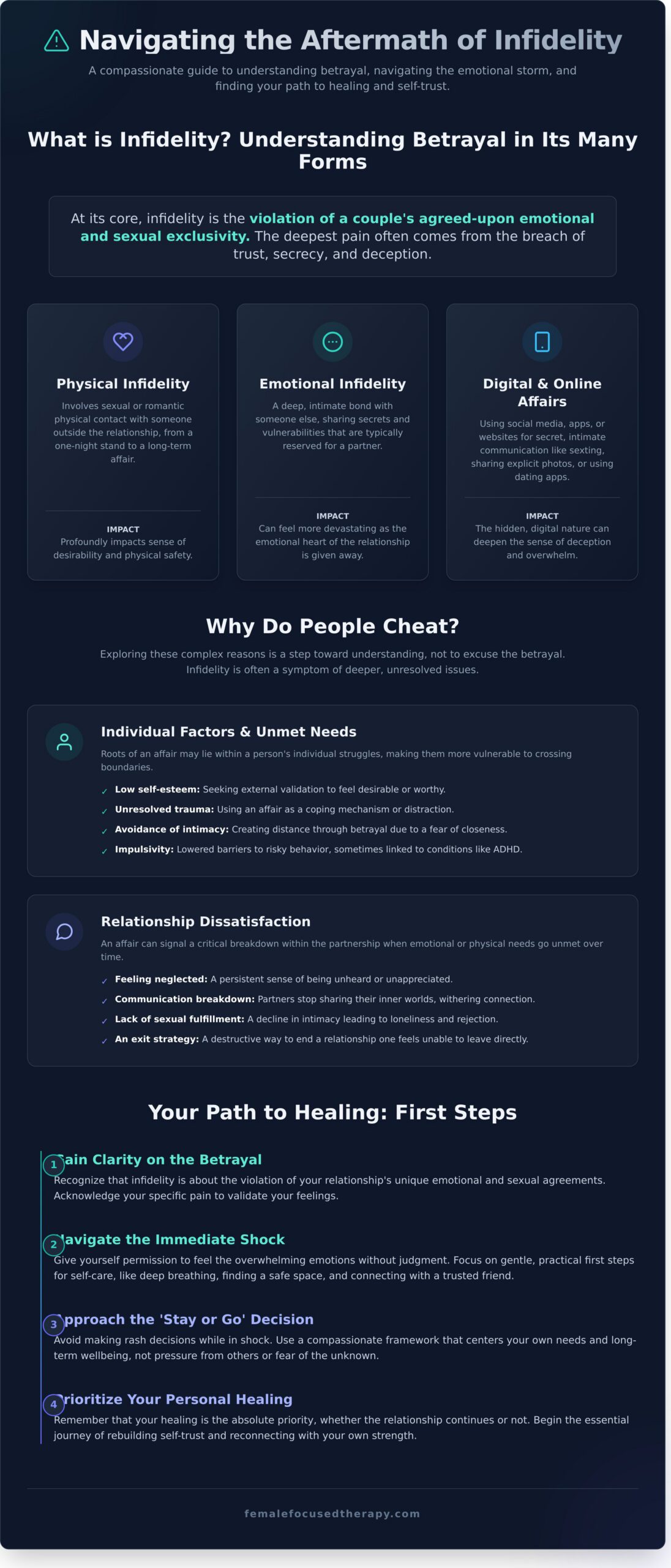
When you hear the word infidelity, your mind might immediately go to a physical affair. While that is one form, the reality of betrayal is often far more complex and nuanced. At its core, infidelity is the violation of a couple’s agreed-upon emotional and sexual exclusivity. It’s not just about the act itself; the deepest pain often comes from the breach of trust, the secrecy, and the deception that shatters your sense of emotional safety within the relationship.
Understanding the different ways this betrayal can manifest is a crucial first step in navigating the confusion and hurt you may be feeling. While the specific definitions can vary between couples, a deeper look into what is infidelity helps to shed light on the common forms of this painful experience. Acknowledging the specific type of betrayal you’ve endured can help validate your feelings and begin the journey toward clarity and healing.
Physical Infidelity
This is the most widely recognised form of an affair, involving sexual or romantic contact with someone outside of the relationship. It can range from a one-night stand to a long-term affair. The discovery of a physical betrayal can profoundly impact your sense of desirability and physical safety, leaving you questioning the very foundation of your shared life and intimacy.
Emotional Infidelity
An emotional affair happens when a deep, intimate bond forms with someone else. This involves sharing personal secrets, dreams, and vulnerabilities that are typically reserved for a partner. For many, this form of betrayal can feel even more devastating than a physical one because it suggests that the emotional heart of the relationship has been given away to someone else.
Digital and Online Affairs
In our connected world, betrayal can also happen through screens. Digital infidelity includes using social media, messaging apps, or websites for secret, intimate communication. This might involve sexting, sharing explicit photos, or maintaining an active profile on a dating app. The hidden nature of these online interactions often deepens the sense of deception, creating a painful discovery that can feel overwhelming.
Why Do People Cheat? Exploring the Complex Reasons Behind an Affair
When you’re reeling from the shock of discovery, the question ‘why’ can feel all-consuming. It’s important to hold space for this question with compassion, not to excuse the betrayal, but to begin untangling the complex factors at play. Infidelity is rarely a simple choice; it is more often a symptom of deeper, unresolved issues. Exploring the complex reasons for infidelity allows us to move away from a cycle of blame and toward understanding the underlying patterns that need healing.
Individual Factors and Unmet Needs
Sometimes, the roots of an affair lie within one person’s individual struggles, which may have little to do with the relationship itself. These are not justifications, but contributing factors that can make someone more vulnerable to crossing a boundary.
- Low self-esteem or a need for external validation: Seeking attention outside the relationship to feel desirable or worthy.
- Unresolved personal trauma: Using an affair as a way to cope with or distract from past pain and difficult emotions.
- Avoidance of intimacy: Fearing true emotional closeness and creating distance through betrayal.
- Impulsivity or underlying conditions: Challenges with impulse control, sometimes linked to conditions like ADHD, can lower the barrier to risky behaviour.
Relationship Dissatisfaction
Often, an affair signals a critical breakdown within the partnership. When emotional or physical needs go unmet over a long period, a sense of distance can grow, creating a space where a third party can enter. This can stem from:
- Feeling neglected or unappreciated: A persistent sense of being unheard or taken for granted.
- A breakdown in communication: When partners stop sharing their inner worlds, emotional connection withers.
- Lack of sexual fulfillment: A decline in intimacy can leave one or both partners feeling lonely and rejected.
- An exit strategy: Sometimes, an affair is a misguided and destructive way to end a relationship that a person feels unable to leave directly.
Situational and External Factors
While not the core cause, external circumstances can create an environment where an affair is more likely to happen. These situations don’t create the desire, but they can provide the opportunity.
- Opportunity and proximity: Frequent travel or a close, emotionally intimate relationship with a work colleague.
- Major life transitions: The stress of a new baby, job loss, or moving to a new city like Singapore can create distance between partners.
- Peer group influence: Spending time in social circles where infidelity is normalized or seen as acceptable.
The Immediate Aftermath: How to Cope When Your World is Shattered
The moment you discover an act of infidelity is a moment your world fractures. The ground beneath you disappears, replaced by a chaotic mix of shock, searing pain, and disbelief. You may feel rage one minute and a profound, hollow numbness the next. Please know, whatever you are feeling is valid. There is no “right” way to react to such a deep betrayal. In these first few hours and days, the goal is not to make life-altering decisions but simply to survive the emotional storm and create a pocket of safety for yourself.
Prioritize Your Physical and Emotional Safety
Your nervous system is in overdrive. The most compassionate thing you can do right now is give yourself permission to pause. You do not need to have answers or a plan. Focus on the absolute basics to help ground your body and mind:
- Breathe. Take slow, deep breaths to calm the physiological panic response.
- Nourish yourself. Try to drink water and eat something simple, even if you don’t feel hungry.
- Create space. If living in the same home feels unbearable, it is okay to arrange to stay with a friend or family member temporarily.
- Avoid harmful coping. Resist the urge to numb the pain with excessive alcohol or other substances, which can intensify emotional distress.
Build a Safe Support System
You do not have to navigate this darkness alone. Reaching out for support is a sign of strength, not weakness. Be mindful of who you confide in during this fragile time. Choose one or two trusted, non-judgmental friends or family members who can simply listen and hold space for your pain without offering unsolicited advice or judgment. This is also the most crucial time to consider professional help. A therapist can provide a confidential, supportive space to begin processing the trauma of the discovery and help you stabilize.
Resist the Urge for Destructive Actions
In a state of shock, it’s common to feel an intense urge to do something-to confront, to expose, to make a decision that ends the pain. However, actions taken from a place of trauma can often lead to more regret. It can be tempting to demand every painful detail, trying to understand the ‘why’ behind it all. While comprehensive research into the reasons for infidelity explores complex underlying factors, this deep dive is often counterproductive in the initial shock phase. Try to steer clear of public ‘revenge’ on social media or making permanent decisions about your relationship. For now, the focus is on your immediate wellbeing.
The Crossroads: Deciding Whether to Stay or Go
After the initial shock of an affair, you will eventually arrive at a crossroads. The pressure to make a decision can feel immense, but it’s vital to give yourself the grace of time. This is a deeply personal journey with no right or wrong answer; the only path that matters is the one that honours your wellbeing.
This process is not about a quick verdict on the infidelity itself. It’s about a gentle, honest reflection on your relationship as a whole and what you truly need to build a healthy, fulfilling future. The goal is to gain clarity, whether that leads to rebuilding your partnership or creating a new path for yourself.
Questions to Ask Yourself
In the quiet moments, it can be helpful to sit with these questions. Allow yourself to explore them without judgment, simply noticing what comes up for you.
- Was our relationship healthy, respectful, and fulfilling before this happened?
- Does my partner show genuine remorse and take full responsibility for their actions, without blame?
- What are my core values and non-negotiables for a partnership?
- Can I realistically envision a future where I could trust this person again?
Signs It May Be Possible to Rebuild
Rebuilding is a challenging journey, but it is possible when certain foundations for healing are present. You may see a path forward together if:
- The cheating partner has ended the affair completely and offers full, voluntary transparency.
- They are willing to do the hard work in both individual and couples therapy to understand the root causes and repair the damage.
- There is a shared history of genuine love and respect that you both feel is worth fighting for.
When Leaving May Be the Healthiest Choice
Sometimes, the most compassionate choice you can make is for yourself. Leaving may be the healthiest path forward if:
- There is no genuine remorse, or your partner continues to blame you or minimise their actions.
- The infidelity is part of a larger, ongoing pattern of disrespect, dishonesty, or emotional abuse.
- Your fundamental needs for emotional safety and security can no longer be met in the relationship.
Navigating this decision is one of the most difficult parts of the healing process. Seeking professional support can provide the clarity and confidence you need to trust yourself and move forward. For more information, please visit femalefocusedtherapy.com.
The Path to Healing: Rebuilding Your Life and Self-Trust
After the shock and pain of discovering an affair, the path forward can feel uncertain. It’s important to remember that your healing is the priority, whether you decide to end the relationship or attempt to repair it. The discovery of infidelity is a form of trauma, and recovering from it requires time, patience, and immense self-compassion. This journey is not just about the relationship; it’s about a profound reconnection with your own strength and rebuilding the most important relationship you will ever have: the one with yourself.
Allow Yourself to Grieve the Loss
It is essential to acknowledge that you are grieving. You are mourning the loss of the reality you thought you had, the trust that was broken, and the future you envisioned. You may move through stages of grief-such as denial, anger, bargaining, and depression-in a non-linear way. There is no timeline for this process. Be kind and patient with yourself, allowing your feelings to exist without judgment as you navigate this painful period.
Reclaim Your Identity and Self-Worth
This is a time to gently turn your focus inward. Reconnect with the parts of yourself that existed outside of the relationship-your hobbies, passions, and friendships that bring you joy and a sense of purpose. It is crucial to challenge any self-blaming thoughts. You are not responsible for your partner’s choices. By investing in your own wellbeing, you begin to rebuild your confidence and reclaim your identity on your own terms.
Physical movement can be a powerful tool in this process, helping to reconnect your mind and body and release stored stress. For many women, re-establishing a fitness routine offers a tangible way to build strength, both physically and emotionally. Apps designed for women’s fitness, like the Nuli App, can provide structured guidance and a supportive community to help you on this journey.
The Role of Therapy in Your Recovery
Navigating the aftermath of infidelity alone can be incredibly isolating. Therapy offers a confidential and safe space to process complex emotions like betrayal, rage, and sadness without judgment. A compassionate therapist can help you understand and heal from this profound relationship trauma, identifying patterns and empowering you with tools for recovery. It is a dedicated space to rebuild your self-trust, gain clarity, and begin planning for a future that feels authentic and secure. We can help you navigate this painful time. Learn more about who I work with.
Embracing Your Future with Clarity and Confidence
Navigating the aftermath of betrayal is one of life’s most profound challenges, leaving you feeling lost and questioning everything you thought you knew. As we’ve explored, understanding the complexities of infidelity and honouring your unique emotional response are the first essential steps toward healing. Whether you choose to rebuild the relationship or forge a new path alone, the most important journey is the one back to yourself-reclaiming your sense of self and rebuilding the trust you have in your own judgment and resilience.
You don’t have to walk this path alone. At Female Focused Therapy, we specialize in helping women heal from relationship trauma with trauma-informed care. In a safe, confidential space-with both online and in-person sessions available in Singapore-we can support you in finding clarity and confidence again. Begin your journey to healing. Book a confidential consultation today. Your story deserves to be heard, and your future is worth rebuilding.
Frequently Asked Questions About Healing from Infidelity
How long does it take to get over infidelity?
There is no single timeline for healing from the pain of infidelity. The journey is deeply personal and depends on many factors, including the nature of the affair and your unique emotional landscape. Rather than focusing on a deadline, therapy supports you in navigating your feelings at a pace that feels safe and sustainable. The goal is not to rush recovery, but to genuinely process the hurt and rebuild a strong sense of self-trust and clarity for your future.
Is an emotional affair considered ‘real’ cheating?
Yes, for many women, an emotional affair is a profound and painful betrayal. It involves a breach of trust where emotional intimacy, secrets, and connection are shared with someone outside the relationship. This violation of emotional boundaries can feel just as devastating as a physical affair, as it undermines the foundation of safety and connection you believed you had. Acknowledging this hurt is a valid and crucial first step toward healing from this type of infidelity.
Can you ever fully trust your partner again after they cheat?
Rebuilding trust is a challenging and gradual process, but it is possible for some couples. It requires complete honesty, accountability, and consistent effort from the partner who was unfaithful. For the hurt partner, it involves a willingness to slowly risk vulnerability again. Therapy can provide a safe, structured space to navigate these difficult conversations and help you decide if a new, stronger foundation of trust can be co-created in your relationship.
What should I do if my partner won’t admit to cheating or continues to lie?
Facing denial or continued dishonesty is incredibly painful and can make healing together feel impossible. Without accountability, there can be no repair. In this situation, the focus of therapy shifts to supporting you. We work to strengthen your self-trust, help you set firm boundaries to protect your emotional wellbeing, and empower you to gain clarity on what you need to feel safe and respected, whether that is inside or outside the relationship.
Is it my fault that my partner cheated on me?
Let us be perfectly clear: your partner’s choice to be unfaithful is never your fault. While all relationships have their own dynamics and challenges, the decision to step outside the relationship was theirs alone. It is a reflection of their choices, coping mechanisms, or issues-not a measure of your worth or a failing on your part. Therapy provides a safe space to release this misplaced self-blame and begin rebuilding your self-esteem and confidence.
Should I tell our friends and family about the affair?
Deciding who to confide in is a very personal choice. Before sharing, it can be helpful to consider what kind of support you need and who can offer it without judgment. Sometimes, telling people too soon can invite unwanted opinions that complicate your healing. A therapist offers a completely confidential and unbiased space to process your experience first, helping you gain clarity before you decide what, and with whom, you wish to share.

Article by
Cheryl Kennedy MacDonald MA BA (Hons) Pg. Dip. SAC BACP
Cheryl Kennedy MacDonald is a psychotherapist specialising in women’s mental health, relationships, and life transitions. She works with women navigating trauma, relationship breakdown, identity shifts, and midlife change, helping them rebuild self-trust, emotional stability, and a clear sense of who they are and what they want.
With over 20 years’ experience working with women internationally, Cheryl is the founder of YogaBellies, a global women’s yoga school, and the creator of the Birth ROCKS method. Her work sits at the intersection of psychotherapy and embodiment, integrating evidence-based therapeutic approaches with somatic, body-based practices that support deep, lasting change.
Known for her grounded and direct approach, Cheryl moves beyond surface-level insight to address the patterns held in the body and nervous system. Her work supports women to regulate, reconnect, and respond to their lives from a place of clarity, strength, and self-respect.
She is a published author in academic journals and has written multiple books on women’s health, pregnancy, and midlife wellbeing, available on Amazon and leading book retailers worldwide.