
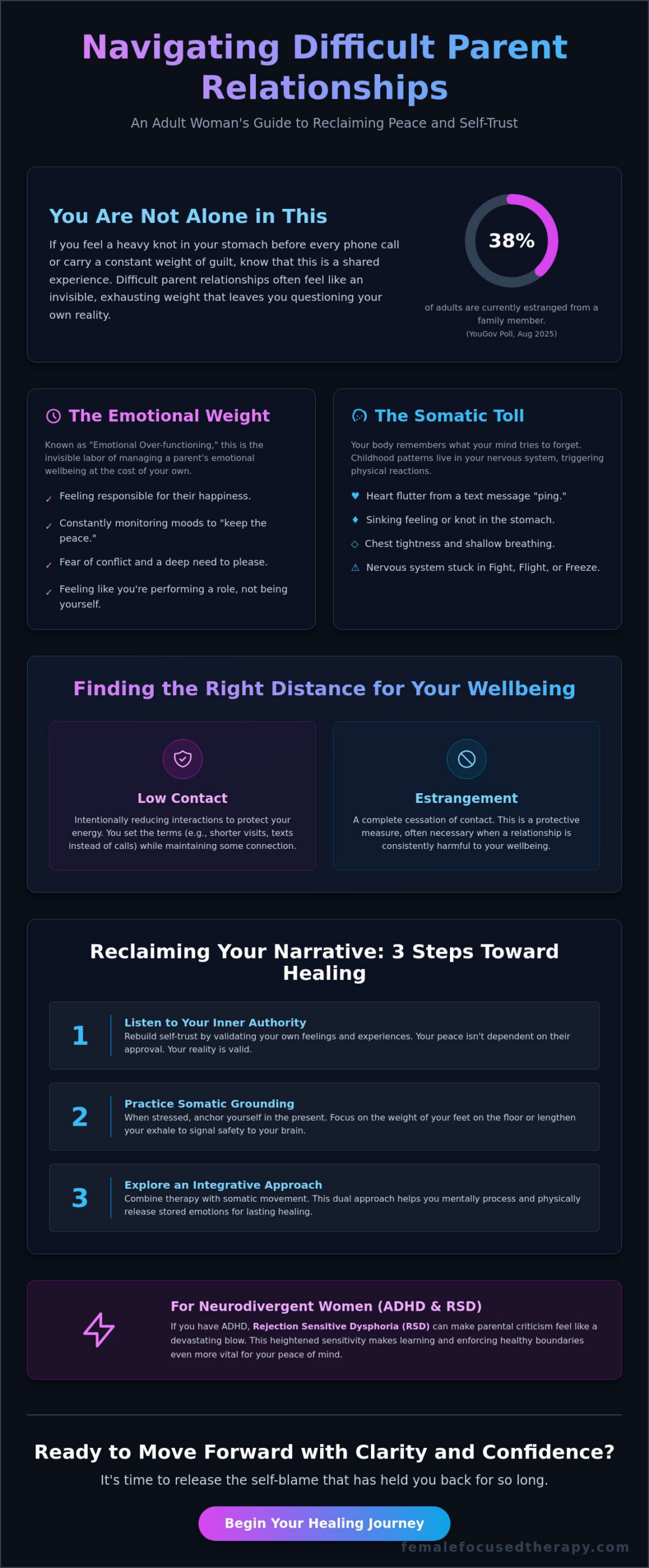
A YouGov poll from August 2025 found that 38% of adults are currently estranged from a family member. If you feel a heavy knot in your stomach before every phone call or carry a constant weight of guilt, please know you aren’t alone. Difficult parent relationships as an adult woman often feel like an invisible, exhausting weight that leaves you questioning your own reality.
Whether you choose to work with me or another experienced therapist like Tracy Kimberg, the most important thing is that you feel seen and supported in your unique journey toward healing.
I understand how it feels to believe you’re responsible for your parent’s emotional wellbeing. You’ve likely spent years over-functioning and trying to keep the peace, only to end up feeling emotionally depleted and physically tense. It’s common to feel that if you just tried a bit harder or said the right thing, the dynamic would finally change.
I want to help you understand this emotional weight and show you that your peace isn’t dependent on their approval. In this guide, I’ll share how you can begin rebuilding your self-trust and setting boundaries that feel safe for your body and mind. We’ll explore the path toward emotional clarity and how to release the self-blame that has held you back for so long.
Key Takeaways
- Understand why you might still feel like a child around your parents even when you’re high-functioning in every other part of your life.
- Discover how childhood patterns live in your body and why difficult parent relationships as an adult woman often trigger a physical “ping” of anxiety.
- Learn the difference between low contact and estrangement so you can find the right distance for your own emotional wellbeing.
- I’ll show you how to start listening to your inner authority instead of the parental voice as you rebuild your self-trust.
- Explore how an integrative approach, combining therapy with somatic movement, can help you move forward with clarity and confidence.
Understanding the Weight: Why These Relationships Feel So Heavy in Adulthood
I often work with women who lead teams or manage complex businesses, yet feel like a small child the moment they step into their parents’ home. It’s a strange, disorienting experience. You might be highly competent in every other area of your life, but difficult parent relationships as an adult woman have a way of bypassing your adult logic. This happens because our early emotional imprints are far more powerful than our current reasoning.
In my sessions, we often talk about emotional over-functioning. This is when you feel fundamentally responsible for your parent’s happiness or stability. You might find yourself constantly monitoring their mood, choosing your words with extreme care, or trying to “fix” their problems to keep the peace. It’s a heavy burden to carry, especially when you’re already managing your own life.
The Invisible Labour of the ‘Good Daughter’
Societal expectations often place a specific weight on women to be the emotional glue of the family. I want you to realise that being the “fixer” was likely a survival strategy you developed long ago, not a personality trait. When we grow up within dysfunctional family dynamics, we learn that our safety or belonging depends on how well we care for others’ emotions.
You might recognise this caretaking in your adult life as a constant need to please or a fear of conflict. This pattern doesn’t just stay within the family; it often spills over into relationship trauma or occupational burnout. When you spend all your energy managing someone else’s internal world, you have very little left for your own.
When Parental Needs Shadow Your Own
Many women I support describe a “vague emptiness” that they can’t quite name. This often stems from emotional neglect, where your parent’s needs were so loud or demanding that yours were simply shadowed. Even if your physical needs for food and shelter were met, your inner world might have been left unattended by those meant to nurture it.
You may feel like you’re performing a role rather than being your true self when you’re around them. It’s like wearing a mask that fits poorly but feels mandatory. Validating your own experience is the first step toward healing. Your feelings are real, and the weight you feel is a legitimate response to difficult parent relationships as an adult woman that have asked too much of you for too long.
The Somatic Toll: How Childhood Patterns Live in Your Body Today
In my practice, I often find that the body remembers what the mind tries to forget. You might think you’ve processed a childhood event, but your physical self reacts before you’ve even had a conscious thought. Difficult parent relationships as an adult woman aren’t just mental puzzles; they’re stored in your tissues, your posture, and your breath.
Think about that specific “ping” of a text message from a parent. For many of my clients, that sound triggers an immediate heart flutter or a sinking feeling in the stomach. Your nervous system has gone into high alert, preparing for an emotional threat that your adult brain knows isn’t physically dangerous, but your body perceives as an emergency.
Common signs of this stress include chest tightness, shallow breathing, or sudden digestive upset before a planned visit. These aren’t just “nerves.” They’re signals that your window of tolerance is narrowing. When we deal with difficult parent relationships as an adult woman, our capacity to stay calm and present shrinks, leaving us in a state of fight, flight, or freeze.
Nervous System Regulation for the Overwhelmed
I believe that healing happens in both the mind and the body. When you’re in the middle of a difficult phone call or visit, you can use simple somatic tools to signal safety to your brain. Try focusing on the weight of your feet on the floor or consciously lengthening your exhale. These small acts of grounding help you stay anchored in the present moment rather than drifting into old childhood fears.
ADHD, Rejection Sensitivity, and the Parental Bond
As a woman with ADHD, I know how Rejection Sensitive Dysphoria (RSD) can intensify the sting of parental criticism. If you’ve always felt “too much” or “not enough” in your family, your neurodivergent brain may process a simple comment as a devastating blow. This sensitivity makes finding guidance on setting healthy boundaries even more vital for your peace of mind.
Neurodivergent women often carry a deep-seated fear of being misunderstood or dismissed by their parents. Understanding this link through ADHD therapy can be a profound step toward self-compassion. It helps you see that your reactions are a part of how your brain is wired, not a personal failing. If you’re ready to explore these somatic patterns in a safe, supportive space, you can reach out to me here to begin your journey.
Boundaries vs. Estrangement: Finding the Right Distance for Your Wellbeing
I often tell my clients that boundaries are not walls designed to shut people out; they are the gates that allow us to love safely. When you’re managing difficult parent relationships as an adult woman, you might feel like your only options are total compliance or complete cutting off. However, there is a vast middle ground where you can decide exactly how much of yourself you are willing to share.
Finding the right distance is a deeply personal process. For some, this means “Low Contact,” where you might limit interactions to brief, scheduled phone calls or public settings. For others, “No Contact” or estrangement becomes a necessary step for survival. With 38% of American adults reporting estrangement from a family member in 2025, it’s clear that many are choosing to prioritise their mental health over traditional expectations of loyalty.
I don’t believe you have to “forgive and forget” to find peace. That narrative often feels dismissive and can actually keep you stuck in a cycle of hurt. Real peace comes from accepting the reality of the relationship as it is today, rather than how you wish it could be. This is especially challenging in cultures like Singapore, where filial piety and family duty carry immense weight, often making a simple boundary feel like a profound betrayal.
The Anatomy of a Healthy Boundary
A boundary is a clear statement of what you will or will not tolerate. I encourage you to use the “No JADE” rule: don’t Justify, Argue, Defend, or Explain. When you give reasons for your limits, you’re essentially inviting the other person to negotiate them. I want you to feel supported in choosing the distance that keeps you safe, even if it triggers an “extinction burst” where the parent temporarily ramps up their pressure to regain control.
Grieving the Parent You Deserved
Setting firm boundaries often requires you to first grieve the parent you deserved but didn’t have. Acknowledging the “mother wound” or “father wound” isn’t about blaming; it’s about honouring your own loss. Grieving is a necessary step because it allows you to let go of the hope that they will suddenly change, which is often what keeps you vulnerable to repeated hurt.
This process of letting go is a significant part of grief and life transitions. As you move through different stages of womanhood, the way you view these early wounds will shift. By allowing yourself to feel that sadness, you create the internal space needed to stand firm in your adult self. You’re not just setting a boundary; you’re protecting the woman you’ve worked so hard to become.
Reclaiming Your Narrative: Practical Steps Toward Self-Trust
Rebuilding self-trust is the cornerstone of my work with women. When you’ve spent decades reacting to another person’s needs, you often lose touch with your own internal compass. Dealing with difficult parent relationships as an adult woman can leave you feeling like a stranger to yourself, always looking outward for permission or validation.
A vital first step is learning to listen to your “inner authority” instead of the internalised parental voice. That critical voice in your head, the one that says you’re not doing enough or that you’re being “difficult,” usually belongs to someone else. I want to help you distinguish between those old echoes and your own quiet, steady truth.
I often suggest a “reparenting” approach to my clients. This simply means learning to give yourself the gentle validation and steady support you might have missed as a child. It’s about becoming the wise, compassionate adult for yourself that you always needed. This isn’t about blaming the past, but about taking responsibility for your own healing today.
Practicality matters too. If you have an upcoming holiday or family gathering, we can develop a “safety plan” together. This might include having your own transport, setting a specific time limit for the visit, or having a “safe person” you can text when things feel heavy. Having a plan signals to your nervous system that you are in control of your environment.
From People-Pleasing to Self-Knowing
Many women I see are experts at “masking” their true needs to keep the peace. You might find yourself saying yes when every cell in your body is screaming no. I encourage you to move at a pace that feels sustainable for you as you begin to unmask. Start with small, clear exercises like writing down three things you value most, independent of your family’s opinions.
Building a ‘Chosen Family’ and Support Network
Safe, healthy adult relationships play a massive role in healing childhood wounds. Your “chosen family” consists of those who see and honour the real you, without the baggage of old roles. These connections provide the mirror you need to see your own worth clearly. Self-trust is the ability to honour your own reality.
Breaking generational cycles is deep, often difficult work. While friends are wonderful, professional support is often needed to navigate the nuances of difficult parent relationships as an adult woman. If you feel ready to start this journey of reconnection with yourself, you can book an initial session with me to explore how we can work together.
Moving Forward: How Therapy Supports Your Healing Journey
I provide a safe, confidential space where you can finally explore the complex feelings you’ve been carrying. Dealing with difficult parent relationships as an adult woman is often isolating, but you don’t have to navigate this journey alone. I am here to hold space for you as you untangle the knots of the past and look toward a more peaceful future.
My integrative approach is designed to support you as a whole person. We combine evidence-based psychotherapy like CBT with somatic movement and mindfulness. This helps us address not just the thoughts in your head, but the physical tension stored in your body from years of emotional over-functioning. Together, we work to rebuild the self-trust that was often eroded during your childhood.
By honouring your own reality and learning to listen to your inner authority, you can begin to feel more grounded and confident. This process isn’t about a quick fix; it’s about sustainable growth at a pace that feels safe for you. Reclaiming your narrative is a journey of reconnection with your true self, away from the shadows of parental expectations.
What to Expect in Our Sessions
I bring a trauma-informed perspective to every session, ensuring your experiences are validated and never sensationalised. We work to address relationship trauma at its root, looking at how early dynamics influence your current patterns. My goal is to provide a calm, unhurried rhythm that respects your emotional boundaries.
In our time together, we might explore how your breath changes when discussing certain memories or use mindfulness to stay present when old fears arise. This mind-body connection is essential for deep, lasting healing. You’ll find a professional space where your voice is the most important one in the room, allowing you to process difficult parent relationships as an adult woman with clarity and support.
Take Your First Step Toward Peace
I offer in-person sessions in Singapore and online therapy for women globally. Whether you are navigating a recent life transition or dealing with long-standing family strain, support is available. I want you to know that internal peace is possible, even when your external circumstances remain challenging.
As a realistic next step today, I invite you to take a quiet moment to reflect. Close your eyes and notice one physical sensation you feel in your body when you think of “home” or your parents. Simply notice it without judgment; this awareness is the beginning of your reconnection with yourself.
When you feel ready to explore these feelings further, you can book a consultation with me. I look forward to supporting you as you reclaim your narrative and build a life that feels truly your own.
Reclaiming Your Peace and Self-Trust
You’ve explored how early patterns live in your body and why boundaries are a form of safety, not a betrayal. Healing from difficult parent relationships as an adult woman is a process of unlearning the need to fix others while learning to trust your own inner voice. It’s about moving from a place of chronic guilt to a space of clarity and internal quiet.
As a Registered Integrative Psychotherapist, I’m here to support you through this journey with a trauma-informed and ADHD-aware approach. Whether you’re based in Singapore or joining me online, I provide a safe, professional space to help you rebuild your sense of self. You can book a confidential therapy session with me today to begin exploring your path forward.
You deserve to feel grounded in your own life and respected in your relationships. It takes immense courage to look at these dynamics, but you’ve already taken the first step by being here. I’m ready to hold space for you whenever you’re ready to start.
Frequently Asked Questions
Is it normal to feel guilty for setting boundaries with my parents?
Yes, it is extremely common to feel a heavy sense of guilt when you first begin to set limits. This happens because you’ve likely been conditioned from a young age to prioritise your parents’ emotional comfort over your own needs. In my practice, I see many women who feel they are “bad daughters” simply for needing space to breathe.
I want you to realise that guilt is often a sign that you are breaking an old, unhealthy cycle. It doesn’t mean you’re doing something wrong; it means you’re doing something new. Over time, as you rebuild your self-trust, this guilt will begin to lose its power over your choices.
Can I heal from a difficult parent relationship without going ‘no contact’?
You can absolutely find peace and healing without cutting ties completely. While a YouGov poll from August 2025 shows that 38% of adults have gone “no contact,” many others choose “Low Contact” instead. This involves setting very specific parameters around when, where, and how you interact with your parents.
Healing is an internal process of reclaiming your own narrative and regulating your nervous system. It isn’t always about the physical distance between you. By focusing on your own wellbeing and somatic peace, you can learn to stay grounded even when the relationship remains challenging.
What are the signs of an emotionally immature parent?
Emotionally immature parents often lack deep empathy and struggle to take any responsibility for their own actions. They may be highly reactive, viewing your personal boundaries as a direct attack or a betrayal of family loyalty. These difficult parent relationships as an adult woman often leave you feeling like the only adult in the room.
You might notice they are unable to sit with your feelings if those feelings don’t align with their own. They tend to communicate through passive-aggression or emotional outbursts rather than calm, direct conversation. Recognising these signs is a vital step in releasing the burden of trying to change them.
How do I deal with a parent who uses guilt-tripping?
The most effective way to handle guilt-tripping is to recognise it as a learned manipulation tactic rather than a reflection of your worth. When a parent says something designed to make you feel responsible for their unhappiness, I encourage you to stay grounded in your own truth. You don’t need to argue or defend your choices.
Try using neutral, boundaried statements like, “I understand you’re upset, but I’ve made my decision.” By refusing to engage in the “guilt debate,” you stop the cycle of emotional over-functioning. This protects your energy and signals to your parent that guilt will no longer dictate your actions.
Can therapy help me if my parents refuse to change their behaviour?
Therapy is incredibly beneficial even if your parents never acknowledge their behaviour or choose to change. My work with women focuses on your growth, your resilience, and your self-trust. We aren’t in the room to “fix” your parents; we are there to support you in building a life that feels safe and authentic.
Through our sessions, you’ll learn how to manage your somatic responses to family stress and how to set boundaries that stick. You’ll gain clarity on your own values and learn to honour your reality. This internal shift allows you to find peace regardless of how your parents choose to act.
What is the ‘mother wound’ and how does it affect adult women?
The “mother wound” refers to the emotional pain and lack of validation passed down through generations of women. It often manifests as a persistent feeling of not being “good enough” or a chronic need to please others at your own expense. This wound can leave you feeling deeply disconnected from your own desires and needs.
In our sessions, we look at how this affects your current relationships and your sense of self. Healing this wound involves grieving the maternal support you deserved but didn’t receive. By acknowledging this loss, you can begin to mother yourself with the kindness and patience you’ve always needed.
How do I explain my boundaries to my parents without causing a fight?
You can explain a boundary clearly by stating it as a fact rather than a request for permission. Use brief “I” statements that focus on your own needs, such as, “I need to leave by 8pm tonight to rest.” You don’t need to provide long justifications, as this often invites them to argue.
Remember that you cannot control their reaction, but you can control your own response. If they try to escalate the conversation into a fight, you have the right to calmly end the interaction. Staying consistent with your limits is the kindest thing you can do for both yourself and the relationship.

Article by
Cheryl Kennedy MacDonald MA BA (Hons) Pg. Dip. SAC BACP
Cheryl Kennedy MacDonald is a psychotherapist specialising in women’s mental health, relationships, and life transitions. She works with women navigating trauma, relationship breakdown, identity shifts, and midlife change, helping them rebuild self-trust, emotional stability, and a clear sense of who they are and what they want.
With over 20 years’ experience working with women internationally, Cheryl is the founder of YogaBellies, a global women’s yoga school, and the creator of the Birth ROCKS method. Her work sits at the intersection of psychotherapy and embodiment, integrating evidence-based therapeutic approaches with somatic, body-based practices that support deep, lasting change.
Known for her grounded and direct approach, Cheryl moves beyond surface-level insight to address the patterns held in the body and nervous system. Her work supports women to regulate, reconnect, and respond to their lives from a place of clarity, strength, and self-respect.
She is a published author in academic journals and has written multiple books on women’s health, pregnancy, and midlife wellbeing, available on Amazon and leading book retailers worldwide.