
The house is quiet, but your mind is loud. You’re sitting across from the person you built a life with, yet a vast emotional distance stretches between you. This quiet, confusing ache is the experience of being married but lonely, a feeling that is far more common-and more painful-than many of us dare to admit. You may feel invisible, as if your needs go unheard. Perhaps the days have settled into a routine where you feel more like roommates than romantic partners, leaving you with a pang of guilt for feeling unhappy in a marriage that, on the surface, seems perfectly fine.
For those who find strength and guidance in their faith, seeking support from a practice that integrates those values can be particularly healing. For instance, counseling groups like New Leaf Counseling are devoted to the reconciliation of relationships from a faith-based perspective.
If this sounds familiar, please know you are not alone, and this feeling does not have to be your final chapter. This guide offers a safe, supportive space to explore these difficult emotions. Together, we will gently navigate the roots of marital loneliness and provide clear, actionable steps to help you begin the journey of reconnection. Our goal is to help you feel seen, heard, and emotionally close again, empowering you to rebuild intimacy with your partner and, just as importantly, with yourself.
Key Takeaways
- Your feeling of being married but lonely is a real and painful experience, often stemming from a lack of emotional connection rather than physical distance.
- Uncover the subtle, common reasons emotional distance grows in a marriage, moving beyond blame to understand the underlying dynamics.
- Rebuilding connection often starts with you; discover small, sustainable actions you can take to foster intimacy and strengthen your sense of self.
- Learn how therapy can provide a supportive, non-judgmental space to help you navigate healing and find your way back to each other.
The Painful Paradox: Understanding Loneliness Within a Marriage
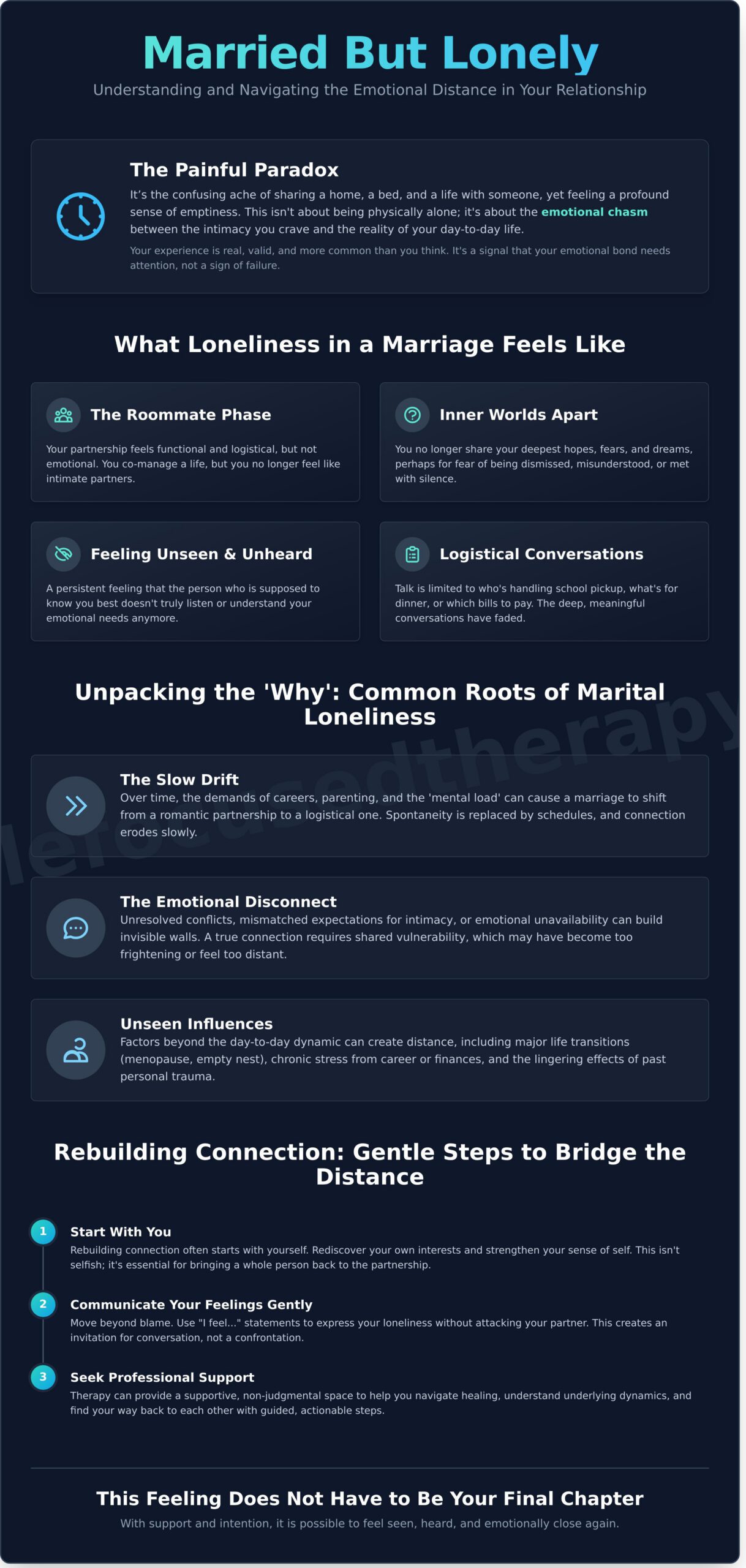
If you’re searching for answers to the feeling of being married but lonely, please know this: your experience is real, valid, and deeply painful. It’s a confusing and isolating paradox to share a home, a bed, and a life with someone, yet feel a profound sense of emptiness. This isn’t about being physically alone; it’s about the emotional distance. It’s the quiet ache of a partnership that provides presence, but not connection-the gap between the deep intimacy you crave and the reality of your day-to-day life.
Feeling this way does not mean your marriage has failed or that you have done something wrong. It is a powerful signal that the emotional bond that once felt so strong needs attention, understanding, and a gentle path toward reconnection.
What Does ‘Married But Lonely’ Actually Feel Like?
This unique form of loneliness often unfolds in quiet, subtle ways-not with a loud bang, but with a slow, creeping silence. This experience of emotional isolation in a marriage is a feeling of being on the outside of your own relationship. It can manifest as:
- A sense that you are living with a roommate or a co-parent, not an intimate partner. The partnership feels functional, but not emotional.
- Sharing a physical space but no longer sharing your inner worlds-your hopes, fears, and dreams feel kept to yourself for fear of being dismissed or misunderstood.
- A persistent feeling of being unseen or unheard by the person who is supposed to know you best. You might speak, but you don’t feel truly listened to.
- Craving deep, meaningful conversation but finding your talks are limited to logistics: who is picking up the children, what’s for dinner, or which bills need paying.
Why This Feeling Is More Common Than You Think
There is often a heavy silence and stigma surrounding marital loneliness. Many women, feeling the pressure to project a “perfect” family life, are afraid to admit they feel this way, even to themselves. They worry it reflects a personal failure. But the truth is, feeling married but lonely is an incredibly common experience. Even seemingly ‘perfect’ marriages can hide a quiet loneliness. Careers, parenting, and the sheer pace of modern life can unintentionally push a couple into functional roles, leaving little room for intimacy. It’s often a phase that many long-term couples navigate, and it is possible to find your way back to each other with support and intention.
Unpacking the ‘Why’: Common Reasons Women Feel Lonely in Marriage
If you feel married but lonely, it’s important to know that this feeling rarely stems from a single, dramatic event. Instead, it’s often the result of a slow, quiet drift-a gradual erosion of connection that happens over years. Understanding the ‘why’ isn’t about placing blame; it’s about gently untangling the patterns and pressures that have led you here. By exploring these common dynamics with compassion, we can begin to see a path toward reconnection.
The Slow Drift: When Routines and Responsibilities Take Over
In the day-to-day rush of life, especially in a fast-paced city like Singapore, it’s easy for a marriage to shift from a romantic partnership to a logistical one. Careers, parenting, and managing a household become the primary focus. For many women, the weight of the ‘mental load’-the invisible labour of anticipating needs and organising family life-can be isolating. You become excellent co-managers of a life, but you may lose the spontaneous, fun-loving friends you once were, leaving a void where connection used to be.
Emotional Disconnect: The Gap Between Talking and Connecting
Are your conversations limited to schedules, bills, and what to have for dinner? While these discussions are necessary, they don’t nurture emotional intimacy. A true connection is built on shared vulnerability, dreams, and fears. When conflicts go unresolved, they can create a lingering resentment that builds an invisible wall between you. In fact, research from the University of Georgia directly links unresolved marital conflict to increased feelings of loneliness and negative health outcomes. This emotional distance grows when partners have mismatched expectations for intimacy or when one or both become emotionally unavailable.
Unseen Influences: Life Transitions, Stress, and Past Trauma
Sometimes, the feeling of being married but lonely is influenced by factors beyond the immediate relationship dynamic. These can be deeply personal and often invisible to the outside world. Key influences include:
- Personal Changes: Major life transitions such as menopause, midlife changes, or becoming empty-nesters can alter your sense of self and your needs within the partnership.
- External Stressors: Intense pressure from work, financial worries, or caring for aging parents can deplete your emotional resources, leaving little energy for your partner.
- Individual Histories: Past trauma, attachment styles learned in childhood, or neurodivergent traits like ADHD can impact how you communicate, regulate emotions, and connect in a long-term relationship.
Rebuilding Connection: Gentle Steps to Bridge the Distance
When you feel married but lonely, the chasm between you and your partner can seem too wide to cross. The thought of “fixing” things can feel overwhelming. Instead, let’s shift our perspective from fixing a problem to gently rediscovering a person. The journey to reconnection doesn’t require grand gestures; it begins with small, sustainable steps that rebuild trust and intimacy over time.
Starting with You: Reconnecting with Your Own Identity
Often, the first step towards bridging the distance in your marriage is to bridge the distance with yourself. When we lose our sense of self, we can lose our footing in our relationships. Rebuilding your own foundation is an act of empowerment. Consider these gentle starting points:
- Rediscover your passions: What did you love to do before you were a “we”? Re-engage with a hobby or interest that is solely for your enjoyment.
- Nurture outside connections: Invest time in friendships that fill your cup and remind you of who you are outside of your partnership.
- Practice self-compassion: Challenge any feelings of guilt or failure. Your feelings are valid, and acknowledging them with kindness is the first step toward healing.
Opening the Door: How to Talk to Your Partner About Loneliness
Sharing your feelings is a courageous step toward improving your connection. In fact, extensive research on marital quality and loneliness shows a direct link between feeling seen and overall relationship satisfaction. To start this conversation without blame, try this framework:
- Choose a calm time: Find a neutral moment when you are both relaxed, not in the middle of a conflict or when you’re rushing out the door.
- Use ‘I feel’ statements: This focuses on your experience, not their actions. For example, “I feel lonely when we spend the evening on our separate devices,” is much softer than, “You always ignore me for your phone.”
- Be specific about what you need: Instead of saying “I need more attention,” try, “I would love it if we could put our phones away and just talk for 15 minutes after dinner.”
Creating ‘Micro-Moments’ of Connection
Lasting change is built on small, consistent efforts. Focus on creating tiny moments of connection that, when woven together, can repair the fabric of your relationship. These “micro-moments” signal care, attention, and a desire to be close.
- Hold a hug for a few seconds longer.
- Send a text during the day just to say you’re thinking of them.
- Ask an open-ended question about their day, like, “What was the most interesting part of your day?”
- Schedule a short, non-negotiable 10-minute walk together in the evening.
Remember, navigating the path from feeling married but lonely to feeling connected is a process. It requires patience and kindness, both for your partner and for yourself. If you need support in this journey, we are here to help you find clarity and confidence.
When to Seek Support: How Therapy Can Help You Heal
Sometimes, navigating the path back to each other requires a guide. If you’ve tried everything you can think of and still feel stuck, seeking professional support isn’t a sign of failure-it’s an act of profound courage and commitment to your wellbeing and your relationship. Therapy offers a structured, supportive environment to untangle the knots of disconnection and find your way forward, together or as individuals.
What Can a Therapist Offer That We Can’t Do Ourselves?
When you’re in the midst of feeling married but lonely, it can be nearly impossible to see the situation with clarity. A professional therapist provides a crucial outside perspective and a safe container for difficult work. They can offer:
- Facilitation: A neutral third party to guide conversations that have become too painful, repetitive, or emotionally charged to have on your own.
- Pattern Recognition: Insight to help you identify and understand negative communication or behavioural cycles that you may be too close to recognise.
- Validation: A confidential, non-judgmental space where your feelings are heard and validated, allowing you to express yourself without fear of blame or dismissal.
- Evidence-Based Tools: Proven strategies and techniques tailored to your unique situation to help you rebuild communication, intimacy, and trust.
Individual vs. Couples Therapy: Which is Right For You?
Deciding where to begin can feel overwhelming, but both paths offer unique benefits. Individual therapy is a powerful space to explore your own feelings, needs, and contributions to the dynamic. It’s a place to rebuild self-trust and gain clarity on what you want for your future. Alternatively, couples therapy provides a structured setting for both partners to work together, learn new ways of relating, and co-create solutions. For many, starting with individual therapy is the most gentle and effective first step.
Finding a Safe Space to Heal and Reconnect
Loneliness in a marriage often stems from deeper, unaddressed wounds. Therapy helps you gently explore the roots of this disconnection, whether it’s from past hurts, unresolved conflicts, or even unhealed relationship trauma. The ultimate goal is to foster genuine understanding and emotional safety, transforming a dynamic of distance into one of meaningful connection. A therapist supports you in creating a more fulfilling relationship-with your partner and with yourself.
If you’re ready to take the first step towards healing, we invite you to learn more about how we can support you on your journey.
Finding Your Way Back to Connection
The experience of being married but lonely is a deeply personal and often painful one. Remember that your feelings are valid, and understanding their roots is the first courageous step toward healing. Rebuilding intimacy and communication is a gentle process, and every small, intentional effort to reconnect matters. You have the strength to navigate this path and rediscover a sense of belonging, both in your relationship and within yourself.
If you need a guiding hand, you don’t have to walk this path alone. At Female Focused Therapy, we provide warm, professional, and confidential support, specializing in the complex relationship challenges women face. Our trauma-informed, integrative therapeutic approach is designed to help you find clarity and confidence. We are here for you, with support available online and in Singapore.
Your journey toward reconnection and renewed self-trust can begin today. Book a confidential consultation to explore your feelings in a safe space.
Frequently Asked Questions About Marital Loneliness
Can a marriage survive if one person feels deeply lonely?
Absolutely. A marriage can not only survive but also grow stronger when loneliness is addressed with courage and compassion. This feeling is often a signal that your emotional connection needs nurturing, not that the relationship is over. With mutual commitment to open communication, and sometimes with professional support, it is entirely possible to navigate this difficult period, rebuild intimacy, and find your way back to a more fulfilling partnership.
What if my husband says I’m just being ‘needy’ or ‘too emotional’?
It is incredibly painful to have your feelings dismissed. This response often stems from a partner’s own discomfort or a lack of understanding, rather than a judgement of your character. Your need for connection is valid and fundamental to a partnership. Try expressing yourself using “I feel” statements, such as, “I feel disconnected when we don’t have time to talk.” This approach can feel less accusatory and open a safer space for dialogue.
How do I know if it’s loneliness or if I’ve simply fallen out of love?
This is a challenging distinction to make. Loneliness is typically a longing to close a gap-you miss the connection you once had and wish you could feel close to your partner again. In contrast, falling out of love often involves a sense of indifference, emotional detachment, or even relief at their absence. If you still care for your partner and yearn for a deeper bond, you are likely navigating loneliness, which can be worked on.
My husband is a good man and a great father, so why do I still feel so lonely?
This is a very common experience. Feeling married but lonely is rarely about a partner being “bad”; it’s about a gap in emotional intimacy and connection. A relationship can be functional on the surface-managing a home and family in Singapore-while starving emotionally. This often happens when partners become consumed by their roles as parents and providers, unintentionally neglecting their connection to each other. Your feelings are valid and signal an unmet need for partnership.
Can technology and social media make loneliness in a marriage worse?
Yes, technology can significantly amplify feelings of isolation. When partners are more engaged with their screens than with each other-a behaviour known as “phubbing”-it creates real emotional distance. Social media can also foster unrealistic comparisons, making your own relationship feel inadequate. Setting aside dedicated, tech-free time to connect with each other is a powerful first step to rebuilding your presence and intimacy in the relationship.
How long does it take to stop feeling lonely in a marriage?
There is no set timeline for healing, as every relationship’s journey is unique. Rebuilding connection is a gradual process that relies on consistent, small efforts. Some couples notice a positive shift within a few weeks of being more intentional, while others may need several months, especially with professional guidance, to address deeper patterns. The focus should be on steady progress and reconnection, at a pace that feels safe and sustainable for you both.

Article by
Cheryl Kennedy MacDonald MA BA (Hons) Pg. Dip. SAC BACP
Cheryl Kennedy MacDonald is a psychotherapist specialising in women’s mental health, relationships, and life transitions. She works with women navigating trauma, relationship breakdown, identity shifts, and midlife change, helping them rebuild self-trust, emotional stability, and a clear sense of who they are and what they want.
With over 20 years’ experience working with women internationally, Cheryl is the founder of YogaBellies, a global women’s yoga school, and the creator of the Birth ROCKS method. Her work sits at the intersection of psychotherapy and embodiment, integrating evidence-based therapeutic approaches with somatic, body-based practices that support deep, lasting change.
Known for her grounded and direct approach, Cheryl moves beyond surface-level insight to address the patterns held in the body and nervous system. Her work supports women to regulate, reconnect, and respond to their lives from a place of clarity, strength, and self-respect.
She is a published author in academic journals and has written multiple books on women’s health, pregnancy, and midlife wellbeing, available on Amazon and leading book retailers worldwide.