
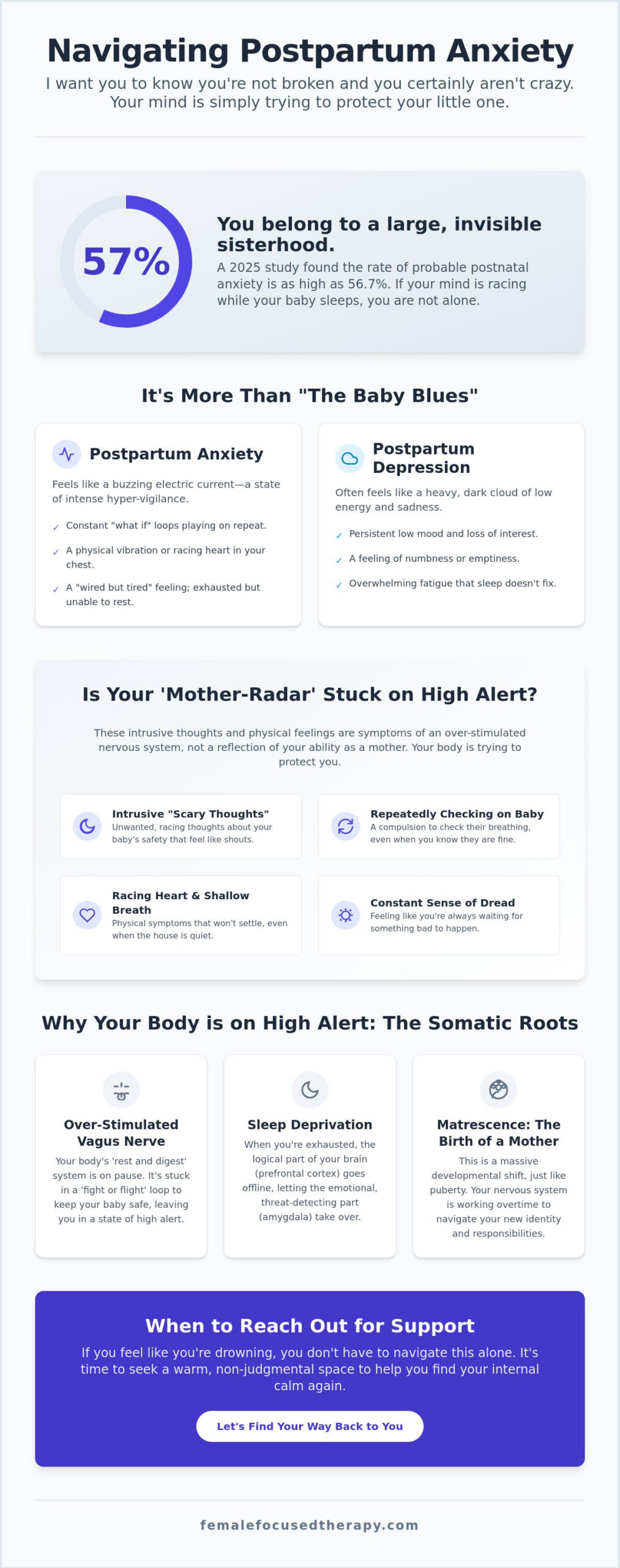
Did you know that a study published in September 2025 found that the rate of probable postnatal anxiety is as high as 56.7%? If you are lying awake at 3am while your baby sleeps soundly, your mind racing with intrusive thoughts about their safety, you belong to a very large, invisible sisterhood. I’m here to show you how to deal with postpartum anxiety so you can finally find the quiet you deserve.
It’s incredibly draining to feel like a failure for not being purely happy, especially when your body feels like it’s on a constant, restless loop. I want you to know that you aren’t broken and you certainly aren’t crazy. Your mind is simply over-functioning in an attempt to protect your little one, and I’ll help you understand why this is happening.
In this guide, I’ll share gentle, somatic ways to find your calm again and provide practical tools to stop a panic attack in its tracks. We’re going to move beyond the noise and find a path to your internal restoration together. You deserve to feel like yourself again, and I’m here to help you find your way back.
Key Takeaways
- Learn why your “scary thoughts” don’t make you a bad mother and how to reframe your “mother-radar” when it’s stuck on high alert.
- Discover how to deal with postpartum anxiety using simple, somatic tools like breathwork to signal safety to your nervous system.
- Understand the role of your vagus nerve and why your body remains in a state of hyper-vigilance after your baby arrives.
- Navigate the unique pressures of life in Singapore, including the “perfect parent” culture and the complexities of the helper dynamic.
- Identify when it’s time to seek a warm, non-judgmental space for integrative psychotherapy to help you find your internal calm again.
Beyond the Baby Blues: Understanding the Weight of Postpartum Anxiety
I want to start by telling you something I wish every new mother heard the moment she left the hospital. Those “scary thoughts” you’re having don’t make you a bad mother. They don’t mean you’re going to hurt your baby, and they certainly don’t mean you’re unfit for this role. These thoughts are just noise, even if they feel like shouts.
I often describe postpartum anxiety as a state of intense hyper-vigilance. It’s as if your “mother-radar” is stuck on high alert, scanning for threats that aren’t actually there. While the “baby blues” usually pass within about two weeks of giving birth, Understanding Postpartum Anxiety involves recognising that this is a much heavier, more persistent weight.
Unlike postpartum depression, which often feels like a heavy, dark cloud of low energy, anxiety feels like a buzzing electric current. It’s the “what if” loops that play on repeat in your head. It’s the physical vibration in your chest that won’t settle, even when the house is finally quiet and you have a rare chance to sleep.
Learning how to deal with postpartum anxiety starts with acknowledging that your body is trying to protect you, albeit in a way that feels incredibly overwhelming. You aren’t “crazy”; you’re responding to a monumental shift in your internal and external world.
The “Invisible” Nature of Postpartum Anxiety
Many women I work with in my Individual Psychotherapy Sessions are experts at hiding this struggle. You might look incredibly organised, with the nursery perfectly tidy and the nappy bag packed for every eventuality. It’s a mask of being “high-functioning” that we wear to prove we’re coping.
Inside, however, you might feel like you’re drowning. I see so many women who look like they have it all together while their internal world is chaotic. It’s vital to recognise that your intrusive thoughts are simply a symptom of a tired, over-stimulated nervous system, not a reflection of your reality.
Common Signs You Might Be Struggling
You might find yourself checking the baby’s breathing repeatedly or feeling a surge of panic if anyone else tries to help with basic tasks. It’s that “wired but tired” feeling where your body is physically exhausted, but your brain refuses to let you rest because it feels unsafe to do so.
Physical symptoms often include a racing heart, shallow breath, and a constant sense of dread in the pit of your stomach. You might feel like you’re constantly waiting for the other shoe to drop, even in moments of peace. Postpartum anxiety is a physiological response to the massive transition of matrescence, where your nervous system is working overtime to navigate your new identity.
Why Your Body is on High Alert: The Somatic Roots of Anxiety
Your body has just undergone a monumental shift. It’s not just about the physical recovery from birth; your entire nervous system has reconfigured itself to protect your new baby. I often talk about “matrescence”, which is the birth of a mother. It is a developmental phase as significant as puberty, yet we rarely give it the same grace or understanding.
During this time, your vagus nerve, which acts as the main highway for your rest and digest system, can become over-stimulated. When you’re figuring out how to deal with postpartum anxiety, it helps to realise your body is stuck in a loop of high alert. Your brain is scanning for danger because it believes that is the only way to keep your infant safe.
Sleep deprivation acts as the primary fuel for these fires. When you haven’t slept, your prefrontal cortex, the logical part of your brain, effectively goes offline. This leaves your amygdala in charge, making every small worry feel like a life or death crisis. It’s a physiological trap that makes the world feel loud and threatening.
The ADHD Connection to Postpartum Overwhelm
As an adult woman living with ADHD, I know that sensory overload can make this period feel even more intense. The sudden loss of routine and the constant, unpredictable noise of a crying baby can trigger severe executive dysfunction. You might find yourself staring at a pile of laundry, unable to start, while your heart races with guilt.
If you’re already navigating a neurodivergent brain, the sensory demands of a newborn can push your anxiety into overdrive. Understanding these unique challenges is a core part of ADHD therapy for women. We look at how your brain processes this new, chaotic environment and find ways to create pockets of predictability.
Sensing Safety in the Body
Anxiety isn’t just “in your head”; it is a visceral, physical experience of not being safe. This is why “just thinking positive” or using logic rarely works when your body is flooded with cortisol. Your tissues and muscles are holding onto a “fight or flight” response that needs a physical exit point before your mind can truly settle.
If you feel like your body is constantly vibrating with tension, you might find it helpful to explore these somatic patterns in Individual Psychotherapy Sessions. We can work on grounding your nervous system together, helping you move from a state of survival back into a state of connection.
Gentle Ways to Regulate Your Nervous System at Home
I know that when you’re in the thick of it, the last thing you need is a suggestion to “go for a run” or “meditate for an hour.” When you’re learning how to deal with postpartum anxiety, you need realistic tools that work in the thirty seconds you have between a nappy change and a feed. These tiny shifts are about signaling to your brain that, right now, in this exact moment, you are safe.
One of the most powerful ways to do this is by making your exhale longer than your inhale. When you breathe out slowly, you’re manually overriding your fight-or-flight response. It’s a direct message to your nervous system to soften. Try it while you’re holding your baby; feel your shoulders drop just a fraction of an inch with every slow breath out.
If the intrusive thoughts feel too loud to ignore, try a physical “shock” to your system. Splashing cold water on your face can trigger the mammalian dive reflex, which naturally slows your heart rate. Alternatively, the deep pressure of a weighted blanket can provide the sensory input your body needs to feel grounded when your mind is spinning out of control.
The 5-4-3-2-1 grounding technique helps you reconnect with your surroundings by identifying five things you see, four you can touch, three you hear, two you smell, and one you can taste. Creating a “sensory sanctuary” for yourself, even if it’s just a corner of the sofa with a soft cushion and a calming scent, can prevent total burnout during the day.
The 5-Minute Somatic Reset
Healing happens when we bring the mind and body back into conversation. A simple practice of somatic movement and yoga can discharge the “wired” energy I mentioned earlier. Try gentle neck rolls or literally “shaking out” the tension in your hands as if you’re flicking water off your fingertips.
You can even use your baby’s weight as a grounding tool. Instead of seeing the contact as another demand, try to feel the gravity of their body against yours. Let their weight help you feel connected to the chair or the floor beneath you, allowing your muscles to relax into that support.
Setting Boundaries with Your “Mental Load”
Part of managing anxiety is learning to say “not right now” to the endless list of chores, visitors, or even your own high expectations. In our high-pressure society, rest is a radical act for a new mother. It isn’t a luxury; it’s a biological necessity for your long-term recovery and well-being.
Practical delegation is key to lowering your stress. If someone asks how they can help, give them a specific task like the laundry or bringing a meal. This allows you to focus entirely on your own regulation. By lowering your own high expectations, you create the space your nervous system needs to finally settle and heal.
Navigating the “Mental Load” and Support in Singapore
Living in Singapore brings a very specific set of pressures that can make the transition into motherhood feel even more intense. There is a pervasive “perfect parent” culture here, where it feels like everyone else is effortlessly managing their careers, their social lives, and their newborns. When you’re struggling with how to deal with postpartum anxiety, this high-performance environment can make you feel like you’re failing at a test everyone else is passing.
One of the most unique aspects of life here is the helper dynamic. While having extra hands in the house is a blessing, it can also be a significant source of anxiety if your “mother-radar” is stuck on high alert. You might find it incredibly difficult to let go of control or feel a surge of panic when someone else handles your baby’s routine. It’s a complex emotional dance of needing help while simultaneously feeling threatened by it.
The physical environment plays a role, too. The relentless heat and humidity in Singapore can sometimes make the physical symptoms of anxiety, like a racing heart or shallow breath, feel more stifling. It’s harder to “just go for a walk” when the air feels heavy, which can lead to a sense of being trapped indoors with your racing thoughts.
The Expat Mother’s Journey
For many of the women I see, there is a deep, quiet grief in not having their own mothers or sisters nearby. If your family is thousands of miles away, the lack of a traditional “village” can make every small challenge feel insurmountable. You aren’t just managing a baby; you’re managing the isolation of an international life, which is why connecting with a community like Chicky & Olive for specialized crèche and playgroup services is so vital.
Building a “chosen village” is essential for your restoration. I often help women navigate these international transitions by finding ways to connect with local supportive communities. You don’t have to carry the weight of matrescence alone just because your passport says you’re far from home.
Communication with Your Partner
Explaining your anxiety to your partner can feel like you’re just “complaining” or being difficult. I encourage you to use “I” statements to express your needs clearly. Saying, “I feel overwhelmed by the noise right now and I need ten minutes of quiet,” is much more effective than suffering in silence until you snap.
If the strain of new parenthood is creating a rift in your relationship, you might find that couples therapy in Singapore provides the safe space you need to reconnect. Understanding how to deal with postpartum anxiety as a team can transform your home from a place of tension into a sanctuary of support.
If you feel like the mental load is becoming too heavy to carry, please know that you can book a session with me to begin unburdening yourself in a safe, confidential space.
When to Reach Out for Integrative Psychotherapy
You don’t have to wait until you’re in a total crisis to ask for professional support. Many women I meet feel they need to be at the absolute end of their tether before they deserve help. I want you to know that seeking support early is an act of profound self-kindness. It is about catching the fire before it spreads.
In my Individual Psychotherapy Sessions, I offer a warm, non-judgmental space where you are the priority. We won’t just talk about your thoughts; we’ll look at the whole picture of your life. I find that combining evidence-based CBT with mindfulness and somatic movement creates a steady path for long-term healing.
Anxiety often tries to convince you that your intuition is broken. It makes you second-guess every decision you make for your baby and yourself. I am here to help you rebuild that self-trust that anxiety has tried to take away. We’ll work together to quiet the noise so you can hear your own wise, capable voice again.
Online vs. In-Person Therapy in Singapore
I understand that for a new mother, leaving the house can feel like a military operation. That’s why Online Therapy is such a vital tool. You can create a safe, confidential space for yourself, even if it’s just in your bedroom for an hour while your baby sleeps or is with a helper.
For those who feel they need more concentrated support, focused intensive therapy can help move through the fog of anxiety more quickly. It’s about finding a rhythm that fits your current life and your specific capacity for restoration. We move at a pace that feels manageable for your nervous system.
A Calm Reassurance for Your Journey
Please remember that you’re doing the best you can with the tools you have right now. That is enough. You are enough. This struggle with how to deal with postpartum anxiety is a season of your life, but it is not your whole story. There is a version of you that feels grounded and joyful, and she is still there waiting to be found.
Take a moment now to simply be. Take three deep breaths, right into the centre of your chest, and feel the ground beneath your feet. If you feel ready to take a small, realistic next step, I invite you to reach out for a consultation. We can find your way back to calm together.
Reclaiming Your Sense of Self
Navigating the early days of motherhood is one of the most profound transitions you’ll ever experience. It’s my hope that by understanding the somatic roots of your “high alert” state and practising small, gentle resets, you can begin to feel more like yourself again. You don’t have to carry the heavy mental load of a high-pressure city like Singapore all on your own.
I believe that healing happens when we address both the mind and the body with kindness. Whether it’s through a somatic reset or learning how to deal with postpartum anxiety by building a supportive village, your path to restoration is unique to you. You deserve to move forward with a renewed sense of stability and internal confidence.
If you’re feeling overwhelmed and ready for a calmer path, you can book a session with me here. As a Registered Integrative Psychotherapist, Yoga Master, and somatic expert, I specialise in female-centric therapy that honours your specific journey. I’m here to hold space for you whenever you’re ready.
This is just a season, and you are doing so much better than you think you are. Be gentle with yourself today.
Your Questions About Postpartum Anxiety
How do I know if I have postpartum anxiety or just “normal” new-mom worry?
You’ll know it’s more than “normal” worry if the feelings are persistent, physically exhausting, and stop you from functioning as you’d like. While most new mums feel some level of concern, anxiety feels like a constant buzzing in your chest or a racing mind. If you’re lying awake even when your baby is sleeping soundly, it’s a clear sign your nervous system is stuck on high alert.
Can postpartum anxiety go away on its own without professional help?
While some women find their symptoms settle over time, many find that anxiety becomes a chronic companion without the right tools. Learning how to deal with postpartum anxiety through integrative support helps you find your way back to calm much faster. You don’t have to wait for it to “go away” on its own when you could be feeling much better and more grounded today.
Will my postpartum anxiety affect my baby’s development or our bond?
Your baby is incredibly resilient and your bond is stronger than the anxiety feels right now. While your racing thoughts can make you feel disconnected, your baby still feels your love and your care. Seeking support is the most loving thing you can do for both of you; it allows you to be more present and find those moments of joy in your interactions again.
Is it safe to do yoga or somatic movement while I am still healing physically?
Yes, it is safe if we focus on very gentle, subtle movements that respect your body’s unique healing process. Somatic work isn’t about a strenuous workout; it’s about using breath and tiny shifts to signal safety to your brain. I always recommend checking with your GP first, but we can adapt every practice to suit exactly where you are in your physical recovery today.
Why do I have scary, intrusive thoughts about my baby being hurt?
These thoughts are actually a misguided attempt by your brain to keep your baby safe. Your “mother-radar” is essentially over-scanning for every possible threat so that you can prevent it. It’s a very common symptom of a tired, over-stimulated nervous system. Having these thoughts doesn’t mean you’ll act on them or that you’re a bad person; it just means you need some rest and regulation.
How can I explain postpartum anxiety to my husband or partner?
Try explaining it as a physical glitch in your nervous system rather than just “feeling stressed.” You can tell them your brain is stuck in a “fight or flight” loop that makes everything feel like an emergency. When we discuss how to deal with postpartum anxiety in sessions, I often help women find the right words to invite their partners into the healing process with kindness.
Does having ADHD make me more likely to experience postpartum anxiety?
Yes, having ADHD can definitely make you more vulnerable to postpartum overwhelm and anxiety. The sensory demands of a newborn, combined with the loss of your usual routines, can trigger severe executive dysfunction. My own experience with ADHD helps me understand how the noise and chaos of motherhood can push a neurodivergent brain into a state of constant, exhausting high alert that requires specific somatic tools.
Can I do therapy online if I can’t find a babysitter in Singapore?
Absolutely, and many mothers in Singapore find online sessions to be a lifesaver during these early months. You don’t need to worry about travel time or finding a babysitter; we can meet while your baby naps or plays nearby. It’s about making therapy accessible and stress-free so you can focus on your own restoration without the logistics of a commute getting in the way.

Article by
Cheryl Kennedy MacDonald MA BA (Hons) Pg. Dip. SAC BACP
Cheryl Kennedy MacDonald is a psychotherapist specialising in women’s mental health, relationships, and life transitions. She works with women navigating trauma, relationship breakdown, identity shifts, and midlife change, helping them rebuild self-trust, emotional stability, and a clear sense of who they are and what they want.
With over 20 years’ experience working with women internationally, Cheryl is the founder of YogaBellies, a global women’s yoga school, and the creator of the Birth ROCKS method. Her work sits at the intersection of psychotherapy and embodiment, integrating evidence-based therapeutic approaches with somatic, body-based practices that support deep, lasting change.
Known for her grounded and direct approach, Cheryl moves beyond surface-level insight to address the patterns held in the body and nervous system. Her work supports women to regulate, reconnect, and respond to their lives from a place of clarity, strength, and self-respect.
She is a published author in academic journals and has written multiple books on women’s health, pregnancy, and midlife wellbeing, available on Amazon and leading book retailers worldwide.