
What if the very drive that makes you successful is also the thing quietly wearing you down? You might look like you have it all together, but I know that behind the scenes, you are often managing a constant hum of worry. When you are constantly overthinking every email or feeling like a fraud, it is natural to wonder what is high functioning anxiety and why it feels so heavy.
I understand how exhausting it is to feel like you can never truly rest. You have worked hard to build a life you are proud of, yet the physical tension and the fear of being found out as a failure make it impossible to enjoy your achievements. It is a lonely place to be when the world sees your strength but you only feel the strain.
I will help you understand why you feel so overwhelmed despite your success and how to finally find some internal peace. In this post, I will share how therapy can help you regulate your nervous system and help you see the link between your drive and your stress, so you can move forward with a renewed sense of stability.
Key Takeaways
- I’ll help you bridge the gap between your outward achievements and the inner turmoil you feel every day.
- You will learn what is high functioning anxiety and why your tendency to people-please is actually a survival mechanism.
- I’ll explain why these feelings are so often missed in women, especially when they overlap with the unique challenges of ADHD.
- Discover how to move from constant “doing” to a state of rest through simple nervous system regulation practices.
- Learn how a safe, therapeutic space allows you to finally take off the mask and rebuild your internal sense of safety.
The hidden exhaustion of doing it all: What high functioning anxiety really is
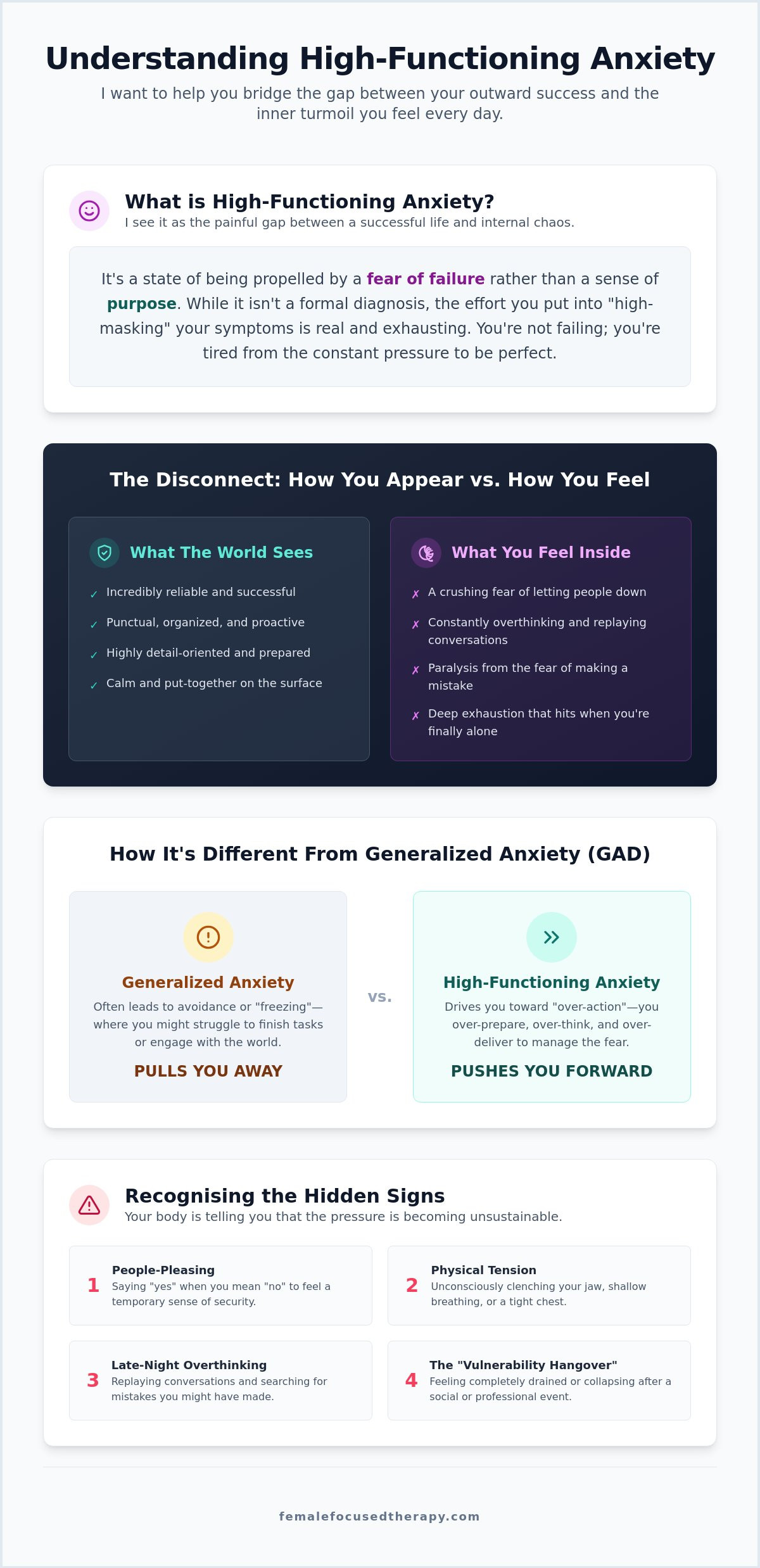
I often see women in my practice who look like they have it all figured out. You might be the person everyone relies on, the one who never misses a deadline and always has a plan. But inside, you feel like you are running on a treadmill that never stops. I define high-functioning anxiety as the painful gap between your outward success and your inner turmoil.
While it isn’t a formal clinical diagnosis, the effort required to “high-mask” your symptoms is clinically significant. Your ability to perform at work or show up for your family doesn’t mean you aren’t suffering. In fact, it often means you are working twice as hard just to stay level. To put it simply, what is high functioning anxiety? It’s a state of being propelled by fear rather than purpose.
The difference between GAD and high-functioning patterns
To understand this better, we can look at Generalized Anxiety Disorder, which involves persistent, excessive worry about various things. In many cases, anxiety leads to avoidance or “freezing,” where a person might struggle to finish tasks or leave the house. High-functioning patterns are different because they drive you toward “over-action.”
Instead of pulling away, you over-prepare, over-think, and over-deliver. Because our society rewards productivity and “doing it all,” this type of anxiety is often praised as a strength. This makes it incredibly hard to recognise as a problem until you are on the verge of burnout. You aren’t failing because you feel this way; you are simply exhausted from the constant pressure to be perfect.
Why we call it “high-masking” anxiety
Masking is the conscious or unconscious effort to appear “normal” and capable when you are actually struggling. You might smile through a meeting while your heart is racing, or precisely script your coffee shop order to avoid looking “clumsy.” It’s a performance that keeps the world at a safe distance while you manage the chaos inside. When we talk about what is high functioning anxiety, we have to talk about the internal cost of that mask.
The cost is a deep, internal exhaustion that hits when the door finally closes. I often hear women describe a “vulnerability hangover” or a total collapse after a social or professional event. As a woman living with ADHD, I have experienced this firsthand. When your brain works differently, you often use anxiety as a tool to stay organised, but that tool eventually starts to cut you.
This masking isn’t just about hiding your feelings from others; it’s often about trying to prove to yourself that you are okay. You might think that as long as you are achieving, the anxiety isn’t a real problem. But your nervous system knows the truth. Rebuilding your internal sense of safety starts with acknowledging that your struggle is real, even if it’s hidden behind a successful life.
Recognising the signs when you are an expert at hiding them
Because you are so capable, you’ve likely become an expert at masking the internal noise. You’ve spent years perfecting the “I’m fine” face while your mind is already ten steps ahead, worrying about a problem that hasn’t even happened yet. When you are trying to understand what is high functioning anxiety in your own life, it helps to look at the patterns you’ve built to stay safe.
For many high-achieving women, people-pleasing and the inability to say no aren’t just personality traits; they are core survival mechanisms. If you can keep everyone happy and every plate spinning, you feel a temporary sense of security. But this safety is fragile. It leads to the “Sunday Scaries” or those quiet, late-night hours where overthinking keeps you awake, replaying conversations and searching for mistakes you might have made.
The physical toll of what is high functioning anxiety often goes ignored because you are so focused on the next task. You might not notice you are clenching your jaw during a meeting or taking shallow breaths until your chest feels tight. These aren’t just “stress symptoms”; they are your body’s way of telling you that the pressure is becoming unsustainable. Understanding and managing high-functioning anxiety starts with acknowledging these subtle, hidden signals.
Outward traits vs. inner experiences
There is often a massive disconnect between how the world sees you and how you feel inside. While others might describe you as incredibly reliable, inwardly you are often driven by a crushing fear of letting everyone down. You might be praised for being detail-oriented, but that “attention to detail” is actually a paralysis caused by the fear of making a single mistake.
Your inner critic likely never allows you to celebrate your wins. The moment you achieve a goal, that voice is already whispering about the next thing you need to do to prove your worth. If these signs feel familiar, we can explore them together in individual psychotherapy sessions that honour your lived experience without judgement.
The physical language of your anxiety
I believe that your body stores the stress your mind tries to ignore. When you spend all day “performing,” that energy has to go somewhere. You might experience frequent headaches, digestive issues, or a constant “buzzing” feeling in your limbs that makes it impossible to sit still and relax without feeling guilty.
These somatic signs are important pieces of information. In my work, I often combine talking therapy with somatic movement and yoga to help you release that stored tension. Learning to listen to your body’s language is a vital step in moving from a state of constant “doing” to a place of genuine internal peace.
Why high functioning anxiety is so often missed in women and ADHD
From a young age, many of us are socialised to be the “helpers” and the “doers.” We are taught that our value lies in how much we can handle for others. This social conditioning is a huge part of why it’s so hard to spot what is high functioning anxiety. When you are busy taking care of everyone else, your own internal struggle just looks like being a “strong woman” who has it all under control.
This pressure often leads to a specific type of perfectionism. I believe that “being a perfectionist” is often just a trauma response to the deep-seated fear of being seen as “too much” or, conversely, not enough. You work harder to ensure no one can find a reason to criticise you. However, this becomes even more complex during life transitions like menopause, when hormonal shifts can make your usual coping strategies feel suddenly unmanageable.
When we look at what is high functioning anxiety through the lens of neurodivergence, we see that it’s often a brilliant, albeit exhausting, way of navigating a world that wasn’t built for us. You aren’t just “anxious”; you are using that energy to bridge the gap between how your brain works and what society expects of you.
The ADHD-Anxiety connection
In my work with ADHD in women, I see a very clear link between neurodivergence and anxiety. If your brain struggles with executive function, you might unconsciously use anxiety as a “manual override” to get things done. You aren’t just naturally organised; you are over-preparing because you are terrified of forgetting a detail or being “found out” as messy or incompetent.
This is often tied to Rejection Sensitive Dysphoria (RSD), which is an intense emotional pain triggered by the perception of being rejected or criticised. To protect yourself from that pain, you become hyper-functional. You stay late, you double-check every email, and you never miss a deadline. The anxiety is the fuel that keeps your ADHD brain on track, but it’s a fuel that eventually leads to total depletion.
Gender expectations and the “Strong Woman” myth
We live in a culture that praises resilience, but often at the expense of our mental health. You might have been told all your life that you are “so strong,” which makes it even harder to admit when you are drowning. This is especially true if you have experienced relationship trauma or narcissistic abuse.
These experiences can “train” your brain into a state of constant hyper-vigilance. You learn to read the room, anticipate needs, and stay one step ahead just to stay safe. This isn’t just a personality trait; it’s a protective shield you built to survive difficult environments. I want you to know that it’s okay to put that shield down. You don’t have to be the “strong one” all the time to be worthy of care and support.
Moving from constant “doing” to a state of being and rest
I want to share some calm insight into how you can begin lowering the immense pressure you put on yourself every day. When we talk about what is high functioning anxiety, we are often describing a nervous system that has become stuck in “high alert” mode. Healing happens when we finally stop trying to “fix” our performance and start allowing ourselves to simply feel our way through the day.
This shift requires nervous system regulation, which is a gentle, daily practice rather than a one-time fix. It is about learning to come back to your body whenever your mind starts to spiral into overthinking. One realistic next step you can take today is a five-minute check-in with your breath during your workday, noticing where you might be holding onto hidden tension.
Somatic tools for the busy mind
Your body is constantly communicating with you, even if you have learned to tune it out to get things done. Simple somatic tools, like changing your posture, softening your jaw, or uncrossing your legs, can signal safety to your brain. If you find yourself feeling overwhelmed in a meeting or a social situation, try a quick grounding exercise using your five senses to anchor yourself.
Quietly name five things you can see, four you can touch, three you can hear, two you can smell, and one you can taste. This pulls you out of the “what ifs” of what is high functioning anxiety and back into the present moment. Remember that rest is a form of resistance against the constant urge to over-work; it is a biological necessity, not a reward you have to earn.
Redefining success on your own terms
I encourage you to look closely at where your “shoulds” actually come from. Are they your own values, or are they expectations you have picked up from others along the way? The journey of building self-trust is about restoring your internal confidence so you can finally make choices that feel right for your own well-being rather than just meeting external demands.
My integrative approach is designed to help you bridge the gap between your busy mind and your physical body. By combining traditional talk therapy with somatic awareness, we can create a grounded, safe space for your internal restoration. If you are ready to explore how we can work together to find your peace, you can book a session with me here.
How we can work together to rebuild your internal sense of safety
Therapy is one of the few places in your life where you don’t have to be “on.” For years, you have likely used your success as a shield, but in our sessions, we create a safe, grounded space where you can finally take off the mask. We explore what is high functioning anxiety in the context of your specific story, moving beyond the labels to understand how it actually feels in your body and mind.
My approach is warm but boundaried. This means I provide a compassionate, non-judgmental environment while maintaining the professional structure that makes you feel secure. You don’t have to worry about taking care of me; our time is entirely for your restoration. It is a space where your vulnerability is respected and held with care.
I want to reassure you that you don’t have to wait for a total breakdown to seek support. In fact, most of the women I work with are still managing their careers and families quite effectively. They simply realise that the internal cost of their performance is too high. Choosing individual psychotherapy is a proactive gift of time and space for yourself.
What to expect in our sessions
Our work together follows a calm, measured rhythm that respects your pace. We look at the “why” behind your anxiety, which might involve exploring past trauma, the impact of ADHD, or the transitions of midlife. We also focus on the “how” by integrating somatic tools and mindfulness to help you regulate your nervous system in real-time. This dual focus ensures we address both the roots and the symptoms of your stress.
I am here to act as a knowledgeable guide on your journey toward internal peace. My goal isn’t to “fix” you, because I don’t believe you are broken. Instead, we work together to rebuild your self-trust and help you move forward with a renewed sense of self-assurance. We bridge the gap between your busy mind and your physical body, allowing you to find a version of success that doesn’t require you to sacrifice your health.
Your first step toward restoration
It takes immense courage to admit that you are tired of just being “fine.” Admitting that you are overwhelmed despite your success is the first step toward a different way of living. It is a brave act to acknowledge that while you are high-functioning, you are also deserving of rest and internal safety. You don’t have to manage the weight of what is high functioning anxiety on your own anymore.
If you feel ready to start this process, I invite you to book a consultation with me to see how we can work together. This is a gentle, no-pressure invitation to explore how therapy can support your unique needs. We can talk about your experiences and how my integrative approach might help you find the stability you’ve been searching for.
You have carried this mask for a long time. It’s okay to put it down now.
Finding your way back to a calmer self
We have explored how the gap between your outward success and inner turmoil defines what is high functioning anxiety. You have learned that your drive is often a survival mechanism, especially when navigating ADHD or the weight of past relationship trauma. True restoration happens when you stop performing and start listening to the quiet signals your body is sending you.
As a Registered Integrative Psychotherapist and a specialist in ADHD and relationship trauma, I am here to help you bridge that gap. Whether you are looking for support in Singapore or joining me from elsewhere globally, my goal is to provide a boundaried, safe space where you can finally rest. My approach combines evidence-based therapy with somatic awareness to help you rebuild your internal sense of safety.
You don’t have to keep running on empty just to prove your worth. If you are ready to move from a state of constant “doing” to a place of genuine being, I am here to guide you. Book a consultation with me to start your journey toward internal peace. You deserve to feel as calm on the inside as you appear on the outside.
Frequently Asked Questions
Is high-functioning anxiety a real mental health diagnosis?
High-functioning anxiety is not a formal clinical diagnosis in the DSM-5; instead, it describes how some people experience Generalized Anxiety Disorder while maintaining a successful life. You might feel that your struggle isn’t “real” because it lacks an official label, but the internal pressure you feel is a clinical reality that deserves support. I see it as a specific way of moving through the world that requires a huge amount of hidden effort.
How do I know if I have high-functioning anxiety or just a busy life?
The main difference lies in how you feel when the work is done. A busy life might leave you tired, but understanding what is high functioning anxiety means recognising a constant, internal hum of worry that doesn’t stop when your to-do list is finished. It is the inability to rest without feeling a crushing sense of guilt or a fear that everything will fall apart if you stop for even a moment.
Can high-functioning anxiety be a symptom of ADHD in women?
Yes, I often see anxiety acting as a “manual override” for the ADHD brain in women. Since over half of adults with ADHD also manage an anxiety disorder, you might be using that nervous energy to compensate for executive function challenges. It is a way of masking your struggles so you can appear organised and capable to the outside world while feeling chaotic inside.
What happens if I stop using my anxiety to motivate myself?
Many women fear that without their anxiety, they will lose their “edge” or become lazy. In our work together, we find that when you lower the volume of your fear, you actually gain more sustainable energy. You move from being propelled by a fear of failure to being guided by your own values and genuine purpose, which is far less exhausting than running on stress.
Can therapy help if I am still performing well at work and home?
Absolutely, therapy is a valuable space for anyone who feels their internal peace doesn’t match their external success. You don’t have to wait for a crisis or a total breakdown to seek support. My sessions provide a safe, boundaried space where you can take off the performance mask and explore your own needs without the pressure of having to look perfect for anyone else.
How much does high-functioning anxiety affect physical health?
Your body often pays the price for the stress your mind tries to push through. High-functioning anxiety can manifest as chronic jaw clenching, shallow breathing, or digestive issues that you might have learned to ignore to stay productive. Over time, this constant state of “high alert” can lead to deep physical exhaustion and burnout if your nervous system isn’t allowed the chance to truly reset.
What is the first step to managing high-functioning anxiety without losing my edge?
The first step is simply noticing the moments when your drive is actually just fear in disguise. I suggest starting with a gentle three-minute check-in with your breath during your workday. By becoming aware of your physical tension, you can begin to regulate your nervous system. This allows you to keep your talents and skills while letting go of the crushing weight of the worry.

Article by
Cheryl Kennedy MacDonald MA BA (Hons) Pg. Dip. SAC BACP
Cheryl Kennedy MacDonald is a psychotherapist specialising in women’s mental health, relationships, and life transitions. She works with women navigating trauma, relationship breakdown, identity shifts, and midlife change, helping them rebuild self-trust, emotional stability, and a clear sense of who they are and what they want.
With over 20 years’ experience working with women internationally, Cheryl is the founder of YogaBellies, a global women’s yoga school, and the creator of the Birth ROCKS method. Her work sits at the intersection of psychotherapy and embodiment, integrating evidence-based therapeutic approaches with somatic, body-based practices that support deep, lasting change.
Known for her grounded and direct approach, Cheryl moves beyond surface-level insight to address the patterns held in the body and nervous system. Her work supports women to regulate, reconnect, and respond to their lives from a place of clarity, strength, and self-respect.
She is a published author in academic journals and has written multiple books on women’s health, pregnancy, and midlife wellbeing, available on Amazon and leading book retailers worldwide.