
You’re lying in bed and the house is finally quiet, but your mind is screaming. You reach for his phone, your heart hammering against your ribs, searching for a ghost that has already stolen your peace. Learning how to rebuild trust in a marriage after infidelity isn’t just about his actions. It’s about your nervous system finally feeling safe enough to rest.
I know that hyper-vigilance feels like a full-time job you never asked for. It’s exhausting to live in a constant loop of intrusive thoughts and mental replays of the betrayal. You might feel like you’ve lost your internal compass along with your sense of security in your own home.
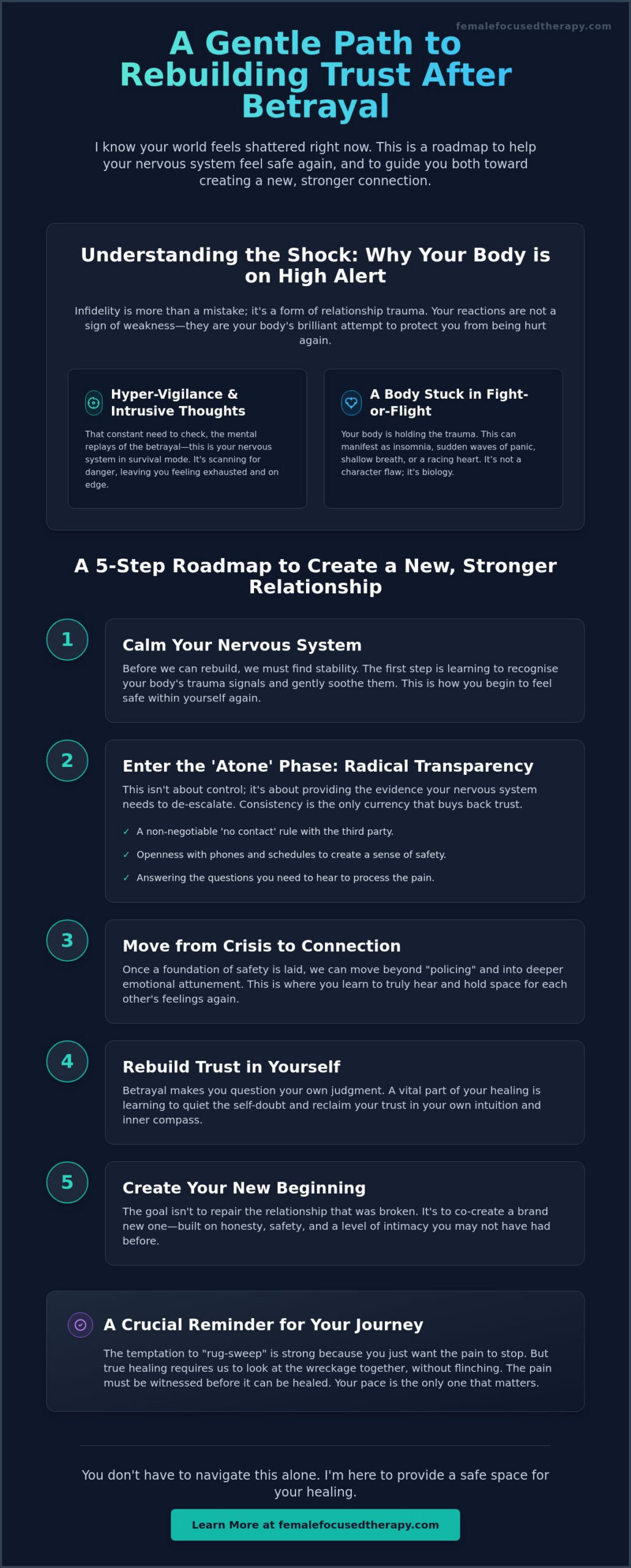
I want you to know that healing is possible. I’ll guide you through the emotional and practical steps of restoring safety and connection in your marriage after the pain of betrayal. We’ll look at how to move past the need for “policing” and create a clear roadmap for your reconciliation together.
Key Takeaways
- Understand why your feelings of hyper-vigilance are a natural response to relationship trauma and how we can begin to calm your nervous system.
- Discover the practical “Atone” phase and how to rebuild trust in a marriage after infidelity using radical transparency to create a sense of safety.
- Learn how to break the cycle of intrusive thoughts and move into deeper emotional attunement with your partner.
- Find ways to restore your trust in your own intuition and quiet the self-doubt that often follows a betrayal.
- Gain a clear roadmap for creating a brand new, stronger relationship rather than simply trying to repair the one that was broken.
Understanding the Shattering of Your Shared World
I want to start by acknowledging the sheer, bone-deep shock you are likely feeling right now. It isn’t just a bad day or a rough patch; it’s as if the ground beneath your feet has suddenly turned to liquid. Everything you thought you knew about your life has been called into question.
Infidelity isn’t just a mistake or a lapse in judgement. It is a profound form of relationship trauma that fundamentally alters how your brain and body process your environment. It shatters the internal map you use to navigate your world.
Betrayal trauma is a physiological response to a broken attachment, leaving your system struggling to find its baseline again.
I see so many women in my practice who tell me they feel “crazy” or “unstable” because of their reactions. I want you to know that your hyper-vigilance is actually a brilliant survival mechanism. Your brain is simply trying to protect you from being blindsided again, keeping you on watch so you aren’t hurt twice.
The Physiological Impact of Betrayal
After the discovery, your nervous system enters a state of “high alert” that rarely switches off. This is why you might find yourself dealing with intrusive flashbacks, persistent insomnia, or sudden waves of emotional flooding that seem to come from nowhere. Your body is stuck in a loop of fight-or-flight.
These reactions are your body’s way of processing Understanding Infidelity as a threat to your basic safety. I often find that understanding the “why” behind these physical symptoms can bring a small sense of peace. It’s not a character flaw; it’s biology.
In our work together, I help you recognise these somatic signals. When your heart starts to race or your breath becomes shallow, that’s your body remembering the trauma. Learning to soothe these physical responses is the first step toward finding your internal stability again.
Why ‘Moving On’ Too Quickly Backfires
When you are looking for how to rebuild trust in a marriage after infidelity, the temptation to “rug-sweep” is incredibly strong. You just want the pain to stop, so you might try to pretend it didn’t happen or rush back to “normal.” This is often done to keep the peace, but it leaves the wound to fester.
I believe that the pain must be witnessed and held before it can truly be healed. If we skip the grieving and the messy middle, the trauma just stays buried in your body, waiting to resurface later. True restoration requires us to look at the wreckage together, without flinching.
Your timeline for healing will almost certainly look different than your partner’s. While they might be eager to look forward and forget, you need space to process the past and ask the difficult questions. Healing isn’t a race, and your pace is the only one that matters.
Creating a Foundation of Radical Transparency and Safety
In my practice, I call this the ‘Atone’ phase. It’s the period where the focus is entirely on establishing safety. I often tell my clients that learning how to rebuild trust in a marriage after infidelity requires more than just an apology; it requires a structural change in how you share your lives.
Transparency isn’t about one person having control over the other. It’s about providing the evidence your nervous system needs to de-escalate from that high-alert state of trauma we’ve already explored. When you can see the truth, your body can finally start to let its guard down.
I help couples navigate the delicate balance of ‘open phone’ policies without losing their humanity. It’s not about being a jailer or a prisoner. Instead, it’s a way for the partner who strayed to say, ‘I’m here, I’m open, and I want you to feel safe.’
Consistency is the only currency that buys back trust. When we explore how to rebuild trust in a marriage after infidelity, we have to talk about the physical reality of safety. If you feel stuck in the cycle of suspicion, my couples therapy sessions provide a safe space to set these new foundations.
The Rules of Engagement for Accountability
We start by establishing clear boundaries, including the ‘no contact’ rule with the third party. This is non-negotiable for safety. We also look at how to handle check-ins so they feel like moments of connection rather than interrogation. I want these moments to be about reassurance, not just reporting.
I encourage you to be honest about what information you actually need to hear to heal. Sometimes, knowing every tiny detail can be more damaging than helpful; we work together to find that balance. It’s about asking the questions that help you process, rather than the ones that keep you stuck in the pain.
Dealing with the Resentment of Scrutiny
I know the ‘policing’ phase is exhausting for both of you. You don’t want to be a detective, and your partner doesn’t want to be under a microscope. I help the partner who strayed understand that their temporary ‘loss of privacy’ is actually a bridge back to intimacy. It’s a heavy lift, but it’s a necessary one.
We also set a clear timeframe for reviewing these measures so they don’t become permanent, heavy fixtures of your marriage. You can find more research-based strategies on Rebuilding Trust After Infidelity to understand why this phase is so critical for your long-term success.
Moving From Crisis to Connection Through Emotional Attunement
Once the “bleeding” has stopped and the immediate crisis of discovery has been managed, I move my clients into what I call the ‘Attune’ phase of healing. This is where the real, quiet work of understanding begins. This is where we learn to speak about the affair without falling back into those same destructive loops of blame and defensive shouting.
Part of this process involves looking at the “why” behind the betrayal. We explore the conditions that allowed the affair to happen without ever using them as an excuse for the behaviour. Understanding the context is a vital step in Mending Your Marriage After an Affair, as it helps prevent the same patterns from repeating.
I often weave in somatic movement and breathwork during these sessions. When you’re discussing how to rebuild trust in a marriage after infidelity, your body often reacts before your mind can catch up. Staying grounded ensures that you can stay in the room, both physically and emotionally, even when the conversation feels heavy.
Learning the Language of Your Emotions
We work on moving beyond the surface-level anger to express the deeper, more vulnerable feelings of fear, loneliness, or inadequacy. I will show you how to listen to your partner’s pain without immediately becoming defensive. This empathy is the bridge that spans the gap the infidelity created, allowing you to see each other as humans again.
This phase is about more than just talking; it’s about feeling felt. When your partner can truly witness your pain without trying to “fix” it or hide from it, something shifts. It creates a new kind of intimacy that is built on raw honesty rather than the polished version of the relationship you had before.
Somatic Tools for Emotional Regulation
Triggers can happen anywhere, from a song on the radio to a specific shop front. I teach you simple breath patterns to calm your heart rate the moment a trigger occurs. These techniques are a core part of somatic movement and yoga for women, helping you reclaim control over your body’s stress response.
Using these grounding techniques helps you stay present in your body during our therapy sessions. Instead of dissociating or shutting down, you learn to sit with the discomfort. This is a key skill in learning how to rebuild trust in a marriage after infidelity, as it allows for genuine, heart-to-heart communication that isn’t derailed by the body’s panic response.
Rebuilding the Trust You Have Within Yourself
I believe the most painful part of infidelity is often the loss of trust in your own intuition. It is a quiet, internal betrayal that leaves you feeling completely adrift. You might find yourself asking, “How did I not see this?” or “Can I even trust my own judgment anymore?” It feels as though your internal compass has been smashed.
Healing requires you to reconnect with your “inner wise woman” and your gut feelings. We spend so much time looking at his phone or tracking his movements that we forget to check in with ourselves. Self-trust is the foundation that allows you to risk trusting someone else again. Without that internal anchor, the world will always feel like an unsafe place.
In our sessions, I focus on this internal restoration just as much as the relationship itself. We look at how to stop the constant second-guessing that keeps you awake at night. When you learn how to rebuild trust in a marriage after infidelity, the first person you need to make peace with is the woman looking back at you in the mirror.
Silencing the Inner Critic
It is so easy to fall into the “if only I had…” loops of self-blame. You might think that if you had been more present, or if you had checked those bank statements sooner, you could have stopped this. This inner critic is just a part of you trying to find a sense of control in the chaos, but it is deeply damaging to your recovery.
I help you separate your worth from your partner’s choices. Their decision to step outside the marriage was a reflection of their own coping mechanisms and internal struggles; it was never a verdict on your value as a woman or a partner. Separating your identity from the trauma is a vital step in moving forward with your head held high.
Nurturing a sense of self-compassion is essential as you navigate this transition. You are doing the best you can with a nervous system that has been through a massive shock. I encourage you to be as kind to yourself as you would be to a dear friend who was hurting. This softness is where the real strength for reconciliation begins.
Reclaiming Your Agency and Intuition
We can start listening to your “gut” again in small, safe ways. This might mean honouring your need for a nap when you’re tired or speaking up about a small boundary in the home. These tiny acts of self-honesty help you find your voice within the relationship again, ensuring you aren’t just reacting to the betrayal but acting from your own truth.
If you feel like your sense of self has been completely eroded by the lies, I offer specialised relationship trauma and narcissistic abuse support. Reclaiming your agency is a journey of coming back home to yourself. It is about knowing that whatever happens in the marriage, you are going to be okay because you have your own back.
When you feel ready to stop the mental loops and start trusting your own intuition again, you can book a session with me to begin that process of internal restoration. You deserve to feel grounded and certain in your own mind once more.
Finding Your Way Back to Intimacy and Peace
The final phase of our work together is what I call “Attach.” This is the part where we move beyond just surviving and start creating a new marriage that is stronger than the one that was broken. It is a time for quiet reflection and intentional rebuilding.
I often tell my clients that we don’t go back to the old relationship. That version of your partnership didn’t have the tools to survive this crisis. Instead, I help you build a brand new one with better foundations. We are not just patching up the cracks; we are designing a shared life based on radical honesty.
Intimacy might feel scary or even “off-limits” for a while. If the thought of physical or emotional closeness makes you want to pull away, I want you to know that is perfectly okay. Your body is still protecting you, and we must respect that boundary as you learn how to rebuild trust in a marriage after infidelity.
I am here to help you decide, in your own time, what the next chapter looks like. There is no rush to “get back to normal.” Your timeline is valid, and your need for safety is the priority as we navigate this final stage of restoration.
Redefining Intimacy on Your Terms
Approaching closeness requires a pace that feels safe for you. It isn’t about meeting an expectation or a “standard” timeline. It’s about reconnecting with your own desire and comfort. For some women, especially those with ADHD or sensory sensitivities, this process requires extra patience and somatic awareness.
We look at how to approach physical and emotional closeness in a way that doesn’t overwhelm your nervous system. If you feel like you’ve hit a plateau in your healing, I often suggest focused intensive therapy options. These sessions allow us to dive deeper into the blocks keeping you from feeling safe.
When to Seek Professional Support
Sometimes, the mental loops and the hyper-vigilance are simply too strong to break on your own. If you find that every conversation leads back to the betrayal, or if you’re stuck in a cycle of “policing,” it might be time for more structured help. You don’t have to carry the weight of this restoration alone.
In a safe, boundaried space like couples therapy in Singapore, we can unpack these triggers together. Having a professional guide helps ensure that difficult conversations lead to connection rather than further wounding. It provides the container you need to explore how to rebuild trust in a marriage after infidelity safely.
I invite you to take a gentle next step today. You don’t need to have all the answers or know exactly what the future holds. Just booking a conversation with me is a powerful act of self-care. Together, we can find your way back to a place of peace and internal stability.
Taking Your First Step Toward a New Chapter
Restoring your marriage is a process of reclaiming safety, one small moment at a time. We’ve explored how to calm your nervous system, the power of radical transparency, and the necessity of trusting your own inner voice again. True healing happens when you stop policing the past and start building a future on firmer ground.
Learning how to rebuild trust in a marriage after infidelity isn’t something you have to figure out in isolation. As a Registered Integrative Psychotherapist, I offer a trauma-informed, gender-centric approach to help you find your footing. I provide a safe, confidential space in Singapore or online for you to process these complex emotions at your own pace.
If you are ready to begin the journey of healing your heart and your marriage, I invite you to book a consultation with me today. You don’t have to carry the weight of this betrayal alone. There is a path through the pain toward a life that feels steady, honest, and whole again.
You deserve to feel secure in your home and certain in your own heart. Healing is a steady, manageable path, and I am here to walk it with you until you feel grounded and at peace once more.
Frequently Asked Questions
How long does it typically take to rebuild trust after an affair?
Rebuilding trust usually takes between one and two years of dedicated, consistent effort from both partners. I often tell my clients that healing isn’t linear; you’ll have weeks of progress followed by sudden setbacks. It’s a marathon of nervous system regulation rather than a sprint to a “finished” state.
Is it possible to ever truly forgive and forget infidelity?
You can certainly reach a place of true forgiveness, but you will never truly “forget” the betrayal. The goal of our work isn’t to erase your memory, but to strip it of its power to flood your system with panic. Eventually, the affair becomes a part of your shared history rather than a constant, painful present.
Should I tell my children or family about the affair?
I generally recommend keeping the specific details away from children to protect their emotional well-being and sense of security. While telling family can provide you with much-needed support, remember that they may hold onto resentment longer than you do. It’s about finding a balance between your need for a safe space and the long-term health of family dynamics.
What if my partner refuses to be transparent with their phone or passwords?
Transparency is the essential foundation your nervous system needs to feel safe enough to begin the journey of healing. If your partner refuses to be open, it’s very difficult to learn how to rebuild trust in a marriage after infidelity. Without that evidence of honesty, your body stays in a state of high alert, which prevents any real connection from forming.
How do I deal with the ‘triggers’ that remind me of the betrayal?
When a trigger occurs, I want you to focus immediately on your breath and your physical surroundings to ground yourself. Triggers are your body’s way of sounding an alarm, so we use somatic tools to tell your brain that you’re safe in the present moment. Over time, these responses will become less intense as we work through the trauma in our sessions.
Can a marriage really be better after infidelity, or is that a myth?
It’s not a myth; many couples find their “new” marriage is more honest and intimate than the one they lost. While I never wish this pain on anyone, the process of rebuilding often forces a level of raw vulnerability that wasn’t there before. Verified research shows that 60 to 75 percent of marriages survive infidelity when the couple pursues structured therapy.
How do I know if I should stay or leave after he cheated?
You’ll find the answer by observing your partner’s willingness to atone and checking in with your own internal sense of peace. If he remains defensive or refuses to change his behaviour, your intuition will likely tell you that the foundation is gone. I help you reconnect with your own agency so you can make a choice that supports your long-term stability.
What is the difference between privacy and secrecy in a marriage?
Privacy is having a personal space that is yours, like a lunch with a friend, while secrecy is hiding information that would hurt your partner or change their choices. After betrayal, the line between the two often disappears for a while to allow for healing. Total transparency is usually required until your sense of safety is robust enough to allow for normal privacy again.

Article by
Cheryl Kennedy MacDonald MA BA (Hons) Pg. Dip. SAC BACP
Cheryl Kennedy MacDonald is a psychotherapist specialising in women’s mental health, relationships, and life transitions. She works with women navigating trauma, relationship breakdown, identity shifts, and midlife change, helping them rebuild self-trust, emotional stability, and a clear sense of who they are and what they want.
With over 20 years’ experience working with women internationally, Cheryl is the founder of YogaBellies, a global women’s yoga school, and the creator of the Birth ROCKS method. Her work sits at the intersection of psychotherapy and embodiment, integrating evidence-based therapeutic approaches with somatic, body-based practices that support deep, lasting change.
Known for her grounded and direct approach, Cheryl moves beyond surface-level insight to address the patterns held in the body and nervous system. Her work supports women to regulate, reconnect, and respond to their lives from a place of clarity, strength, and self-respect.
She is a published author in academic journals and has written multiple books on women’s health, pregnancy, and midlife wellbeing, available on Amazon and leading book retailers worldwide.