
Growing up, you may have learned to be very good at reading a room. You became an expert at anticipating needs, smoothing over tensions, and keeping the peace, all while your own feelings were quietly pushed aside. You learned that love felt conditional, and your worth seemed to depend entirely on what you could do for others, especially for her.
If this experience feels deeply familiar, you might be here because you’re starting to question the impact of being raised by a narcissistic mother. It’s a term that may have struck a painful chord, helping to explain the confusing feelings you’ve carried for so long. This dynamic often leaves you struggling with chronic self-doubt, a pattern of people-pleasing in your adult relationships, and a profound sense of guilt for even questioning your upbringing.
I want you to know this is a safe, quiet space to explore those feelings without judgment. This article is my gentle guide to help you understand the dynamic you grew up in, validate the emotional impact it has had on you, and begin to find your own path toward healing and rebuilding your sense of self. You’re not alone in this.
Key Takeaways
- Learn to validate the quiet, confusing feeling that ‘something isn’t right’ in your relationship, without the burden of guilt.
- Discover how the dynamic with a narcissistic mother can shape your adult relationships and create a harsh inner critic.
- Explore the gentle but powerful shift from trying to change her behaviour to focusing on your own healing and responses.
- Find your first, small step toward reclaiming yourself by learning to observe your feelings without judgment.
Recognising the Feeling: When ‘Something Isn’t Right’ With Your Mother
If you’re reading this, you may be holding a deep sense of confusion, perhaps even guilt. Questioning your relationship with your mother can feel like a betrayal, but I want you to know that your feelings are valid. This unease often isn’t born from one single, dramatic event, but from a thousand small moments where you felt unheard, unseen, or unimportant.
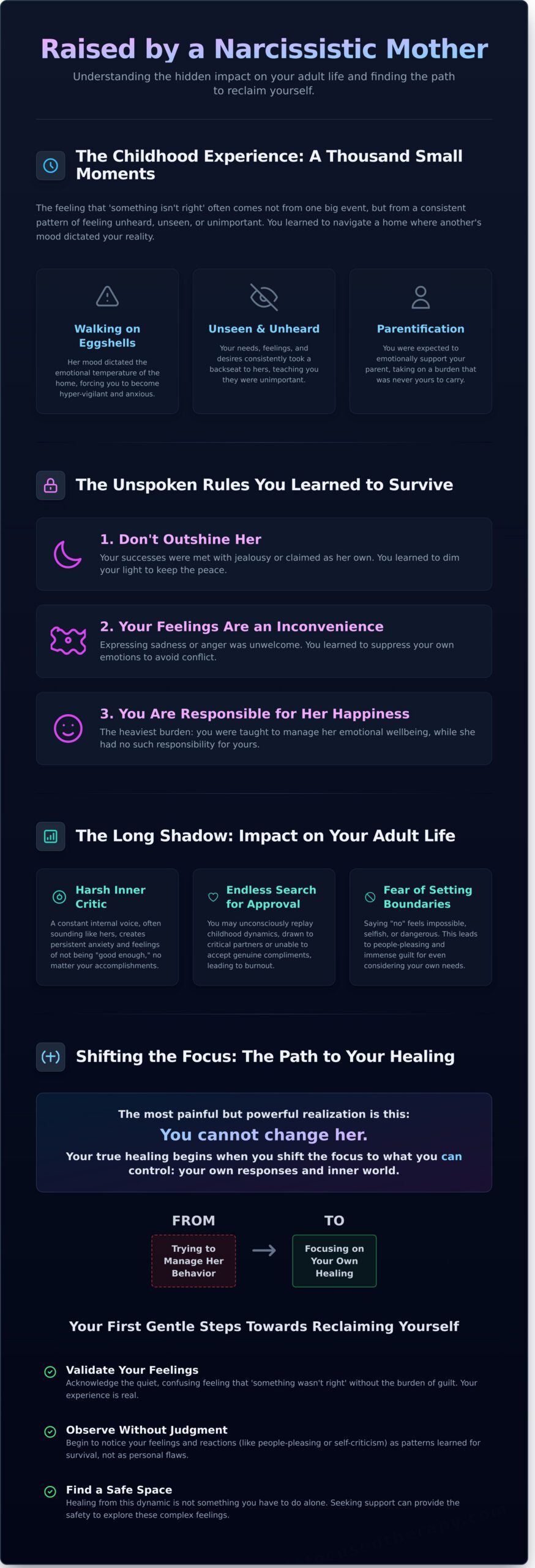
You might recognise the feeling of constantly walking on eggshells, where her mood dictates the emotional temperature of the entire home. From a young age, you may have learned that her needs, feelings, and desires always came first. This dynamic, where a child is expected to emotionally support a parent, is a form of parentification, and it can leave you feeling responsible for things that were never yours to carry.
It’s More Than Just ‘Difficult’
Many of us have challenging relationships with our parents, but there’s a distinct difference between a ‘difficult’ mother and one whose behaviour is consistently damaging. This pattern is what can have significant and lasting Mental health effects on children. Love may have felt conditional, something you had to earn by being compliant or successful. You might also notice a jarring disconnect between the charming, caring person she presents to the world and the critical, demanding person you experience behind closed doors.
The Unspoken Rules You Learned
Growing up with a narcissistic mother often means learning a set of unspoken rules to survive emotionally. You internalised these rules so deeply that they now feel like second nature.
- Don’t outshine her. Your successes may have been met with jealousy or were quickly co-opted as her own achievements, teaching you to dim your own light.
- Your feelings are an inconvenience. You learned that expressing sadness, anger, or disappointment was unwelcome, so you began to suppress your own emotional needs to keep the peace.
- You are responsible for her happiness. This is perhaps the heaviest rule of all. You were taught that it was your job to manage her moods and emotional wellbeing, but that she had no such responsibility for yours.
How This Relationship Can Shape Your Adult Life
The patterns you learned in childhood don’t simply vanish when you leave home. The dynamic with a narcissistic mother can cast a long shadow, influencing your relationships, your career, and the very way you see yourself. You may find yourself over-functioning-always being the responsible one, the high achiever-in an unconscious attempt to finally earn your place.
Yet, even with all your accomplishments, there’s often a harsh inner critic that sounds suspiciously like her voice. This constant internal pressure can have significant Impacts on young adult mental health, often leading to anxiety and a persistent feeling of not being good enough.
The Search for Approval
That childhood search for approval doesn’t just end; it often gets transferred onto other people and situations. You might find yourself drawn to partners who are emotionally distant or critical, unconsciously replaying the familiar dynamic of trying to win over someone who is impossible to please.
When you do receive a genuine compliment or praise, it can feel deeply uncomfortable. You might brush it off or question its sincerity because, on a deep level, you don’t feel you deserve it. This constant striving for external validation is exhausting and can easily lead to burnout as you pour all your energy into proving your worth to everyone but yourself.
A Fear of Setting Boundaries
For many women I work with, boundaries feel threatening. If your childhood attempts to express your own needs or opinions were met with disapproval, anger, or punishment, you learn that it’s safer to have no boundaries at all.
As an adult, this can make saying ‘no’ feel almost impossible. You might agree to things you don’t have the time or energy for, simply to avoid conflict or disappointing someone. This pattern often comes with an immense wave of guilt, as if you are being selfish for having needs. It’s a very common experience for women healing from relationship trauma and narcissistic abuse, as your own nervous system was wired to prioritise another’s emotional state over your own.
Shifting the Focus: From Her Behaviour to Your Healing
After years spent trying to understand, please, or manage her, it can feel deeply unsettling to hear this truth: you cannot change her. You cannot make her see the pain she has caused or become the mother you’ve always longed for. This realisation is often a painful one, but it is also where your true healing begins.
I often hear women say, “But she’s my mother.” Of course she is. The bond is profound and complex. Shifting your focus isn’t about ceasing to love her; it’s about learning to love yourself enough to protect your own wellbeing. We can reframe the goal from confrontation or seeking her approval to one of self-preservation and finding your own internal peace.
This is where you reclaim your power. Recognising that your healing is your own responsibility isn’t a burden-it’s a liberation. It means you are no longer waiting for someone else’s permission to feel whole.
Letting Go of the Hope for a Different Past
A significant part of healing from a relationship with a narcissistic mother involves grief. You are grieving the mother you needed, the childhood you deserved, and the unconditional support you never received. This grief is not a sign of weakness; it’s a vital and necessary part of the process. Allowing yourself to feel it is how you move through it. Remember, this acceptance is for you. It’s not about letting her ‘off the hook’-it’s about setting yourself free from the heavy weight of a hope that has kept you stuck.
Understanding Your Own Needs
When you’ve spent a lifetime focused on her emotional needs, identifying your own can feel like learning a new language. Your inner voice may have been silenced, and it takes patience to hear it again. The work is about gentle reconnection.
You can start small. In a quiet moment, just ask yourself: ‘What do I need right now?’ Perhaps it’s a glass of water, a five-minute stretch, or simply the permission to feel sad without judgment. As you practise this, you begin to rebuild self-trust. Exploring new coping skills for healing can offer practical support as you learn to prioritise yourself. This journey of reconnection is a cornerstone of the work we do together at Female Focused Therapy.
Your First Gentle Steps Towards Reclaiming Yourself
When you realise the impact your relationship with your mother has had on you, it’s natural to feel an urge to do something-to confront, to explain, to fix. But I want to gently suggest that the most powerful first steps are not big or dramatic. They are small, quiet, and they happen entirely inside of you.
This is not about changing her; it’s about slowly, carefully, reclaiming your own emotional space. Here are a few places you can begin:
- Become an Observer: Without judgment, start to notice what happens in your body during or after you interact with her. A tight jaw? A churning stomach? A feeling of exhaustion? This isn’t about blaming; it’s about gathering information about your own experience.
- Start an ‘Evidence Log’: Each day, write down one thing you did well or are proud of, no matter how small. This is your private practice in self-validation, a way to build a foundation of self-worth that doesn’t depend on her approval.
- Practice the ‘Pause’: Before you automatically say “yes” to a request, give yourself a moment. A simple, “Let me think about that and get back to you,” creates a tiny, powerful space for you to check in with your own needs.
- Find One Safe Person: Connect with one person-a trusted friend, a partner, or a therapist-with whom you feel you can be your authentic self. This relationship acts as an anchor, reminding you what genuine connection and acceptance feel like.
Building Internal Boundaries
The most crucial boundaries you can build are not with your mother, but with yourself. This means consciously deciding how much of your emotional energy you will give to worrying about her, analysing her behaviour, or trying to win her approval. It might mean choosing not to share a vulnerable part of your life with her, not because you’re being unkind, but because you are protecting your own heart. This is a profound act of self-care.
Cultivating Self-Compassion
Your inner critic has likely had decades of training, often echoing the voice of your narcissistic mother. Learning self-compassion is a practice, one that requires patience and intention. When you feel that familiar wave of self-blame, I invite you to ask yourself, “What would I say to my dearest friend if she were in this situation?” You deserve that same warmth and understanding.
Healing is not a linear path; there will be good days and difficult days. Each step you take, however small, is part of the journey of rebuilding your sense of self and trusting your own feelings again.
Finding a Safe Space to Explore These Feelings
Untangling the impact of a difficult childhood can be one of the loneliest journeys you take. The feelings of confusion, anger, and grief are often overwhelming, and it can feel like no one truly understands what you’ve been through.
But it’s important to remember that you don’t have to do this work alone. Therapy offers a confidential, non-judgmental space that is entirely yours-a space dedicated to your healing and growth.
In our sessions, your experience is the most important thing in the room. Your feelings are centred and validated, allowing you to safely explore the complex dynamics of your relationship with your mother. It’s a place where you can finally practice using your voice, perhaps for the very first time.
What Therapy Can Offer
A therapist can help you see the complex patterns of relating you learned in childhood-things you’re often too close to see yourself. We can gently identify the connection between your past experiences and your present-day struggles with self-doubt or people-pleasing.
It is also a space to grieve for the mother you needed but didn’t have, without the guilt that so often accompanies these feelings. At Female Focused Therapy, we work together to gently navigate this grief and rebuild that essential self-trust that may have been eroded over many years.
You Deserve Support
Please know that seeking support is a sign of incredible strength, not weakness. It is an act of profound self-care and a commitment to your own wellbeing after years of putting others first.
Healing from the effects of a narcissistic mother is the kind of deep, meaningful work I support women with every day. If you feel ready to take the next step, you can learn more about who I work with and see if my approach feels right for you.
Your Healing Journey Is Your Own
Acknowledging the impact of your upbringing is a powerful and validating first step. The journey of healing from a narcissistic mother isn’t about changing her, but about gently shifting the focus back to your own needs, your own voice, and your own wellbeing. It’s about understanding that your feelings are valid and that you deserve peace.
This path of rediscovery doesn’t have to be walked alone. As a trauma-informed psychotherapist specialising in narcissistic abuse recovery for women, I provide a warm, safe, and confidential space where you can explore these experiences without judgment. Together, we can work towards rebuilding self-trust and finding clarity.
If you feel ready to take the next gentle step, I invite you to find out more about working with me. You can email me at cheryl@femalefocusedtherapy.com or book an appointment directly. Please know that a future with confidence and a stronger sense of self is entirely possible for you.
Frequently Asked Questions
Can a narcissistic mother love her daughter?
This is such a complex and painful question. A mother with narcissistic traits often struggles with the capacity for selfless, unconditional love. Her affection may feel conditional, offered only when you are fulfilling a specific role or making her look good. It’s more of a reflection of her own needs than a deep, nurturing connection. This can be incredibly confusing, as you may have felt moments of warmth that were later withdrawn.
What are the long-term effects of having a narcissistic mother?
Growing up with this dynamic can leave deep imprints. Many women I work with struggle with a persistent inner critic, chronic self-doubt, and a tendency towards people-pleasing. You might find it difficult to trust your own judgment or set healthy boundaries in other relationships. This emotional exhaustion often stems from a lifetime of trying to earn love and approval, which can impact your sense of self-worth and ability to feel secure.
Why do I feel so guilty for setting boundaries with my mother?
Feeling guilty is a very common, and often intentional, outcome of this dynamic. You were likely conditioned from a young age to be responsible for your mother’s emotional wellbeing. When you assert your own needs, it disrupts this pattern. The guilt you feel is a learned response, a signal that you are breaking a long-standing, unhealthy agreement. It’s not a sign you’re doing something wrong, but that you’re beginning to prioritise your own health.
What happens when you go ‘no contact’ with a narcissistic mother?
Going ‘no contact’ is a deeply personal decision that often brings a mix of emotions. Many women initially feel an immense sense of peace and relief as the daily stress subsides. However, it’s also common to experience waves of grief for the mother you wish you had. Your mother may react by trying to pull you back in or by speaking poorly of you to others. It’s a path that requires strong support to navigate the complex feelings that arise.
Will I become a narcissistic mother too?
This is a fear that weighs heavily on so many daughters. The very fact that you are asking this question shows a level of self-awareness that is fundamentally different from the narcissistic mindset. While you may have learned some unhealthy relational patterns, you have the power to unlearn them. Healing from your past allows you to parent consciously and with empathy, breaking the cycle and creating a different, healthier future for your own children.
How do I explain my narcissistic mother to my partner or friends?
This can be incredibly challenging, as the dynamic is often hidden from outsiders. Instead of trying to label her, I suggest focusing on explaining the impact of her behaviour on you. Use clear ‘I’ statements, such as, ‘When my mum criticises my choices, I feel small and unsupported.’ This shifts the focus to your experience, which is undeniable, rather than getting into a debate about her intentions. It helps others understand what you need from them.
Is it possible to have a relationship with a narcissistic mother?
It is possible to have a form of relationship, but it requires a significant shift in your expectations. A relationship with a narcissistic mother must be carefully managed with very strong, consistent boundaries to protect your own mental health. It means accepting that she is unlikely to change and learning to emotionally detach from her reactions. The goal is not to create a warm, reciprocal bond, but to interact in a way that minimises harm to you.