
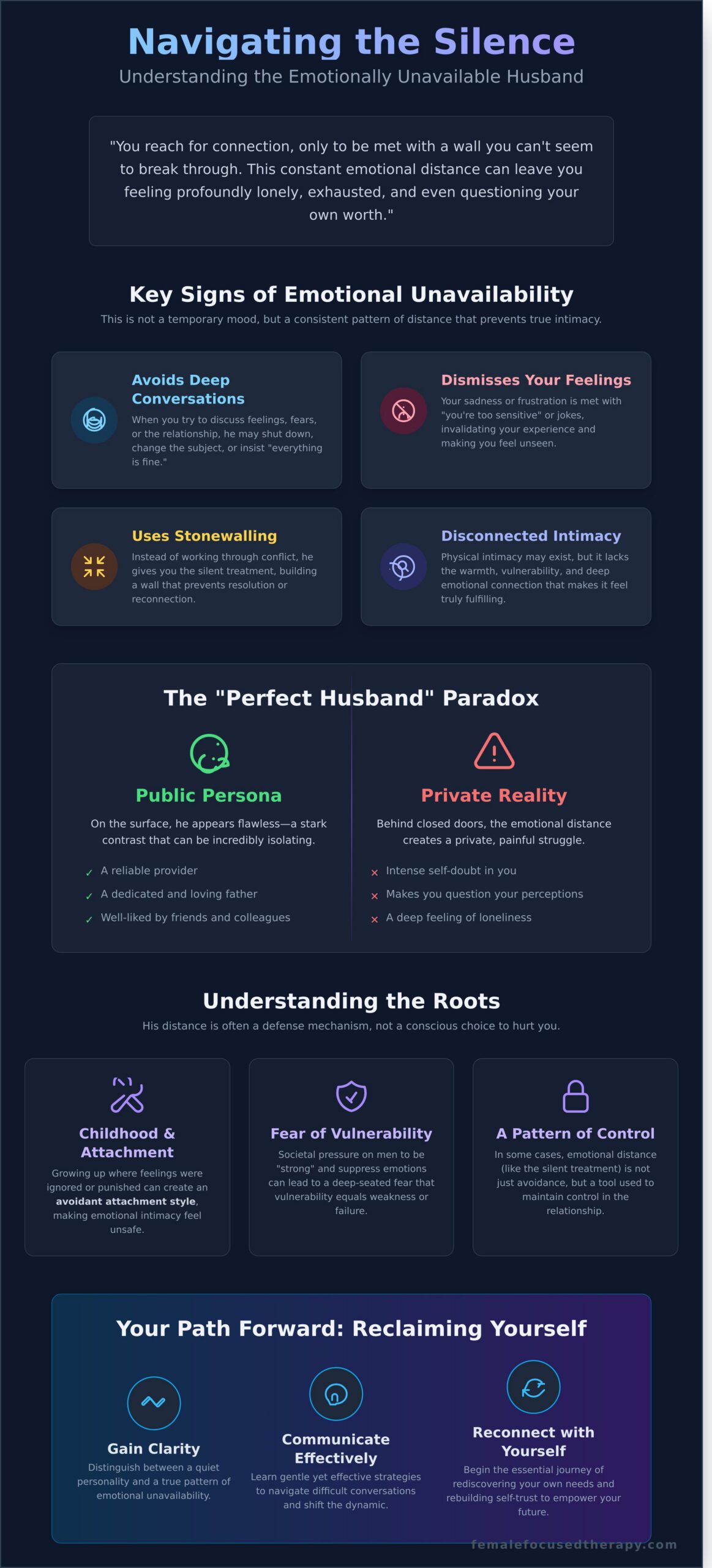
You may be here because the silence in your marriage has become deafening. You reach for connection, only to be met with a wall you can’t seem to break through. You share your heart, and he offers a brief nod or a change of subject. This constant emotional distance can leave you feeling profoundly lonely, exhausted, and even questioning your own worth. If this experience resonates, you may be navigating the difficult reality of being married to an emotionally unavailable husband.
It’s a confusing and painful place to be, but please know you are not alone, and there is a path toward clarity and healing. This article is designed to be a compassionate guide. We will gently explore the signs and potential causes behind his emotional distance, offering you a deeper understanding of what you are experiencing. More importantly, we will provide you with supportive, effective strategies to help you communicate differently, navigate your own feelings, and begin the vital work of rebuilding connection-both with your partner and, crucially, with yourself. Your emotional wellbeing matters, and this is your first step toward reclaiming it.
Key Takeaways
- Learn to distinguish between a quiet personality and a true pattern of emotional distance, giving you clarity on the situation.
- Understand the compassionate reasons why a partner becomes emotionally distant, often as a protective shield rather than a malicious choice.
- Gain gentle yet effective communication strategies for navigating conversations with an emotionally unavailable husband, shifting the dynamic for your own wellbeing.
- Begin the essential journey of reconnecting with your own needs and rebuilding self-trust, creating a path forward that empowers you.
What Does an Emotionally Unavailable Husband Really Mean?
The phrase ‘emotionally unavailable husband’ is more than just a label; it’s the painful, day-to-day reality of feeling disconnected from the person you love most. If you feel a persistent emotional void in your marriage, please know you are not imagining it. This feeling of loneliness is valid and real.
It’s crucial to differentiate this from a temporary bad mood or an introverted personality. While anyone can have an off-day or need space, emotional unavailability is a consistent pattern of distance. It’s a chronic wall that prevents true intimacy and leaves you feeling isolated, even when you’re in the same room.
Key Signs of Emotional Unavailability in a Marriage
This consistent pattern of creating distance is a core component of emotional unavailability. To understand the psychological underpinnings, it can be helpful to explore the question: What is emotional detachment? In a marriage, this often manifests through specific, recurring behaviours:
- He consistently avoids deep or vulnerable conversations. When you try to talk about feelings, fears, or the future of your relationship, he may change the subject, shut down, or insist that “everything is fine.”
- He dismisses, minimizes, or jokes about your feelings. Your attempts to express sadness or frustration are met with responses like “you’re being too sensitive” or a joke, which invalidates your experience.
- He uses stonewalling during conflict. Instead of working through disagreements, he gives you the silent treatment, effectively building a wall that prevents any chance of resolution or reconnection.
- Physical intimacy may feel disconnected from emotional intimacy. You might have a physical relationship, but it lacks the warmth, vulnerability, and deep connection that makes it feel truly intimate.
The ‘Perfect’ Husband Who is Secretly Distant
One of the most confusing aspects of this dynamic is that on the surface, he may seem perfect. He might be a reliable provider, a dedicated father, and well-liked by friends and colleagues in your Singapore community. The emotional distance is a private struggle, only apparent behind closed doors. This stark contrast between his public persona and his private unavailability can be incredibly isolating, leading to intense self-doubt and making you question your own perceptions of the relationship.
Understanding the Roots: Why is My Husband Emotionally Distant?
When you feel a constant distance from your partner, it’s easy to feel hurt, rejected, and even responsible. You may find yourself wondering, “What did I do wrong?” But exploring the ‘why’ behind his emotional unavailability isn’t about assigning blame-it’s about gaining clarity with compassion. More often than not, this emotional distance is a deeply ingrained defense mechanism, not a conscious choice to hurt you.
Understanding the origins of this behaviour can help you depersonalise it. It’s not necessarily a reflection of his love for you, but rather a reflection of his own internal world and past experiences. This insight is the first, most crucial step toward navigating the dynamic in your relationship and fostering a path toward reconnection.
Childhood Experiences and Attachment Styles
Our earliest relationships create the blueprint for how we connect as adults. If your husband grew up in an emotionally sterile home-where feelings were ignored, dismissed, or punished-he may never have learned how to engage with his own emotions, let alone share them. This can lead to an avoidant attachment style, where he learned that relying on himself was safer than depending on others. Extensive research into childhood trauma and attachment styles shows that for many, emotional intimacy can feel profoundly unsafe due to unresolved past pain.
Fear of Vulnerability and Societal Pressures
From a young age, many men are conditioned to suppress emotions like sadness or fear, viewing them as signs of weakness. In a high-pressure environment like Singapore, the expectation to be a stoic provider can amplify this. Your emotionally unavailable husband might carry a deep-seated fear that being vulnerable will lead to judgment or failure. He may not even have the emotional vocabulary to articulate what he’s feeling, making silence his default mode of communication.
Is it a Pattern of Relationship Trauma?
While often a defense mechanism, it’s also important to recognise when emotional distance is used as a tool for control. In some cases, withholding affection, giving the silent treatment, or dismissing your feelings is not just avoidance-it’s a tactic. This pattern can be a feature of relationship trauma or narcissistic abuse. The key difference is intent: avoidance is about protecting oneself, while control is about maintaining power over you. Recognising this distinction is vital for your own wellbeing and safety.
The Impact on You: Navigating the Loneliness of a Disconnected Marriage
Living with an emotionally unavailable husband can be a profoundly lonely experience. You may be sharing a home, a bed, and a life, yet feel a vast, silent distance between you. This persistent lack of connection isn’t just disappointing; it can slowly erode your confidence and sense of self. Over time, you might begin to question your own perceptions, your worth, and your right to have emotional needs. This internal struggle is a heavy burden to carry and a common challenge when dealing with an emotionally distant partner. Understanding how you have adapted to this environment is the first step toward reclaiming your wellbeing.
The Pursuer-Withdrawer Dance
Does it feel like the more you try to connect, the more he pulls away? This exhausting cycle is known as the pursuer-withdrawer dynamic. As the pursuer, you might initiate conversations, ask for reassurance, or seek intimacy, only to be met with silence, defensiveness, or distance. This pattern reinforces feelings of rejection and can leave you feeling frustrated and unseen. Recognizing your role in this dance isn’t about blame; it’s about empowering you to see the dynamic clearly and choose a different step.
Emotional Over-Functioning and Burnout
In an attempt to create connection, you may have found yourself doing the emotional work for both of you. This is called emotional over-functioning, and it is a direct path to burnout. You may recognise it if you are:
- Constantly anticipating his needs and managing his moods.
- Acting as the sole social planner and emotional barometer for your family.
- Feeling responsible for his happiness and shielding him from stress.
While born from a place of love, this pattern is unsustainable. It can lead to deep-seated resentment, emotional exhaustion, and a gradual loss of your own identity as your needs are continually set aside.
How to Respond: Strategies for Communication and Setting Boundaries
Feeling unheard by your emotionally unavailable husband can leave you feeling exhausted and reactive. The path forward isn’t about trying to ‘fix’ him, but about shifting your own approach from reaction to intentional, compassionate action. This change in focus is incredibly empowering. It allows you to protect your emotional wellbeing and begin changing the dynamic of your relationship, regardless of whether he changes his behaviour. These strategies are about what you can control: your own responses and the energy you bring to your interactions.
Communicating Your Needs Effectively
When communication feels like hitting a wall, it’s often the approach, not just the topic, that needs adjusting. The goal is to express yourself in a way that invites connection rather than defensiveness. Try these gentle shifts:
- Use ‘I feel’ statements: Instead of saying, “You never listen,” try, “I feel lonely when I’m sharing something important and don’t get a response.” This expresses your emotion without accusation.
- Choose a calm time: A difficult conversation will rarely go well when one or both of you are already stressed or angry. Find a neutral moment when you can both be present.
- Be specific: Vague complaints are easy to dismiss. Clearly state the behaviour and its impact. For example, “When we don’t talk about our plans for the weekend, I feel disconnected from you.”
The Power of Setting Loving Boundaries
A boundary is not a wall you build to punish someone; it is a line you draw to protect your own peace and emotional energy. It is an act of self-respect. For a woman coping with an emotionally unavailable husband, this can mean learning to stop ‘pursuing’ him for a connection he is currently unable to give. By creating space, you stop depleting your own energy and allow him the opportunity to step toward you. An example of a loving boundary could be: “I would love to finish this conversation, but I can see you’re distracted. I will step away for now, and we can talk later when we can both focus on it.”
When to Consider Professional Help
If you find your conversations consistently go in circles, or if attempts to set boundaries lead to more conflict, a neutral third party can provide invaluable support. Professional Couples therapy creates a safe, structured environment where you can both learn healthier ways to communicate without fear of judgment. It’s not about finding who is right or wrong; it’s about breaking unhealthy patterns and giving your relationship a real chance to heal and reconnect. If you feel ready to explore this supportive path, we are here to help.
Your Path Forward: Reclaiming Yourself and Finding Support
Navigating a relationship with an emotionally unavailable husband can leave you feeling drained, lonely, and disconnected from your own sense of self. While it’s natural to hope for change in your partner, the most empowering step you can take is to gently shift the focus back to you. This journey is not about fixing him; it is about reclaiming your own emotional presence and wellbeing. True strength is found in building a fulfilling life for yourself, one where your happiness does not depend on his capacity for connection.
Prioritizing Your Own Emotional Health
This is a time for reconnection-not with him, but with yourself. It involves rediscovering the parts of you that may have been set aside. This is a crucial step in rebuilding your inner world and finding stability, regardless of your relationship’s future.
- Reconnect with joy: Make dedicated time for hobbies, friendships, and activities that genuinely light you up. Whether it’s a walk in the Singapore Botanic Gardens, joining a book club, or restarting a creative project, these are anchors to your own identity.
- Practice self-compassion: Release the belief that his distance is a reflection of your worth. You are not responsible for his emotional landscape. Treat yourself with the same kindness and understanding you would offer a dear friend.
- Build your support system: Nurture connections with friends, family, or support groups who offer the validation and empathy you need. A strong network outside your marriage is essential for your emotional health.
How Individual Therapy Can Help You Heal
Feeling unheard and unseen in your marriage can erode your confidence over time. Therapy offers a dedicated, confidential space to process these complex emotions and find your footing again. It’s a powerful act of self-care that supports your personal growth.
- A safe space to process: It provides a non-judgmental environment to explore your hurt, anger, and frustration without fear of dismissal.
- Rebuild self-trust: The constant questioning of your reality when dealing with an emotionally unavailable husband can damage your intuition. Therapy helps you reconnect with and trust your own feelings and perceptions again.
- Gain clarity and confidence: A therapist can help you understand relational dynamics, set healthy boundaries, and navigate your path forward with greater clarity and a stronger sense of self.
- Empower your decisions: Ultimately, therapy empowers you to make the best decisions for your future, whether that means finding new ways to cope within the marriage or exploring other possibilities.
If you are ready to begin this journey of reconnection and empowerment, we are here to support you. Learn more about how Female Focused Therapy can help you navigate this challenging time and rebuild a life centered on your own wellbeing.
Your Path to Reconnection and Wellbeing
Navigating a marriage with an emotionally unavailable husband can be a lonely and confusing journey. As we’ve explored, the path to healing begins not with changing him, but with understanding the dynamics, honouring the impact on your own wellbeing, and reclaiming your sense of self. Your feelings are valid, and it’s essential to remember that you are empowered to change how you respond and care for yourself, regardless of the outcome of the relationship.
You do not have to navigate this complex path alone. Professional support can provide the clarity and guidance you deserve. At Female Focused Therapy in Singapore, we offer confidential, trauma-informed psychotherapy for women specializing in complex relationship challenges and rebuilding self-trust. Whether through secure online or in-person sessions, we provide a safe, non-judgmental space to help you find your footing and move forward with confidence.
If you’re ready to take the first step, book a consultation to begin your journey toward clarity and reconnection. A more fulfilling future is possible.
Frequently Asked Questions
Can an emotionally unavailable husband ever truly change?
Change is possible, but it must come from him. An emotionally unavailable husband can learn to connect more deeply, but it requires his genuine willingness to explore the root causes of his distance and a commitment to doing the inner work. This journey often involves professional support, like therapy, to build emotional awareness and develop new ways of relating. While you can offer support, the motivation to change must ultimately be his own.
Am I responsible for my husband’s emotional distance? Could it be my fault?
It is not your fault. Emotional unavailability often stems from a person’s own history, such as their childhood, past relationships, or unresolved trauma, long before you met. While relationship dynamics can be complex, you are not responsible for your husband’s core emotional patterns or his reactions. Releasing self-blame is a crucial first step in protecting your own wellbeing and gaining clarity on the situation, allowing you to navigate it more effectively.
How can I tell the difference between emotional unavailability and him just being stressed or tired?
The key difference is the pattern. Stress and fatigue are temporary states, and while they may cause temporary distance, emotional connection typically returns once the stressor passes. Emotional unavailability is a consistent, long-term pattern of deflecting, dismissing, or avoiding emotional intimacy. It persists even during calm periods and shows up as a chronic difficulty in discussing feelings, offering empathy, or being vulnerable, regardless of his energy levels.
What if he refuses to acknowledge there’s a problem or go to therapy?
This can feel incredibly disheartening, and it’s important to acknowledge your frustration. You cannot force someone to see a problem or seek help. Your focus can then shift to what you can control: your own wellbeing. You can communicate your feelings and needs using “I” statements, set healthy boundaries to protect your emotional health, and seek your own support to navigate this challenging dynamic with greater strength and clarity.
At what point is it healthier to consider leaving the relationship?
This is a deeply personal decision without a single right answer. It may be time to reflect on leaving when the relationship consistently harms your mental, emotional, or physical health. If you feel chronically lonely, unseen, and have exhausted your efforts without any sign of change or willingness from him, prioritising your own wellbeing may become necessary. Therapy can provide a safe space to explore this difficult choice and rebuild the self-trust needed to decide.
How can individual therapy help me if my husband is the one with the ‘problem’?
Individual therapy offers you a confidential, supportive space to process your own feelings of hurt, loneliness, and frustration. It is not about “fixing” him, but about empowering you. Therapy can help you develop powerful coping strategies, establish firm boundaries, and reconnect with your own needs and sense of self. This process builds resilience and clarity, helping you make decisions about your future from a place of confidence and strength.