
You may be here because you feel a constant sense of confusion and emotional exhaustion in your relationship. Perhaps you spend your days walking on eggshells, second-guessing your every move, and have started to believe you are the problem. If this sounds achingly familiar, please know you are not alone, and you are not imagining things. These feelings are often the most telling signs you are in a narcissistic relationship, and understanding them is the first step toward clarity.
This guide is designed to be a gentle, supportive resource to help you navigate this difficult space. Together, we will explore 11 key patterns-from overt manipulation to more subtle tactics like gaslighting-that can help validate your experiences and give you the language for what you’ve been feeling. Our goal is to illuminate a clear, safe path forward, supporting you as you begin to rebuild your self-trust and reclaim your wellbeing.
Key Takeaways
- Discover why narcissistic relationships often begin with an intense “fairytale” phase before shifting to a confusing pattern of devaluation.
- Learn to identify the core traits beneath the behaviour, including a profound lack of empathy and a persistent need for control.
- Understanding the key signs you are in a narcissistic relationship is the first step toward validating the impact on your emotional wellbeing and self-trust.
- This guide provides compassionate, actionable steps to help you begin the journey of healing and reclaiming your sense of self.
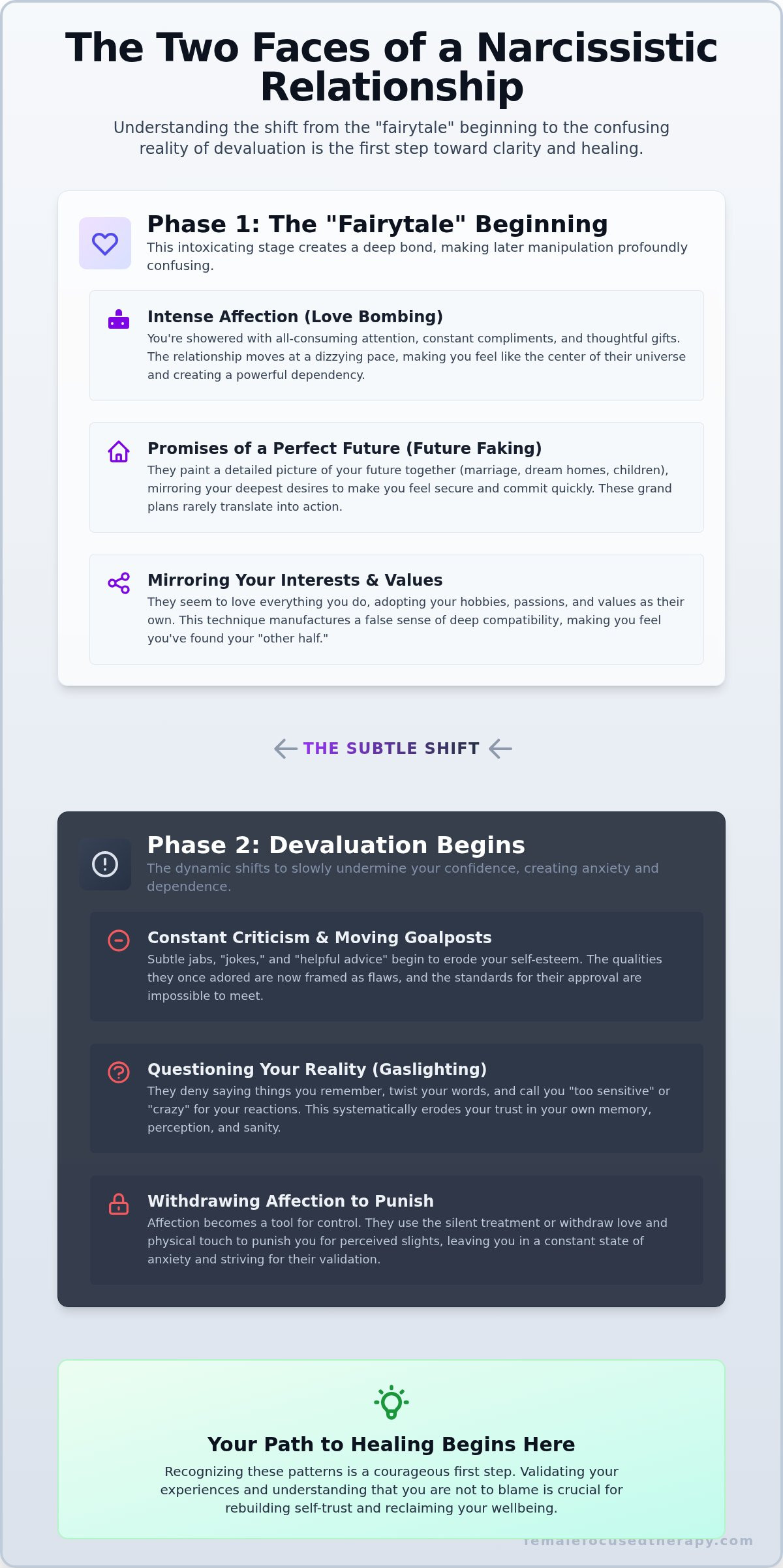
The Beginning Feels Like a Fairytale: Early Signs of Idealization
Narcissistic relationships rarely begin with the red flags we’re taught to look for. Instead, they often start with an intoxicating rush of what feels like a perfect, once-in-a-lifetime connection. This initial stage, known as idealization, is a powerful and disarming experience designed to make you feel uniquely seen, cherished, and understood. It creates a deep emotional bond that makes the later stages of devaluation and discard so profoundly confusing and painful. Recognizing these early, seemingly positive patterns is one of the most important first steps in identifying the signs you are in a narcissistic relationship.
Intense and Overwhelming Attention (Love Bombing)
You may feel as though you’ve finally met your soulmate. They shower you with constant communication, lavish compliments, and thoughtful gifts that seem to read your mind. The relationship moves at a dizzying pace, and their attention feels all-consuming and incredibly flattering. This behaviour, known as love bombing, is designed to overwhelm you with affection, creating a powerful dependency on their validation and making you feel like the centre of their universe.
Promises of a Perfect Future (Future Faking)
Very early in the relationship, they may begin painting a detailed picture of your future together. They talk about marriage, moving to your dream neighbourhood, or even the names of your future children. These promises are often a direct reflection of your deepest desires, which makes you feel incredibly secure and quick to commit. However, you might notice that these grand plans rarely translate into concrete actions, a pattern known as future faking.
They Mirror Your Interests and Values
It can feel like you’ve found your other half because they seem to love everything you do. From your favourite obscure films to your passion for hiking, they adopt your interests and values as their own. This technique, called mirroring, is a way to manufacture a deep sense of compatibility. It is a common tactic used by individuals exhibiting traits associated with Narcissistic Personality Disorder (NPD) to create a false bond. Over time, you may discover their true personality is starkly different from the one they first presented.
Understanding this fairytale beginning is crucial. It’s the foundation upon which the entire cycle of abuse is built, making it difficult to rebuild self-trust later on. When the idealization fades, you are left questioning what went wrong, often blaming yourself. Acknowledging these early behaviours is a key part of seeing the complete picture of what a narcissistic relationship pattern looks like.
The Subtle Shift: Walking on Eggshells as Devaluation Begins
After the intense and wonderful idealization phase, a confusing and painful shift often begins. This is the start of devaluation, a period designed to slowly undermine your confidence and create an unhealthy dependence. You may start to feel like you can’t do anything right, and the person you felt so connected to now feels distant and critical. This unsettling dynamic of walking on eggshells is one of the most common signs you are in a narcissistic relationship, leaving you feeling anxious and constantly trying to regain the harmony you once had.
Constant Criticism and Moving Goalposts
The erosion of your self-esteem often starts with subtle jabs disguised as ‘jokes’ or ‘helpful advice.’ The very qualities they once claimed to adore-your laugh, your passion for your career, your close friendships-may now be framed as flaws to be fixed. The standards for your behaviour seem to be constantly changing, making them impossible to meet. You find yourself in a draining cycle of trying to earn back their approval, an approval that is always just out of reach.
You Constantly Question Your Reality (Gaslighting)
Gaslighting is a deeply disorienting form of emotional manipulation. Your partner may deny saying things you clearly remember, twist your words, or tell you that your emotional reactions are invalid by calling you ‘too sensitive’ or ‘crazy.’ This tactic, a core component of psychological manipulation, is one of the most damaging signs of narcissistic abuse as it systematically erodes your self-trust. Over time, it can cause you to doubt your own memory, perception, and even your sanity, making it easier for them to maintain control.
Withdrawing Affection to Punish You
In a healthy relationship, affection is given freely. In this dynamic, it becomes a tool for control. Your partner may use the silent treatment for days to punish you for a perceived slight. Love, compliments, and physical touch are given and then suddenly withdrawn without explanation, leaving you in a state of constant anxiety. This unpredictability creates a powerful trauma bond, reinforcing a dynamic where you are always striving for their validation and feeling responsible for their emotional state.
Section 3: Recognizing Isolation as a Sign of Narcissistic Abuse
One of the most subtle yet powerful tactics in narcissistic abuse is the slow and steady erosion of your support system. A healthy partner encourages and celebrates your connections with friends and family. A narcissistic partner, however, often views these relationships as a threat to their control. This systematic isolation is one of the most challenging signs you are in a narcissistic relationship because it can happen so gradually that you barely notice it.
They Undermine Your Closest Relationships
You may notice a pattern of subtle digs or overtly negative comments about the people you care about most. Your partner might frame their criticism as concern, making it difficult to challenge. This is a deliberate strategy to plant seeds of doubt and create distance between you and your support network.
You might hear phrases like:
- “Your mother is always so critical of you. I just want to protect you from that.”
- “I don’t think your friends really have your best interests at heart. They seem jealous of our connection.”
- “Are you sure you want to take advice from your brother? He doesn’t seem to understand you the way I do.”
They Sabotage Your Social Time
Does drama seem to erupt just before you’re about to meet friends or attend a family event? This is often not a coincidence. A narcissistic partner may start a fight, suddenly feel ill, or create an urgent “crisis” that requires you to cancel your plans and stay with them. The goal is to make socialising so stressful and exhausting that you begin to do it less and less, leaving you with more time and energy exclusively for them.
They Position Themselves as Your Only True Ally
After slowly chipping away at your trust in others, the narcissistic partner positions themselves as the only person who truly understands, loves, and supports you. This creates a powerful and dangerous dynamic of dependency. By isolating you, they become your primary source of validation and emotional support, which makes you far more vulnerable to their influence and control. Rebuilding your sense of self and reconnecting with those who genuinely care for you is a vital step toward healing.
The Core Pattern: A Lack of Empathy and a Need for Control
Beyond the individual moments of confusion and hurt, a consistent pattern of profound self-centeredness lies at the heart of a narcissistic dynamic. It’s crucial to understand that these behaviours are not a reflection of your worth, but a manifestation of their own deep-seated needs. In their world, a partner is not an equal to connect with, but a source of validation and admiration-often called “narcissistic supply.” Recognizing this core pattern is one of the most vital steps in identifying the signs you are in a narcissistic relationship and beginning to navigate your way toward clarity.
A Profound Lack of Empathy
One of the most painful realities is their inability or unwillingness to truly connect with your emotional world. Your feelings are not seen as valid, but as an inconvenience or a direct challenge to their own comfort. This is why attempts to share your hurt are so often met with dismissal, annoyance, or even blame.
- They cannot sit with your sadness or offer genuine comfort during difficult times.
- They may become angry when you express needs that conflict with their own agenda.
- Your emotional experiences are minimised, invalidated, or outright ignored.
A Grandiose Sense of Self-Importance and Entitlement
A narcissistic individual operates from a core belief that they are inherently special and superior. This isn’t just high self-esteem; it’s a deep-seated sense of entitlement that places them above others. They expect preferential treatment and constant admiration, often exaggerating their accomplishments to maintain this fragile self-image.
- They believe rules and social norms apply to you, but not to them.
- They react with explosive anger (often called narcissistic rage) when their superiority is questioned or they don’t get their way.
Manipulating Social Dynamics (Triangulation)
To maintain control and keep you feeling insecure, a narcissist may intentionally involve a third person in your relationship dynamics. This is a manipulative tactic known as triangulation. By creating a triangle-often with an ex-partner, a colleague, or even a family member-they can generate jealousy, competition, and confusion. They control the narrative, making you look unstable while they appear desirable and in demand. This keeps you off-balance and focused on “winning” their affection, a game you can never truly win.
Understanding these three pillars-the lack of empathy, the grandiosity, and the manipulation-is fundamental to seeing the complete picture. These are not isolated incidents but interconnected signs you are in a narcissistic relationship, designed to serve one person’s needs at the expense of your own wellbeing.
The Emotional Toll: How This Relationship Impacts Your Wellbeing
Being in a relationship with a narcissist takes a profound toll on your mental and emotional health. The constant cycle of emotional manipulation, criticism, and instability is designed to wear you down, leaving you feeling exhausted and confused. You may look in the mirror and no longer recognise the person you see. Understanding this emotional toll is vital, as these feelings are themselves some of the most telling signs you are in a narcissistic relationship. It is the first step toward acknowledging the harm and beginning to heal.
Erosion of Self-Esteem and Self-Trust
Over time, the relentless criticism and gaslighting cause you to internalise your partner’s negative view of you. You may start to believe you are worthless, incompetent, or “too sensitive.” This erodes your self-trust, making it difficult to rely on your own intuition or make even small decisions without seeking approval. Rebuilding your inner compass is a key part of healing from relationship trauma and narcissistic abuse.
Chronic Anxiety, Stress, and Hypervigilance
Living on eggshells puts your nervous system into a constant state of high alert, a condition known as hypervigilance. You are always scanning for threats or subtle shifts in your partner’s mood to avoid conflict. This chronic stress can manifest physically, leading to fatigue, digestive issues, headaches, or trouble sleeping. It’s common to experience a persistent feeling of dread or even panic attacks, as your body is perpetually braced for the next emotional storm.
Feeling of Loneliness and Deep Isolation
One of the most painful paradoxes of a narcissistic relationship is feeling profoundly lonely while with someone. Narcissists often isolate their partners from friends and family who might see the red flags and offer support. You may have pulled away from your network to avoid conflict or because you feel no one could possibly understand what you’re going through. This isolation is not accidental; it’s a tactic that strengthens their control.
These feelings are not a sign of weakness; they are a normal human response to a damaging environment. Recognising these emotional wounds is the first step toward reclaiming your sense of self and your wellbeing. If this experience resonates with you, please know that support is available to help you navigate this journey and reconnect with your inner strength.
Your First Steps Toward Healing and Reclaiming Yourself
If you are reading this, you have already taken the most courageous step: acknowledging that something feels deeply wrong. Simply recognising the signs you are in a narcissistic relationship is a profound act of self-awareness and the true beginning of your healing journey. This path is not about blame or regret; it is about gently turning your focus back toward yourself, honouring your needs, and reclaiming your sense of self with patience and compassion.
Acknowledge and Validate Your Experience
Your feelings have been your guide, even when you were encouraged to doubt them. The first step in rebuilding self-trust is to give yourself permission to believe your own reality. You are not overreacting; your experience was real.
- Start a private journal to document incidents and, more importantly, your emotional responses to them.
- Educate yourself by reading books or listening to podcasts on narcissistic abuse recovery.
- Gently remind yourself: “My feelings are valid.”
Reconnect with Your Support System
Narcissistic abuse often thrives in isolation. Reaching out to a trusted friend or family member, even one you may have lost touch with, can be a powerful antidote. You don’t need to share every detail at once; a simple “hello” can reopen the door. Spending time with people who see and value the real you is essential for remembering who you were before the relationship and who you can be again.
Seek Professional, Trauma-Informed Support
Navigating the complex emotional aftermath of this experience is challenging to do alone. A therapist who specialises in narcissistic abuse can provide crucial, trauma-informed guidance in a safe, non-judgmental space. Therapy is a dedicated container for your healing, helping you process your experiences, rebuild your self-worth, and learn to set the healthy boundaries needed for future wellbeing.
This journey is about returning home to yourself. If you are ready to navigate this path with dedicated, compassionate support, you can learn more about how Female Focused Therapy can help you move forward with clarity and confidence.
Your Path to Healing Begins with a Single Step
Navigating the complexities of a narcissistic relationship, from the initial fairytale to the slow erosion of your self-worth, is an incredibly challenging journey. The constant walking on eggshells and lack of genuine empathy can leave you feeling drained and disconnected from your own intuition. Acknowledging these signs you are in a narcissistic relationship is a powerful act of self-awareness and the first step toward reclaiming your peace.
If these signs resonate with you, please know you are not alone. We offer specialized support for narcissistic abuse in a safe, trauma-informed therapeutic space for women, guiding you to rebuild your self-trust and confidence. Book a confidential session to find clarity and support on your path to healing.
Remember, your wellbeing matters. A future filled with confidence and a strong sense of self is not only possible-it is waiting for you.
Frequently Asked Questions About Narcissistic Relationships
Can a person with narcissistic traits change?
While true, lasting change is possible for anyone, it is exceptionally rare for individuals with strong narcissistic traits. This is because genuine change requires a level of self-awareness and accountability they often lack. The motivation must come from within, not from external pressure. It is more empowering to focus on your own healing and wellbeing rather than holding onto the hope that your partner will fundamentally change their core patterns of behaviour.
Why do I feel addicted to the relationship, even though it’s so painful?
This feeling of addiction is a common and deeply confusing experience. It often stems from the cycle of intense highs and painful lows. The initial ‘love bombing’ phase creates a powerful bond, and the intermittent reinforcement-unpredictable moments of affection mixed with cruelty-can create a biochemical addiction in the brain. Your body craves the highs to escape the lows, making it incredibly difficult to leave, even when you know the relationship is causing you harm.
What is the difference between narcissism and Narcissistic Personality Disorder (NPD)?
It’s helpful to think of narcissism as a spectrum. Many people may exhibit some narcissistic traits, like selfishness or a need for admiration, from time to time. Narcissistic Personality Disorder (NPD), however, is a formal clinical diagnosis. It describes a pervasive and inflexible pattern of grandiosity, a constant need for admiration, and a lack of empathy that significantly impairs a person’s life and relationships. Not everyone with narcissistic traits has NPD, but both can be incredibly damaging.
How do I know if I’m the one who is actually the narcissist?
It’s a common fear, especially when you’ve been gaslighted into questioning your own reality. However, the very fact that you are asking this question with genuine concern is a strong sign that you are not the narcissist. Individuals with NPD rarely engage in this kind of self-reflection. Recognising the signs you are in a narcissistic relationship often includes being made to feel like you are the problem, a tactic used to deflect responsibility and maintain control.
What is a ‘trauma bond’ and how does it relate to a narcissistic relationship?
A trauma bond is a powerful emotional attachment that can form between an abuser and the person they are harming. In a narcissistic relationship, this bond is created by the intense cycle of idealisation (kindness, praise) and devaluation (criticism, cruelty). This pattern creates a deep-seated, confusing attachment where the person causing the pain is also the one you turn to for comfort. It’s a survival response that can feel like love but is rooted in fear and dependency.
Is it better to leave a narcissistic relationship, or can I make it work by setting boundaries?
Setting boundaries is always a healthy step for your own wellbeing. However, a key part of navigating a narcissistic relationship is recognising that your partner will likely not respect those boundaries and may even punish you for setting them. While boundaries can help you regain a sense of self and clarity, the safest and healthiest long-term solution for most individuals is to create a plan to leave the relationship and begin their own healing journey in a supportive space.

Article by
Cheryl Kennedy MacDonald MA BA (Hons) Pg. Dip. SAC BACP
Cheryl Kennedy MacDonald is a psychotherapist specialising in women’s mental health, relationships, and life transitions. She works with women navigating trauma, relationship breakdown, identity shifts, and midlife change, helping them rebuild self-trust, emotional stability, and a clear sense of who they are and what they want.
With over 20 years’ experience working with women internationally, Cheryl is the founder of YogaBellies, a global women’s yoga school, and the creator of the Birth ROCKS method. Her work sits at the intersection of psychotherapy and embodiment, integrating evidence-based therapeutic approaches with somatic, body-based practices that support deep, lasting change.
Known for her grounded and direct approach, Cheryl moves beyond surface-level insight to address the patterns held in the body and nervous system. Her work supports women to regulate, reconnect, and respond to their lives from a place of clarity, strength, and self-respect.
She is a published author in academic journals and has written multiple books on women’s health, pregnancy, and midlife wellbeing, available on Amazon and leading book retailers worldwide.