
You might think staying in a relationship that hurts is a sign of weakness, but it is actually your body’s way of trying to keep you safe. I know that heavy, hollow weight in your chest and the deep exhaustion that comes from months or years of chronic stress. You keep asking yourself, “why can’t I leave my relationship,” while feeling buried under layers of intense guilt and the painful confusion between love and trauma bonding. It is a lonely and draining place to be, but I want you to know that I see you and I understand.
I promise that staying isn’t a character flaw; it is a complex physiological response that happens when your nervous system is overwhelmed. I will help you understand why your body and mind feel stuck, even when you know you deserve more. We will explore the biological mechanisms of being stuck and offer a sense of hope for your internal restoration. By looking at how your mind and body work together, we can begin to find a path toward peace and self-reliance at a pace that feels manageable for you.
Key Takeaways
- I’ll help you see that your struggle to leave isn’t a lack of logic, but a natural response to emotional exhaustion and shame.
- Discover the biological reasons behind why can’t I leave my relationship and how trauma bonding creates a cycle that feels like a physiological addiction.
- Learn how neurodivergent traits like ADHD and executive dysfunction can make the practical steps of leaving feel insurmountable.
- Recognise the difference between familiar chaos and true emotional safety by tuning into the signals your body is sending you.
- Explore how gentle somatic practices like breath and rest can help you begin the quiet journey of internal restoration.
The heavy weight of staying when your heart says go
I’ve sat with so many women who feel completely paralysed by this choice. You know the relationship is no longer serving you, yet your feet feel like they’re set in concrete. It’s an exhausting internal tug-of-war that leaves you physically and emotionally depleted. I want to tell you right now: this isn’t a character flaw.
When you’re constantly asking yourself, “why can’t I leave my relationship,” the weight of that question can feel like lead. You might feel a heavy sense of shame, especially if you’re someone who is usually “in control” of your life. I’m here to offer you a different lens. Your brain and body might be trying to protect you from a perceived threat, even if that protection keeps you in a place of pain.
This journey isn’t just about the mechanics of a breakup. It is about your internal restoration. It is about learning to trust your own intuition again and understanding that your struggle to leave is a physiological response, not a sign of weakness. I see this every day in my practice, and I want you to know there is a way through the fog.
Why logic isn’t enough to break the cycle
You are likely an intelligent, self-aware woman. You’ve probably tried to “logic” your way out of this a hundred times. The trouble is that the parts of our brain responsible for attachment don’t speak the language of logic. They speak the language of survival.
We often fall into the trap of cognitive dissonance, where we hold two opposing truths at once. You know they hurt you, but you remember when they were kind. To cope, we often minimise our own needs just to maintain the status quo. This is often linked to Traumatic bonding, a physiological attachment that makes leaving feel like a physical withdrawal.
- You might find yourself justifying their behaviour because of their past.
- You might be waiting for the “good” version of them to return.
- You may believe that if you just change your own reaction, the relationship will improve.
The isolation of the high-functioning woman
I see this so often in my work, whether I’m supporting women through relationship trauma and narcissistic abuse in Singapore or via my online practice. You’re managing a high-pressure career, perhaps raising children, and keeping the household running. On the surface, you are the picture of strength.
The isolation comes from the fear of being judged by those who see you as “strong.” You worry that if you admit how bad things are, people won’t understand how a woman like you ended up here. I want you to know that I see capable women in this exact position every single week. You aren’t “weak” for being here; you are human, and your nervous system is simply doing its best to cope.
Understanding the biological ‘glue’ of trauma bonding
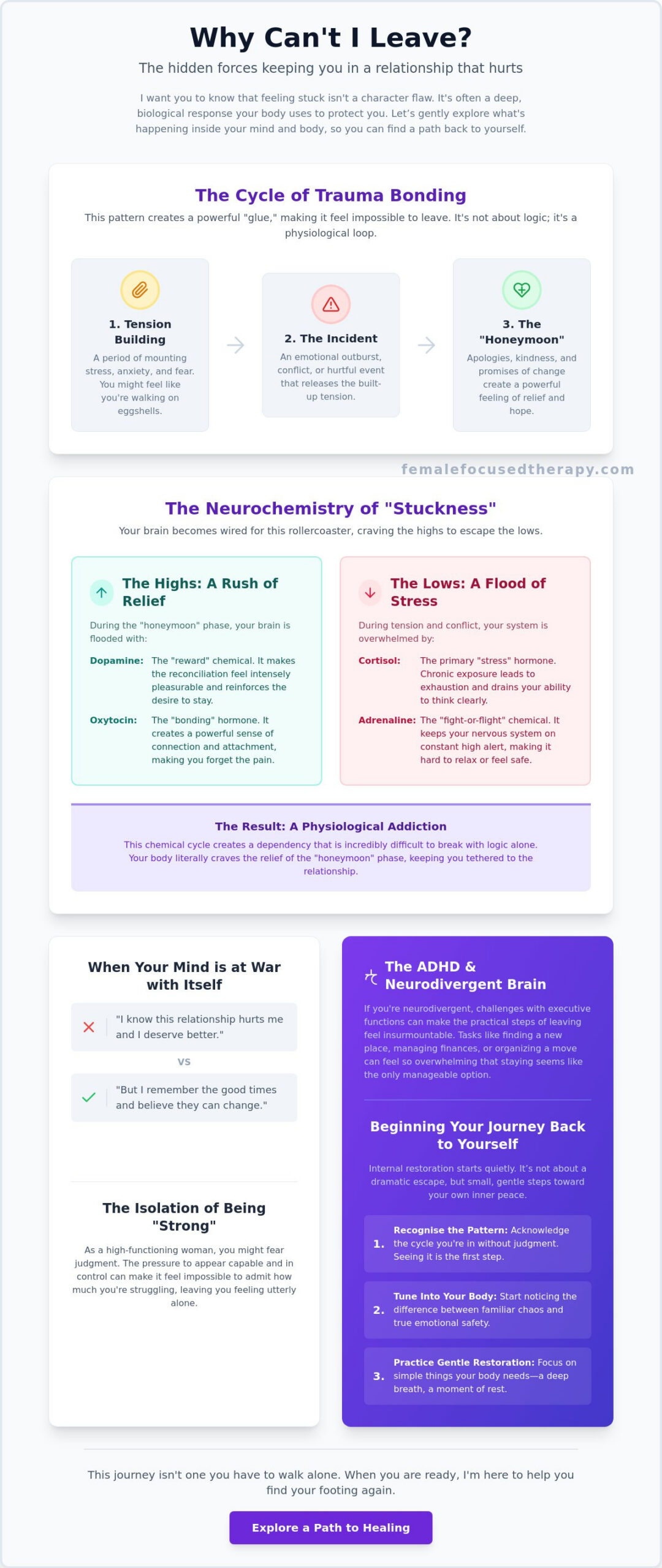
I often hear women describe a sense of being “glued” to their partner, even when the relationship has become a source of pain. This isn’t because you lack willpower or strength. It is because trauma bonding creates a literal, physiological addiction to the highs and lows of the relationship cycle. This biological glue often explains why can’t I leave my relationship even when my mind tells me it’s time to go.
The cycle usually follows a predictable pattern: a period of mounting tension, followed by an incident, and then the “honeymoon” or reconciliation phase. During this final phase, your partner might be incredibly kind, apologetic, or vulnerable. This creates a powerful hit of relief that makes you forget the pain of the incident. In my work with relationship trauma and narcissistic abuse, I see how this intermittent reinforcement keeps women trapped in a loop of hope and disappointment.
Your brain begins to crave those moments of reconciliation like a drug. When the “good” version of your partner returns, your system is flooded with chemicals that temporarily soothe the preceding distress. This creates a chemical dependency that is incredibly difficult to break through logic alone. If you feel your body is stuck in this cycle, you might find it helpful to speak with me privately about how to begin uncoupling from these patterns.
The neurochemistry of ‘stuckness’
During the reconciliation phase, your brain releases dopamine and oxytocin. These are the same chemicals responsible for bonding and reward, making the “honeymoon” feel intensely safe and loving. However, the rest of the time, your system is flooded with cortisol and adrenaline. This keeps your nervous system on high alert, creating a state of chronic stress that exhausts your physical and mental reserves.
Trauma bonding is a survival mechanism of the nervous system. It is your body’s attempt to find safety with the very person who is causing the distress. Because your brain associates that person with the eventual relief of the “honeymoon,” it prioritises staying close to them over the uncertainty of being alone.
Your body’s ‘freeze’ response
We often talk about fight-or-flight, but many women in difficult relationships exist in a state of “functional freeze.” This is a somatic experience where you feel numb, heavy, or unable to make a move. Your body chooses the “safety” of familiar discomfort because the unknown feels like a much greater threat to your survival.
You might recognise this in your own body through physical signs like shallow breathing or chronic tension in your jaw and hips. These are signals that your nervous system is trying to hold itself together under immense pressure. Recognising these somatic cues is the first step toward moving out of the freeze response and back into a place of internal restoration.
How neurodivergence and ADHD can keep us stuck in loops
As an adult woman living with ADHD, I know that our brains process the world differently. When you are struggling with the question, “why can’t I leave my relationship,” having a neurodivergent brain adds a layer of complexity that often goes unrecognised. It isn’t just about your feelings; it is about how your brain handles change, organisation, and emotional intensity.
Executive dysfunction is a core part of the ADHD experience, and it makes the logistics of leaving feel like an insurmountable mountain. Moving house, separating finances, and changing daily routines require a level of planning and initiation that can feel completely overwhelming. When we are already depleted by relationship stress, our brains often choose the “now” over the “next,” simply because the steps to get there feel too big to manage. This is a topic I explore deeply in my ADHD therapy for women.
Rejection Sensitive Dysphoria (RSD) also plays a significant role in keeping us stuck. For many of us, the perceived “failure” of a relationship or the fear of being rejected by a partner triggers intense, almost physical pain. We might stay in a difficult situation just to avoid the crushing weight of that emotional blow. It’s a survival tactic to protect ourselves from a level of hurt that feels impossible to bear.
Dopamine seeking and the intensity of ‘love’
High-conflict relationships are many things, but they are rarely boring. For an ADHD brain that is constantly seeking dopamine, the “spark” of a volatile relationship can feel like a necessary hit of stimulation. The cycle of arguments and passionate reconciliations provides a biological intensity that our brains can become hooked on. It’s a bit like a rollercoaster; even when it’s scary, the rush is addictive.
This can make a healthy, stable relationship feel “quiet” or even dull at first. We might mistake peace for a lack of chemistry because our nervous systems are so used to the noise of chaos. We might even find ourselves subconsciously using relationship drama to fuel our focus or provide the stimulation our brains crave, making it even harder to step away from the fire.
Emotional regulation and the ‘all or nothing’ mindset
Our brains often lean toward an “all or nothing” way of thinking. This makes it incredibly difficult to hold two conflicting truths at once: “I love this person” and “This person is hurting me.” We might swing between hyper-focusing on their good qualities and feeling completely despondent about the bad ones, never quite finding the middle ground where we can make a clear decision.
This hyper-focus can also be directed toward “fixing” the partner. We treat the relationship like a puzzle that we can solve if we just find the right words or the right approach. If you are neurodivergent, the key to moving forward is often breaking down the transition into tiny, manageable somatic steps. By focusing on your breath and finding small moments of rest, you can begin to quiet the noise enough to hear your own intuition again.
Recognising the difference between safety and familiar discomfort
I often talk with women who have lived in chaos for so long that they’ve forgotten what peace actually feels like. When your nervous system is constantly braced for impact, “familiar” starts to feel like “safe,” even when it is actually hurting you. If you are asking why can’t I leave my relationship, it might be because your baseline for what is acceptable has shifted toward chronic distress.
Emotional safety isn’t just the absence of a fight. It is the presence of a deep, somatic sense of ease where you don’t have to monitor your partner’s mood to feel okay. High-functioning women often overlook subtle emotional neglect because they are so used to carrying the weight of the world on their own. You might be confusing a “rough patch” with a destructive pattern that is slowly draining your vitality.
I want to encourage you to shift your internal question. Instead of asking “is he bad enough to leave?”, try asking “is this relationship nourishing me?”. You deserve a partnership that adds to your life rather than one that requires constant internal restoration just to survive the week. If you’re ready to explore what true safety looks like for you, I invite you to book a private session with me.
A checklist for your nervous system
Your body often knows the truth long before your logical mind is ready to accept it. I want you to take a quiet moment and check in with your physical sensations. Do you find yourself rehearsing what you’re going to say in your head to avoid a negative reaction? This is a sign that you are living in a state of hyper-vigilance rather than safety.
- Does your body feel lighter or heavier when your partner enters the room?
- Do you feel a tightening in your chest or a clenching in your jaw when you think about the weekend ahead?
- Do you find yourself “holding your breath” figuratively or literally when they are nearby?
Trusting your somatic “gut” feeling is vital. Your logical mind can make a thousand excuses, but your body doesn’t lie about how it feels in another person’s presence.
The myth of ‘it’s not bad enough’
There is a common misconception that if there is no physical abuse, the situation isn’t “bad enough” to justify leaving. This is simply not true. Emotional turmoil and narcissistic abuse can be just as damaging, often eroding your sense of reality through subtle gaslighting and control.
When someone constantly questions your memory or dismisses your feelings, it creates a fog that makes it hard to trust yourself. You don’t need a visible bruise to prove that you are hurting. Your unhappiness and the sense that you are disappearing within the relationship are more than enough reasons to seek change and begin your journey back to yourself.
Beginning your journey back to yourself
I want you to take a deep breath and let it out slowly. For a long time, your energy has likely been focused entirely on your partner. You have been monitoring their moods, predicting their reactions, and trying to fix the unfixable. Now is the time to turn that compassionate gaze inward and focus on your own internal restoration.
When you are stuck in the loop of asking “why can’t I leave my relationship,” the answer often lies in your nervous system. Healing doesn’t start with a big, dramatic exit; it starts with small, quiet moments of reclaiming your own body. By prioritising your own rest and safety, you begin to build the internal strength needed to make bigger decisions later on.
Building a safety net is a vital part of this process. Whether you are looking for support in person here in Singapore or through online therapy, having a professional guide can make all the difference. I provide a space where you don’t have to have all the answers today. We simply start where you are.
Somatic tools for emotional regulation
If you feel stuck in a “freeze” state, simple grounding techniques can help you find your voice again. Try placing your feet flat on the floor and noticing the sensation of the ground beneath you. This simple act tells your brain that you are physically safe in this moment. It allows your nervous system to downshift from high alert to a more manageable state.
- Gentle movement and yoga can help you inhabit a body that has felt unsafe or tense for too long.
- Practising “micro-rests” throughout the day gives your brain a chance to recover from chronic stress.
- Focusing on the rhythm of your breath creates a small, private sanctuary that belongs only to you.
Your first realistic next step
Your first step isn’t to leave or to stay; it is simply to acknowledge your feelings without judgment or pressure. You have been through a lot, and your body is tired. Rebuilding self-trust takes time, and professional support can offer the emotional stability you need to navigate this transition at your own pace.
I invite you to step into a quiet, safe space for your first session. Together, we can begin the gentle work of listening to what your body and mind truly need, away from the noise of the relationship. You are not alone in this, and you deserve to feel safe in your own life again.
Reclaiming your peace and your power
Understanding the biological glue of trauma bonding and the unique ways ADHD impacts our decisions is the first step toward clarity. You’ve spent so long wondering “why can’t I leave my relationship,” but I hope you now see that your struggle is a physiological response rather than a lack of strength. Your body has been doing its best to protect you in a state of chronic stress.
As a Registered Integrative Psychotherapist specialising in relationship trauma and ADHD, I use a trauma-informed, mind-body approach to help you move out of functional freeze. We focus on internal restoration through gentle somatic tools and compassionate insight. You don’t need to have every step planned out today; you only need to be willing to prioritise your own wellbeing.
If you are ready to start this quiet, transformative work, I am here to hold space for you. You can book a confidential consultation with me to begin your journey back to yourself.
There is a version of your life where you feel light, safe, and entirely yourself. That journey starts with one small, brave choice.
Frequently Asked Questions
Why do I still love my partner if they treat me so poorly?
You still feel love because your brain has formed a deep physiological attachment through a cycle of highs and lows. This isn’t a lack of self-respect; it is a natural response to the intermittent reinforcement of the relationship. You remember the kind version of them, and your nervous system craves that reconciliation phase to feel safe again. I see this often in my work with relationship trauma.
How can I tell if I am trauma bonded or just in a difficult relationship?
A trauma bond is characterized by a “push-pull” dynamic and a feeling of being addicted to the person despite the harm they cause. In a difficult but healthy relationship, you can communicate your needs without fear of retaliation or gaslighting. If you feel you are losing your sense of self and constantly walking on eggshells, it is likely a trauma bond. Your body knows the difference.
Is it possible to heal my relationship without leaving?
Healing requires both partners to be fully committed to deep, honest change and personal accountability. While you can work on your own internal restoration and boundaries, you cannot fix a partner who isn’t willing to acknowledge their destructive patterns. Sometimes, the healthiest choice is to focus on your own safety and stability first. I help women explore these choices in a safe, non-judgmental space.
Why does the thought of leaving make me feel physically ill?
Your body is experiencing a literal withdrawal from the chemical hits of the relationship cycle. When you ask yourself why can’t I leave my relationship, remember that your nervous system is likely in a state of functional freeze. This physical nausea or panic is a survival response to the perceived threat of losing your primary attachment. It is a sign that your body needs gentle care and regulation.
How does my ADHD affect my ability to end a relationship?
ADHD makes the executive tasks of leaving, like planning and organizing, feel incredibly overwhelming. Rejection Sensitive Dysphoria (RSD) also makes the emotional pain of a breakup feel physically unbearable. You might also find yourself hyper-focusing on “solving” the relationship problems rather than accepting that it is time to move on. I understand how these neurodivergent traits can keep us stuck in loops for longer than we intend.
What should I do if I don’t feel ‘ready’ to leave yet?
You can start by simply acknowledging your feelings without any pressure to make a move today. Focus on small somatic steps, like mindful breathing and finding moments of rest to settle your nervous system. Building your internal strength and a support network is more important than rushing into a decision you aren’t prepared for. I am here to support you in that quiet, preparatory phase.
Can therapy help me if I’m not sure if I want to stay or go?
Yes, therapy provides a neutral, safe space to explore your feelings without judgment or an agenda. I help women untangle the confusion between love and trauma bonding so they can trust their own intuition again. We focus on your internal stability, which allows you to make a choice from a place of peace. You don’t need to have the answer before we begin our work together.
What is the first step to take if I feel stuck in a toxic cycle?
The first step is to reconnect with your own body and begin to trust your “gut” feelings again. Start with very small acts of self-care that have nothing to do with your partner, such as a gentle walk or five minutes of quiet rest. Acknowledging the reality of your situation to a trusted professional can help you break the isolation. This simple act of reaching out is a powerful move toward your own restoration.

Article by
Cheryl Kennedy MacDonald MA BA (Hons) Pg. Dip. SAC BACP
Cheryl Kennedy MacDonald is a psychotherapist specialising in women’s mental health, relationships, and life transitions. She works with women navigating trauma, relationship breakdown, identity shifts, and midlife change, helping them rebuild self-trust, emotional stability, and a clear sense of who they are and what they want.
With over 20 years’ experience working with women internationally, Cheryl is the founder of YogaBellies, a global women’s yoga school, and the creator of the Birth ROCKS method. Her work sits at the intersection of psychotherapy and embodiment, integrating evidence-based therapeutic approaches with somatic, body-based practices that support deep, lasting change.
Known for her grounded and direct approach, Cheryl moves beyond surface-level insight to address the patterns held in the body and nervous system. Her work supports women to regulate, reconnect, and respond to their lives from a place of clarity, strength, and self-respect.
She is a published author in academic journals and has written multiple books on women’s health, pregnancy, and midlife wellbeing, available on Amazon and leading book retailers worldwide.