
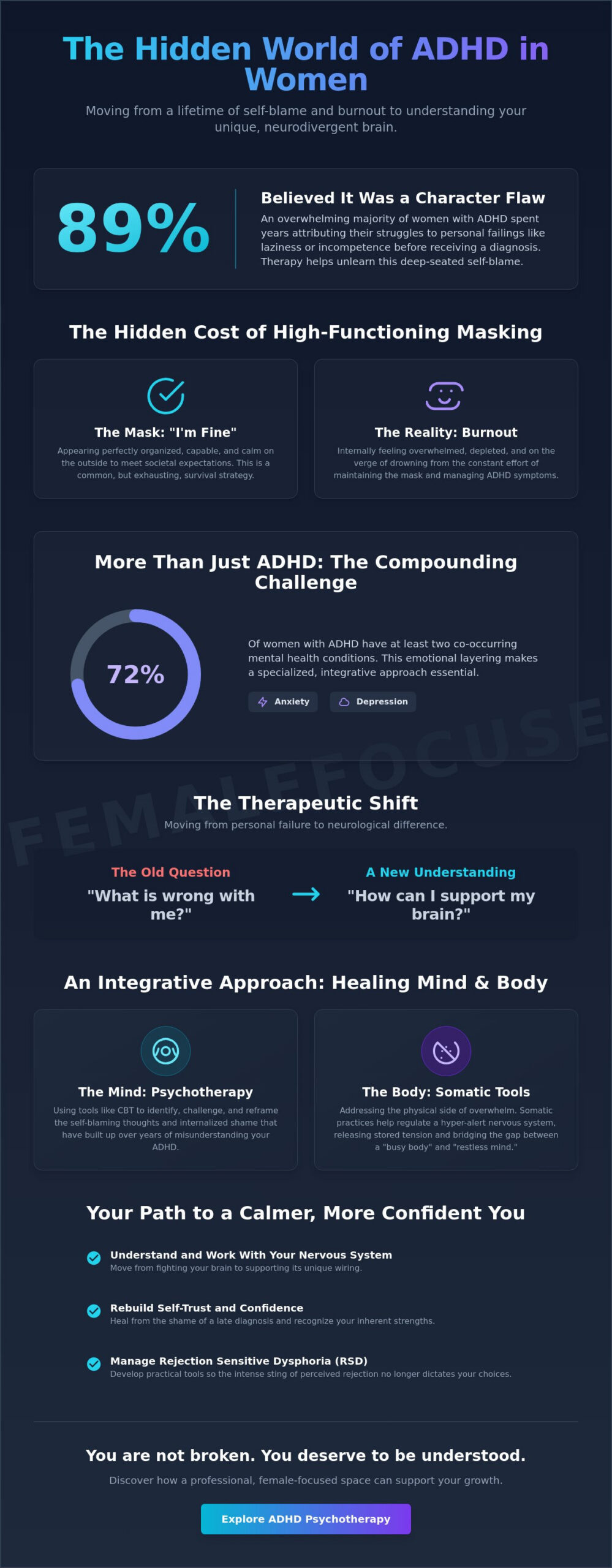
Did you know that 89% of women with ADHD spent years believing their struggles were actually personal character flaws? If you’ve spent your life in a shame spiral, wondering why you can’t just do things the way everyone else does, I want you to know that you aren’t broken. Specialised adhd psychotherapy offers a way to move through the overwhelm and finally understand how your unique brain works.
I understand the deep burnout that comes from masking and the intense, often painful sting of rejection sensitivity. Since 72% of women with ADHD have at least two other mental health conditions, the layers of emotional exhaustion are very real. Together, we can move past the chronic self-blame and start rebuilding your self-trust from the ground up, working with your nervous system rather than fighting it.
In this article, I’ll share how an integrative approach can help you move from chronic overwhelm to a place of genuine calm. We’ll explore somatic tools to ground your body and look at how you can navigate life’s transitions with much more ease and self-compassion. You deserve to feel understood and validated in your experience.
Key Takeaways
- I’ll help you understand why adhd psychotherapy for women looks beyond productivity to address the deep exhaustion of trying to appear ‘normal’.
- I’ll show you how my integrative approach uses both the mind and body to help you move from chronic overwhelm to a place of calm.
- We’ll explore how to rebuild your self-trust and recognise why your ADHD might make you more vulnerable to certain relationship dynamics.
- You’ll discover practical ways to manage Rejection Sensitive Dysphoria (RSD) so it no longer dictates your career or your friendships.
- I’ll share how a professional, female-focused space can support your growth and help you navigate life transitions with more confidence.
Why ADHD psychotherapy feels different for women
I understand that for many women, ADHD isn’t just about focus or organisation. It’s about the deep, bone-weary exhaustion of trying to keep it all together every single day. For my clients, adhd psychotherapy is a supportive process that looks far beyond productivity or time management to focus on your emotional wellbeing. It is a space where we address the internalised shame of feeling like you are constantly failing at being a “normal” adult.
Traditional therapy often misses the mark because it focuses on changing behaviours without understanding the underlying nervous system. A neuro-affirming, female-focused approach is different; it validates your experience instead of trying to “fix” your brain. This specialised form of adhd psychotherapy acknowledges that your struggles aren’t character flaws, they are part of how your brain is wired.
ADHD therapy for women must specifically address the internalised shame of “not being enough” while navigating a world that wasn’t built for your unique neurotype. I focus on creating a confidential, professional space where we can unpick these layers of self-blame together.
The hidden cost of high-functioning masking
You might spend your entire day appearing perfectly fine, yet you feel like you are drowning inside. This is masking, and it’s an incredibly heavy burden to carry. I’ve found that for many women, traditional talk therapy can actually feel like just another task on an already impossible to-do list. When you are already high-achieving but emotionally depleted, you don’t need more “homework”; you need a safe space to simply be yourself.
Research into Adult attention deficit hyperactivity disorder shows that women are frequently misdiagnosed or diagnosed much later in life. This delay often leads to a lifetime of “over-functioning” to compensate for hidden struggles. You aren’t lazy or incompetent; you are simply working twice as hard as everyone else to maintain a baseline of “normalcy” while your inner resources are running on empty.
Moving from ‘what is wrong with me’ to understanding
I want to help you shift your perspective from personal failure to neurological difference. When you receive a late diagnosis, it often feels like a confusing mix of relief and intense grief for the years you spent struggling. Since 89% of women with ADHD report attributing their symptoms to character flaws before their diagnosis, unlearning that self-blame is our first priority.
As an adult woman with ADHD myself, I use my own lived experience to guide our sessions. I know what it feels like to have a “noisy” brain and a sensitive heart. Together, we can move away from the question of “what is wrong with me” and start building a life that actually supports your unique, brilliant mind. This journey isn’t about becoming “normal”, it’s about becoming yourself.
How an integrative approach supports your neurodivergent brain
I believe that true healing happens when we address both the mind and the body. While many approaches to ADHD focus purely on cognitive strategies or “building systems,” I use an integrative approach. Your neurodivergent brain doesn’t exist in a vacuum; it’s connected to a nervous system that might feel constantly “on” or stuck in a state of high alert.
My specialised ADHD-focused therapy serves as a path to regulation by looking at the synergy between traditional psychotherapy and somatic practices. While Cognitive Behavioural Therapy (CBT) helps you challenge self-blaming thoughts, somatic tools address the physical overwhelm that often triggers a shame spiral. If you’d like to see if this path is right for you, you can explore how an integrative approach could support you in a private session.
Understanding the unique challenges and treatment for women with ADHD is vital for long-term wellbeing. Research shows that 72% of women with ADHD experience at least two co-occurring mental health conditions, such as anxiety or depression. When we only use cognitive tools, we often miss the physiological roots of these struggles, leaving you feeling like you are “failing” at therapy itself.
Why I combine psychotherapy with somatic movement
ADHD often feels like a “busy” body trapped in a “restless” mind. Somatic work helps bridge that gap by using simple movement to release the physical tension held from years of chronic stress. This isn’t about “exercise” or “getting fit.” It’s about learning to befriend your nervous system so you can feel safer and more grounded in your own skin.
When you’ve spent decades masking, your body often stays in a state of hyper-vigilance. Simple somatic movements signal to your brain that the immediate “threat” is gone. This allows the adhd psychotherapy process to go deeper; you aren’t fighting your own body just to stay present and engaged during our time together.
The role of mindfulness and rest in regulation
Finding a pace that feels safe is a core part of our work. Many neurodivergent women struggle with the idea of “slowing down” because it feels like falling behind or being lazy. I help you discover “productive rest” tailored for your brain. Rest isn’t just about sleep; it’s about sensory regulation and giving your mind a break from the constant noise.
Simple breathwork acts as a quick reset button for emotional intensity, helping you find a moment of calm when things feel too loud. These small, daily shifts help regulate the emotional dysregulation that 80% of adults with ADHD experience. By incorporating these tools, we move away from just “managing tasks” and towards a life that feels genuinely sustainable and kind to yourself.
Beyond the diagnosis: Addressing trauma and self-trust
Many of the women I work with have spent years doubting their own perceptions. They’ve lived in a state of constant over-functioning, trying to anticipate everyone’s needs to compensate for their own perceived failures. This pattern can unfortunately leave us more vulnerable to relationship trauma and narcissistic abuse. When you’ve been told your whole life that your reactions are “too much” or that you’re “just being sensitive,” it becomes very easy for a toxic partner to gaslight you.
Over-functioning often looks like being the one who remembers every birthday, manages the household perfectly, and never says no, all while your internal world feels like chaos. You do this because you’re terrified that if you drop one ball, everyone will see the “mess” you believe you are. This exhaustion is a form of trauma itself. We use adhd psychotherapy to unpack these survival strategies and find a way of living that doesn’t require you to constantly perform.
In our sessions, we look at how these dynamics have impacted your sense of self. It’s not about blaming yourself for the past. It’s about understanding how your neurodivergent traits might have been exploited by others. We work toward a multimodal approach for ADHD treatment that includes healing these emotional wounds alongside managing daily symptoms. The central goal is always the rebuilding of self-trust that was eroded by years of feeling fundamentally wrong.
Healing the shame spiral of late diagnosis
I help you navigate the painful “if only” thoughts that often follow a late diagnosis. It’s natural to feel a deep sense of grief for your younger self, the girl who struggled without support or understanding. We use self-compassion as a practical clinical tool to soothe that old hurt. By acknowledging that your past difficulties were the result of an unsupported brain, not a lack of effort, we can begin to release the heavy weight of chronic shame.
Reconnecting with your intuition
Our work together helps you stop looking to others for the “right” way to live your life. Society has very specific expectations of how women should behave, and these often clash with an ADHD brain’s natural rhythm. We work to identify your personal values versus these external pressures, allowing you to set boundaries that actually protect your energy. You are the expert on your own life; I am simply here as your guide to help you listen to your own inner voice again.
Practical ways therapy helps you navigate daily overwhelm
In our adhd psychotherapy sessions, we won’t just talk about your problems. I want to offer you calm insight into how your brain actually works so you can stop fighting your natural rhythms. We move away from the “shoulds” and focus on what is actually happening in your nervous system during moments of crisis.
Many women I work with fall into a pattern of “emotional over-functioning.” You might feel like you have to do everything for everyone else to make up for your own invisible struggles with focus or memory. This leads to deep burnout because you’re constantly monitoring everyone’s needs but your own, leaving your own tank completely empty.
We work together to create “energy-aware” systems that account for your natural fluctuations rather than rigid time-management schedules that often feel like a cage. By understanding your capacity at different points of the day, we can build a life that feels sustainable and kind.
Managing emotional intensity and RSD
Rejection Sensitive Dysphoria (RSD) can make a minor critique or a slow reply to a text feel like a physical blow. For the neurodivergent brain, these perceived slights can cause intense emotional pain that lingers far longer than it does for others. This often impacts your career confidence and how you show up in your closest friendships.
I help you build a “buffer” between an event and your emotional reaction. A gentle tool we might use is a “sensory pause.” When an emotional wave feels too big to handle, we focus on one physical sensation, like the cool air on your skin or the weight of your feet on the floor, to ground your body before the shame spiral takes over.
Creating systems that respect your energy
Forget standard planners that just collect dust on your shelf. I help you find ways to work with your hyperfocus and your natural dips in energy. We look at your environment and sensory needs, such as lighting or noise levels, as these play a massive role in managing your daily stress levels and preventing sensory overload.
It’s vital to learn how to navigate “low-demand days” without the crushing weight of guilt. On days when your executive function is low, we identify the bare minimum required to keep you safe and supported. If you’re ready to stop the cycle of burnout and start rebuilding your self-trust, you can book an individual session to start building a life that respects your energy.
Working with me: A safe, female-focused space for your growth
I offer a confidential, professional space where you’re seen as a whole person, not just a set of symptoms. I know how exhausting it is to be reduced to a diagnosis or a list of tasks you haven’t finished. My approach is about seeing the brilliance and the struggle together, creating a safe container where you can finally stop masking and just breathe.
Whether you’re in Singapore or joining me online from across the globe, my goal is to help you move forward with clarity. I specialise in working with women navigating life transitions and menopause alongside ADHD. We know that hormonal shifts during perimenopause can cause significant fluctuations in dopamine levels, which often makes previously managed ADHD symptoms feel suddenly unmanageable.
If you’re currently exploring your options for support, I’ve written a sibling article called Finding a Therapist in Singapore: A Compassionate Guide for 2026. It’s designed to help you find a professional who truly understands the nuances of the female experience and neurodivergence, ensuring you feel supported from the very first session.
A trauma-informed, female-centric environment
I bring my background as a yoga master and psychotherapist to every session, always sprinkled with my Scottish warmth. This isn’t about clinical detachment; it’s about a grounded, human connection that helps you feel safe enough to explore your inner world. You can learn more about my integrative journey and how I combine these different modalities to support your healing.
This integrative approach ensures our adhd psychotherapy sessions happen at a pace that feels safe and sustainable for you. We won’t rush the process or force “solutions” that don’t fit your life. Instead, we work together to rebuild your self-trust, using somatic tools and mindfulness to ground your nervous system while we process the emotional weight of your experiences.
Taking your first step toward clarity
You don’t have to have everything figured out before you reach out to me. Many women wait until they’re in a state of total burnout, but you deserve support long before you hit a breaking point. The first step is simply a conversation to see if we’re a good fit for your healing journey. I want you to feel empowered to choose a therapist who truly resonates with you.
Change is possible, even when you feel completely stuck in a cycle of chronic self-blame. By understanding how your brain works and learning to work with your body, you can move from a place of constant overwhelm to one of genuine calm. I’m here to guide you through that process with kindness, patience, and professional insight.
Reclaiming your sense of self and calm
You’ve spent long enough trying to fit into a world that wasn’t designed for your brain. We’ve explored how understanding your neurodivergence is not about finding a “fix,” but about unlearning the chronic shame that so often follows a late diagnosis. By combining traditional talk therapy with somatic tools, we can help you move away from the exhaustion of masking and toward a life that actually feels sustainable.
Taking the time for specialised adhd psychotherapy is an act of deep self-compassion. It’s about more than just managing a to-do list; it’s about reconnecting with your intuition and rebuilding the self-trust you may have lost along the way. Whether you’re navigating career stress, relationship patterns, or the unique challenges of midlife, you don’t have to carry the weight of overwhelm alone.
As a Registered Integrative Psychotherapist, I’m here to support you with trauma-informed and neuro-affirming care that respects your individual pace. You’re invited to book a session with me to start your journey toward calm. I offer global online support for women and would be honoured to be your guide as you move forward with more clarity and confidence. You deserve to feel understood.
Frequently Asked Questions
Is ADHD psychotherapy different from ADHD coaching?
Yes, while coaching focuses on the “how” of task management, adhd psychotherapy explores the “why” behind your emotional blocks and patterns. I help you navigate the deep-seated shame and relationship trauma that coaching often doesn’t touch. We focus on rebuilding your self-trust rather than just giving you a new set of productivity tools you might not use.
Can therapy help if I am already taking ADHD medication?
Therapy is highly effective alongside medication as part of a multimodal approach to your wellbeing. Since 80% of adults with ADHD have at least one other co-occurring psychiatric condition, medication might help with focus, but therapy helps you process the anxiety or depression that often comes with it. I provide a space to manage the emotional layers that pills cannot reach.
How long does it typically take to see progress in ADHD therapy?
While every journey is unique, many women report feeling a sense of validation and initial relief within the first 4 to 6 sessions. Deeply unlearning the 89% of self-blame patterns that many women carry typically takes longer. We use adhd psychotherapy to work at a pace that feels sustainable for you, focusing on long-term emotional regulation rather than a quick fix.
Do I need a formal diagnosis before I can start therapy with you?
No, you don’t need a formal diagnosis to begin working with me in my private practice. I focus on your lived experience and the specific challenges you face daily, such as sensory overwhelm or rejection sensitivity. We treat the whole person, and your self-identification or “suspected” ADHD is a perfectly valid place for us to start our work together.
How does an integrative approach help with ADHD symptoms like brain fog?
My integrative approach uses somatic tools to clear brain fog by regulating your nervous system. When your body is stuck in a “fight or flight” response, your cognitive clarity suffers significantly. By using breath and gentle movement to ground yourself, we can reduce the physiological noise that creates that “foggy” feeling in your mind.
Can we have sessions online if I am not based in Singapore?
Yes, I provide global online support for women regardless of where you are currently located. Whether you are living in Singapore or joining me from another part of the world, our sessions are held in a confidential, professional virtual space. This allows you to receive specialised support from the comfort of your own safe and familiar environment.
What should I expect in our very first ADHD-focussed session?
Our first session is a gentle, low-pressure conversation where I listen to your story and your current struggles. We will explore what has brought you here and what you hope to gain from our time together. There is no need to have it all figured out; I am simply here to hold space for you and begin building a foundation of trust.

Article by
Cheryl Kennedy MacDonald MA BA (Hons) Pg. Dip. SAC BACP
Cheryl Kennedy MacDonald is a psychotherapist specialising in women’s mental health, relationships, and life transitions. She works with women navigating trauma, relationship breakdown, identity shifts, and midlife change, helping them rebuild self-trust, emotional stability, and a clear sense of who they are and what they want.
With over 20 years’ experience working with women internationally, Cheryl is the founder of YogaBellies, a global women’s yoga school, and the creator of the Birth ROCKS method. Her work sits at the intersection of psychotherapy and embodiment, integrating evidence-based therapeutic approaches with somatic, body-based practices that support deep, lasting change.
Known for her grounded and direct approach, Cheryl moves beyond surface-level insight to address the patterns held in the body and nervous system. Her work supports women to regulate, reconnect, and respond to their lives from a place of clarity, strength, and self-respect.
She is a published author in academic journals and has written multiple books on women’s health, pregnancy, and midlife wellbeing, available on Amazon and leading book retailers worldwide.