
What if the most effective way to change your relationship doesn’t actually require your partner to be in the room? You might be asking yourself, can i go to couples therapy alone? because you’re tired of feeling gaslit or carrying the emotional weight of two people. It’s a common crossroads, especially since women initiate 70% of all couples therapy referrals as of 2026.
Sometimes, focusing on your own healing is the best foundation for relationship health. If you are dealing with childhood trauma or managing executive function challenges, your personal wellbeing is the most important asset you bring to the table. To explore how professional support can facilitate this process, you can learn more about Individual Psychotherapy. We use mindfulness and somatic practices to help you regulate your own stress first. By calming your nervous system, you become less reactive, which naturally changes the temperature of the home. Millennial couples are 50% more likely than Baby Boomers to seek this kind of proactive support, recognising that a healthy “me” leads to a healthier “we.”
I know how draining it is to feel like the relationship is doomed unless your partner finally decides to change. You’ve likely spent months over-functioning while your own needs sit on the back burner. It’s easy to feel like you’re losing your sense of self and your peace of mind in the process.
I will help you understand how attending these sessions solo can be a powerful catalyst for relationship change and personal healing. By focusing on your own boundaries and rebuilding self-trust, you can find the clarity you need to move forward. We’ll look at how shifting your response forces the whole system to move, giving you the tools to manage stress regardless of what your partner chooses to do.
Key Takeaways
- I’ll show you why the answer to “Can i go to couples therapy alone?” is a resounding yes, especially when you feel like you’re the only one carrying the emotional weight.
- Learn how changing your own “steps” in the relationship dance naturally shifts the entire dynamic, even if your partner isn’t ready to join you yet.
- Understand the vital difference between individual therapy and solo couples work, focusing on the “space between” you through a trauma-informed lens.
- Discover how to stop the exhausting cycle of “convincing” and start modelling grounded boundaries that protect your energy and mental health.
- Gain a path toward rebuilding your self-trust, helping you find the inner clarity needed to make decisions about your future with confidence.
When you feel like the only one trying to save your relationship
The short answer is yes. You can absolutely attend couples therapy alone, and for many of the women I work with, this is where the real healing begins. It is a heavy, isolating feeling to be the only one holding the map while your partner refuses to even get in the car. You might be asking, can i go to couples therapy alone? because you are tired of being the only one fighting for the future of your marriage.
I often see women who are “over-functioning.” This means you are carrying the emotional and mental load for two people while your partner remains disengaged or defensive. Industry data from 2026 shows that women initiate 70% of all couples therapy referrals. This statistic highlights how often women take on the role of the “relationship fixer,” often at the expense of their own well-being.
Choosing to start this process solo isn’t a sign of failure or a white flag of surrender. It’s a courageous step toward breaking long-standing cycles of people-pleasing and chronic self-blame. I define solo couples therapy as a focused therapeutic space where we map out your relationship patterns and emotional responses from your unique perspective.
The myth of the ‘perfect’ joint session
Many women stay in a holding pattern of resentment because they are waiting for their partner to finally be “ready” to change. You don’t need someone else’s permission to start your own growth. When you wait for a joint session that never comes, you remain stuck in the same painful loop. Research indicates that 40% of couples cite communication breakdown as their primary reason for seeking help, but you can begin repairing your end of that bridge today.
Starting alone lets you speak freely. You can express your deepest fears, frustrations, or even your desire to leave without worrying about your partner’s immediate reaction or counter-claims. It allows us to focus entirely on your experience without the distraction of a partner’s defensiveness or “gaslighting” behaviours.
Recognising the ‘over-functioning’ trap
In my work with relationship trauma, I see how over-functioning becomes a survival strategy. You might be the one researching therapists, initiating every difficult conversation, or managing your partner’s moods to keep the peace. This is often deeply rooted in the way women are socialised to be caretakers and emotional shock absorbers.
Solo therapy helps you identify these burdens and gives you the tools to set down the ones that aren’t yours to carry. By stepping back from over-functioning, you create space for your partner to either step up or for the reality of the situation to become clear. It is an essential part of rebuilding self-trust and finding your way forward with a grounded sense of self.
The surprising power of changing your half of the dance
I often describe relationships as a complex dance. When two people have been together for years, they develop a rhythm that becomes second nature, even if that rhythm is painful. If you suddenly change your steps, your partner is physically and emotionally unable to continue the old routine in the same way. The entire system is forced to shift because the old “moves” no longer find their mark.
You might worry that the work won’t “count” if you’re the only one in the room. When you ask, can i go to couples therapy alone? you’re really asking if you have the power to influence a situation that feels out of control. By rebuilding your self-trust, you naturally begin to set firmer boundaries. The relationship must then adapt to this new, more grounded version of you.
In my practice, I use an integrative approach to help you see where your “half” of the dynamic is rooted. Often, these patterns are tied to past experiences or trauma that we carry in our bodies. We look at how your nervous system responds to conflict. We work on moving you from a state of “fawn” or “freeze” into a state of grounded presence. Statistics show that 75% of couples report sustained satisfaction two years after therapy, and that journey often begins with one person deciding to do things differently.
Breaking the cycle of reactive patterns
We focus on shifting your “half” of the system from a place of reaction to one of intentional action. Using somatic awareness, you can learn to notice the physical signals in your body before you “over-function” or “people-please.” Perhaps your chest tightens or your breath becomes shallow. When you recognise these signs, you can choose a different response. This internal shift creates a new baseline for what you will accept in your relationship, moving away from the 43% of couples who struggle primarily with communication difficulties.
Rebuilding self-trust after relationship trauma
Solo work is particularly essential for women who have experienced relationship trauma and narcissistic abuse. Chronic gaslighting can make you feel like you can’t trust your own mind. I focus on helping you reconnect with your intuition. That quiet voice inside usually knows the truth, but it has been silenced by conflict. If you feel ready to start listening to that voice again, you might find it helpful to book a session to explore these patterns in a safe, confidential space.
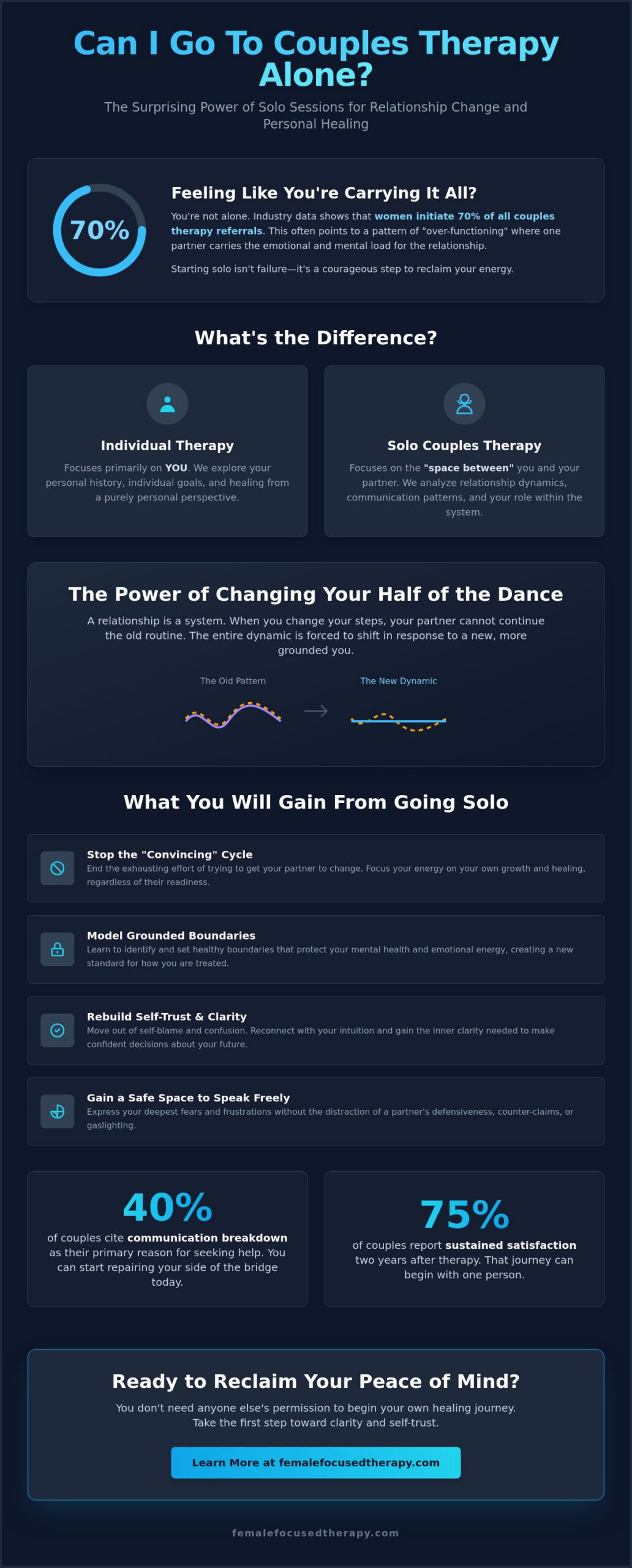
Individual therapy vs. solo couples therapy: What’s the difference?
People often ask me if there is a real distinction between these two paths. When you ask, can i go to couples therapy alone? you are usually looking for a way to fix the relationship, whereas individual therapy often focuses on your personal history. Individual work is like looking in a mirror to understand your own reflection. Solo couples work is like looking through a window at the “space between” you and your partner.
In our sessions, I help you look at your partnership through a trauma-informed lens. We explore how current life stages, such as menopause or midlife, might be magnifying existing cracks in your communication. Hormonal shifts can lower your threshold for frustration, making old relationship patterns feel suddenly unbearable. This is particularly relevant as the average age for couples entering therapy is 38, a time when many women begin navigating these transitions.
For women living with ADHD, solo work is a vital tool for managing the sensory and emotional overwhelm that conflict triggers. Relationship stress can hijack an ADHD brain, making it harder to regulate your responses or stay grounded during an argument. We work together to understand how your unique brain wiring influences the way you experience connection and rejection within your marriage.
When individual support is the priority
Sometimes, focusing on your own healing is the best foundation for relationship health. If you are dealing with childhood trauma or managing executive function challenges, your personal wellbeing is the most important asset you bring to the table. We use mindfulness and somatic practices to help you regulate your own stress first. By calming your nervous system, you become less reactive, which naturally changes the temperature of the home. Millennial couples are 50% more likely than Baby Boomers to seek this kind of proactive support, recognising that a healthy “me” leads to a healthier “we.”
When ‘solo couples work’ is the specific goal
If our specific goal is the relationship, we map out the dynamics from your side using evidence-based insights. This includes identifying the “Four Horsemen” of the Gottman Method, such as criticism and defensiveness. Data shows that 94% of couples see an improvement in their friendship scores after using these interventions. We develop a relationship roadmap that clearly defines your needs and non-negotiables. This process prepares you to eventually invite your partner into the room from a place of quiet strength rather than desperation.
Navigating a partner’s refusal without losing yourself
It is deeply painful when you reach out for help and your partner says “no.” That refusal can feel like a final door slamming shut on the future you imagined. However, their choice to stay still doesn’t have to be the end of your own progress. When you ask, can i go to couples therapy alone?, you’re often looking for a way to bridge a gap that feels wider every day. You can continue to grow even if you are currently the only one willing to do the work.
I encourage you to stop the exhausting cycle of “convincing.” When we spend our energy trying to persuade someone to value the relationship, we often lose sight of our own needs. Instead, we focus on “modelling.” This means showing your partner what grounded, healthy boundaries look like in practice. It shifts the focus from their refusal to your own resilience. Statistics from 2026 show that 45% of couples seek therapy specifically for ongoing conflict, but if your partner won’t join that 45%, you can still find your own peace.
We also work on distinguishing between a partner who is “scared” and one who is “unwilling.” Many people fear that therapy will be a space where they are “ganged up on” or blamed. That is a fear we can address. However, a partner who is unwilling to be accountable for their actions requires a different approach. Recognising this difference is a vital part of rebuilding your self-trust.
The ‘invite’ vs. the ‘demand’
How we communicate our needs matters. I help you move away from “demands” and toward “invites” using “I” statements. Instead of focusing on their failings, we focus on your feelings. It’s also important to recognise when “nagging” is actually a trauma response to feeling chronically unheard. By setting a boundary around your own therapy time, you create a sacred, non-negotiable space that belongs only to you. If you are ready to reclaim that space, you can book a session here to begin your own journey.
Somatic grounding for relationship storms
When a partner disengages, it often triggers a state of high alert in our nervous systems. We use simple breath-work and somatic movement to help you stay “in your body” during these moments. Somatic grounding allows you to remain anchored in your own reality when relationship dynamics feel turbulent. Resting your nervous system isn’t just a break; it’s a radical act of self-care. It allows you to respond from a place of clarity rather than reacting from a place of fear or exhaustion.
How we can rebuild your self-trust and clarity together
Whether you are sitting with me in Singapore or joining me online from across the globe, I provide a safe, confidential space for you to exhale. When you ask, can i go to couples therapy alone?, you’re often looking for a way to stop the spinning and find solid ground. My work is about creating that ground beneath your feet so you can see your situation with fresh eyes.
My integrative approach isn’t about “fixing” your relationship or forcing a specific outcome. Instead, it’s about empowering you to find the clarity and confidence you’ve likely lost along the way. We focus on your wellbeing as the priority, knowing that a stronger sense of self is the only way to navigate the road ahead.
We move at a pace that feels safe and sustainable for you. I weave in somatic practices like gentle breath-work and mindful movement to support both your mind and body. This helps you process the emotional exhaustion of over-functioning while rebuilding your internal reserves. You can learn more about the different women and situations who I work with to see how this support fits your life.
A trauma-informed path forward
Having a “warm but boundaried” therapist is essential when you’re navigating relationship trauma solo. You need more than just advice; you need a witness to your experience. I understand the subtle, draining nuances of narcissistic dynamics and how they can leave you feeling like you’re losing your mind.
I help you translate the insights we find in therapy into real-world changes in your home life. It’s about more than just understanding why things are happening. It’s about developing the practical tools to protect your peace and trust your own decisions again. We work together to ensure you feel supported in every choice you make.
Your realistic next step
I want to take the pressure off “solving everything” today. Healing isn’t a race, and you don’t have to have all the answers right now. Your only job is to focus on the next right thing for your own peace of mind. Taking that one small step can be the most empowering thing you do all week.
Today, I encourage you to book just ten minutes for yourself. Find a quiet spot to just “be” with your thoughts without the need to fix or change anything. Just notice how you feel in your body and allow yourself to breathe. This simple act of presence is the beginning of rebuilding that vital connection with yourself.
Please know that you are not alone in this, even if it feels that way right now. I am here to hold space for you whenever you are ready to take that first step toward clarity and healing. You deserve a life that feels grounded, safe, and entirely your own.
Finding your way back to yourself
You’ve spent so much time wondering if your relationship can survive, but now it’s time to focus on your own healing. We’ve explored how shifting your own patterns can force a change in the entire relationship system. You don’t have to wait for someone else to be ready before you start reclaiming your peace and your sense of self.
When you ask can i go to couples therapy alone?, you’re choosing to stop over-functioning and start listening to your own intuition. As a registered integrative psychotherapist and a specialist in relationship trauma and ADHD, I’ve seen how this solo work creates the clarity needed to decide your next steps. Whether we’re working on somatic grounding or mapping out the space between you, my goal is to help you feel grounded.
As a warm, Scottish born expert based in Singapore, I offer a safe space for women to finally exhale. If you are ready to find clarity and rebuild your self-trust, you can book a session with me here. You deserve to feel supported and heard as you find your way forward.
Frequently Asked Questions
Can couples therapy work if only one person attends?
Yes, it absolutely can. You are half of the relationship system, and when you change your emotional response, the entire system is forced to shift. Statistics from 2026 indicate that 71% of people who attend therapy see an improvement in their relationship. Even if you are the only one in the room, your new boundaries and clarity will naturally change the way you interact at home.
What happens if I go to couples therapy alone and my partner finds out?
This can be a moment of honest connection or a boundary you choose to keep private for your own emotional safety. If you feel safe, you can explain that you are seeking support to help you manage your own stress within the relationship. For many women, having this private space is essential for rebuilding self-trust without the fear of immediate criticism or defensiveness from a partner.
Is solo couples therapy just the same as individual counselling?
No, it is quite different in its focus. You might ask, can i go to couples therapy alone? because you specifically want to address the “space between” you and your partner. While individual therapy explores your personal history, solo couples work targets relationship dynamics. We map out patterns like the Gottman “Four Horsemen” and look at how your nervous system reacts during conflict.
How do I tell my partner I am going to therapy because of our relationship?
I recommend using “I” statements that focus on your own needs rather than your partner’s failings. You might say, “I’ve been feeling emotionally exhausted lately, and I’ve decided to see a therapist to help me find some clarity.” This approach feels less like an accusation and more like a proactive step for your own wellbeing. It moves the conversation away from blame and toward personal accountability.
What if the therapist thinks I am the problem because my partner isn’t there?
A trauma-informed therapist knows that there is no “identified patient” in a relationship dynamic. I don’t look for someone to blame; I look at the system as a whole. We work together to understand how you have been socialised to over-function and how we can rebuild your confidence. My role is to be a steady, non-judgmental witness to your experience while offering professional insight.
Can solo therapy help me decide whether to stay or leave my marriage?
Yes, providing clarity is one of the primary goals of our work together. When you are caught in a cycle of gaslighting or chronic conflict, it is almost impossible to think clearly. By calming your nervous system and rebuilding your self-trust, the “right” path usually becomes much more evident. We focus on helping you find the internal strength to make whatever decision feels right for your future peace.
How many sessions of solo work are usually needed to see a shift?
Most women I work with begin to feel a significant internal shift within 6 to 10 sessions. While somatic relief from the “over-functioning” trap can happen quite quickly, rebuilding deep self-trust is a gradual process. We move at a pace that feels safe and sustainable for you. This ensures that the changes you make in your boundaries and communication are grounded and lasting.
Will my partner eventually be allowed to join the sessions?
Yes, we can certainly discuss transitioning to joint sessions if and when you both feel ready. If your partner becomes willing to engage in the process, we can look at how to bring them into the room safely. However, we only do this if it supports your growth and doesn’t compromise the progress you’ve made. Your sense of safety and validation remains the priority throughout our work.

Article by
Cheryl Kennedy MacDonald MA BA (Hons) Pg. Dip. SAC BACP
Cheryl Kennedy MacDonald is a psychotherapist specialising in women’s mental health, relationships, and life transitions. She works with women navigating trauma, relationship breakdown, identity shifts, and midlife change, helping them rebuild self-trust, emotional stability, and a clear sense of who they are and what they want.
With over 20 years’ experience working with women internationally, Cheryl is the founder of YogaBellies, a global women’s yoga school, and the creator of the Birth ROCKS method. Her work sits at the intersection of psychotherapy and embodiment, integrating evidence-based therapeutic approaches with somatic, body-based practices that support deep, lasting change.
Known for her grounded and direct approach, Cheryl moves beyond surface-level insight to address the patterns held in the body and nervous system. Her work supports women to regulate, reconnect, and respond to their lives from a place of clarity, strength, and self-respect.
She is a published author in academic journals and has written multiple books on women’s health, pregnancy, and midlife wellbeing, available on Amazon and leading book retailers worldwide.