
It is 9:00 PM on a Tuesday in Singapore, and the only sound in your flat is the hum of the aircon and the soft breathing of your sleeping baby. You are sitting on the sofa next to your partner, yet the distance between you feels like miles. You might be feeling a deep sense of relationship strain after having a baby, wondering where the “us” went amidst the nappies and the never-ending mental load. It is exhausting to feel like you have become roommates who simply manage a schedule rather than a couple who shares a life together.
I know how heavy that silence can feel, especially when you are also grappling with a loss of your own identity and self-trust. You are not alone in feeling this way, and it is not a sign that your relationship is broken. I want to help you understand why your partnership feels so strained right now and how we can gently begin to rebuild your connection. We will explore how to move past the unspoken resentment and find a way to communicate that feels safe, helping you feel seen and validated as you find your way back to each other at a pace that feels sustainable.
Key Takeaways
- Understand why the distance you feel isn’t a personal failure, but a common emotional thinning known as relationship strain after having a baby.
- Explore the concept of matrescence and how the loss of your “pre-baby self” naturally shifts the way you relate to your partner.
- Learn to release the pressure of the “perfect transition” and the “shoulds” that often fuel resentment and feelings of isolation.
- Discover the power of micro-connections to gently rebuild your bond when you don’t have the energy for big romantic gestures.
- Recognise when seeking professional support is a sign of strength that can help you break repetitive loops of conflict and find your way back to each other.
The quiet reality of relationship strain after having a baby
I want to start by telling you that the distance you feel right now is incredibly common. You might look at your partner across the room and feel like they are a stranger, or perhaps just another person you have to manage. This relationship strain after having a baby is something I see daily in my practice. It is a heavy, isolating feeling, but you are certainly not alone in it.
I define this strain as an emotional thinning. It occurs when your internal resources are stretched to the limit. You are constantly pouring out energy, care, and attention to a new life, but you might be receiving almost zero emotional input in return. For many women in Singapore, this transition is compounded by the pressure to return to high-pressure roles while managing a household that has suddenly tripled in complexity.
The transition to motherhood is one of the most significant identity shifts you will ever experience. It changes your brain, your body, and your priorities. It is perfectly normal to feel a sense of grief for your old life. I often hear from women who feel intense guilt because they aren’t “happy” in their partnership. Please know that your frustration with your partner does not diminish your love for your baby. These two feelings can, and do, exist at the same time.
When joy and resentment live side by side
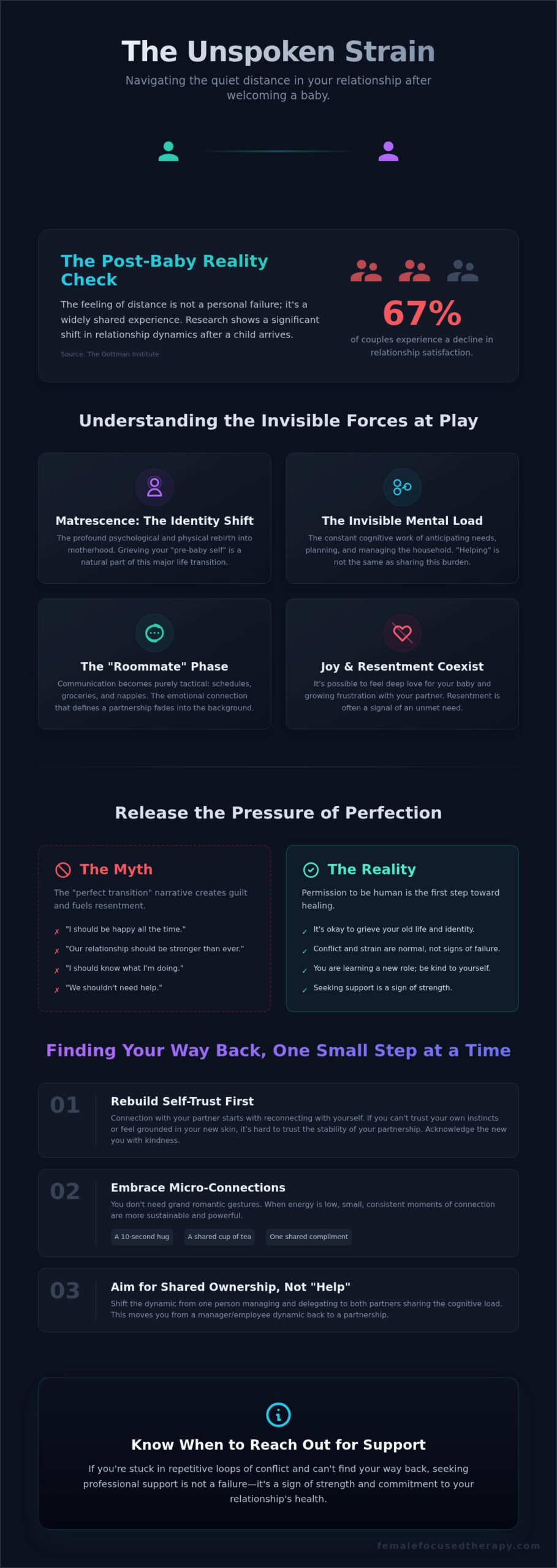
I often see women struggling to hold love for their baby alongside a growing frustration for their partner. You might feel a flash of anger when you see them sleeping or leaving for work. Resentment is rarely about “hating” the other person. Instead, it is usually a signal of an unmet need or a boundary that has been crossed. Research from the Gottman Institute suggests that 67% of couples experience a decline in relationship satisfaction in the first three years after a baby arrives.
This often manifests as the roommate phase. Your communication becomes purely tactical. You talk about nappies, sleep schedules, or who is ordering the groceries, but you stop talking about yourselves. Understanding Attachment theory can help you see why your focus has shifted so intensely toward the baby, often at the expense of the adult bond.
The invisible weight of the mental load
Your exhaustion isn’t just physical. It is the mental weight of thinking for three people at once. This cognitive responsibility leads to emotional over-functioning, where you feel you must anticipate every need before it happens. When a partner asks how they can “help,” it often adds to your burden because you still have to provide the instructions. Helping isn’t the same as sharing the cognitive load of the household.
I want to help you see that your burnout is a logical response to an unsustainable workload. If you feel like you are losing yourself in these new roles, you can explore how I support women on the Female Focused Therapy homepage. Recognising that your relationship strain after having a baby is a systemic issue, rather than a personal failure, is the first step toward finding your way back to each other.
If you’d like to find out more about working with Cheryl Kennedy MacDonald, you can email her at cheryl@femalefocusedtherapy.com or go ahead and book an appointment here: https://www.femalefocusedtherapy.com/book-now/
Why this transition feels like losing your old self
You might be feeling a strange sense of grief for the woman you used to be. This isn’t just about being tired; it is a profound developmental shift known as matrescence. Just as adolescence marks the transition from child to adult, matrescence is the psychological and physical rebirth into motherhood. It is a time of immense internal upheaval where your hormones, brain structure, and identity are all changing at once.
When you don’t quite recognise yourself in the mirror, it’s natural to feel more sensitive to any shifts in your relationship. You might find yourself searching for your old identity in the way your partner looks at you. When they don’t see the “old you” either, it can feel like a secondary loss. I often see women project this internal struggle for identity onto their partners, perhaps blaming them for the loss of freedom or the heavy weight of new responsibilities.
I believe that rebuilding self-trust is the first step to healing the relationship. If you can’t trust your own instincts or feel grounded in your new skin, it becomes very difficult to trust the stability of your partnership. Learning to be kind to this new version of yourself is essential for navigating life transitions with grace.
Navigating the shift from partners to parents
The change from being each other’s primary focus to being “co-managers” of a tiny human is abrupt. In Singapore, where the pace of life is fast and the pressure to excel is high, this shift can feel particularly clinical. You might find your evening conversations have moved from dreams and shared interests to a logistical checklist of nap times and nappy changes. This loss of spontaneous intimacy often feels like the friendship itself is slipping away.
I often find that couples forget to be “us” because they are so busy being “them.” The relationship strain after having a baby often stems from this loss of connection. When you stop being friends and start being colleagues in a high-stakes job, the warmth begins to fade. Research from the Journal of Family Psychology indicates that 67% of couples experience a decline in relationship satisfaction within the first three years of a child’s life, largely due to this shift in focus.
The impact of physical and emotional exhaustion
A sleep-deprived brain is a vulnerable brain. When you are running on three hours of broken sleep, your amygdala stays on high alert. This makes you far more likely to interpret your partner’s neutral actions as negative or even hostile. A dish left in the sink is no longer just a dish; it feels like a personal attack on your hard work. You can read more about common relationship strains to understand how universal these feelings are.
Hormones and sensory overwhelm also play a massive role in how you respond to closeness. If you have been “touched out” by a baby all day, your partner’s hand on your shoulder can feel like another demand rather than a comfort. It is incredibly hard to be a “good partner” when your own cup is completely empty. Acknowledging this exhaustion isn’t a failure; it is a necessary step in reducing the relationship strain after having a baby.
If you feel like you are struggling to find your way back to each other, couples therapy in Singapore can provide a calm space to talk through these changes without judgement.
If you’d like to find out more about working with Cheryl Kennedy MacDonald, you can email her at cheryl@femalefocusedtherapy.com or go ahead and book an appointment here: https://www.femalefocusedtherapy.com/book-now/
Letting go of the myth of the perfect transition
Social media can be a cruel mirror when you are a new mother. You might find yourself scrolling through Instagram at 3 a.m., seeing images of glowing parents in pristine Singapore apartments. It creates a false narrative that everyone else is “having it all” while you are just trying to survive. This comparison makes you feel like you’re the only one struggling, but those highlight reels never show the exhaustion or the quiet arguments over who washed the bottles last.
I want to encourage you to be gentle with yourself as you navigate these messy feelings. The reality of your daily life is much more complex than a filtered photo. I’ve found that when we stop comparing our “behind-the-scenes” to everyone else’s polished front, we find the space to breathe again. At Female Focused Therapy, I see so many women who feel they are failing simply because they are human.
Moving past the “shoulds” in your relationship
The “shoulds” are heavy burdens we carry. You might think you should be happier, or that your partner should just know what you need without being asked. These expectations often lead to significant relationship strain after having a baby. When we live in the world of “should,” we miss the reality of the person standing in front of us. We forget that they are also learning a brand new, demanding role for the first time.
Every couple has a different rhythm. There is no “right” way to do this. Research from the Gottman Institute suggests that 67 percent of couples experience a dip in relationship satisfaction in the first three years of a child’s life. Recognising that relationship strain after having a baby is a common, shared experience can help lower the pressure. Letting go of the need for a perfect transition allows for a much more genuine, honest connection between you and your partner.
Recognising the signs of deeper relationship trauma
It is important to distinguish between normal “new parent” friction and something more deeply rooted. The lack of sleep and the shift in household dynamics puts a strain on relationships that most people expect. However, the arrival of a baby can also act as a catalyst for old wounds. You might find that childhood patterns or previous experiences of relationship trauma are suddenly triggered by the vulnerability of motherhood.
If you feel a sense of persistent dread, or if the conflict feels weighted with “gaslighting” or control, it may be more than just tiredness. Sometimes, the stress of a new baby brings out coping mechanisms in a partner that are harmful. I offer a safe space to explore these deeper patterns if they feel too heavy to carry alone. We can look at these feelings together, at a pace that feels safe for you, helping you rebuild the self-trust that is so often shaken during this time.
If you’d like to find out more about working with Cheryl Kennedy MacDonald, you can email her at cheryl@femalefocusedtherapy.com or go ahead and book an appointment here: https://www.femalefocusedtherapy.com/book-now/
Finding your way back to each other slowly
It is natural to feel a sense of loss for the couple you used to be. The relationship strain after having a baby is a physical and emotional weight that many women in Singapore carry silently. I often see clients who feel they must fix everything at once with a big holiday or an expensive dinner. I believe that small, consistent shifts are much more sustainable than these grand, one-off efforts.
Right now, I want you to give yourself permission to prioritise the friendship part of your relationship. If the romantic or sexual side feels too heavy or complicated, let it rest for a while. Rebuilding the “us” starts with being teammates again. When you don’t have the energy for big gestures, look for micro-connections instead. These are the tiny moments of recognition that keep you tethered to each other.
Communication that feels safe and supportive
When you are exhausted, words can easily become weapons. I want to help you find the words for the feelings that currently feel like a knot in your chest. Using “I” statements is a simple but powerful tool to start speaking your needs without the edge of criticism. Instead of saying “You never help with the bottles,” try “I feel overwhelmed and lonely when I am cleaning the kitchen by myself at night.” It shifts the focus from an attack to an invitation for support.
I recommend implementing the “ten-minute check-in” rule. This is a dedicated 600 seconds each evening where you talk about anything except the baby’s schedule, household chores, or finances. Research suggests that couples who spend just 60 minutes a week in intentional conversation report higher levels of relationship satisfaction. It is a time to share a thought, a fear, or a small win from your day, ensuring you remain two separate people who are still interested in one another.
Small ways to rebuild intimacy and connection
We need to redefine intimacy for this season of your life. It doesn’t always have to mean physical closeness or sex. Right now, intimacy is about being “known” and “seen” in the middle of the chaos. It is perfectly okay for your connection to look different today than it did 12 months ago. Acceptance of this shift can actually reduce the pressure you both feel.
The power of a shared look across a messy living room or a gentle hand on a shoulder while the kettle boils shouldn’t be underestimated. These small physical touchpoints tell your nervous system that you are safe and loved. If you feel stuck in a cycle of blame, couples therapy in Singapore can provide a neutral, warm space to untangle these feelings at a pace that feels sustainable for you both.
Focus on being kind rather than being right. When the relationship strain after having a baby feels at its peak, a single kind word can act as a bridge. You are both learning a new language and a new way of existing together. Be patient with the process of finding your way back.
Knowing when to reach out for professional support
I want you to know that seeking help is a profound act of strength. It is not a sign that you have failed as a mother or that your partnership is beyond repair. Often, we carry a heavy expectation that we should be able to “figure it out” on our own, especially when it comes to our most intimate connections. However, the 12 months following the birth of a child bring about some of the most significant psychological shifts a woman will ever experience. Acknowledging that you need a little extra help to find your footing again is a brave choice.
When you feel stuck in a loop of conflict, therapy can provide the “third perspective” that is often missing. It’s very easy to get lost in the “he said, she said” of daily chores and sleep deprivation. I help couples step back from the immediate frustration to see the underlying patterns at play. By exploring couples therapy in Singapore, you can create a dedicated space to address the relationship strain after having a baby before resentment becomes a permanent fixture in your home.
You don’t have to wait for a crisis to start working through these feelings. Many women I work with in my practice find that even a few sessions can provide the clarity needed to feel like a team again. We don’t need to wait until things feel “broken” to start the process of repair. In fact, addressing the relationship strain after having a baby early on allows you to build a foundation of communication that will serve your family for years to come.
Taking the first step towards feeling like you again
While the focus is often on the couple, your individual wellbeing is just as vital. Individual therapy can be a powerful way to begin rebuilding your self-trust after the identity shift of becoming a mother. It’s about finding your voice again amidst the noise of new demands. You might find it helpful to explore who I work with to see if my approach resonates with your current needs. I am here to support you at a pace that feels safe, sustainable, and entirely free of judgment.
A small step for today
I hope you can find a moment of calm today, even if it is only for the length of a cup of tea. You are doing a difficult thing, and you are doing it with more grace than you realise. Perhaps today you can simply acknowledge one thing you are doing well, whether that is nourishing your baby, showing up for work, or simply choosing to be kind to yourself in a moment of frustration. You are doing enough.
If you’d like to find out more about working with Cheryl Kennedy MacDonald, you can email her at cheryl@femalefocusedtherapy.com or go ahead and book an appointment here: https://www.femalefocusedtherapy.com/book-now/
Finding your way back to each other
It is important to remember that the shift you’re feeling isn’t a sign that you’ve failed. You’re navigating matrescence, a profound identity change that requires a complete recalibration of your life and your partnership. By letting go of the myth of the perfect transition, you can begin to address the relationship strain after having a baby with more patience and less self-blame. Reconnection doesn’t happen overnight; it happens in the small, quiet moments where you choose to see each other again.
In my work as a Registered Psychotherapist, I help women navigate these transitions using an integrative approach that combines CBT and mindfulness. I specialise in relationship trauma and the unique challenges of matrescence, providing a safe, confidential space to rebuild your sense of self and your connection to those you love. I invite you to explore my homepage to see how we can work together to restore your well-being at a pace that feels sustainable for you.
You don’t have to navigate this season of change alone. If you’d like to find out more about working with Cheryl Kennedy MacDonald, you can email her at cheryl@femalefocusedtherapy.com or go ahead and book an appointment here: https://www.femalefocusedtherapy.com/book-now/
Common questions about your relationship after baby
Is it normal to hate my partner after having a baby?
Yes, it is incredibly common to feel intense anger or even a fleeting sense of “hate” toward your partner. In my practice, I see many women struggling with these feelings because of extreme sleep deprivation and the sharp drop in oestrogen and progesterone after birth. You aren’t a bad person; you’re likely just overwhelmed by the sudden shift in your identity and the sheer volume of new responsibilities you’re carrying.
How long does the relationship strain usually last after a baby?
Most couples find that the most intense period of transition lasts about 12 to 18 months. Research from the Gottman Institute suggests that 67 percent of couples experience a significant drop in relationship satisfaction during the first three years of a child’s life. This phase of relationship strain after having a baby is often a temporary adjustment period as you both learn to navigate your new roles and find a new rhythm together.
What are the most common causes of relationship problems after a baby?
The most frequent causes include chronic exhaustion, a perceived imbalance in household chores, and the heavy “mental load” of managing a baby’s needs. In Singapore, the pressure to return to a high-pressure career while managing a household can make these issues feel even more heavy. This often leads to a sense of relationship strain after having a baby where one partner feels they’re carrying much more of the emotional weight and “invisible labour.”
How can I stop resenting my partner for the mental load?
Start by making the invisible visible through a calm, scheduled conversation rather than bringing it up in the heat of the moment. I often suggest writing down every single task you do in a week, from sterilising bottles to booking paediatrician appointments at a clinic in Orchard or Tampines. When you both see the list, it’s easier to divide tasks fairly, which helps lower the resentment that builds when you feel you’re the only one “holding it all.”
Can a marriage survive the first year of parenthood?
Absolutely, your marriage can survive and even grow stronger through this transition. While the first year is often described as a “survival mode” phase, many couples find that being intentional about small moments of connection helps. It’s about shifting your expectations and accepting that this season of life looks different from your pre-baby days, focusing on being a team rather than keeping score of who did what.
When should we consider couples therapy after having a baby?
You might consider therapy if you feel stuck in a cycle of “roommate syndrome” or if every conversation turns into a conflict. If you find yourself feeling lonely even when your partner is in the room, it’s a sign that you need a safe space to reconnect. Seeking support early through Female Focused Therapy can help you address these feelings before they become deeply rooted patterns that feel impossible to break.
How do I tell my partner I am struggling without starting an argument?
Timing is everything, so try to speak when you’re both relatively calm and not in the middle of a nappy change or a work crisis. Use “I” statements like “I feel overwhelmed when the kitchen is messy” instead of “You never help.” This approach focuses on your feelings rather than your partner’s failings, which usually helps them hear your request for support without feeling the need to be defensive or shut down.

Article by
Cheryl Kennedy MacDonald MA BA (Hons) Pg. Dip. SAC BACP
Cheryl Kennedy MacDonald is a psychotherapist specialising in women’s mental health, relationships, and life transitions. She works with women navigating trauma, relationship breakdown, identity shifts, and midlife change, helping them rebuild self-trust, emotional stability, and a clear sense of who they are and what they want.
With over 20 years’ experience working with women internationally, Cheryl is the founder of YogaBellies, a global women’s yoga school, and the creator of the Birth ROCKS method. Her work sits at the intersection of psychotherapy and embodiment, integrating evidence-based therapeutic approaches with somatic, body-based practices that support deep, lasting change.
Known for her grounded and direct approach, Cheryl moves beyond surface-level insight to address the patterns held in the body and nervous system. Her work supports women to regulate, reconnect, and respond to their lives from a place of clarity, strength, and self-respect.
She is a published author in academic journals and has written multiple books on women’s health, pregnancy, and midlife wellbeing, available on Amazon and leading book retailers worldwide.