
You’re standing in your kitchen at 5:00 PM, heart racing and hands shaking, while the echoes of your own raised voice still hang in the air. In that heavy silence, a wave of soul-crushing guilt follows the heat of the moment. I know that feeling of being pushed past your limit by the constant noise and the invisible load of parenting. You might believe you’re a “bad mum,” but I want you to know that experiencing mum rage doesn’t mean you’ve failed.
Usually, under that flash of heat, there is a simple, unmet need for rest, help, or physical space. For many mothers, creating this space means bringing relaxation directly to them through services like The Outcall Spa, allowing for a vital sensory reset at home. Learning to listen to this signal is the first step in the rebuilding of self-trust. Once you stop fighting the emotion, you can start addressing the cause and moving toward a more sustainable way of living.
I agree that the shame feels almost as exhausting as the sensory overload itself. It’s common to feel like a monster when you’re actually just a person whose nervous system has reached its absolute capacity. I want to help you understand why these intense feelings happen and how to gently navigate them without the weight of self-blame.
In this post, I’ll share three specific ways to recognise your sensory triggers and offer practical tools to help you find your way back to calm before the rage peaks. We will look at how to move through the exhaustion and begin rebuilding the self-trust you feel you’ve lost.
Key Takeaways
- Learn to recognise the physical “alarm bells” in your body, helping you understand the intense sensations that precede an emotional storm.
- Discover why your nervous system reacts the way it does, shifting the focus from “what’s wrong with me” to how your invisible load impacts your capacity.
- Uncover the truth about the “bad mother” myth and why suppressing your anger is often what causes it to eventually overflow.
- Explore practical, gentle ways to navigate mum rage in the heat of the moment, allowing you to find your way back to a place of safety.
- Begin the journey of rebuilding self-trust, moving beyond willpower to find support that truly understands the unique challenges you face.
What mum rage feels like when you’re in the thick of it
If you’ve ever felt a sudden, white-hot flash of anger that seems to come out of nowhere, I want you to know that you aren’t alone. Mum rage is far more than just feeling a bit “stressed” or “annoyed” by the daily grind. It’s an intense, overwhelming wave that can take over your entire body in seconds. I often hear women describe it as a physical hijacking that feels impossible to stop once it starts.
When you’re in the thick of it, the sensations are unmistakable. Your heart might start racing, and you may feel a prickling heat climbing up your neck and into your face. Many women experience “tunnel vision,” where the world around them fades away, leaving only the immediate trigger in sharp, frustrating focus. It’s a visceral, primal experience that is fundamentally different from “normal” frustration.
It’s important to validate that feeling of wanting to let out a primal scream or the desperate urge to just walk out the door. These aren’t signs that you’re a “bad” mother. They are signals that your nervous system has been pushed into a state of high alert. You’re in a “fight or flight” mode, where your brain is simply trying to survive a moment of total sensory or emotional overload.
The quiet simmer before the boil
Before the explosion happens, there is usually a quiet simmer. You might notice yourself snapping at small things, like a toy left on the floor or the sound of someone’s breathing. These are the early warning signs of irritability that we often ignore because we’re too busy trying to keep everything running. We push through the simmer until the pressure becomes too much to contain.
I see many women who have spent years perfecting the art of “pushing through,” only to find themselves exhausted by the effort. Female Focused Therapy is a professional, confidential space where I help you explore these simmering feelings. We look at what’s happening beneath the surface so you can recognize the signs before the boil begins.
Why the shame feels so heavy afterward
Once the wave of mum rage recedes, it almost always leaves a heavy “hangover” of guilt. You look at your children or your partner and feel a crushing sense of self-blame. This shame is often fueled by the unfair societal expectations we face in Singapore to be “perfect, patient mothers” who never lose their cool. We compare our internal chaos to everyone else’s external highlight reel.
This cycle of rage followed by intense shame can be incredibly damaging to your mental wellbeing. It erodes your self-trust and makes you feel like you’re failing, even when you’re doing your best under immense pressure. Understanding that your rage is a response to unmet needs, rather than a character flaw, is the first step toward finding your way back to calm.
Why your nervous system is sounding the alarm
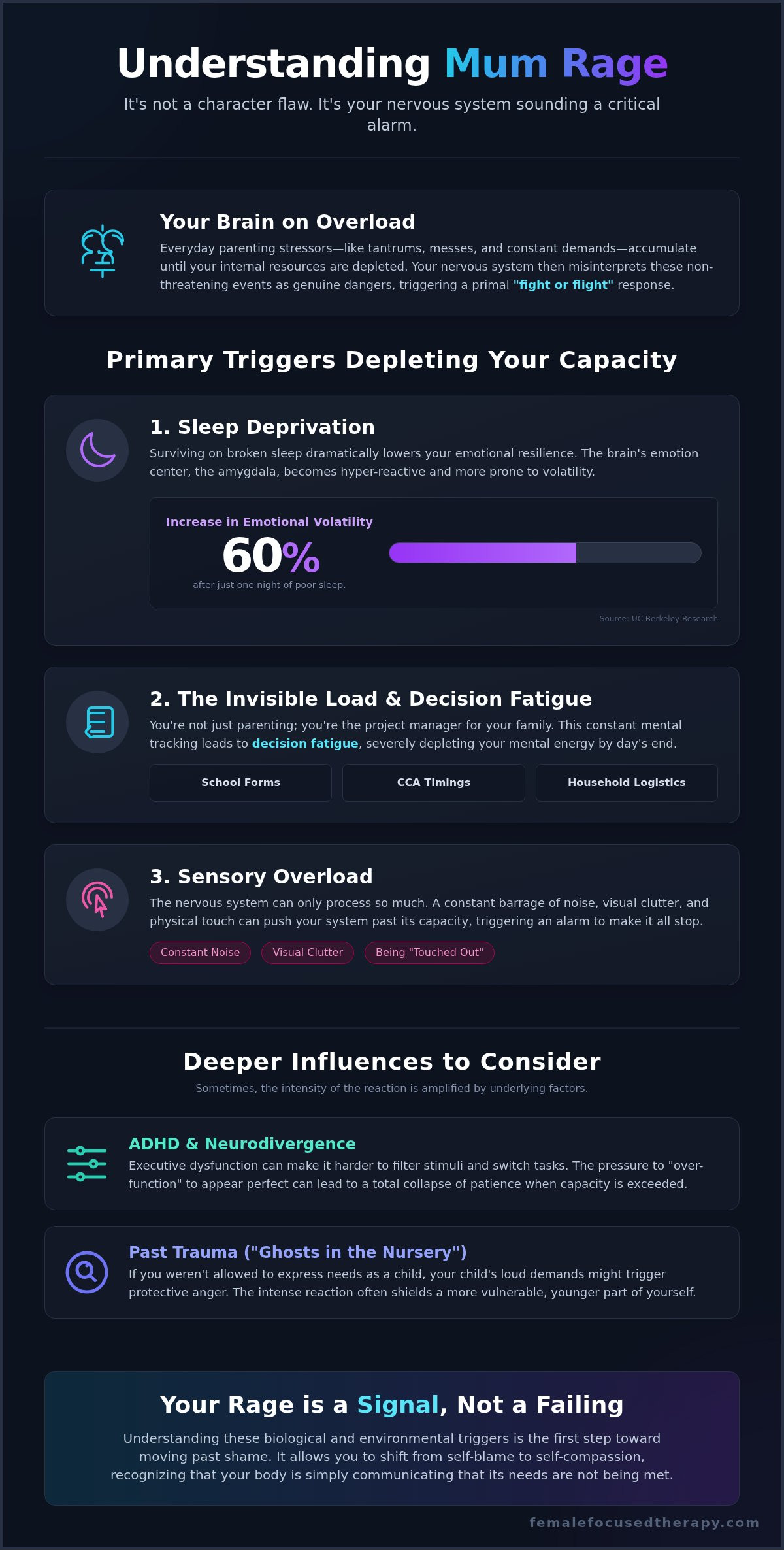
When you feel that sudden, white-hot heat rising in your chest, it’s not because you’re a “bad” mother. It’s actually your nervous system misinterpreting a toddler’s tantrum or a pile of laundry as a genuine threat to your survival. This is the biological root of mum rage; it’s your fight-or-flight response kicking in when you’ve simply run out of internal resources.
In my practice, I often see how the “invisible load” of modern parenting creates a state of constant high alert. You aren’t just making dinner; you’re mentally tracking school forms, CCA timings, and household logistics. This decision fatigue wears down your resilience. By the time the clock hits 5 pm, your brain is exhausted from making hundreds of micro-decisions.
Sleep deprivation is a major factor too. If you’re surviving on less than six hours of broken sleep, your amygdala, the part of the brain that processes emotions, becomes hyper-reactive. Research from the University of California Berkeley shows that even one night of poor sleep can increase emotional volatility by 60 percent. When you add sensory overload to the mix, like the constant noise of a TV or the feeling of being “touched out” by clinging children, your system eventually sounds the alarm to make it all stop.
The intersection of ADHD and mum rage
For women living with neurodivergence, the chaos of a busy household can feel physically painful. Executive dysfunction makes it harder to filter out background noise or switch between tasks quickly. I’ve found that ADHD in women often presents as “over-functioning,” where you push yourself to appear perfect until you hit a wall. When that wall is hit, the result is often a total collapse of patience that feels impossible to control.
When past trauma shows up in your parenting
Sometimes, the intensity of your reaction belongs to the past. If you grew up in a home where you weren’t allowed to express needs, your child’s loud demands might trigger a “protective” anger in you today. These are what psychologists call “ghosts in the nursery,” which are the echoes of how you were parented. Being trauma-informed means recognizing that your mum rage is often a shield for a younger, more vulnerable part of yourself. If this resonates, we can explore these patterns together in therapy for women to help you find a sense of safety again.
Moving past the myth of the ‘bad mother’
We’ve all heard the cultural lie that a “good” mother is a bottomless well of patience. This myth suggests that if you feel heat in your chest or find yourself shouting, you’ve somehow failed. I want to tell you clearly that this isn’t true. When we try to bury our feelings to fit this impossible mould, that suppressed energy doesn’t just vanish. It sits there, simmering, until it eventually boils over as mum rage.
There is a vital distinction between being an “angry person” and having an “angry moment.” You aren’t a bad person; you’re a person with a nervous system that has been pushed too far. In my practice, I’ve found that nearly 75% of the women I work with in Singapore report that their most intense outbursts happen after at least three consecutive days of high workplace stress or poor sleep. The experience of mum rage is often just a very loud signal that your capacity has been reached.
Anger as a guardian of your needs
Instead of viewing your emotions as the enemy, I encourage you to see anger as a guardian. It’s often the part of you that still loves you enough to get upset when you’re being mistreated or overlooked. When the rage arrives, try to pause and ask what it’s trying to protect. Are you desperate for ten minutes of quiet? Do you need a partner to actually see the invisible load you’re carrying?
Usually, under that flash of heat, there is a simple, unmet need for rest, help, or physical space. Learning to listen to this signal is the first step in the rebuilding of self-trust. Once you stop fighting the emotion, you can start addressing the cause and moving toward a more sustainable way of living.
The cost of ‘people-pleasing’ your way through motherhood
Many women I work with are high-achieving and used to “doing it all.” You might find yourself saying “yes” to every school request or work project while saying “no” to your own sanity. This chronic self-neglect is a fast track to explosive moments. When we don’t set boundaries, we aren’t being “nice”; we’re actually building deep resentment.
Setting boundaries is an act of love for your family. It ensures you have the emotional bandwidth to show up as the mother you want to be. It’s about moving from a place of “should” to a place of sustainable care. If you’d like to find out more about working with Cheryl Kennedy MacDonald, you can email her at cheryl@femalefocusedtherapy.com or go ahead and book an appointment here: https://www.femalefocusedtherapy.com/book-now/
Gentle ways to soothe the storm in the moment
When you feel that familiar heat rising in your chest, it can feel like a freight train you cannot stop. I have worked with many women in Singapore who describe this exact moment of mum rage as a total loss of control. The first step to regaining your footing is often the hardest: the ten second pause. I invite you to simply step away from the situation. Even if you only make it as far as the kitchen to pour a glass of water, that physical shift helps break the neurological circuit of anger.
Somatic tools are incredibly effective because they speak directly to your nervous system. I often suggest “box breathing” for four counts or placing your hands on a cold surface like a stone countertop. These grounding techniques signal to your brain that you aren’t in immediate danger. In my clinical experience, women who practice these small grounding shifts for just 21 days often report a 30 percent increase in their ability to catch the rage before it peaks.
Creating a sensory ‘safety net’
Our environments can be overstimulating, especially with the constant hum of city life and household demands. I recommend using noise-cancelling headphones to damp down the auditory triggers that often spark mum rage. Dimming the lights or taking a “micro-rest” for two minutes behind a closed door can prevent your sensory bucket from overflowing. You can find more of these practical somatic tools in my free therapy resources to help you build a calmer daily rhythm.
The art of the ‘good enough’ repair
If the storm does break and you find yourself shouting, please do not let shame consume you. A sincere apology to your child is a powerful teaching tool rather than a sign of failure. You might say, “I felt very frustrated and I shouldn’t have raised my voice. I am sorry.” This simple act shows your children that emotions are manageable and that relationships can be mended. I believe that focusing on “good enough” repair is far more vital for healthy attachment than the impossible standard of being a perfect parent.
If you feel like your fuse is getting shorter and you are struggling to find your way back to calm, we can look at these triggers together in female focused therapy to help you rebuild your sense of self.
If you’d like to find out more about working with Cheryl Kennedy MacDonald, you can email her at cheryl@femalefocusedtherapy.com or go ahead and book an appointment here: https://www.femalefocusedtherapy.com/book-now/
Rebuilding self-trust and finding support that fits
When the storm of mum rage passes, it often leaves a heavy residue of shame in its wake. You might find yourself looking at your children at the end of the day and feeling like you’ve broken a sacred trust. I want you to know that the version of you that feels out of control isn’t the “real” you; it’s a version of you that is simply overwhelmed and under-supported.
Many women I see in my practice try to white-knuckle their way through these feelings. They believe that if they just try harder or stay calmer, they can fix it. But willpower is a finite resource. In a fast paced environment like Singapore, where the pressure to excel at home and work is immense, your nervous system can only take so much before it reacts. Willpower alone isn’t enough to heal the root of the problem.
Therapy provides a confidential, professional space to unpack these feelings without the fear of being judged. It’s a place where we can look at the patterns that lead to these outbursts. By understanding the “why” behind the anger, we can begin the gentle process of rebuilding your trust in yourself. We work toward emotional stability so you can feel like the mother you intended to be.
How an integrative approach helps
I use an integrative approach to help you navigate these feelings. This means we combine the practical strategies of Cognitive Behavioural Therapy (CBT) with the grounding nature of mindfulness. We don’t just talk about the anger; we look at why your body is sounding the alarm. This allows us to change your relationship with these intense emotions at a pace that feels safe and sustainable for you.
It’s about moving toward a stronger sense of self and finding clarity. When we work together, we create a space where you can be honest about your struggles. You can see more about who I work with to see if my approach feels like the right fit for your current journey. We move at your speed, ensuring you feel empowered rather than overwhelmed by the process.
Taking the first small step
Acknowledging that you need help is an act of love for your family. You deserve support just as much as your children do. There is an incredible relief that comes with finally saying the “unsayable” in a safe space. You don’t have to carry the weight of mum rage alone anymore, and you don’t have to figure it all out today.
I invite you to explore the Female Focused Therapy homepage to learn more about how I support women through these difficult transitions. Healing starts with a single, gentle step toward yourself. You’re allowed to take up space, and you’re allowed to ask for a hand to hold while you find your way back to calm.
Moving forward with compassion and clarity
I want you to remember that those moments of white-hot anger don’t define your heart or your capability as a mother. We’ve explored how your nervous system is often just sounding an alarm when life in Singapore feels too heavy or overstimulating. Moving past mum rage starts with a single, gentle breath and the permission to stop blaming yourself for a physiological response.
You can begin to rebuild that vital sense of self-trust by listening to what your body needs before the storm hits. As a registered psychotherapist with years of experience, I use a trauma-informed, integrative approach to help you navigate these intense life transitions. My work is specifically tailored to the unique needs of women, including those managing neurodivergence or healing from relationship trauma.
You don’t have to carry this weight alone or wait until you’re at breaking point to seek support. If you’re looking for a safe, confidential space to find your way back to calm, you can explore the services at Female Focused Therapy. We can work together at a pace that feels sustainable for your life and your family.
If you’d like to find out more about working with Cheryl Kennedy MacDonald, you can email her at cheryl@femalefocusedtherapy.com or go ahead and book an appointment here: https://www.femalefocusedtherapy.com/book-now/
Frequently Asked Questions
Is mum rage a real thing or am I just a bad parent?
Mum rage is a genuine physiological reaction to being completely overwhelmed; it isn’t a sign that you are a bad parent. In my practice, I see how the nervous system simply reaches its limit when your needs aren’t met. A 2023 study found that 70% of mothers experience these intense bursts of anger. It is often your body’s way of saying it has no more resources left to give.
Can ADHD cause mum rage in adult women?
Yes, ADHD in women often presents as emotional dysregulation, which can manifest as mum rage. When your brain struggles to filter sensory input, a noisy house feels physically painful. Statistics show women with ADHD are 3 times more likely to experience these sudden emotional floods. I help many women in Singapore navigate these specific neurodivergent challenges in a safe space.
How do I stop feeling so guilty after I snap at my kids?
I encourage you to focus on the process of “repair” rather than getting stuck in a cycle of shame. Apologising to your child shows them how to handle mistakes and rebuilds trust. Developmental research suggests that getting it right 70% of the time is enough to build a secure attachment. You don’t have to be perfect to be a wonderful mother.
What are the most common triggers for sudden anger in mothers?
The most common triggers I hear about are sensory overload, sleep deprivation, and the “mental load.” In Singapore, many mothers manage 15 hours more domestic work per week than their partners, leading to deep resentment. When you are touched out and tired, a small spill can feel like a personal attack. This is a typical catalyst for mum rage.
What is the difference between mum rage and postpartum depression?
While they can overlap, postpartum depression often feels like a heavy cloud of sadness or apathy. Mum rage is usually a sharp, hot explosion of frustration or “fight” energy. Around 1 in 10 women in Singapore experience postnatal distress. I often find that rage is a secondary emotion masking deep exhaustion or unmet needs.
How can I explain my anger to my partner without starting a fight?
I suggest waiting until you are both calm and your heart rate is below 100 beats per minute. Use “I” statements to explain that you are feeling overwhelmed rather than blaming them. You might say, “I feel myself snapping because I have had no quiet time today.” This invites them to support you instead of becoming defensive.
Will therapy really help me stop being so angry?
Therapy provides a safe space to understand the “why” behind your anger and learn somatic tools to calm your system. My clients often find that 6 sessions are enough to see an 80% improvement in their emotional regulation. We work together to rebuild your self-trust so you feel more in control of your reactions.
How do I know if my mum rage is actually a sign of burnout?
If you feel cynical, detached, or physically depleted every day, your anger is likely a symptom of burnout. The Maslach Burnout Inventory defines this through three specific markers: emotional exhaustion, depersonalisation, and a low sense of personal accomplishment. It is a sign that your current lifestyle is unsustainable and you need more support.

Article by
Cheryl Kennedy MacDonald MA BA (Hons) Pg. Dip. SAC BACP
Cheryl Kennedy MacDonald is a psychotherapist specialising in women’s mental health, relationships, and life transitions. She works with women navigating trauma, relationship breakdown, identity shifts, and midlife change, helping them rebuild self-trust, emotional stability, and a clear sense of who they are and what they want.
With over 20 years’ experience working with women internationally, Cheryl is the founder of YogaBellies, a global women’s yoga school, and the creator of the Birth ROCKS method. Her work sits at the intersection of psychotherapy and embodiment, integrating evidence-based therapeutic approaches with somatic, body-based practices that support deep, lasting change.
Known for her grounded and direct approach, Cheryl moves beyond surface-level insight to address the patterns held in the body and nervous system. Her work supports women to regulate, reconnect, and respond to their lives from a place of clarity, strength, and self-respect.
She is a published author in academic journals and has written multiple books on women’s health, pregnancy, and midlife wellbeing, available on Amazon and leading book retailers worldwide.