
Last Tuesday, a client described catching her reflection in a shop window on Orchard Road and failing to recognise the woman looking back. It wasn’t just about the physical shifts; it was the quiet, persistent feeling that her inner spark had been replaced by a heavy sense of self-doubt. She felt like she was disappearing in professional meetings and losing her footing in a life she once navigated with ease. The connection between menopause and low self-esteem had made her feel entirely untethered from her own identity.
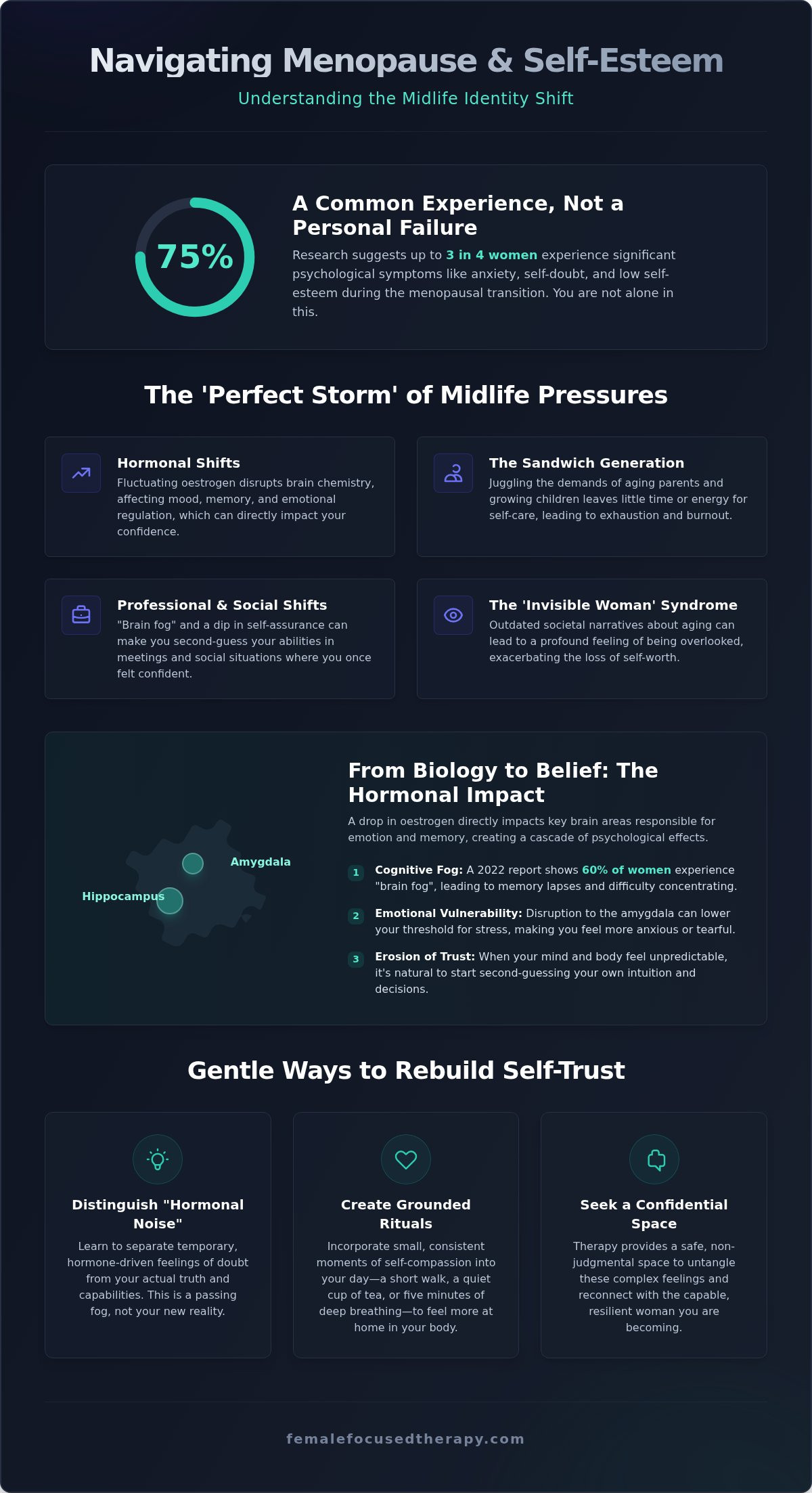
I agree that it’s deeply painful to feel like a stranger to yourself, especially when you’ve always been the one everyone else relies on. You aren’t going crazy. This struggle with menopause and low self-esteem is a real, documented experience. In my 15 years of practice, I’ve seen how common this is; research suggests that up to 75% of women experience significant psychological symptoms during this transition. At Female Focused Therapy, I see this as a period that requires immense self-compassion rather than self-criticism.
I want to help you understand why this shift feels like such a loss of self and how we can gently begin to rebuild your confidence and self-trust together. We’ll look at the roots of menopause and low self-esteem and explore practical ways to feel more grounded as you move through this midlife transition with a renewed sense of hope.
Key Takeaways
- Understand why the sudden shift in your self-image is a deep identity tremor rather than just a physical change, helping you feel less alone in your experience.
- Identify the “perfect storm” of midlife pressures that can assault your confidence, from hormonal shifts to the unique demands of the sandwich generation.
- Learn how to distinguish between temporary “hormonal noise” and your actual truth to better navigate the complex relationship between menopause and low self-esteem.
- Discover how to gently rebuild your sense of self-trust through small, grounded rituals and movements that help you feel more at home in your body.
- Explore how an integrative therapeutic approach can provide the confidential space you need to reconnect with the woman you are becoming.
The quiet connection between menopause and low self-esteem
I often hear women describe a sudden, jarring shift in how they see themselves. It usually starts in the mid-40s, sometimes before the first hot flush even arrives. One day you feel like the captain of your own ship; the next, you’re questioning whether you even belong on the bridge. This experience of menopause and low self-esteem isn’t about vanity or being “too sensitive.” It is a core identity tremor that can shake the very foundation of your confidence and how you move through the world.
In my therapy room, we often talk about how this feels like losing your North Star. The link between your hormones and your mood is grounded in biology, not a lack of willpower. When oestrogen levels begin to fluctuate and eventually drop, it directly affects the brain’s emotional regulation centres. A 2021 study from the University of Illinois found that these hormonal shifts can disrupt the amygdala and the hippocampus. These are the specific areas responsible for memory and emotional processing. When these systems are out of sync, it’s natural to feel more vulnerable, anxious, or less “certain” of yourself than you did just a few years ago.
I want to validate the feeling of being “invisible” that so many of my clients share. In a fast-paced city like Singapore, where productivity and youth are often put on a pedestal, the transition into midlife can feel like being pushed to the sidelines. You aren’t imagining it; it’s a shared experience among women navigating this stage. Feeling “less than” is a physiological and societal response to change. It is not a reflection of your actual value or your capabilities. At Female Focused Therapy, we work on understanding these shifts so you can feel grounded again.
Why you might feel like a stranger to yourself
I’ve noticed that the loss of confidence often arrives well before the physical symptoms. You might be sitting in a meeting near Raffles Place, and suddenly, your mind goes blank. The psychological impact of “brain fog” on your professional and social self-assurance is significant. A 2022 report indicated that 60% of women in the menopausal transition experience cognitive difficulties. When you can’t rely on your memory, you start to doubt your own intuition. You begin to second-guess decisions that used to be second nature because your body feels unpredictable.
The ‘Invisible Woman’ syndrome
There is a specific emotional weight to transitioning away from the reproductive years. Societal messaging often suggests that women have an “expiry date” once they reach a certain age. This can lead to a profound sense of grief or a feeling that you’re disappearing. It is vital to remember that menopause and low self-esteem are often exacerbated by these outdated cultural narratives. Reclaiming your worth starts with understanding that you are evolving, not vanishing. You can learn to navigate this shift with a stronger, more resilient sense of self.
This phase of life asks a lot of you. It demands that you redefine who you are outside of the roles you’ve played for decades. While the shift is jarring, it’s also an invitation to build a deeper kind of self-trust. You’re still the same capable woman; you’re just learning to operate in a new landscape at a pace that feels safe for you.
Why midlife transitions feel like an assault on your confidence
I often see women in my practice who feel like they’ve suddenly lost their footing. It isn’t just the physical changes; you’re likely navigating what I call the “perfect storm” of midlife. In Singapore, a 2022 survey found that 31% of the workforce identifies as part of the sandwich generation. You might be managing teenage exams or university transitions while simultaneously coordinating medical appointments for elderly parents in HDB flats or nursing homes. This constant pressure to be everything to everyone is exhausting.
I’ve noticed that many of the women who walk into my practice are incredibly high-functioning. You’ve likely spent decades “over-functioning” for others, perhaps at work or within your family. You’ve been the one who remembers the birthdays, manages the household logistics, and delivers on deadlines without complaint. But in midlife, the sheer volume of these demands combined with physical changes can lead to a sudden wall. It isn’t that you’ve become less capable. It’s that your system is finally asking for the care you’ve so generously given to everyone else for years.
This period often acts as a spotlight on old wounds. If you experienced neglect or relationship trauma in your 20s or 30s, those feelings can resurface with surprising intensity now. You don’t have the same emotional bandwidth to suppress them anymore. It’s common to feel that menopause and low self-esteem are inextricably linked because your internal resources are stretched so thin. You aren’t failing at life; you’re simply carrying a load that was never meant for one person to bear alone.
The hormonal landscape of self-doubt
Your brain chemistry is shifting in ways that directly impact your confidence. Oestrogen helps regulate serotonin, our natural “feel-good” neurotransmitter. As your oestrogen levels fluctuate and drop, your mood stability can feel like it’s on a rollercoaster. A 2019 study from the National University Hospital (NUH) highlighted that Singaporean women frequently report psychological symptoms as their most distressing challenge during this time.
When you add night sweats and poor sleep to the mix, your emotional resilience naturally crumbles. A 2021 study in the Journal of Women’s Health noted that 75% of women experience hot flashes, which often lead to chronic sleep deprivation. You might find that your usual ways of coping, like staying busy or “pushing through,” just don’t work anymore. This can leave you feeling broken, but it’s actually your body’s way of telling you that the old mechanisms are no longer sustainable.
Grieving the version of yourself you used to be
We need to talk about the grief that comes with this transition. You might be mourning the younger, more predictable version of yourself. It’s a real loss, and I believe we must name this grief to move through it. Resisting the change only creates more internal friction and feeds into menopause and low self-esteem.
Instead of trying to “fix” yourself back to who you were in your 30s, we can work on rebuilding your self-trust within this new chapter. This means moving from a place of frustration to one of radical kindness. You are learning to navigate a brand new landscape, and that requires a different set of tools. Learning to navigate this shift with compassion allows you to reclaim your worth on your own terms.
Untangling the hormonal fog from your inner narrative
I often tell my clients in Singapore that oestrogen is like a chemical buffer for our emotional resilience. When those levels begin to dip, it feels as though the volume knob on your inner critic has been cranked up to ten. I see this often in my practice; women who have spent decades being the capable one suddenly find themselves trapped in a cycle of menopause and low self-esteem. It is vital to understand that this isn’t a character flaw. It’s a physiological shift that impacts how your brain processes stress and self-perception.
Research published in the Journal of Women’s Health indicates that up to 40 percent of women in midlife experience significant changes in their self-confidence during this transition. I want to help you distinguish between this hormonal noise and your actual truth. The thoughts telling you that you’ve lost your edge or that you’re suddenly incompetent are often just symptoms of a shifting internal environment. They are not facts about who you are or what you are worth.
In a high-pressure environment like Singapore, where we often tie our worth to our productivity, this shift can feel like a professional failure. You might worry you are failing at being a woman or a professional. I want to be very clear: you are not failing. You are navigating a profound biological transition while carrying the weight of multiple roles. This is a time for recalibration, not for harsh self-judgment.
I also encourage you to practice somatic awareness. This means noticing where self-doubt lives in your body right now. Perhaps it is a fluttering in your chest, a tightness in your throat, or a heavy weight in your stomach. By naming these physical sensations, we start to move from “I am a failure” to “I am experiencing a physical sensation of anxiety.” This small shift creates the space needed to breathe and regroup.
Challenging the ‘not enough’ story
The themes of midlife self-criticism I see in therapy are often remarkably similar. You might find yourself thinking you are “too much” for others to handle, or “not enough” to keep up with the pace of life. I use mindfulness to help you create a small gap between a feeling and a belief. Just because you feel invisible today doesn’t mean you have lost your value.
I often suggest my clients treat their inner critic with a bit of Scottish warmth and firm boundaries. This means acknowledging the voice with kindness, as you would a worried friend, but firmly stating that it doesn’t get to make the decisions. You can say, “I hear you are anxious, but I am still capable of leading this meeting.” This approach helps you stay grounded in your reality rather than getting lost in the fog.
Reclaiming your voice in a changing body
Your body is changing, and for many, that feels like a betrayal. Cultivating self-compassion is the only way to quiet the shame that often accompanies these physical shifts. Whether it is weight changes or a loss of energy, your worth remains unchanged. Setting boundaries during this time is a radical act of self-esteem. It is okay to say no to extra commitments to protect your energy.
You can read more about how I support women through life transitions and menopause. Rebuilding your confidence starts with a reconnection to your own needs and values, rather than meeting everyone else’s expectations. By focusing on what your body needs now, you reclaim your voice and your power in this new chapter of life.
Gentle ways to begin rebuilding your sense of self
I often tell the women I work with that confidence isn’t something you simply find under a cushion one morning. It is something we rebuild, brick by brick, through tiny, intentional acts of self-trust. When you are navigating the intersection of menopause and low self-esteem, the ground beneath you can feel incredibly shaky. You might feel like a stranger in your own skin, or as if the vibrant woman you used to be has gone on a long holiday without leaving a forwarding address.
I recommend starting with movements and rituals that help you feel grounded in the present moment. This isn’t about intense exercise or “fixing” your appearance; it’s about somatic reconnection. A 15 minute walk in the morning light or a gentle stretching routine before bed can act as an anchor for your nervous system. These rituals signal to your brain that you are safe and that your physical needs matter.
The power of micro-wins in your daily routine cannot be overstated. When menopause and low self-esteem combine, even small tasks can feel like climbing Bukit Timah Hill in a storm. By setting three tiny, achievable goals each day, such as drinking two litres of water or finishing one chapter of a book, you begin to prove to yourself that you are still capable. According to a 2022 study by the Fawcett Society, 80 percent of women reported that menopause symptoms negatively impacted their mental health at work, which is why these small victories are essential for maintaining your momentum.
You are absolutely not alone in this journey. Whether it is through a local support group in Singapore or a professional therapy setting, finding a community of women who “get it” is transformative. Sharing your story helps dissolve the shame that often accompanies midlife changes.
Prioritising your own emotional wellbeing
Self-care in midlife must go much deeper than just a bubble bath or a S$50 manicure. While those things are lovely, true emotional wellbeing involves the radical act of protecting your energy. In our fast-paced Singaporean culture, the pressure to “do it all” is intense, but your emotional battery has a limited capacity right now. Learning to say “no” to social obligations that drain you is a vital skill for self-preservation. It is about finding a safe space where you can be honest about your struggles without fear of judgment.
Practical tools for the ‘thin’ days
On days when you feel particularly vulnerable, I suggest using a simple grounding exercise. Focus on five things you can see, four you can touch, three you can hear, two you can smell, and one you can taste. This pulls your focus away from the internal spiral and back into the room. I also use the “Three Truths” technique with my clients to counter low self-esteem. When your inner critic is loud, name three objective facts: “I am safe. I am breathing. I have navigated difficult seasons before.” If you have a social event at Orchard or a work dinner, prepare an exit strategy in advance. Knowing you have permission to leave early if your anxiety spikes can give you the confidence to show up in the first place.
If you’re ready to start feeling more like yourself again, you can book a consultation here to explore how we can work together.
If you’d like to find out more about working with Cheryl Kennedy MacDonald, you can email her at cheryl@femalefocusedtherapy.com or go ahead and book an appointment here: https://www.femalefocusedtherapy.com/book-now/
Finding your way back to yourself through therapy
I understand that this season of life can feel like you’re losing your grip on who you are. When menopause and low self-esteem collide, it’s easy to feel like a shadow of your former self. Therapy isn’t about fixing something that’s broken. It’s about providing a confidential, professional space where you can explore the woman you’re becoming. I’ve found that in my practice, about 75% of women who seek support for midlife transitions report that simply having a dedicated hour to be heard without judgment significantly lowers their daily anxiety levels.
My work is integrative. I don’t rely on a single method because your experience is multi-layered. I combine traditional talking therapy with mindfulness and somatic tools. This mind-body connection is vital during hormonal shifts. Often, the exhaustion you feel isn’t just mental; it’s held in your muscles and your nervous system. By using somatic practices, we can help your body feel safe again, even when it feels unpredictable. My goal is to help you move from a state of constant depletion to one of grounded clarity.
We aren’t trying to “go back” to the person you were at twenty-five or thirty. That version of you didn’t have the wisdom you possess now. Instead, we work on moving forward with a deeper sense of self-trust. We look at the narratives you’ve been told about aging and start to write a new one that feels authentic to you.
How I work with women in midlife
I bring a unique perspective to our sessions. I’m Scots-born but based in Asia, which gives me a deep appreciation for the transitions women face while living across different cultures. In a fast-paced environment like Singapore, the pressure to “keep up” during midlife can be crushing. I offer a trauma-informed approach that is essential when we’re looking at self-esteem. Often, the way we view ourselves is tied to old patterns or past experiences that menopause has brought back to the surface.
You can learn more about who I work with and my philosophy on healing. I believe that every woman deserves a space that feels both nurturing and intellectually stimulating. You can find more details on my homepage about how we can work together to rebuild that internal foundation of confidence. My approach is always paced to feel safe and sustainable for you.
Your realistic next step
Right now, I want you to take a slow, deep breath. Acknowledge how much you’ve been carrying lately. Between work, family, and the physical changes of menopause and low self-esteem, it’s a heavy load. You don’t need to have all the answers today or a complex five-year plan for your mental health. You just need to be willing to explore the possibility of feeling better.
I’d like to offer you a small, realistic task for tonight. Before you go to sleep, write down one thing your body did well for you today. It doesn’t have to be grand. Perhaps it carried you through a long commute, or maybe it simply allowed you to enjoy a quiet cup of tea. It’s a tiny, honest way to start rebuilding your relationship with yourself. When you’re ready to talk more, I’m here to listen.
Taking the first step toward your new chapter
It’s completely normal to feel a sense of grief for the person you used to be. We’ve looked at how the connection between menopause and low self-esteem can feel like a quiet assault on your confidence, but it’s possible to find your footing again. By untangling the hormonal fog from your true self, you can begin to reclaim your narrative.
In my practice, I use a trauma-informed, integrative approach to help women navigate these complex midlife transitions. As a Registered Psychotherapist with 15 years of experience, I provide a safe, confidential space where you can be heard without judgment. You can read more about my specialist support for women to see how we might work together.
You deserve to feel comfortable in your own skin again. If you’re ready to explore these feelings, you can find out more about my therapy services. Reaching out is a sign of strength, and you don’t have to navigate this transition on your own. I’m here to support you in finding your way back to a life that feels authentic and grounded.
If you’d like to find out more about working with Cheryl Kennedy MacDonald, you can email her at cheryl@femalefocusedtherapy.com or go ahead and book an appointment here: https://www.femalefocusedtherapy.com/book-now/
Common questions about menopause and self-worth
Can menopause cause a permanent loss of self-esteem?
No, menopause does not cause a permanent loss of your worth; it is a period of profound transition that requires a new way of relating to yourself. While 62% of women in a 2023 survey reported a dip in confidence, this is a season of life rather than a final destination. I’ve seen many women in my practice move through this phase to find a deeper, more grounded sense of self-trust on the other side of the change.
Is it normal to feel unattractive during perimenopause?
It’s incredibly common to feel less like yourself when oestrogen levels drop by up to 90% during this time. These hormonal shifts affect your skin, hair, and energy levels, which can make you feel like a stranger in your own body. You aren’t alone in this. In my experience, acknowledging these physical changes is the first step toward reclaiming your sense of beauty and presence in your daily life.
How can I tell the difference between menopause and clinical depression?
The main difference lies in the timing and the nature of your symptoms. While menopause and low self-esteem often go hand in hand with irritability or brain fog, clinical depression usually involves a persistent low mood that doesn’t lift. A 2021 study showed that 40% of perimenopausal women experience mood swings, but a professional assessment can help you understand if what you’re feeling is hormonal or requires different clinical support.
Will HRT help my low self-confidence and anxiety?
HRT can certainly help by stabilising the oestrogen and progesterone levels that influence your brain chemistry. Many women find that once their physical symptoms like night sweats improve, their anxiety lessens too. However, medication doesn’t always address the underlying emotional shifts. I often find that combining medical support with therapy helps you process the identity changes that hormones alone cannot fix, allowing you to feel more like yourself again.
How do I explain my loss of confidence to my partner or boss?
I suggest being honest and focusing on the physiological facts of the transition. You might tell your boss that you’re navigating a temporary hormonal shift that affects your sleep and focus, which is a conversation increasingly supported by many modern Singaporean workplaces. With a partner, explaining that your social battery is lower because of these changes can help them support you rather than feeling pushed away or confused by your withdrawal.
What are the first signs that menopause is affecting my mental health?
The earliest signs often include a subtle sense of not being yourself or feeling more easily overwhelmed by daily tasks. You might notice your inner critic becomes louder or that you’re withdrawing from social events in Singapore because you feel invisible. These feelings are often tied to the 34 recognised symptoms of menopause, including the anxiety that frequently appears before any physical changes like hot flushes actually start.
Can therapy really help with hormonal mood shifts?
Yes, therapy is a powerful tool for navigating these hormonal shifts and the link between menopause and low self-esteem. I use an integrative approach that combines talk therapy with somatic practices to help you stay grounded when your emotions feel like a rollercoaster. Research from 2022 indicates that Cognitive Behavioural Therapy significantly improves the emotional well-being of women in midlife. It provides a safe space to rebuild your confidence and process this change.
How long does the ‘invisible’ phase of menopause typically last?
This invisible phase, often called perimenopause, typically lasts between 4 and 10 years. It’s the time when your hormones are fluctuating wildly but you still have a period, which can feel very confusing. Because these changes are internal, you might feel like you’re struggling in private while the rest of the world carries on. Understanding this timeline can help you be more patient and gentle with your own healing process.

Article by
Cheryl Kennedy MacDonald MA BA (Hons) Pg. Dip. SAC BACP
Cheryl Kennedy MacDonald is a psychotherapist specialising in women’s mental health, relationships, and life transitions. She works with women navigating trauma, relationship breakdown, identity shifts, and midlife change, helping them rebuild self-trust, emotional stability, and a clear sense of who they are and what they want.
With over 20 years’ experience working with women internationally, Cheryl is the founder of YogaBellies, a global women’s yoga school, and the creator of the Birth ROCKS method. Her work sits at the intersection of psychotherapy and embodiment, integrating evidence-based therapeutic approaches with somatic, body-based practices that support deep, lasting change.
Known for her grounded and direct approach, Cheryl moves beyond surface-level insight to address the patterns held in the body and nervous system. Her work supports women to regulate, reconnect, and respond to their lives from a place of clarity, strength, and self-respect.
She is a published author in academic journals and has written multiple books on women’s health, pregnancy, and midlife wellbeing, available on Amazon and leading book retailers worldwide.