
You’re in a team meeting, a conversation you’ve had a dozen times before, when suddenly your heart starts to pound. Your thoughts race, and the confidence you’ve spent a lifetime building seems to vanish into thin air. You lie awake at 3 a.m., replaying the day, a sense of dread churning in your stomach for no reason you can name.
If this sounds familiar, you’re not imagining it, and you’re certainly not alone. This isn’t the anxiety you might have known in your twenties or thirties; it feels physical, relentless, and deeply unsettling. This kind of perimenopause anxiety can feel completely overwhelming, as if an internal alarm is stuck in the ‘on’ position.
I want to offer you some gentle reassurance and clarity. In this article, we’ll explore why this transition can feel so destabilising and, most importantly, how you can begin to navigate your way back to a place of calm and rebuild your trust in yourself. We’ll look at the powerful connection between your hormones and your nervous system, creating a path towards feeling more grounded and in control again.
Key Takeaways
- Understand why this anxiety feels so different, moving beyond simple “worry” to recognise its physiological roots.
- Explore why your trusted coping tools might suddenly feel ineffective and how midlife pressures contribute to this.
- Learn gentle, practical ways to soothe your nervous system and find your ground when perimenopause anxiety feels overwhelming.
- Begin to reframe this transition as an opportunity for reconnection, supporting yourself with kindness rather than trying to “fix” what you’re feeling.
Understanding the unique weight of perimenopause anxiety
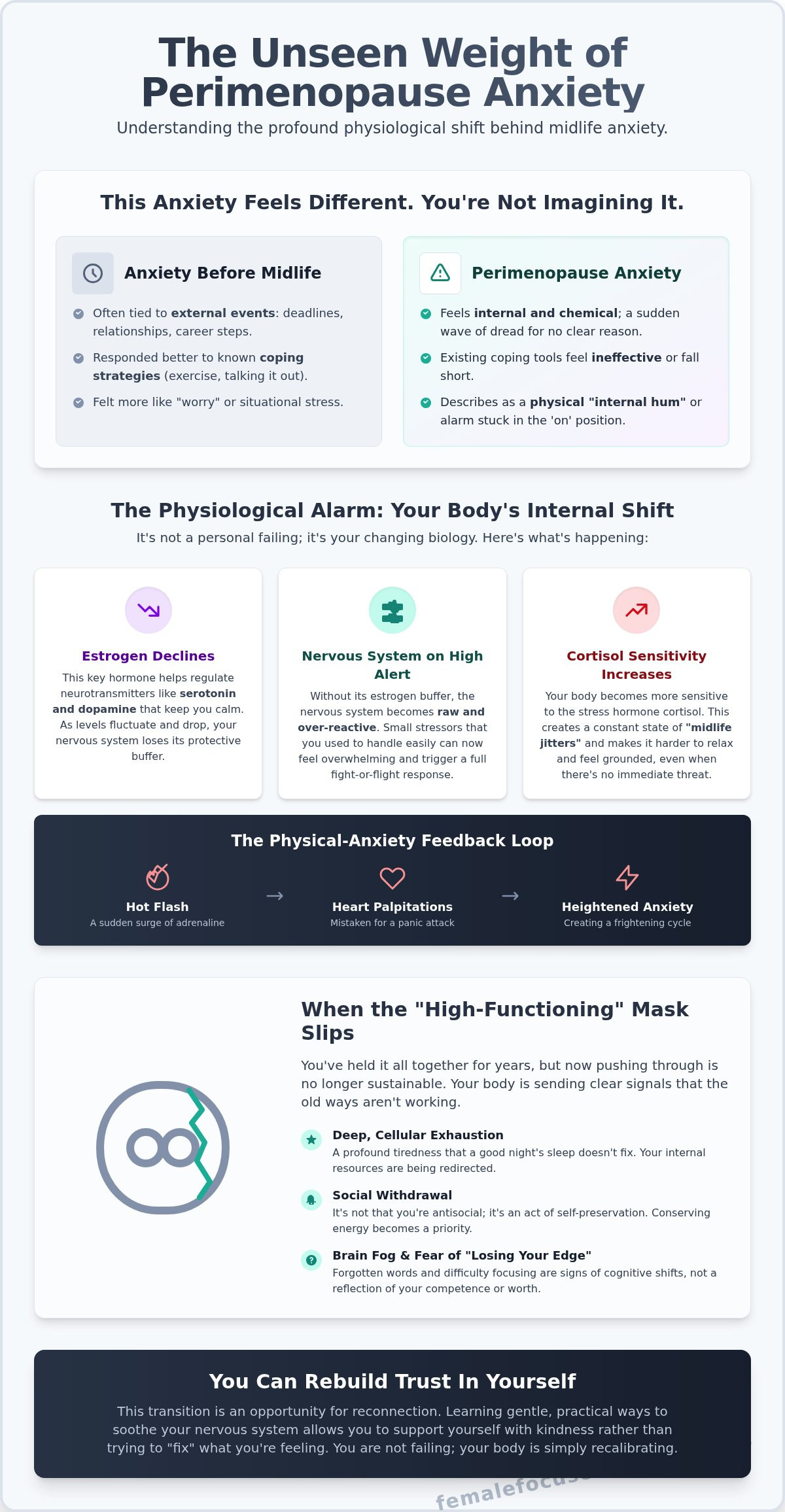
If you’ve found your way here, it’s likely because you’re feeling a type of anxiety that feels… different. It’s not the familiar worry about a deadline or a difficult conversation. I often hear women in my practice describe it as a constant “internal hum” or a sudden, groundless wave of dread that appears from nowhere. You are not imagining it, and you are certainly not just “worrying too much.”
This is the unique weight of perimenopause anxiety. It’s a profound physiological shift, not a personal failing. The anxiety you may have navigated in your 20s or 30s was often tied to external events. This feels internal, chemical, and deeply unsettling because its roots are in your changing biology, not just your circumstances.
The physiological “alarm” in your body
During perimenopause, your hormones, particularly estrogen, begin to fluctuate and decline. Estrogen isn’t just about reproduction; it’s a key player in regulating neurotransmitters like serotonin and dopamine, which help you feel calm and stable. As its levels drop, it can feel like your nervous system has lost its protective buffer, leaving you feeling raw and exposed.
As estrogen, a hormone that helps regulate your stress response, declines, your body can become more sensitive to cortisol, creating a constant state of midlife jitters. This hormonal rollercoaster is a key part of the transition, and understanding the stages of menopause can provide valuable context for what you’re experiencing. Suddenly, a hot flash isn’t just a moment of heat; it’s a surge of adrenaline. Heart palpitations, a common symptom, can easily be mistaken for the beginning of a panic attack, creating a frightening cycle of physical symptoms and anxious thoughts.
When your “high-functioning” mask starts to slip
For years, you’ve probably been the one who holds it all together. You’re capable, reliable, and used to powering through. But now, that familiar strategy feels impossible. You’re experiencing a deep, cellular exhaustion that doesn’t improve with a good night’s sleep. This is your body sending a clear signal that the old way of pushing through is no longer sustainable, a core theme in navigating midlife changes.
This is why you might find yourself withdrawing from social plans or avoiding situations you used to enjoy. It’s not that you’ve become antisocial; it’s an act of self-preservation. Maintaining that “high-functioning” mask when you feel so unsettled inside requires an immense amount of energy. Conserving that energy becomes a priority.
I also want to validate the very real fear that you might be “losing your edge.” The brain fog, the forgotten words, the struggle to focus at work – it can all feed a narrative that you’re no longer as sharp or competent. Please know that this is not a reflection of your worth or your abilities. It is a sign that your internal resources are being redirected to navigate this transition. You can find support for this entire journey through the services offered at Female Focused Therapy.
Why your usual coping tools might feel like they are failing
You may be here because you feel frustrated, or even a little betrayed by your own mind and body. The things that always worked before-a long run, a good chat with a friend, or simply “thinking positive”-no longer seem to touch the sides of the anxiety you’re feeling. You’ve always been capable and resilient, so it can be deeply unsettling when your trusted coping strategies suddenly fall short.
Please know, you are not failing. What you’re experiencing is often the result of a “perfect storm,” a unique collision of midlife transitions and profound hormonal vulnerability. This is a time when your entire system is recalibrating. I often see women who, during this period, finally get a diagnosis of ADHD in women. The drop in oestrogen can unmask underlying executive function difficulties, making the world feel chaotic and fuelling a new, overwhelming kind of anxiety.
The resurfacing of old wounds
Perimenopause can act like a magnifying glass for our emotional world, bringing old, unresolved issues into sharp focus. The hormonal shifts, particularly the decline in progesterone and oestrogen, can thin our psychological defences. That carefully constructed calm you’ve maintained for years might suddenly feel fragile.
Many women tell me they feel a decreased capacity for “people-pleasing.” The energy it takes to mask your true feelings or absorb the emotional needs of others is simply no longer there. If you experienced childhood neglect, for example, you may have learned to be hyper-vigilant to keep yourself safe. Now, with your nervous system already on high alert, those old patterns can resurface as intense midlife anxiety.
The midlife “squeeze” and emotional capacity
This biological shift rarely happens in a vacuum. It often coincides with the intense pressure of being in the “sandwich generation.” You might be navigating an ageing parent’s health crisis while also supporting a teenager through their own emotional turbulence. Your career may be at its most demanding, leaving you with very little room for yourself.
Your emotional bandwidth is naturally narrower during this time. It’s not a sign of weakness; it’s a biological fact. Your system is already managing significant internal changes. In fact, research on anxiety in early perimenopause shows that this initial stage is when women often experience the highest levels of stress. The sense of being overwhelmed is a very real response to a very real situation.
So, let’s reframe this. Feeling like you’re “not coping” isn’t a personal failure. It is a clear, intelligent signal from your body that your old support system is no longer enough. It’s an invitation to explore a different, more compassionate kind of support, which is often where the focused work we do at Female Focused Therapy can provide a safe space to land.
Moving beyond “it’s just hormones” to emotional reconnection
If you’ve ever tried to explain the intensity of your feelings only to be told, “it’s just your hormones,” you know how deeply invalidating that can be. It dismisses your reality and reduces a complex, profound experience to a simple chemical problem. Your psychological and emotional experience is real, and it deserves to be seen and supported.
This dismissal can make you feel lost, as if the person you’ve always known yourself to be is slipping away. But I invite you to consider a different perspective. What if this transition isn’t an ending, but a bridge? A path towards a new, perhaps more authentic, version of yourself who is no longer willing to ignore her own needs.
When your body and mind feel unfamiliar, the first casualty is often self-trust. You might second-guess your reactions or question your own sanity. This is why the journey through perimenopause is so often about the careful work of rebuilding self-trust. It’s about learning to listen to your body again, not as a stranger, but as a wise guide. I believe this transition is a powerful invitation to look inward with deep kindness.
Is it me, or is it my hormones?
So many women get caught in this question, as if it’s a binary choice. The truth is, it’s both. Hormones are powerful chemical messengers, and their fluctuations absolutely impact your brain chemistry and emotional state. But the anxiety, the sadness, or the rage you feel is your experience. It is real. Acknowledging the biological trigger doesn’t make the psychological pain any less valid. In fact, medical sources consistently affirm the connection between Mental Health and Perimenopause. Therapy offers a quiet space to untangle the hormonal noise from the core of who you are, helping you hear your own voice more clearly.
The power of a female-focused perspective
Navigating this life stage with a therapist for women means you don’t have to spend precious energy explaining the context of your experience. There is a shared, implicit understanding of the pressures, joys, and challenges of the female life cycle. In a confidential, professional space, you can feel truly heard without fear of judgment. An integrative approach, which blends tools like Cognitive Behavioural Therapy (CBT) with mindfulness, can be especially helpful for perimenopause anxiety. It allows us to address the anxious thought patterns in your mind while also calming the physical sensations in your body, fostering a holistic sense of wellbeing.
Practical ways to find your ground again
When your mind is racing and your body feels like it’s humming with a nervous energy you can’t place, the idea of ‘managing’ it can feel impossible. I understand. The goal isn’t to fight this feeling, but to gently guide your nervous system back to a place of safety. It starts with small, sensory-based anchors that you can turn to in the moment.
This is also a time to practice pacing. Your energy reserves are fluctuating, and pushing through as you always have might not be serving you anymore. Pacing isn’t about stopping; it’s about listening to your body and adjusting your day to honour its needs. It’s about choosing to do one less thing, or taking a 10-minute pause between tasks.
Somatic grounding for the “internal hum”
When perimenopause anxiety spikes, your body is flooded with stress hormones like adrenaline. Somatic (body-based) tools can help process this physical response without you having to think your way out of it. Try these gentle anchors:
- A 4-4-4 Breath: Close your eyes if you feel safe to do so. Breathe in through your nose for a count of four, hold your breath for a count of four, and then exhale slowly through your mouth for a count of four. Repeat this four or five times. This simple rhythm signals to your brain that you are not in immediate danger.
- The Temperature Reset: When you feel a wave of panic, temperature can be a powerful tool to reset your vagus nerve. Splash your face with cold water, hold an ice cube in your hand for 30 seconds, or place a cold pack on your chest. The sudden change in temperature can interrupt the anxiety cycle.
- Gentle Movement: Allow your body to process the excess adrenaline. This doesn’t mean a high-intensity workout. It could be a slow, 10-minute walk around your block, gently shaking out your hands and feet, or doing a few simple stretches.
Creating a “safety plan” for intrusive thoughts
The thoughts that accompany anxiety can be relentless and feel incredibly real. I often encourage my clients to think of them as “hormonal weather” – a storm passing through rather than an absolute truth about who you are or what is going to happen. You don’t have to believe every thought you have.
Externalising these feelings can lessen their power. You might find journaling helpful. You don’t need to write a perfect narrative; simply getting the words out can create much-needed space. Try these prompts:
- What is the story this anxiety is telling me right now?
- What is one small thing that is actually true and safe in this moment?
Recognising when the hormonal weather is too intense to navigate on your own is a true act of self-compassion. If the thoughts feel unmanageable, it may be time to reach out for professional menopause therapy support.
Learning to communicate your needs to your partner or family is also a vital part of your safety plan. It doesn’t have to be a big, dramatic conversation. It can be as simple as saying, “I’m feeling overwhelmed today and need some quiet time,” without shame or apology. This is a key part of rebuilding self-trust and finding your ground again in this new chapter. If you’re ready to create a personalised toolkit for your anxiety, you can explore how we can work together here.
How therapy supports your journey through midlife
It’s a common misconception that therapy is about ‘fixing’ something that’s broken. Perimenopause isn’t a flaw to be corrected; it’s a profound biological and psychological transition. My role isn’t to fix this natural process, but to support you, the woman who is navigating its often-choppy waters.
In our sessions, you can expect a confidential space built on warmth and empathy. We don’t focus on clinical labels. We focus on your lived experience: the sleepless nights, the sudden waves of panic, the feeling that you don’t recognise the person in the mirror anymore. This is your story.
The goal of our work together is to help you find your way back to yourself. It’s about untangling the complex experience of perimenopause anxiety from the other demands of your life, so you can find clarity again. We work towards rebuilding your confidence and reconnecting you with your own deep sense of self.
You don’t have to walk through this time alone. Many women describe it as one of the most challenging periods of their lives, and having dedicated support can make all the difference.
A pace that feels safe and sustainable
We move at your speed. Some days you might want to explore practical coping skills for managing anxiety; other days you might just need a quiet space to feel heard. Together, we work to rebuild your emotional stability in a way that feels sustainable for you. There is no rush here.
Online therapy also offers a practical way to fit this support into your life, especially with the busy schedules we often keep in Singapore. Investing in your mental wellbeing now is an investment in your future. It lays the foundation for a second half of life that isn’t defined by anxiety, but by purpose, connection, and a renewed sense of self-trust. You can find out more about my approach on my homepage.
Your next small step
Just by reading this article, you have already taken a significant step. You’ve acknowledged what you’re feeling and have sought out understanding. That takes courage, and I want you to recognise that in yourself.
Perhaps the goal for today isn’t to solve everything. Perhaps it’s simply to feel a little bit more like yourself tomorrow than you did today. That is more than enough.
This turbulent time will pass. And very often, what emerges on the other side is a woman who is more resilient, more self-aware, and wiser than before. You are on a journey of profound transformation, even when it feels like you’re just trying to survive the day.
Reconnecting With Yourself Through This Transition
Navigating this chapter can feel isolating, especially when the anxiety feels so unfamiliar. It’s important to remember that it isn’t a personal failing if your old coping tools no longer work; it’s simply a sign that your needs are changing. The journey through perimenopause anxiety is less about fighting the feelings and more about gently turning towards yourself with new understanding and compassion.
If you feel you could use a guide on this path, I’m here to help. As a registered psychotherapist with specialised experience in midlife transitions, I offer a warm, trauma-informed space for women to find their footing again. My integrative approach combines evidence-based practices like CBT with mindfulness and somatic work to support your whole self.
Based in Singapore and working with women globally online, my work is about helping you find clarity and rebuild self-trust. You can explore my approach and how we might work together over at Female Focused Therapy. This transition is a profound one, but it’s not a journey you have to take alone.
Frequently Asked Questions About Perimenopause Anxiety
Why has my anxiety suddenly spiked in my 40s even though my life is stable?
Your anxiety has likely spiked due to hormonal fluctuations, not a change in your life’s stability. During perimenopause, levels of oestrogen and progesterone, which have a calming effect on the brain, begin to decline erratically. This can dysregulate your nervous system and make your body’s stress response, driven by cortisol, far more sensitive. It’s a physiological shift that can feel confusing when everything externally seems fine.
Can perimenopause cause sudden panic attacks out of nowhere?
Yes, perimenopause can absolutely trigger sudden panic attacks. These feel like they come from nowhere because the cause is internal and physiological. The sharp drops in your hormones can send a false alarm to your brain’s threat-detection system, activating a “fight or flight” response. This results in very real physical symptoms like a racing heart, dizziness, and a sense of impending doom, even when you are perfectly safe.
How can I tell the difference between “normal” anxiety and perimenopausal anxiety?
The main difference is often the trigger, or lack thereof. “Normal” anxiety is typically connected to a specific external stressor, like a work deadline or a family argument. Perimenopausal anxiety often feels more physical and free-floating. You might experience a sudden surge of dread, internal trembling, or heart palpitations for no discernible reason. It’s a bodily sensation of unease that your mind then races to explain.
Is it possible to manage perimenopause anxiety without taking hormones (HRT)?
Yes, it’s definitely possible to manage your anxiety without HRT, although it remains a helpful option for many women. An integrative approach can be incredibly effective. This involves using therapy to build coping strategies, making lifestyle adjustments like reducing caffeine and prioritising sleep, and incorporating mind-body practices such as mindfulness or breathwork to help regulate your nervous system. These tools empower you to navigate the changes from within.
How can therapy help when my problem feels purely hormonal?
Therapy helps by giving you the tools to manage your *response* to what’s happening in your body. While we can’t stop the hormonal shifts, therapy provides a safe, confidential space to understand and calm your anxious reactions. You can learn to identify triggers, challenge catastrophic thinking, and develop grounding techniques that soothe your nervous system. It’s about rebuilding self-trust and finding your footing during an unsettling time.
Does perimenopausal anxiety feel worse at night or when I wake up?
It’s extremely common for anxiety to feel worse in the morning or at night. Cortisol, our stress hormone, naturally peaks around 3-4 am to prepare us for waking, and this surge can feel like pure dread during perimenopause. At night, as the world gets quiet, there are fewer distractions to keep anxious thoughts at bay. Declining progesterone can also disrupt sleep, making you more vulnerable to nighttime worry.
How long does this phase of intense anxiety usually last during the transition?
There isn’t a fixed timeline, as the experience is unique to each woman. The perimenopausal transition itself can last anywhere from 4 to 8 years on average. For some, the intense anxiety might be a phase that lasts several months; for others, it may ebb and flow throughout the entire period. The focus of our work at Female Focused Therapy is on building skills to navigate the anxiety, rather than just waiting for it to pass.
What is the first thing I should do when I feel a wave of midlife dread coming on?
The very first thing to do is focus on your breath to ground yourself in your body. A simple and powerful technique is “box breathing”: inhale slowly for a count of four, hold for four, exhale for four, and pause for four. Repeat this four or five times. This simple, rhythmic action helps to calm your nervous system and interrupt the panic spiral, reminding your body that you are safe in the present moment.

Article by
Cheryl Kennedy MacDonald MA BA (Hons) Pg. Dip. SAC BACP
Cheryl Kennedy MacDonald is a psychotherapist specialising in women’s mental health, relationships, and life transitions. She works with women navigating trauma, relationship breakdown, identity shifts, and midlife change, helping them rebuild self-trust, emotional stability, and a clear sense of who they are and what they want.
With over 20 years’ experience working with women internationally, Cheryl is the founder of YogaBellies, a global women’s yoga school, and the creator of the Birth ROCKS method. Her work sits at the intersection of psychotherapy and embodiment, integrating evidence-based therapeutic approaches with somatic, body-based practices that support deep, lasting change.
Known for her grounded and direct approach, Cheryl moves beyond surface-level insight to address the patterns held in the body and nervous system. Her work supports women to regulate, reconnect, and respond to their lives from a place of clarity, strength, and self-respect.
She is a published author in academic journals and has written multiple books on women’s health, pregnancy, and midlife wellbeing, available on Amazon and leading book retailers worldwide.