
Do you ever look in the mirror and wonder who is looking back at you? Perhaps you feel defined more by your roles-as a mother, a partner, or a professional in bustling Singapore-than by the person you are deep down. This profound sense of disconnection, of feeling adrift and uncertain about your future, is a common experience. It’s a feeling that can be deeply unsettling, and it’s often a sign of the identity crisis women navigate during periods of significant life change.
If this resonates, please know you are not alone, and your feelings are entirely valid. This guide was created to be a warm, supportive space for you. Together, we will gently explore the signs and causes behind this feeling of being lost. More importantly, we’ll provide practical, gentle strategies to help you begin the journey of reconnection, rebuilding self-trust, and rediscovering the authentic, confident you. It’s time to find your way back to yourself.
Key Takeaways
- Understand that feeling lost is not a personal failure, but a sign of a deep disconnection from your core self and values.
- Recognise the common triggers and signs of an identity crisis women experience, reframing them as important signals for personal growth.
- Discover gentle, manageable steps you can take to begin the journey of reconnecting with your authentic self at a pace that feels right for you.
- Learn how professional therapy in Singapore can provide a safe, supportive space to navigate your journey and rebuild self-trust with clarity.
What is an Identity Crisis? Understanding the Feeling of Being Lost
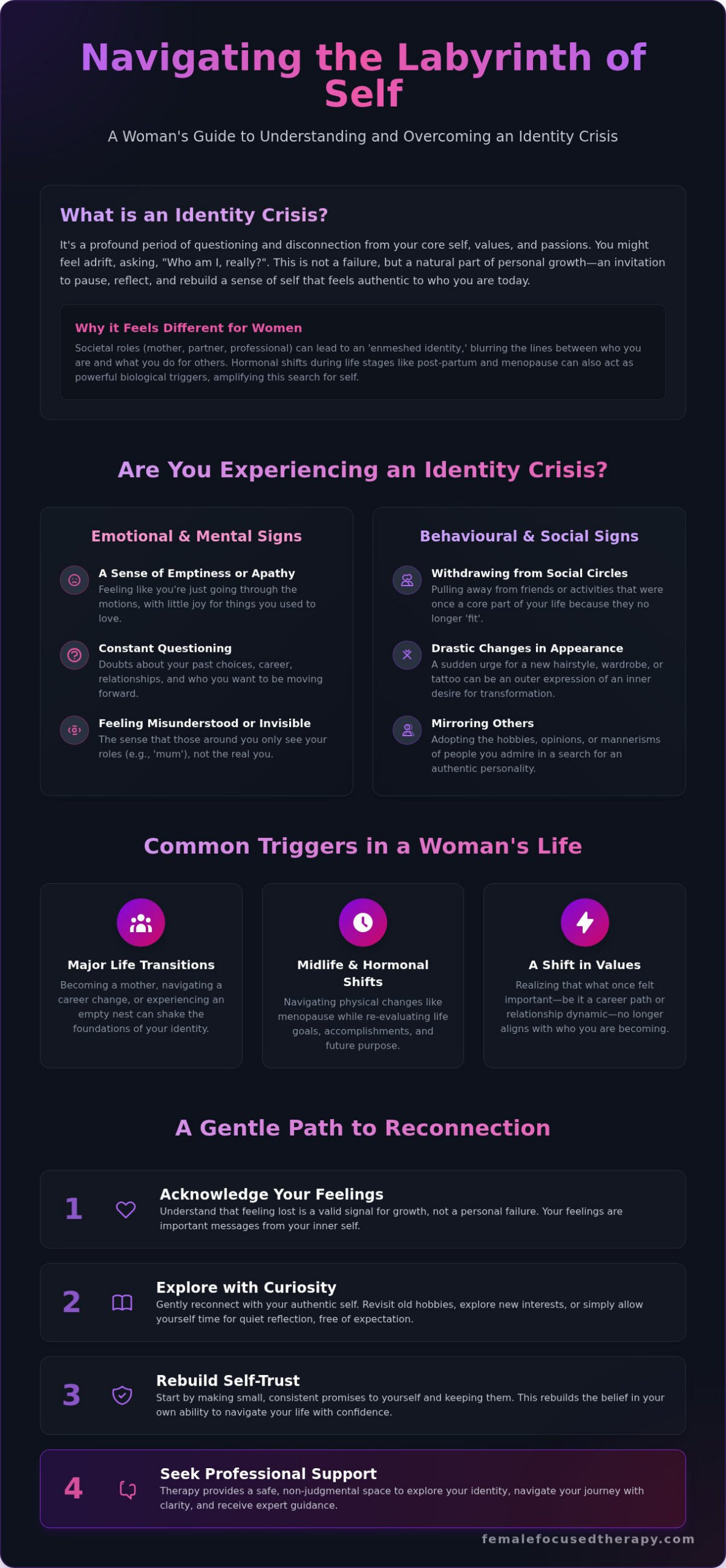
You may be here because you look in the mirror some days and barely recognise the person staring back. It’s a quiet, unsettling feeling-a sense that the ‘you’ you’ve always known has become distant or faded. This isn’t just a clinical diagnosis; it’s a deeply emotional experience of disconnection from your core self, your values, and the passions that once lit you up. An identity crisis is a period of intense, often confusing, questioning: Who am I, really? What do I want? Where am I going?
It’s important to know that this feeling of being lost is not a sign of failure. In fact, it is often a natural and necessary part of personal growth, an invitation from within to pause, reflect, and consciously rebuild a sense of self that feels more authentic to who you are today.
Why Identity Crises Can Feel Different for Women
For many, the experience of an identity crisis women face is uniquely shaped by a lifetime of navigating societal roles and expectations. We are often encouraged to be caregivers, supportive partners, and dedicated professionals-sometimes all at once. This can lead to an ‘enmeshed identity,’ where our sense of self becomes so intertwined with our relationships and responsibilities that we lose track of where we end and others begin. Furthermore, significant hormonal shifts during life stages like post-partum and menopause can act as powerful biological triggers, amplifying this profound search for self.
Erikson’s Stages and the Modern Woman
While the psychological concept of What is an Identity Crisis? was first explored by psychologist Erik Erikson in the context of adolescence-his ‘Identity vs. Role Confusion’ stage-we now understand that this is not a one-time event. For the modern woman, this search for identity is a recurring developmental task. Major life transitions like becoming a mother, navigating a career change, or entering midlife are all potent moments that call for us to re-evaluate and reconnect with ourselves. It’s a chance to redefine who we are, on our own terms.
Key Signs You’re Experiencing an Identity Crisis
If you feel adrift, you are not alone. The transition into motherhood is profound, and it often prompts a deep period of questioning. These feelings are not signs of failure; they are courageous signals from within, asking for your attention and compassion. Recognising these signs is the first step toward navigating this change and rebuilding your connection to yourself. The experience of an identity crisis in a woman’s life, particularly after major life shifts, is a well-understood phenomenon. Let’s gently explore what this can look and feel like.
Emotional and Mental Signs
Internally, an identity crisis can feel like a quiet, persistent hum of unease. You may notice yourself feeling disconnected from the person you once were. Does any of this sound familiar?
- A sense of emptiness or apathy: You might feel like you’re simply going through the motions of your day, with little joy or enthusiasm for things you used to love.
- Constant questioning: Your mind may be filled with doubts about your past choices, your career path, your relationships, and who you want to be moving forward.
- Feeling misunderstood or invisible: It might seem like those around you only see you as ‘mum’, leaving the other parts of you unacknowledged and unseen.
Behavioural and Social Signs
This internal uncertainty often shows up in our actions and how we relate to the world. For many women experiencing an identity crisis, these behaviours are an attempt to find something that feels solid and ‘right’ again.
- Withdrawing from social circles: You may pull away from friends or activities that were once a core part of your life because they no longer feel like they fit.
- Drastic changes in appearance: A sudden urge to cut all your hair off, change your style completely, or get a tattoo can be an outer expression of an inner desire for transformation.
- Mirroring others: You might find yourself adopting the opinions, hobbies, or even mannerisms of people you admire, as you search for a personality that feels authentic.
If these points resonate with you, take a gentle breath. Seeing your experience named is the first step toward clarity and a stronger sense of self. This is not an endpoint, but a powerful starting point for rediscovery.
Common Triggers for an Identity Crisis in a Woman’s Life
An identity crisis rarely appears out of nowhere. Instead, it often follows a significant life event that disrupts the roles, routines, and relationships that once defined us. You may feel adrift because a core pillar of your life has shifted, leaving you questioning who you are without it. Understanding these triggers is the first step toward navigating this uncertainty and seeing it not as a loss, but as an invitation to reconnect with yourself on a deeper level.
Major Relationship Shifts
The end of a significant relationship through divorce or separation can feel like losing a part of yourself, especially if your identity was deeply intertwined with your role as a partner. Similarly, when children leave home, the shift from active, hands-on parent to ’empty nester’ can leave a profound void. This questioning can also arise after losing a loved one or when you begin healing from deeply damaging dynamics, such as those found in narcissistic abuse, where your sense of self was systematically eroded.
Career and Life Role Transitions
Our careers often form a large part of our identity. A sudden layoff, a planned career change, or retirement can make you feel directionless. For many, the transition into motherhood is one of the most significant identity shifts, as the all-consuming role of ‘mother’ can overshadow the woman you were before. This is a common trigger for an identity crisis in women, as is re-entering the workforce after a break or even achieving a long-held goal, which can paradoxically leave you with a feeling of, “What now?”.
Biological and Midlife Changes
The journey through midlife brings its own unique set of changes. The physical and emotional turbulence of perimenopause and menopause can feel disorienting, as your body and mind navigate a new landscape. A significant health diagnosis can similarly force a re-evaluation of your life and priorities. Research from the National Institutes of Health highlights how the challenges of midlife women often include a need for self-rediscovery. These significant life transitions are powerful catalysts for introspection, prompting us to ask fundamental questions about who we are and what we want for the next chapter.
How to Reconnect With Yourself: A Gentle Path Forward
Navigating the path back to yourself after becoming a mother is not about finding a ‘new you’ or erasing the person you’ve become. It’s a gentle process of reconnection, guided by compassion and curiosity. The constant demands of motherhood can feel overwhelming, but these small, internal shifts can help you find your footing again. This journey is a tender act of self-care, essential for women moving through this profound life transition.
Step 1: Pause and Create Space for Stillness
The first step is simply to pause. Stepping off the relentless autopilot of daily tasks allows you to hear your own inner voice again. You don’t need an hour of meditation; start with just five minutes. Find a quiet corner, close your eyes, and focus on your breath. Another powerful tool is journaling. Before sleep, try writing down one thing you felt or one thought that was truly your own during the day. This creates a small, sacred space just for you.
Step 2: Re-discover Your Core Values
Your values are your internal compass, guiding your decisions and defining what feels meaningful. An identity crisis women often experience stems from a misalignment between their daily life and these core values. To reconnect with yours, consider the list below. Which words resonate most deeply with you? Choose your top 3-5.
- Connection
- Creativity
- Growth
- Authenticity
- Security
- Adventure
- Compassion
Once you have your list, gently ask yourself: “Where in my life do I honour these values? Where is there a gap?” This isn’t about judgment, but about gathering information with kindness.
Step 3: Experiment with Gentle Curiosity
Now, it’s time to play. Think of this as data-gathering about your own joy. What did you love to do before you had children? Could you listen to an old favourite album or pick up a sketchbook for ten minutes? Or perhaps a new interest has sparked a flicker of excitement. The goal here is exploration, not commitment. There is no pressure to master a new skill or start a business; the only aim is to follow what feels interesting and notice how it makes you feel.
This process of rebuilding and reconnection takes time. Be patient and kind with yourself. If you feel you need dedicated support to navigate this journey, Female Focused Therapy provides a safe, professional space to explore who you are now.
When to Seek Support: The Role of Therapy in Finding Yourself
Navigating the journey back to yourself after motherhood is profound work. While self-reflection is powerful, sometimes the path feels unclear or overwhelming. You might wonder if what you’re feeling is ‘big enough’ for therapy. The answer is a compassionate and resounding yes. The identity crisis women often experience during this life transition is a valid and significant reason to seek professional support. Therapy isn’t about fixing something that’s broken; it’s about creating a dedicated, supportive space to explore, understand, and intentionally rebuild.
Working with a therapist provides you with an objective, compassionate guide who is there solely for you-without judgment or expectation. It’s a unique relationship designed to help you hear your own voice more clearly amidst the noise of daily demands.
How a Therapist Can Help
A professional therapist can offer focused support as you navigate this change. In a confidential space, we can work together on:
- Providing a safe, non-judgmental space where you can freely explore your feelings of loss, confusion, and desire for something more.
- Helping you identify the patterns and ingrained beliefs about motherhood and womanhood that may be holding you back from embracing your whole self.
- Guiding you in reconnecting with your core values, passions, and inner wisdom that may have been quieted but never truly lost.
- Supporting you in rebuilding self-trust and the confidence to make choices that align with who you are now and who you want to become.
Finding the Right Support for You
The connection you have with your therapist is key. Look for a professional who specialises in working with women and understands the unique challenges of motherhood. An integrative approach that connects mind and body can be particularly powerful in fostering holistic wellbeing. Above all, it’s essential that you feel safe, seen, and truly understood.
You are not alone in this, and you don’t have to figure it all out by yourself. You deserve support. Book a confidential consultation to see how we can help you on your journey of rediscovery.
Reconnecting With Your Authentic Self
Navigating an identity crisis is a profound journey of rediscovery. Remember that feeling lost is a temporary state, not a permanent destination. By recognising the signs and understanding your triggers, you can begin to gently reconnect with your core values and passions. The experience of an identity crisis women often face is a sign that a new, more authentic chapter is waiting to be written, and you have the strength to turn the page.
You do not have to walk this path alone. If you are seeking dedicated support, Female Focused Therapy offers a warm, confidential, and professional space for your journey. Led by registered psychotherapist Cheryl Kennedy MacDonald, our practice provides specialised therapy focused on the unique challenges women face in Singapore. We are here to help you find clarity and rebuild self-trust.
Ready to find clarity and reconnect with yourself? Book a consultation today. Your most authentic self is not lost, just waiting to be rediscovered. The journey back to you is worth taking.
Frequently Asked Questions About Navigating Your Identity
Is an identity crisis the same as depression or a midlife crisis?
While they can feel similar and sometimes overlap, they are distinct experiences. An identity crisis, especially for women after major life changes like motherhood, is a period of intense questioning about who you are. Depression is a clinical mood disorder with persistent symptoms like low mood and loss of interest. A midlife crisis is often tied to age and mortality. Understanding the differences is a key step in navigating your feelings and seeking the right support for your unique journey.
How long does an identity crisis typically last?
There is no set timeline for navigating an identity crisis, as it is a deeply personal journey of reconnection. For some, it may be a period of a few months, while for others, it can be an exploration that unfolds over a year or more. The duration often depends on your individual circumstances, the support systems you have in place, and the time you can dedicate to self-discovery. The goal is not to rush, but to move at a pace that feels safe and sustainable for you.
Can an identity crisis happen at any age, not just in midlife?
Yes, absolutely. While often associated with midlife, an identity crisis can happen at any age, particularly during significant life transitions. For many women, becoming a mother is a primary trigger. Other events like changing careers, relocating to a new country like Singapore, or ending a relationship can also prompt this deep questioning of self. The experience of an identity crisis women face is tied to profound change, not a specific number of birthdays.
What is the very first step I should take if I feel completely lost?
The most powerful first step is to simply pause and acknowledge your feelings with kindness and without judgment. Give yourself permission to feel lost. Instead of searching for big answers immediately, try a small, gentle action. This could be carving out 10 minutes for yourself to journal, taking a quiet walk alone, or confiding in one trusted friend. This simple act of creating space for yourself is the first move towards finding clarity and rebuilding your sense of self.
Can rebuilding my identity affect my current relationships?
Yes, this journey of self-reconnection will likely impact your relationships, often in positive ways. As you gain clarity on your values, needs, and boundaries, the dynamics with your partner, family, and friends may shift. This can lead to deeper, more authentic connections as you learn to communicate your needs more effectively. While change can feel unsettling at first, it is a natural part of personal growth and can strengthen the relationships that truly support the person you are becoming.
Is it selfish to spend time and money on ‘finding myself’?
This is a common concern, but the answer is a heartfelt no. Investing in your own well-being is not selfish; it is essential. Think of it as putting on your own oxygen mask first. When you are grounded, confident, and clear about who you are, you are better able to show up for your loved ones. Spending time or money on your growth—whether through therapy, hobbies, or even aesthetic treatments from places like Dr. Sankeerth Reddy’s Clinic to boost confidence—is an investment in your long-term mental health and the health of your entire family system.

Article by
Cheryl Kennedy MacDonald MA BA (Hons) Pg. Dip. SAC BACP
Cheryl Kennedy MacDonald is a psychotherapist specialising in women’s mental health, relationships, and life transitions. She works with women navigating trauma, relationship breakdown, identity shifts, and midlife change, helping them rebuild self-trust, emotional stability, and a clear sense of who they are and what they want.
With over 20 years’ experience working with women internationally, Cheryl is the founder of YogaBellies, a global women’s yoga school, and the creator of the Birth ROCKS method. Her work sits at the intersection of psychotherapy and embodiment, integrating evidence-based therapeutic approaches with somatic, body-based practices that support deep, lasting change.
Known for her grounded and direct approach, Cheryl moves beyond surface-level insight to address the patterns held in the body and nervous system. Her work supports women to regulate, reconnect, and respond to their lives from a place of clarity, strength, and self-respect.
She is a published author in academic journals and has written multiple books on women’s health, pregnancy, and midlife wellbeing, available on Amazon and leading book retailers worldwide.