
You may be here because life feels heavy right now. The thought of seeking support is on your mind, but the path forward seems confusing, and you’re not sure where to begin. Perhaps you feel overwhelmed by the different terms like counselling and psychotherapy, or anxious about what a first session might entail. Taking that brave first step towards finding professional help through psychotherapy in Singapore can feel like the biggest hurdle, especially when you want to find someone you can truly trust.
This gentle guide is here to walk alongside you on that first step. Together, we will softly unpack what psychotherapy involves, help you understand how to choose the right approach for your needs, and offer clear, supportive guidance on how to begin. Our aim is to replace uncertainty with a sense of clarity and confidence, empowering you to start your journey towards healing and self-discovery in a safe, non-judgemental space.
What is Psychotherapy? A Clear, Simple Explanation
Think of psychotherapy as physiotherapy for your emotional and mental wellbeing. It’s a collaborative and confidential journey of self-discovery, undertaken with a trained professional in a safe, non-judgmental space. Here, you are given the support to explore your thoughts, feelings, and behaviours without fear. While many ask, What is psychotherapy? in a technical sense, at its heart, it is a process focused on understanding the root causes of your difficulties, not just managing the symptoms. The ultimate goal of psychotherapy Singapore is to help you build resilience, gain clarity, and create lasting, positive change in your life.
Psychotherapy vs. Counselling in the Singapore Context
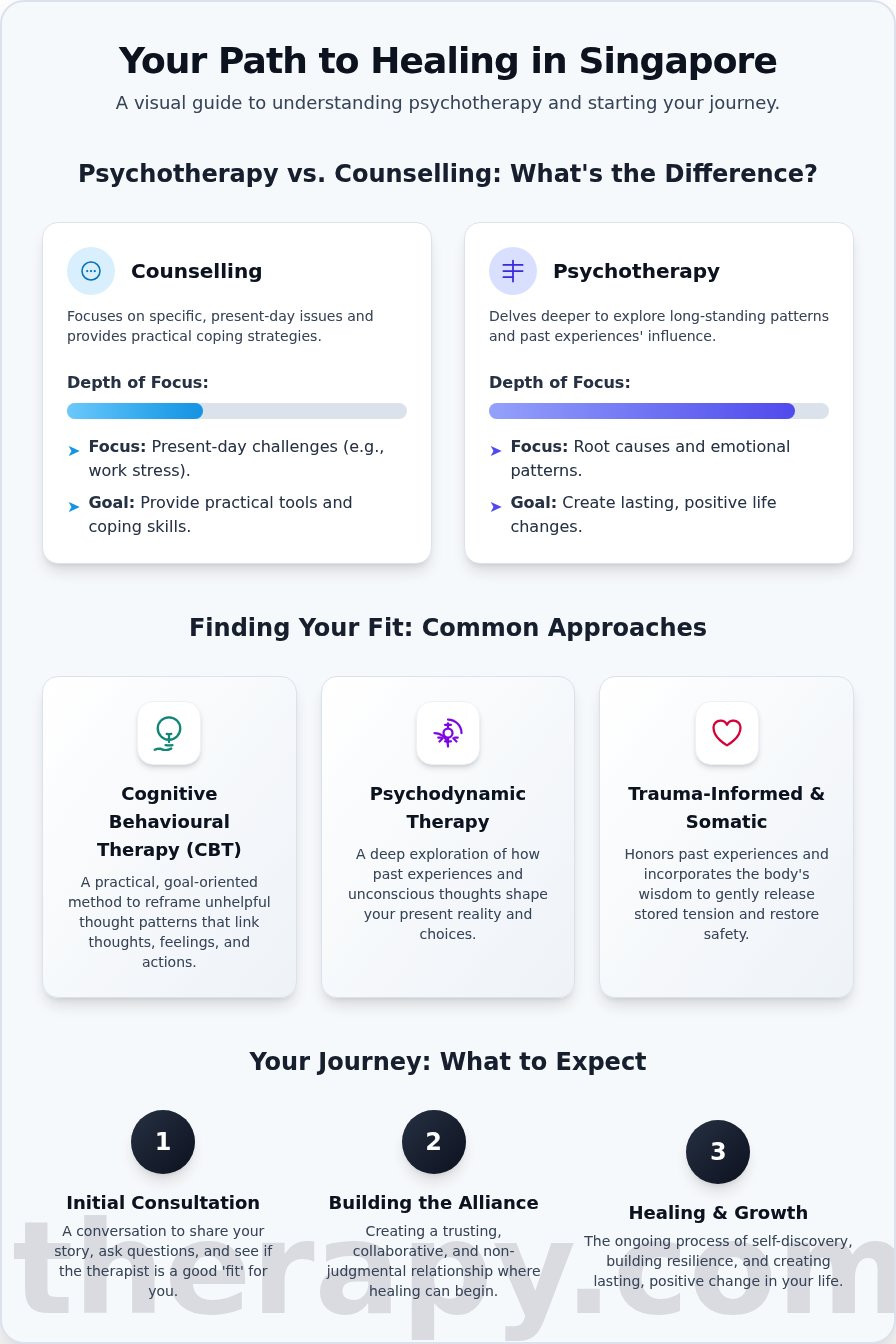
While the terms are often used interchangeably, there is a gentle distinction. Counselling typically focuses on specific, present-day issues-like stress at work or a recent conflict-and provides you with practical coping strategies. Psychotherapy tends to delve deeper, exploring long-standing emotional patterns and the influence of past experiences on your present life. Both are incredibly valuable, and the right choice simply depends on your personal goals. Many practitioners offering psychotherapy in Singapore integrate techniques from both disciplines to provide holistic support.
Who Can Benefit from Psychotherapy?
Benefiting from psychotherapy Singapore isn’t just for moments of crisis; it’s a powerful tool for anyone committed to personal growth. You don’t need to be at rock bottom to seek support. People often begin therapy to navigate challenges and build a more fulfilling life. Common reasons include:
-
Managing anxiety, stress, or feelings of depression.
-
Navigating difficult life transitions, such as a career change, relocation, or parenthood.
-
Improving relationships and communication patterns.
-
Healing from past trauma or difficult experiences.
-
Addressing the unique challenges of expat life in a new culture.
Ultimately, the journey of psychotherapy Singapore offers is for anyone who wants to understand themselves more deeply and rebuild a stronger sense of self-trust and confidence.
Common Psychotherapy Approaches: Finding Your Fit
Stepping into the world of therapy can sometimes feel like learning a new language, with various acronyms and names for different approaches. Please know, you don’t need to be an expert to begin your healing journey. The most important thing is finding a connection with a therapist who understands you; their role is to guide you towards the modality that best supports your needs.
Many skilled therapists in Singapore use an ‘integrative’ approach, which means they thoughtfully blend different evidence-based methods to create a plan that is tailored just for you. Here are a few common approaches you might encounter.
Cognitive Behavioural Therapy (CBT)
CBT is a practical and goal-oriented approach that focuses on the powerful link between your thoughts, feelings, and actions. It helps you identify and gently reframe unhelpful thinking patterns that may be keeping you stuck. It’s highly effective for managing challenges like anxiety, depression, and specific phobias, equipping you with tangible coping skills to build confidence in your daily life.
Psychodynamic and Psychoanalytic Therapy
This approach invites a deeper exploration of how your past experiences, relationships, and unconscious thoughts might be shaping your present reality. It is a journey toward profound self-awareness, helping you understand the deep-rooted patterns that influence your emotions and choices. The safe, trusting relationship you build with your therapist is a key part of the process, providing a space for insight and lasting personal growth.
Trauma-Informed and Somatic Approaches
Built on a foundation of safety and empowerment, a trauma-informed approach honours the impact of past difficult experiences. It moves beyond just talking by incorporating the body’s wisdom. Somatic therapy recognises that the body holds onto stress and trauma, and it focuses on gently releasing this stored tension. This helps to calm the nervous system, rebuild a sense of inner security, and restore your connection to yourself.
You don’t have to choose just one path. The most effective psychotherapy Singapore has to offer is often personalised and flexible. A compassionate therapist will draw from these modalities to create a supportive framework for your healing. While your therapist guides you personally, it’s also empowering to understand the broader landscape of care. You can find an overview of various resources within Singapore’s national mental health services. Ultimately, the right approach is the one that helps you feel seen, understood, and able to move forward with clarity.
Your Psychotherapy Journey: What to Expect
Taking the first step towards therapy can feel like stepping into the unknown. We want to demystify the process and reassure you that it is a structured, supportive, and confidential journey designed to help you navigate life’s challenges. The entire process is paced by your comfort and needs, ensuring you always feel in control as you move towards greater clarity and wellbeing.
The First Step: The Initial Consultation
Think of the first session not as a commitment, but as a conversation. It’s an opportunity for you to share what’s on your mind and for both you and the therapist to see if you are a good ‘fit’. You can ask questions about their approach and discuss practical details like confidentiality, session frequency, and fees (which can range from S$150-S$300+ in Singapore). For more information on financial assistance, the Agency for Integrated Care offers a helpful guide to Community Mental Health Support and available subsidies. The most important goal is to leave feeling heard and understood.
Building the Therapeutic Alliance
The foundation of effective psychotherapy in Singapore is the therapeutic alliance-the trusting, collaborative, and empathetic relationship you build with your therapist. This connection is where the healing work happens. It is carefully built on a bedrock of non-judgment, genuine care, and the consistent feeling that you are in a safe space where all parts of your story are welcome. A safe space is essential. Learn about our approach.
Setting Goals and Navigating Sessions
Therapy is a partnership. Together, you and your therapist will clarify what you hope to achieve, whether it’s developing coping skills, processing past events, or rebuilding self-trust. Your sessions will be a space for talking, exploring thoughts and feelings, and sometimes learning new strategies. There is no ‘right’ or ‘wrong’ thing to discuss. Remember, progress isn’t always a straight line. Some weeks will bring breakthroughs, while others may be for quiet reflection, and that is a perfectly normal and valid part of the journey.
Finding the Right Psychotherapist in Singapore For You
Beginning the search for a psychotherapist can feel daunting, but it is a courageous and empowering step towards healing and growth. The connection you share with your therapist-often called the therapeutic alliance-is one of the most significant factors in a successful outcome. It’s about finding a balance between professional expertise and a genuine human connection where you feel safe, heard, and understood. We encourage you to trust your intuition throughout this important process.
If you have specific needs, such as navigating trauma, grief, or a late-in-life ADHD diagnosis, finding a therapist who specialises in that area can make a profound difference in your journey.
Key Qualifications to Look For
When researching options for psychotherapy in Singapore, it’s vital to verify a therapist’s credentials. A qualified professional should be registered with a recognised body like the Singapore Association for Counselling (SAC) or British Association of Psychotherapists and Counsellors (BACP) and hold at least a Master’s degree in a relevant field like counselling or clinical psychology. Feel empowered to ask about their specific training in different therapy models (e.g., CBT, psychodynamic, somatic). A trustworthy therapist will always be transparent about their qualifications.
Questions to Ask a Potential Therapist
Most therapists offer a brief introductory call. This is your opportunity to see if you feel a connection and if their approach resonates with you. Consider asking:
-
What is your experience working with issues like mine?
-
How would you describe your therapeutic approach?
-
What can I expect in our first few sessions?
-
How do you ensure confidentiality?
A Safe Space for Women to Heal and Grow
At Female Focused Therapy, we understand that women’s mental health needs are often unique. We specialise in creating a safe, non-judgmental space for women navigating the complexities of relationship trauma, ADHD, and challenging life transitions. Our approach is warm, integrative, and trauma-informed, designed to help you gently reconnect with yourself, rebuild self-trust, and move forward with clarity and confidence.
If our approach resonates with you, we invite you to take the next step. Book a confidential consultation to see if we’re the right fit.
Your Path Forward: Embracing Therapy in Singapore
Embarking on a therapeutic journey is a courageous and powerful step towards healing. This guide has walked you through understanding what psychotherapy is, the various approaches available, and the importance of finding a therapist who truly fits your unique needs. Remember, the right support can make all the difference, and you don’t have to navigate life’s challenges alone.
If you are looking for professional psychotherapy in Singapore, it’s essential to find a space where you feel safe, heard, and understood. As a Registered Psychotherapist specializing in women’s mental health, Cheryl provides just that-a confidential environment for both in-person and online therapy. Her trauma-informed, integrative approach is tailored to help you navigate your experiences and rebuild a stronger sense of self.
Ready to take the next step on your journey? Book a confidential consultation with Cheryl today. Your path to clarity, confidence, and wellbeing is waiting.
Frequently Asked Questions About Psychotherapy in Singapore
What is the average cost of psychotherapy in Singapore?
The cost of psychotherapy in Singapore typically ranges from S$180 to S$300+ per session for private practitioners. This fee reflects the therapist’s experience and specialisation. While this is a significant investment, many view it as a vital part of their journey towards wellbeing and growth. More affordable, subsidised options are also available through social service agencies or public hospitals, though these may have longer waiting lists. Some private therapists may also offer sliding scale rates.
How long does psychotherapy typically take?
The duration of therapy is a deeply personal journey, unique to each individual’s needs and goals. Some people find the support they need for a specific challenge in a shorter timeframe, perhaps 8-12 sessions. For others navigating more complex life experiences or long-standing patterns, the process may take several months or longer. The goal is always to move at a pace that feels safe and sustainable for you, allowing for genuine and lasting change.
Do I need a doctor’s referral to see a psychotherapist in Singapore?
No, you do not need a doctor’s referral to see a psychotherapist in private practice in Singapore. You are empowered to research and connect directly with a therapist who feels like the right fit for your needs. However, if you are seeking subsidised services through a public hospital or a restructured clinic, you will typically need a referral from a General Practitioner (GP) or a doctor at a polyclinic to begin the process.
Is online psychotherapy as effective as face-to-face sessions?
Yes, for many individuals and concerns, online therapy has been shown to be just as effective as in-person sessions. It offers valuable convenience and accessibility, allowing you to engage in deep, meaningful work from a space where you feel most comfortable and safe. The strength of the therapeutic relationship is the most critical factor for success, and a strong, supportive connection can be built both online and face-to-face. The best choice is the one that suits you personally.
How is my privacy and confidentiality protected in therapy?
Your privacy is paramount. Professional psychotherapists are bound by a strict code of ethics that mandates confidentiality. This means that what you share in our sessions remains completely private and is held in the strictest confidence. The only legal and ethical exceptions are situations where there is an immediate risk of serious harm to yourself or others, or if records are subpoenaed by a court. This commitment ensures a safe space for you to explore and heal.
What’s the difference between a psychologist and a psychotherapist?
While these roles often overlap, there can be a distinction. A psychologist often has a postgraduate degree in psychology and may be trained in conducting formal psychological assessments and diagnoses. A psychotherapist is a professional specifically trained in providing ‘talk therapy’ to help you navigate emotional and mental health challenges. Both are qualified to provide therapy, so the most important factor is finding a practitioner whose approach resonates with you and makes you feel supported.

Article by
Cheryl Kennedy MacDonald MA BA (Hons) Pg. Dip. SAC BACP
Cheryl Kennedy MacDonald is a psychotherapist specialising in women’s mental health, relationships, and life transitions. She works with women navigating trauma, relationship breakdown, identity shifts, and midlife change, helping them rebuild self-trust, emotional stability, and a clear sense of who they are and what they want.
With over 20 years’ experience working with women internationally, Cheryl is the founder of YogaBellies, a global women’s yoga school, and the creator of the Birth ROCKS method. Her work sits at the intersection of psychotherapy and embodiment, integrating evidence-based therapeutic approaches with somatic, body-based practices that support deep, lasting change.
Known for her grounded and direct approach, Cheryl moves beyond surface-level insight to address the patterns held in the body and nervous system. Her work supports women to regulate, reconnect, and respond to their lives from a place of clarity, strength, and self-respect.
She is a published author in academic journals and has written multiple books on women’s health, pregnancy, and midlife wellbeing, available on Amazon and leading book retailers worldwide.